



When IVF costs, waiting periods, or limited treatment options make it harder to move forward, Tijuana may offer a practical alternative close to the United States. IVF in Tijuana prices commonly begin around $4,000, although medication, genetic testing, embryo storage, donor services, and additional transfers may raise the final total. Before choosing a clinic, verify its COFEPRIS health license and confirm that your physician holds a professional license and current certification in Gynecology and Obstetrics or Human Reproductive Biology.
Quick Summary of IVF Treatment in Tijuana
- Estimated price: Provider-listed standard IVF options in Tijuana commonly range from approximately $4,000 to $7,500. Confirm whether medication, ICSI, anesthesia, embryo freezing, transfer, and monitoring are included.
- Who may be considered: Patients with tubal infertility, male-factor infertility, ovulation disorders, endometriosis, diminished ovarian reserve, unexplained infertility, or a need for donor-assisted treatment may be evaluated for IVF.
- Typical timeline: Ovarian stimulation and egg retrieval usually require about two weeks. A complete fresh or frozen transfer pathway may take several weeks or longer.
- Credentials to verify: Ask for the clinic’s COFEPRIS health-license details, the physician’s Mexican professional-license number, and current specialist certification through CMGO or a CONACEM-recognized specialty board.
- Main travel advantage: Tijuana is accessible through the San Diego–Tijuana border, which may make consultations and monitoring more manageable for patients from California, Arizona, Nevada, and other western regions.
- Important caution: IVF does not guarantee pregnancy or live birth. Your age, egg source, embryo quality, diagnosis, sperm factors, laboratory performance, and previous treatment history all influence the outcome.
Why Patients Consider IVF Treatment in Tijuana?
Patients generally consider IVF treatment in Tijuana because they want fertility care that is geographically close to the United States but potentially more affordable. The city’s proximity to San Diego can also reduce the time and expense associated with long-haul medical travel.
The emotional reason is often just as important. Many patients have already completed months or years of testing, timed intercourse, medication, surgery, or intrauterine insemination. They may be looking for a clearer plan, more direct access to a fertility specialist, or a treatment budget they can realistically manage.
Cross-border access
Patients can reach Tijuana by land from Southern California or fly through San Diego and arrange ground transportation.
Lower listed prices
Base IVF prices may be below many self-pay options in the United States, although package inclusions differ significantly.
Treatment availability
Clinics may offer IVF, ICSI, donor programs, embryo freezing, and preimplantation genetic testing in one location.
Bilingual coordination
Some centers serve international patients with English-speaking coordinators, remote consultations, and document support.
Do not choose a clinic from price alone. The embryology laboratory, medication monitoring, embryo-transfer policy, licensing, and emergency plan can be more important than a small difference in package cost.
How IVF in Tijuana Works?
In vitro fertilization is a fertility treatment in which eggs are collected from the ovaries and fertilized with sperm inside an embryology laboratory. One embryo is then commonly selected for transfer into the uterus, while suitable additional embryos may be frozen.
Your exact protocol depends on your age, ovarian reserve, menstrual cycle, medical history, sperm analysis, previous pregnancies, and prior fertility treatment. A responsible clinic should not promise a protocol or outcome before reviewing these factors.
| IVF stage | What happens | What you may need | Questions to ask |
|---|---|---|---|
| Initial evaluation | The specialist reviews fertility history, ultrasound findings, laboratory tests, semen analysis, and previous treatment. | Medical records, medication list, prior cycle reports, imaging, and infectious-disease screening. | Which diagnosis is IVF addressing, and are less invasive options still reasonable? |
| Ovarian stimulation | Hormone medication encourages several follicles to develop during one treatment cycle. | Daily medication, blood tests, and repeated ultrasound monitoring. | Who adjusts medication, and how are after-hours concerns handled? |
| Egg retrieval | A physician collects mature eggs through an ultrasound-guided procedure, usually with sedation. | Fasting instructions, transportation, and a responsible adult after sedation. | Where is retrieval performed, and what emergency support is available? |
| Fertilization | Eggs are combined with sperm conventionally or through ICSI, where one sperm is injected into an egg. | A fresh or previously frozen sperm sample and laboratory consent forms. | Why is ICSI recommended, and is it included in the package? |
| Embryo culture | Embryos are observed for several days while the laboratory records their development. | Decisions about freezing, genetic testing, transfer timing, and embryo disposition. | How does the laboratory track embryos and prevent identification errors? |
| Embryo transfer | A selected embryo is placed in the uterus using a thin catheter. | Medication support and a scheduled pregnancy blood test. | How many embryos are recommended, and what is the multiple-pregnancy risk? |
Who May Be a Candidate for IVF in Tijuana
IVF may be considered when a qualified fertility specialist determines that laboratory fertilization could improve your chance of pregnancy compared with continued natural attempts, medication alone, or intrauterine insemination. It may also support family building when donor eggs, donor sperm, or embryo testing is needed.
IVF may be discussed for
- Blocked, damaged, or absent fallopian tubes
- Moderate or severe male-factor infertility
- Endometriosis-associated infertility
- Ovulation disorders that have not responded to treatment
- Unexplained infertility after appropriate evaluation
- A need for donor eggs, sperm, or embryos
- A known inherited condition requiring genetic counseling
Further evaluation may be needed for
- Untreated thyroid, metabolic, or hormonal disorders
- A uterine condition that may affect implantation
- Severe uncontrolled medical disease
- A history of blood clots or medication reactions
- Very low ovarian reserve or repeated failed cycles
- Active infection requiring treatment
- A pregnancy risk requiring maternal-fetal medicine review
A low anti-Müllerian hormone level, previous failed cycle, or age above 40 does not produce the same recommendation for every patient. Ask for a personalized explanation of expected egg yield, embryo potential, alternatives, and stopping points.
IVF Treatment Cost in Tijuana, Mexico
Provider listings reviewed in 2026 show standard IVF options in Tijuana beginning near $4,000, with more comprehensive packages reaching approximately $7,500. The lowest listed number may cover only the core procedure, while a higher package may include ICSI, monitoring, laboratory work, anesthesia, embryo culture, or one transfer.
The safest comparison is a written, itemized cycle estimate based on your medical plan. Compare the total expected cost through pregnancy testing rather than comparing only the first number shown by each clinic.
| Treatment or service | Current Tijuana listing range | What to confirm |
|---|---|---|
| Standard IVF | Approximately $4,000–$7,500 | Medication, monitoring, retrieval, anesthesia, fertilization, culture, freezing, and transfer. |
| IVF with ICSI | Listed from approximately $4,800 at selected providers | Whether ICSI is medically indicated, included for every mature egg, or billed separately. |
| PGT-A laboratory testing | Listed from approximately $2,300 as an additional service | Embryo biopsy, number of embryos tested, shipping, genetic laboratory fee, and frozen transfer. |
| Intrauterine insemination | Approximately $1,250–$1,300 in selected listings | Medication, ultrasound monitoring, sperm preparation, donor sperm, and repeat attempts. |
| Egg freezing | Approximately $7,300–$7,600 in selected listings | Medication, retrieval, first-year storage, annual storage, thawing, fertilization, and future transfer. |
IVF cost comparison for international patients
IVF treatment in Tijuana may cost less than private treatment in the United States, and Canada. However, the lowest clinic price rarely represents the complete amount you will pay. Medication, ICSI, embryo freezing, genetic testing, storage, additional transfers, and travel expenses can substantially change the final cost.
| Treatment location | Estimated IVF cost in USD | Medication and common additions | Important comparison point |
|---|---|---|---|
| Tijuana, Mexico | $4,000–$7,500 for a provider-listed standard cycle Estimated total with medication: approximately $5,500–$11,000 |
Medication may add approximately $1,500–$3,500. ICSI, PGT-A, embryo freezing, donor services, and additional transfers may cost extra. | Some packages include retrieval, anesthesia, embryology services, and one embryo transfer, but package definitions differ between clinics. |
| United States | $12,000–$25,000 per cycle | Medication, ICSI, genetic testing, embryo freezing, storage, anesthesia, and frozen embryo transfer may be charged separately. | Insurance coverage varies by state, employer, and policy. A patient without fertility benefits may pay most expenses directly. |
| Canada | Approximately $14,000 for a complete cycle Converted from an estimated average of about C$20,000 |
Medication alone may cost several thousand dollars. ICSI, embryo freezing, genetic testing, storage, and additional transfers can increase the total. | Public funding and tax support differ by province. Eligibility rules, funded services, and waiting periods should be checked before comparing private treatment abroad. |
Possible additional expenses include fertility medication, repeat monitoring, anesthesia, ICSI, embryo biopsy, genetic testing, donor compensation, sperm retrieval, embryo freezing, annual storage, frozen embryo transfer, repeat pregnancy tests, accommodation, transportation, border-crossing delays, and treatment after a complication.
IVF Options Available in Tijuana
Tijuana fertility clinics may offer several assisted-reproduction pathways, but more treatment is not automatically better treatment. Each add-on should address a defined medical, genetic, or laboratory reason.
| IVF option | How it works | When it may be discussed | Important limitation |
|---|---|---|---|
| Conventional IVF | Eggs and prepared sperm are placed together in controlled laboratory conditions. | Tubal infertility, unexplained infertility, endometriosis, or other indications. | Not every egg fertilizes, and not every fertilized egg becomes a transferable embryo. |
| IVF with ICSI | An embryologist injects one selected sperm into a mature egg. | Severe sperm abnormalities, surgically retrieved sperm, or previous fertilization problems. | ICSI supports fertilization but does not correct egg quality or guarantee embryo development. |
| Frozen embryo transfer | A previously frozen embryo is thawed and transferred in a later cycle. | When embryos are frozen after retrieval, PGT is used, or the uterus needs additional preparation. | Storage, thawing, preparation medication, and transfer may carry separate charges. |
| PGT-A or PGT-M | Cells from an embryo are analyzed for selected chromosomal findings or a specific inherited condition. | Selected age-related, recurrent-loss, repeated-failure, or inherited-disease situations after counseling. | Testing has limitations and may not improve outcomes for every patient. |
| Donor-egg IVF | Eggs from a screened donor are fertilized and an embryo is transferred to the recipient. | Very low ovarian reserve, age-related egg factors, genetic concerns, or repeated failed cycles. | You need clear consent, donor-screening, legal, identity, and future-information policies. |
IVF Success Rates and Patient Demographics
There is no dependable public registry showing age-adjusted live-birth rates specifically for international IVF patients treated in Tijuana. Therefore, a clinic should provide its own recent results using clear definitions rather than quoting a single pregnancy percentage.
Ask whether a result is reported per cycle started, egg retrieval, embryo transfer, clinical pregnancy, or live birth. Also ask whether donor-egg cycles, PGT cycles, cancelled cycles, and patients with a poor prognosis are included.
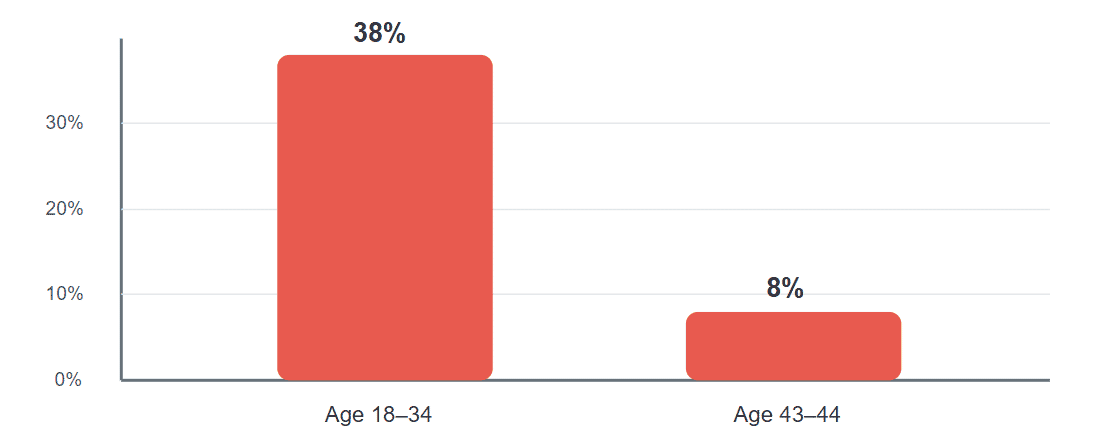
Age-group histogram: 2024 birth rate per embryo transferred
HFEA data reported a 38% average for patients aged 18–34 and 8% for patients aged 43–44 using their own eggs. The difference demonstrates why age and egg source must be included in any meaningful clinic comparison
Who travels to Tijuana for fertility treatment?
Reliable Tijuana-specific demographic percentages are not publicly available, so claims about exact patient origins, ages, or gender distribution should be treated cautiously. In practice, the city is positioned to serve patients from Southern California and other western U.S. states, Mexican residents, binational families, Canadians, single intended parents, and couples requiring donor-assisted treatment.
Your treatment plan should be based on individual medical findings rather than the profile of a typical medical tourist. Age, diagnosis, egg source, sperm quality, pregnancy history, and laboratory performance matter more than nationality.
How to Choose an IVF Clinic in Tijuana
A fertility clinic in Mexico that performs assisted-reproduction procedures should be able to explain its applicable health authorization, responsible medical leadership, laboratory controls, informed-consent process, and emergency arrangements. For assisted reproduction performed in an ambulatory surgical or obstetric setting, ask to see the relevant COFEPRIS health license rather than accepting a general business registration.
| Credential or quality signal | What to request | Why it matters |
|---|---|---|
| COFEPRIS health license | License number, licensed entity name, authorized address, and covered services. | It helps confirm that the facility is operating under the applicable federal health authorization. |
| Responsible health professional | Name and role of the designated responsible clinician or laboratory director. | You should know who is accountable for clinical and laboratory oversight. |
| Embryology laboratory controls | Witnessing system, incubator monitoring, backup power, alarm response, and identity-tracking process. | Laboratory consistency and traceability directly affect embryo handling and patient safety. |
| Outcome reporting | Recent live-birth results by age, egg source, and reporting denominator. | A single pregnancy percentage may hide cancelled cycles, losses, or donor-egg results. |
| Emergency and transfer plan | After-hours number, hospital relationship, ambulance process, and complication policy. | Ovarian stimulation and retrieval can occasionally require urgent medical assessment. |
| Written financial policy | Itemized quote, cancellation terms, refund policy, storage fees, and repeat-transfer costs. | It reduces disputes if stimulation is cancelled or no transferable embryo develops. |
JCI or another international accreditation may provide an additional quality signal when applicable, but it is not a substitute for Mexican licensing. Many facilities operate under national regulation without holding an international accreditation.
How to Verify an IVF Doctor in Mexico
The physician directing your IVF treatment should have a valid Mexican professional license and appropriate specialist training. In Mexico, the Consejo Mexicano de Ginecología y Obstetricia certifies Gynecology and Obstetrics and related fields that include Human Reproductive Biology.
CONACEM provides a public specialist directory where patients can search a physician’s name, specialty board, and current certification status. Certification is not the only measure of quality, but it is an important verification step.
- Request the doctor’s full legal name as it appears on official documents.
- Verify the professional-license number through Mexico’s national professional registry.
- Check specialist certification through CONACEM or the relevant recognized specialty board.
- Ask who performs each stage, including monitoring, egg retrieval, embryo transfer, and emergency review.
- Review treatment-specific experience, including annual IVF volume and experience with your diagnosis.
- Ask how outcomes are audited and whether the doctor will discuss unsuccessful cycles and complications.
Questions for the fertility specialist
- Why are you recommending IVF instead of IUI, surgery, or continued observation?
- What result is realistic for someone with my age, diagnosis, and ovarian reserve?
- What circumstances would cause you to cancel the stimulation cycle?
- Do you recommend one embryo or more, and why?
- Who will manage complications after I return home?
IVF Risks, Complications, and Warning Signs
IVF is generally considered an established fertility treatment, but it is not risk-free. Risks may arise from ovarian-stimulation medication, the egg-retrieval procedure, embryo transfer, pregnancy, or the underlying infertility diagnosis.
| Possible risk | What it means | Risk-reduction question |
|---|---|---|
| Ovarian hyperstimulation syndrome | An excessive response to stimulation medication that may cause enlarged ovaries, abdominal swelling, pain, nausea, or fluid imbalance. | How will my medication dose and hormone response be monitored? |
| Bleeding or infection | Egg retrieval uses a needle near pelvic organs, creating a small risk of bleeding, infection, or injury. | Where would I be evaluated if severe pain or fever develops? |
| Multiple pregnancy | Transferring more than one embryo can increase the chance of twins or higher-order pregnancy and related maternal and newborn complications. | Am I suitable for elective single-embryo transfer? |
| Ectopic pregnancy | A pregnancy may rarely implant outside the uterine cavity and require urgent treatment. | When will pregnancy location be confirmed by ultrasound? |
| Cycle cancellation | A cycle may stop because of poor response, excessive response, premature ovulation, illness, or laboratory findings. | What costs remain payable if my cycle is cancelled? |
| No transferable embryo | Egg collection does not guarantee fertilization, normal embryo development, or an embryo suitable for transfer. | How will the clinic discuss next steps if no embryo is available? |
Contact your clinic or emergency services promptly for severe or worsening abdominal pain, rapid abdominal swelling, persistent vomiting, difficulty breathing, chest pain, fainting, reduced urination, fever, heavy bleeding, one-sided pelvic pain, shoulder pain, or sudden weakness. Confirm your clinic’s emergency number before treatment begins.
IVF Recovery and Follow-Up Timeline
Most IVF care is outpatient, but the biological process continues after you leave the clinic. You need clear instructions for medication, activity, pregnancy testing, ultrasound follow-up, and emergency symptoms.
| Timeframe | Biological or clinical process | Possible sensation | Activity level | Action required |
|---|---|---|---|---|
| Stimulation days | Multiple follicles develop under medication. | Bloating, injection-site discomfort, mood changes, or pelvic heaviness. | Normal light activity unless restricted. | Attend every monitoring appointment and report increasing symptoms. |
| Retrieval day | Eggs are collected and laboratory fertilization begins. | Cramping, fatigue, light spotting, or sedation effects. | Rest and avoid driving after sedation. | Use only clinic-approved medication and follow discharge instructions. |
| Days after retrieval | Embryos develop while ovaries begin returning toward normal size. | Mild bloating and pelvic tenderness may continue. | Gradual return to normal activity. | Receive embryo-development updates and confirm transfer or freezing plan. |
| After embryo transfer | The embryo may continue development and potentially implant. | Many patients feel no specific symptoms; mild cramping may occur. | Follow individualized advice; prolonged bed rest is not routinely required for everyone. | Continue prescribed support medication and avoid early home-test conclusions. |
| Pregnancy testing | A blood test checks whether implantation has produced measurable pregnancy hormone. | Symptoms are not a reliable indicator of success. | Normal activity according to medical guidance. | Complete testing on the scheduled date and obtain follow-up instructions. |
Planning Your IVF Trip to Tijuana
Travel planning should be integrated into your medical schedule. Monitoring appointments may change according to follicle development, and egg retrieval timing is determined by your response rather than by a fixed travel itinerary.
Some patients complete preliminary testing at home and travel for the active treatment phase. Others stay near the clinic throughout stimulation. Ask whether outside monitoring is accepted, which laboratory standards apply, and how quickly results must reach the Tijuana medical team.
| Before travel | During treatment | Before returning home |
|---|---|---|
| Confirm passport and Mexican entry requirements for your nationality. | Keep medication refrigerated when required and carry written prescriptions. | Obtain discharge notes, medication instructions, laboratory summaries, and emergency contacts. |
| Review travel-health recommendations and routine vaccinations. | Use planned transportation and avoid driving immediately after sedation. | Confirm the date and location of pregnancy testing and early ultrasound. |
| Arrange flexible accommodation because retrieval timing may change. | Allow extra time for border congestion and clinic appointments. | Ask when flying, long-distance driving, exercise, and sexual activity may resume. |
| Review current security guidance for Baja California and travel through established routes. | Keep copies of your passport, clinic address, and insurance information secure. | Identify a local physician who can coordinate follow-up after you return. |
Current U.S. travel guidance advises reconsidering travel to Baja California because of crime and kidnapping risks, while noting no additional restrictions for U.S. government employees in Tijuana itself. Review the latest advisory before departure, remain on established routes, use trusted transportation, and avoid remote areas.
Frequently Asked Questions
How much does IVF cost in Tijuana, Mexico?
Provider-listed standard IVF prices commonly fall between approximately $4,000 and $7,500. The final amount depends on medication, monitoring, ICSI, anesthesia, genetic testing, embryo freezing, storage, donor services, and the number of transfers required.
Is IVF treatment in Tijuana safe?
IVF can be performed safely when a properly licensed clinic uses qualified specialists, careful medication monitoring, laboratory quality controls, informed consent, and a clear emergency plan. Safety cannot be judged from the city or price alone.
How do I verify an IVF clinic in Tijuana?
Request the clinic’s COFEPRIS health-license number, licensed legal name, responsible health professional, and authorized address. Also review laboratory controls, complication procedures, written fees, outcome definitions, and the hospital-transfer plan.
How can I verify a fertility doctor in Mexico?
Check the physician’s professional-license details through Mexico’s professional registry and search for current specialist certification through CONACEM. Relevant certification may include Gynecology and Obstetrics or Human Reproductive Biology.
How long must I stay in Tijuana for IVF?
The active stimulation and retrieval phase commonly requires roughly 10 to 14 days, but individual responses vary. A frozen embryo transfer may require a later visit, while some patients complete part of their monitoring near home.
Does a Tijuana IVF package include medication?
Medication is not automatically included in every package. Ask for a written estimate showing stimulation medication, trigger medication, monitoring, retrieval, anesthesia, fertilization, embryo culture, transfer, pregnancy testing, and storage separately.
Can I use donor eggs for IVF in Tijuana?
Some Tijuana fertility programs offer donor-egg treatment. Before proceeding, review donor screening, consent, identity and information policies, egg-source documentation, legal considerations, total cost, and how embryos will be stored or transported.
Is PGT-A included with IVF treatment in Tijuana?
PGT-A is generally an additional service rather than part of basic IVF. Confirm the embryo-biopsy fee, genetic laboratory fee, number of embryos covered, freezing, storage, and frozen embryo transfer before accepting the estimate.
What IVF success rate should a Tijuana clinic provide?
Ask for recent live-birth rates separated by age, egg source, diagnosis, and treatment type. The clinic should state whether the percentage is measured per cycle started, retrieval, embryo transfer, pregnancy, or live birth.
Compare IVF Treatment Options in Tijuana
PlacidWay can help you review IVF providers, understand package inclusions, compare treatment costs, and prepare questions about licensing, specialist credentials, laboratory standards, and aftercare.
Request IVF Treatment InformationDisclaimer: This information is for educational purposes only and does not replace professional medical advice. Always consult a qualified healthcare provider before making medical decisions.
References
- Guideline for the Prevention, Diagnosis and Treatment of Infertility – World Health Organization
- Fertility Treatment 2024: Trends and Figures – Human Fertilisation and Embryology Authority
- The Safety of In Vitro Fertilization – American Society for Reproductive Medicine
- Health Licensing for Surgical, Obstetric and Assisted-Reproduction Facilities – COFEPRIS
- Certification in Gynecology, Obstetrics and Human Reproductive Biology – CMGO
- Mexican Medical Specialist Certification Directory – CONACEM
- Mexico Traveler Health Information – U.S. Centers for Disease Control and Prevention
- Mexico Travel Advisory – U.S. Department of State




-Package-at-Advanced-Fertility-Center-Cancun,-Cancun,-Mexico.png)

.png)




.png)








Share this listing