


The landscape of aesthetic surgery is constantly advancing to meet the demands for highly customized, natural-looking results. For women seeking the ultimate refinement in breast enhancement, composite breast augmentation with fat grafting in South Korea has emerged as the premier surgical solution. This innovative hybrid technique masterfully combines the reliable volume projection of traditional silicone implants with the delicate, biological contouring of autologous fat transfer.
By addressing the structural limitations of using implants alone, this procedure offers unprecedented control over the final aesthetic outcome. Patients traveling for medical tourism prioritize this sophisticated approach to bypass common complications such as visible implant rippling, unnatural upper pole fullness, and overly wide cleavage gaps. Understanding the intricate mechanics and profound benefits of this dual-modality surgery is essential for anyone considering a superior aesthetic transformation.
Video Chapters & Quick Navigation
- The Evolution of Composite Augmentation
- Implants for Foundational Volume
- Smoothing Edges with Fat Grafting
- Ideal Solutions for Thin Skin Patients
- Customized Aesthetics for Slim Profiles
- Correcting Congenital Breast Asymmetry
- Refining Post-Implant Surgical Results
- Simultaneous Liposuction Benefits
- The Science of Fat Purification
- Recovery Timeline and Expectations
The Evolution of Composite Breast Augmentation with Fat Grafting in South Korea
The discipline of plastic surgery is characterized by continuous refinement and technological integration. Historically, aesthetic surgeons were forced to rely exclusively on synthetic devices to enhance breast volume. This singular approach often fell short when attempting to replicate the intricate anatomical nuances of natural breast tissue.
South Korea has positioned itself at the vanguard of aesthetic innovation, pioneering techniques that prioritize biological harmony. Board-certified surgeons in the region recognized that marrying prosthetic support with living tissue yielded vastly superior outcomes. This realization birthed the widespread adoption of composite breast augmentation.
By leveraging the distinct advantages of two separate modalities, surgeons can engineer results that are both visually stunning and structurally sound. The implant provides the necessary architectural foundation, while the autologous fat acts as a customizable soft-tissue envelope. This dual strategy represents a monumental leap forward in achieving true aesthetic perfection.
Overcoming the Limitations of Monolithic Implants
Standard implant procedures often result in an artificial appearance, characterized by stark transitions and excessive firmness. When the synthetic device is placed beneath a thin tissue envelope, its mechanical presence becomes undeniable. Patients frequently report dissatisfaction with the palpable edges and rigid upper pole dynamics.
Composite techniques systematically dismantle these historical limitations. By introducing a layer of purified adipose tissue over the implant, the surgical footprint is effectively masked. This biological padding ensures that the enhanced breast responds naturally to movement and tactile interaction.
How Structural Silicone Breast Implants Provide Foundational Volume and Shape
As clearly established in the clinical overview [00:00], the primary function of the breast implant is to provide absolute volume and shape. Implants remain the most reliable mechanism for generating significant dimensional increases across multiple cup sizes. They serve as the indispensable internal scaffolding for the entire aesthetic reconstruction.
Surgeons meticulously evaluate the patient's existing chest wall dimensions to select the optimal implant profile. High-profile implants deliver aggressive forward projection, while moderate-profile variants offer a wider, more subtle base footprint. The strategic selection of this basal framework dictates the preliminary contour of the new breast.
However, an implant alone cannot intelligently adapt to superficial contour irregularities or thin soft-tissue coverage. While it excels at establishing the bulk structural mass, it lacks the finesse required for micro-aesthetic detailing. This is precisely why the foundational volume must be supplemented by targeted biological grafting.
Selecting High-Cohesive Gel Formulations
Modern hybrid surgeries overwhelmingly utilize highly cohesive silicone gel implants. These devices, often referred to as gummy bear implants, offer unparalleled form stability and safety profiles. The viscous nature of the cross-linked silicone gel mimics the dense glandular feel of youthful breast tissue.
When this advanced silicone technology is paired with an overlying fat graft, the sensory result is phenomenal. The implant establishes the firm, supportive core, while the fat provides the soft, yielding exterior. This combination delivers a sensory experience that is indistinguishable from natural anatomy.
Utilizing Autologous Fat Grafting to Smooth Implant Edges and Enhance the Upper Pole
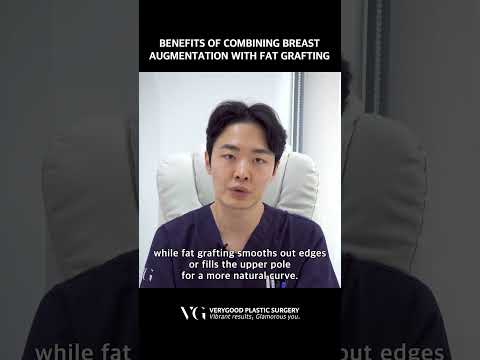
The true transformative power of the composite procedure lies in the integration of biological tissue. As noted in the surgical explanation [00:03], fat grafting meticulously smooths out the edges or fills the upper pole for a more natural curve. This strategic deployment of autologous fat acts as a customized biological camouflage system.
Submuscular or subglandular implant placement frequently leaves the peripheral margins of the device susceptible to visual detection. This rippling effect is a primary source of postoperative anxiety for cosmetic patients. By injecting purified fat cells directly over the implant shell, surgeons create a robust buffer zone that completely conceals these transitions.
Furthermore, fat grafting is instrumental in engineering the ideal teardrop breast aesthetic. Standard round implants often produce an overly convex upper pole, creating an artificial shelf-like appearance. Targeted fat injections soften this gradient, ensuring a gentle, anatomical slope that seamlessly blends into the upper chest wall.
The Mechanics of Micro-Droplet Injection
The efficacy of fat grafting depends entirely on the precision of the injection technique. Surgeons utilize specialized blunt-tipped micro-cannulas to deposit the purified fat in minute, distinct aliquots. This rigorous protocol prevents the formation of large fat pools, which are prone to necrosis or calcification.
By weaving these micro-droplets through multiple planes of native tissue, the surgeon maximizes the surface area available for revascularization. The newly transferred fat cells must rapidly establish a blood supply from the surrounding capillary networks to survive. This meticulous layering technique guarantees high graft retention rates and enduring aesthetic enhancements.
Why Hybrid Breast Augmentation is the Ideal Solution for Patients with Thin Skin
Selecting the appropriate surgical intervention requires a thorough analysis of the patient's unique physiological constraints. The medical guidance explicitly states [00:11] that this technique is great for patients who want softer cleavage or have thin skin. Individuals presenting with minimal subcutaneous adipose tissue face significant hurdles during traditional enhancement surgeries.
A thin tissue envelope provides inadequate padding to mask the rigid architecture of a synthetic implant. Without sufficient natural coverage, the breast often feels artificially firm and displays visible mechanical folds. Composite breast augmentation directly confronts this anatomical deficiency by building a customized layer of biological insulation.
The harvested fat serves as a living matrix that wraps the implant in a protective, sensory-rich layer. This added thickness fundamentally alters the physical characteristics of the surgical site. Patients with severely depleted fat reserves finally have access to a procedure that guarantees a soft, indistinguishable outcome.
| Feature | Traditional Implant Surgery | Composite Breast Augmentation |
|---|---|---|
| Tissue Coverage | Relies entirely on existing native tissue | Adds customized autologous fat layer |
| Implant Visibility | High risk in thin or slim patients | Virtually eliminated via fat padding |
| Upper Pole Slope | Often rounded and artificial looking | Smooth, natural anatomical teardrop curve |
| Cleavage Refinement | Limited by pocket placement anatomy | Highly customizable with medial fat injection |
Achieving Softer Cleavage and a Customized Natural Look for Slim Patients
The pursuit of bespoke aesthetic results is paramount in modern plastic surgery. As articulated in the clinical breakdown [00:16], the composite methodology creates a softer, more customized look, especially in slim patients. Athletic women often possess a broad, flat chest wall that resists conventional augmentation techniques.
Standard implants placed in a wide, athletic chest typically result in a substantial intermammary distance, or a wide cleavage gap. Attempting to force the implants closer together can lead to devastating complications such as symmastia. Hybrid breast augmentation provides a safe and elegant workaround by utilizing fat transfer to fill the medial space.
Surgeons can precisely inject autologous fat along the inner borders of the breasts, narrowing the cleavage gap without compromising the structural integrity of the implant pockets. This targeted medial enhancement results in a lush, closely set cleavage that looks entirely organic. The outcome is a perfectly proportioned bustline that flatters the patient's slender physique.
- Targeted Medial Fullness: Fat grafting allows for precise volume addition specifically in the cleavage area, independent of the main implant positioning.
- Enhanced Tactile Sensation: The outer layer of living adipose tissue ensures the breasts feel remarkably soft and indistinguishable from natural tissue.
- Proportional Harmony: The dual-layer approach allows the surgeon to sculpt a breast shape that perfectly complements a narrow or athletic frame.
Correcting Congenital Breast Asymmetry with Targeted Fat Transfer Techniques
Absolute anatomical symmetry is virtually nonexistent in the human body, and the breasts are particularly prone to visible discrepancies. The surgical insights confirm [00:22] that fat can also be used to correct asymmetry. Most patients present with varying degrees of volume differential, structural variances, or mismatched nipple positions.
While utilizing implants of differing volumes can address significant size imbalances, it is often a blunt instrument for achieving perfect harmony. Implants cannot correct subtle shape irregularities or inframammary fold discrepancies. Fat grafting provides the requisite micro-tuning capabilities to resolve these intricate aesthetic challenges.
Surgeons can deploy small, calculated volumes of fat to equalize projection, balance the lower pole fullness, or adjust minor contour depressions. This granular level of control is impossible to achieve with solid prosthetic devices. By utilizing autologous fat as a dynamic sculpting medium, the surgeon orchestrates a perfectly balanced and symmetrical outcome.
Addressing Tuberous Breast Deformities
Composite augmentation is exceptionally valuable when treating complex structural anomalies, such as tuberous breast deformity. This condition is characterized by a constricted tissue envelope, herniated areolas, and significant asymmetry. Standard implants alone often exacerbate the unnatural shape of a tuberous breast.
The hybrid approach allows the surgeon to release the constricting fibrous bands and expand the tissue envelope with an implant. Simultaneously, fat grafting is utilized to plump the deficient lower pole and smooth the transition zones. This multi-faceted surgical strategy comprehensively rehabilitates the breast architecture.
Refining Surgical Results and Addressing Implant Rippling Post-Placement
The utility of autologous fat transfer extends far beyond the initial primary augmentation. The transcript explicitly notes its value in refining the result after implant placement. Even with meticulous surgical planning, subtle contour irregularities or visible wrinkling can manifest during the healing process.
Implant rippling is particularly common in patients who experience massive weight loss post-surgery or those who naturally possess highly elastic skin. Secondary revision surgeries involving complete implant exchanges are invasive and carry substantial recovery burdens. Fat grafting offers a minimally invasive alternative to correct these aesthetic shortfalls.
By injecting a customized layer of fat over the compromised areas, surgeons can effectively permanently conceal the rippling. This touch-up procedure restores the smooth, uninterrupted surface tension of the breast without disrupting the established implant pocket. It is an indispensable tool in the modern plastic surgeon's armamentarium for guaranteeing long-term patient satisfaction.
The Synergistic Benefits of Simultaneous Liposuction and Breast Enhancement
One of the most compelling advantages of composite breast augmentation is the inherent secondary benefit of localized body contouring. The procedure necessitates the harvesting of viable adipose tissue, which fundamentally requires a liposuction phase. This transforms a singular breast enhancement surgery into a comprehensive, full-body aesthetic refinement.
Surgeons meticulously identify donor sites that will yield the highest quality adipocytes while simultaneously improving the patient's overall silhouette. Common harvesting locations include the periumbilical region, the flanks, and the inner or outer thighs. By systematically extracting fat from these stubborn areas, the surgeon sculpts a narrower, more defined torso.
This dual-action approach drastically amplifies the visual impact of the breast augmentation. A reduction in waist circumference naturally accentuates the newly enhanced bustline, promoting a dramatic hourglass figure. Patients consistently express immense satisfaction with this synergistic transformation, appreciating the efficiency of addressing multiple cosmetic concerns in one operative session.
Preserving Adipocyte Viability During Extraction
The success of the body contouring phase must be carefully balanced against the requirement for viable fat cells. Surgeons employ gentle, low-pressure liposuction techniques to extract the tissue without mechanically rupturing the delicate cell membranes. Aggressive, high-heat energy devices like traditional laser-lipo are generally avoided for the harvesting phase.
The objective is to acquire an intact, biologically active fat matrix. The meticulous care taken during extraction ensures that the harvested material possesses the regenerative potential necessary for successful engraftment in the breast tissue.
Understanding the Advanced Surgical Process of Autologous Fat Purification
The transition from harvested body fat to injectable, high-quality graft material involves sophisticated biomedical processing. Raw lipoaspirate contains a heterogeneous mixture of viable adipocytes, ruptured cells, blood, and tumescent fluid. Injecting this unrefined mixture into the breast would result in massive graft failure and profound complications.
Advanced surgical clinics in South Korea utilize state-of-the-art closed-loop centrifugation and filtration systems. These mechanisms isolate the healthy, robust fat cells from the unwanted inflammatory debris. The purification process is executed rapidly to minimize ischemic time and preserve the vital cellular structures.
The resulting purified fat graft is highly concentrated and rich in mesenchymal stem cells. These stem cells are critical for promoting angiogenesis, the biological process through which new blood vessels infiltrate and nourish the transplanted fat. This meticulous purification protocol is the definitive factor separating a temporary plumping effect from a permanent, living tissue augmentation.
Managing the Recovery Timeline for Hybrid Breast Augmentation Procedures
Navigating the postoperative period requires a comprehensive understanding of the dual healing processes involved. Because composite augmentation impacts both a donor site and the recipient chest area, the recovery protocol is distinct from standard implant surgery. Adhering to specialized aftercare instructions is paramount for securing the final aesthetic result.
Patients are required to wear dedicated compression garments over the liposuction donor areas to minimize edema and encourage skin retraction. Simultaneously, a highly supportive, non-underwire surgical bra is mandated to stabilize the implants and protect the delicate fat grafts. Unnecessary pressure on the newly injected fat must be strictly avoided to prevent graft necrosis.
While the volume provided by the implant is immediately stable, the autologous fat undergoes a natural equilibration phase. Over the initial three to four months, a predictable percentage of the transferred fat will be reabsorbed by the body. The surviving adipocytes will integrate permanently, behaving identically to the surrounding native breast tissue for the rest of the patient's life.
Ready to Transform Your Silhouette in South Korea?
Connect with board-certified plastic surgeons specializing in advanced composite breast augmentation with fat grafting. Take the first step towards achieving a perfectly customized, natural-looking result.
Get Free QuoteView Full Video Transcript
00:00 The implant provides volume and shape,
00:03 while fat grafting smooths out edges or fills the upper pole for a more natural curve.
00:11 IT'S GREAT FOR PATIENTS WHO WANT SOFTER CLEAVAGE OR HAVE THIN SKIN.
00:16 It creates a softer, more customized look, especially in slim patients.
00:22 Fat can also be used to correct asymmetry or refine the result after implant placement.








.jpg)









Share this listing