


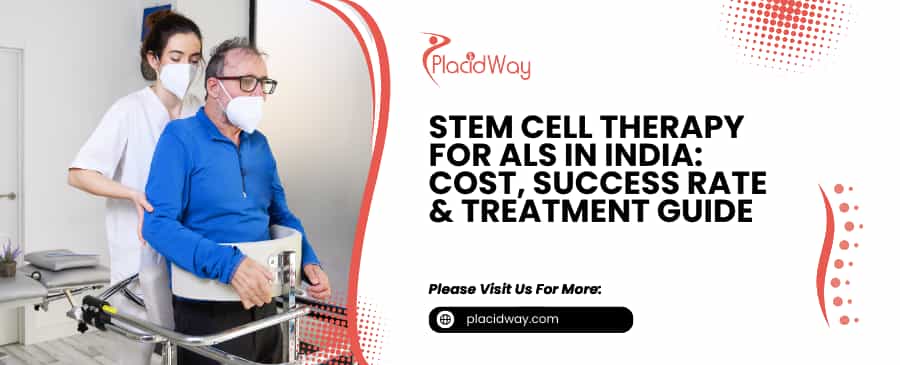
Amyotrophic Lateral Sclerosis (ALS), or Lou Gehrig's disease, is a progressive neurodegenerative condition that has long challenged modern medicine. For patients facing limited options with conventional treatments like Riluzole, stem cell therapy for ALS in India has emerged as a beacon of hope. By leveraging the body's regenerative capabilities, this therapy aims to slow disease progression, protect motor neurons, and improve quality of life.
India has positioned itself as a global hub for advanced regenerative medicine, offering high-quality medical infrastructure at a fraction of Western costs. With world-class neuro-specialists in Mumbai and Delhi utilizing FDA-compliant protocols and state-of-the-art laboratories, international patients are finding affordable, comprehensive care packages that combine cutting-edge science with intensive rehabilitation.
Key Takeaways: ALS Treatment in India
Choosing India for your medical journey offers distinct advantages in cost and care quality:
- Massive Cost Savings: Save 60-70% compared to the US or Europe, with packages averaging $8,000 – $12,000.
- All-Inclusive Care: Standard packages typically include hospital stay, airport transfers, extensive physiotherapy, and neurologist consultations.
- Advanced Protocols: Clinics utilize Mesenchymal Stem Cells (MSCs) via Intrathecal injections to bypass the blood-brain barrier for maximum efficacy.
- Immediate Access: Zero waiting lists for international patients, allowing for rapid intervention which is critical for progressive conditions like ALS.
Typical Cost Snapshot:
- India: $8,000 – $12,000 (Comprehensive Package)
- Mexico: $12,000 – $25,000
- USA: $30,000 – $60,000+ (Procedure Only)
Understanding the Potential: Can Stem Cells Treat ALS?
Stem cell therapy is not a cure, but a regenerative management strategy designed to protect remaining neurons and slow down the rapid progression of ALS symptoms.
The primary goal of stem cell therapy for ALS is neuroprotection and immunomodulation. In ALS, motor neurons die, leading to muscle weakness and paralysis. Stem cells, particularly Mesenchymal Stem Cells (MSCs), act as "medicinal signaling cells." When introduced into the body, they migrate to sites of damage and secrete growth factors (neurotrophic factors) that nourish and protect existing neurons. They also help reduce the neuro-inflammation that drives the disease's progression.
While clinical trials are ongoing globally, real-world data from India suggests that this therapy can stabilize the condition for periods ranging from 6 months to several years, depending on the patient's initial stage. It is most effective when combined with rigorous physical therapy, which helps retrain muscles to utilize the new neural pathways potentially strengthened by the treatment.
The "Blood-Brain Barrier" is a major obstacle for oral ALS medications. However, in India, specialists use Intrathecal administration (lumbar puncture) to inject stem cells directly into the cerebrospinal fluid. This bypasses the barrier, delivering regenerative cells directly to the spinal cord and brain where they are needed most.
Why Choose India for ALS Treatment?
Beyond affordability, India offers a unique combination of highly skilled English-speaking specialists, JCI-accredited safety standards, and permitted "compassionate use" protocols unavailable in many Western nations.
Medical tourism in India has matured significantly. Patients traveling for ALS treatment in India are not visiting generic clinics, but specialized departments within large, multi-specialty hospitals that are often JCI (Joint Commission International) accredited. This ensures safety standards equivalent to American hospitals.
Furthermore, Indian regulatory bodies like the ICMR allow for autologous (patient's own) stem cell applications under strict medical supervision for incurable conditions. This regulatory environment allows patients to access therapies that might still be years away from FDA approval in the United States, without compromising on medical ethics or safety.
Step-by-Step Treatment Journey
From your initial inquiry to your return flight, the process is streamlined for international patients to ensure comfort, safety, and medical efficacy.
Evaluation & Approval
Before you travel, you will send your medical reports (EMG, nerve conduction studies, MRI) to the medical team. Neurologists will review your case to ensure you are a candidate for stem cell therapy.
Arrival & Harvesting
Upon admission, you undergo pre-operative blood tests. The next day, stem cells are harvested. This is usually done via bone marrow aspiration from the hip bone (under local anesthesia) or adipose tissue extraction (mini-liposuction). It is a minimally invasive procedure taking about 30-45 minutes.
Laboratory Processing
The harvested sample is sent to a certified GMP (Good Manufacturing Practice) laboratory. Here, the stem cells are isolated, enriched, and checked for viability. This ensures a high count of active cells—typically 100 to 300 million cells per dose.
Administration & Rehab
The concentrated cells are administered back to the patient. The standard protocol for ALS includes an Intrathecal injection (into the spine) and an Intravenous (IV) infusion. Following this, patients undergo 3-5 days of intensive rehabilitation to stimulate motor function.
"The volume of surgeries and procedures performed in India allows our specialists to refine techniques rapidly. A top neurologist in Mumbai or Delhi handles highly complex neuro-degenerative cases daily. This high volume correlates with lower complication rates and more precise administration of intrathecal injections for international patients."
Detailed Cost Comparison: India vs. The World
A transparent look at how India's all-inclusive packages stack up against other major medical tourism destinations for ALS therapy.
| Country | Avg. Price (USD) | Inclusions | Typical Stay |
|---|---|---|---|
| India | $8,000 - $12,000 | Treatment, 5-7 Day Hospital Stay, Physio, Airport Pickup | 7 - 14 Days |
| Mexico | $12,000 - $25,000 | Treatment, Short Stay (1-2 days) | 3 - 5 Days |
| Thailand | $15,000 - $25,000 | Treatment, Nursing Care, Transfers | 5 - 10 Days |
| Germany | $20,000 - $40,000 | Treatment Only (Outpatient often) | 5 - 7 Days |
| USA | $30,000 - $60,000+ | Treatment Only (Clinical Trials fees vary) | Outpatient |
Success Rates & What to Expect
Honesty is vital in ALS treatment. While not a cure, a majority of patients report tangible improvements in daily living and a slowing of symptom onset.
Success in ALS therapy is measured by the "slowing of progression" rather than a complete reversal. Clinical observations from India indicate that roughly 60% to 70% of patients respond positively to the treatment. Improvements are typically noted in:
- Reduced Fasciculations: A decrease in involuntary muscle twitching.
- Improved Swallowing & Speech: Better control over bulbar functions in early-stage patients.
- Stabilized Motor Function: Maintenance of limb strength for a longer duration compared to the natural course of the disease.
- Reduction in Salivation: Better management of oral secretions.
Top Cities for ALS Treatment in India
India's major metros offer excellent connectivity and medical infrastructure. Here are the primary hubs for international patients.
Mumbai
The financial capital is home to some of the country's oldest and most prestigious neuro-regenerative institutes. Mumbai is ideal for patients seeking high-end private hospitals that rival 5-star hotels in comfort.
New Delhi (NCR)
The capital region boasts several JCI-accredited super-specialty hospitals. It is particularly convenient for international travelers due to excellent flight connectivity. Delhi offers competitive stem cell packages that often include sightseeing options for accompanying family members.
Bangalore
Known as the "Silicon Valley of India," Bangalore is a hub for biotechnology and research. Hospitals here are often at the forefront of clinical trials and experimental protocols, utilizing the latest lab technology for cell expansion.
India is one of the world's largest manufacturers of pharmaceuticals and biotechnology products. This domestic production capability significantly lowers the overhead costs for lab reagents and cell processing, savings that are directly passed on to international patients seeking affordable ALS surgery in India.
Frequently Asked Questions (FAQs)
Common queries from international patients planning their treatment journey.
What is the success rate of stem cell therapy for ALS in India?
While there is no known cure for ALS, clinical data from top Indian hospitals indicates that approximately 60% to 70% of patients report a slowing of disease progression and improvements in quality of life measures, such as reduced muscle stiffness and better sleep, within 3-6 months post-treatment.
How much does stem cell treatment for ALS cost in India?
The average cost of stem cell therapy for ALS in India ranges from $8,000 to $12,000 USD. This typically includes the procedure, hospital stay (3-7 days), physiotherapy, pre-operative testing, and airport transfers, offering a savings of nearly 70% compared to the US or Europe.
Is stem cell therapy for ALS legal in India?
Yes, stem cell therapy is permitted in India under strict guidelines set by the ICMR (Indian Council of Medical Research). It is often administered as an investigational therapy or under "compassionate use" protocols for incurable conditions like ALS in registered, ethical medical facilities.
What type of stem cells are used for ALS treatment?
Most clinics in India use Autologous Mesenchymal Stem Cells (MSCs) derived from the patient's own bone marrow or adipose (fat) tissue. In some cases, Allogeneic (donor) cells from umbilical cord Wharton's Jelly are used due to their higher potency and lack of immune rejection.
How is the therapy administered to ALS patients?
The most effective protocol involves a combination of Intrathecal injections (directly into the spinal fluid via lumbar puncture) to bypass the blood-brain barrier and Intravenous (IV) infusions to address systemic inflammation.
Are there any side effects?
The procedure is generally safe, especially when using the patient's own cells (autologous). Common minor side effects include temporary headache, low-grade fever, or soreness at the injection site. Serious complications are rare in JCI-accredited facilities.
How long do I need to stay in India for treatment?
International patients typically stay in India for 7 to 14 days. This allows time for pre-procedure evaluations, the stem cell harvesting and injection process, and an initial course of intensive neuro-rehabilitation.
Does the package include physical therapy?
Yes, most comprehensive packages in India include intensive physiotherapy and occupational therapy sessions during your hospital stay, as rehabilitation is crucial for maximizing the benefits of stem cell regeneration.
Can I travel immediately after the procedure?
Doctors usually recommend resting for 48-72 hours after the intrathecal injection to prevent spinal headaches. Most patients are cleared to fly back home 5-7 days after the final procedure.
Ready to Explore New Possibilities?
Don't let ALS progression limit your life or your finances. PlacidWay partners with the top JCI-accredited research hospitals in India to bring you world-class stem cell packages tailored for international patients.
Get a free, no-obligation quote today and speak directly with our medical care team to plan your journey to hope and healing.
















Share this listing