



Finding out that prostate cancer has spread beyond the prostate changes the conversation, but it does not mean treatment options have run out. Metastatic prostate cancer can behave differently from one person to another, so doctors typically consider where the cancer has spread, whether it remains responsive to hormone suppression, previous treatments, symptoms, genetic findings, and overall health before recommending the next step.
For patients considering metastatic prostate cancer treatment in Mexico, the priority should be finding a qualified multidisciplinary cancer team rather than choosing a treatment by name alone. Costs can vary substantially because advanced prostate cancer may involve ongoing medication, imaging, radiation, chemotherapy, laboratory monitoring, or specialized nuclear medicine. Before traveling, verify the physician’s Mexican professional license, current specialty certification, and the facility’s authorization to provide the proposed treatment.
Quick Summary: Metastatic Prostate Cancer Treatment in Mexico
- What “spread” means: Prostate cancer found in distant lymph nodes, bones, or organs is generally considered metastatic or stage IV disease.
- The most important treatment question: Doctors determine whether the cancer remains hormone-sensitive or has become castration-resistant because treatment choices differ.
- Possible treatments: Androgen-deprivation therapy, androgen-receptor pathway medicines, chemotherapy, radiation, selected targeted therapies, radiopharmaceutical treatment, and supportive care may all have roles.
- Cost: There is no reliable single national price for metastatic prostate cancer treatment in Mexico. Total cost depends heavily on the drugs, imaging, treatment duration, disease complexity, and supportive care required.
- Doctor verification: Check the physician's professional registration through Mexico's Registro Nacional de Profesionistas and current specialty certification through CONACEM.
- Important caution: A treatment promoted as “advanced” or “innovative” is not automatically appropriate for metastatic prostate cancer. Ask what biomarker, imaging result, or clinical evidence makes you eligible.
- Emergency symptoms: New leg weakness or numbness, loss of bladder or bowel control, sudden severe back pain, inability to urinate, or serious infection symptoms require urgent medical evaluation.
What Does It Mean When Prostate Cancer Has Spread?
When prostate cancer has spread, cancer cells have moved beyond the prostate to another location. Common metastatic sites include lymph nodes and bones, although advanced disease can also involve organs such as the liver or lungs.
The words metastatic prostate cancer describe where the cancer is located, but they do not tell doctors everything needed to choose treatment. Your oncologist will also want to know whether the disease is still controlled by lowering testosterone.
| Clinical situation | What it means | Why it matters |
|---|---|---|
| Metastatic hormone-sensitive prostate cancer | Cancer has spread but remains responsive to therapies that suppress androgen signaling. | Modern treatment commonly intensifies hormone suppression with an additional systemic therapy rather than relying on androgen deprivation alone. |
| Metastatic castration-resistant prostate cancer | Cancer progresses despite testosterone being suppressed to castration levels. | Doctors may consider additional hormone-pathway drugs, chemotherapy, radioligand therapy, biomarker-directed treatments, or other options according to previous treatment. |
What Treatment Options Can Be Considered for Metastatic Prostate Cancer?
Treatment is usually systemic, meaning it works throughout the body rather than targeting only the prostate. The goal may be to control cancer for as long as possible, delay progression, relieve symptoms, protect bone health, and maintain quality of life.
Androgen-Deprivation Therapy
Prostate cancer cells commonly depend on male hormones called androgens. Androgen-deprivation therapy, or ADT, lowers or blocks this hormonal stimulation and remains a foundation of treatment for metastatic disease.
Mexico's NOM-048-SSA2-2017 recognizes hormonal treatment for advanced metastatic prostate cancer. Modern international practice often combines ADT with another treatment for patients who are medically suitable rather than using ADT alone.
Androgen-Receptor Pathway Treatment
Medicines that more strongly interrupt androgen production or androgen-receptor signaling can be combined with ADT in appropriate patients. Examples used internationally include abiraterone, enzalutamide, apalutamide, and darolutamide.
Which medicine makes sense depends on your disease state, previous treatments, cardiovascular and metabolic health, drug interactions, access, and other clinical factors.
Chemotherapy
Taxane chemotherapy such as docetaxel can play an important role in metastatic prostate cancer. Some patients with newly diagnosed hormone-sensitive metastatic disease may receive chemotherapy as part of an intensified combination strategy, while chemotherapy is also used in later-stage castration-resistant disease.
Radiation Therapy
Radiation may be used for several different reasons. It can relieve pain from bone metastases, treat disease threatening important structures, control specific metastatic lesions, or be incorporated into treatment of the prostate in selected patients.
Targeted and Biomarker-Directed Therapy
Genetic and molecular testing is increasingly important in metastatic prostate cancer. Some tumors contain alterations involving DNA-repair genes such as BRCA1 or BRCA2. Selected patients may therefore become candidates for PARP-inhibitor-based treatment.
| Treatment category | When it may be considered | Question to ask |
|---|---|---|
| ADT | Foundation treatment for many metastatic hormone-driven prostate cancers | What will be combined with ADT in my situation? |
| Androgen-receptor pathway therapy | Hormone-sensitive or selected castration-resistant disease | Does my previous treatment affect which drug is appropriate? |
| Chemotherapy | Selected hormone-sensitive or castration-resistant disease | What benefit is expected compared with the risks for me? |
| Radiation | Painful or threatening metastases and selected disease-control situations | Is the goal symptom relief or longer-term disease control? |
| PARP-targeted therapy | Selected cancers with qualifying molecular alterations | Have I had appropriate tumor and germline genetic testing? |
| PSMA-directed radioligand treatment | Selected PSMA-positive metastatic disease according to indication, prior therapy, and regulatory availability | Do my PSMA imaging and treatment history make me eligible? |
Can PSMA-Targeted Treatment Be Used When Prostate Cancer Has Spread?
PSMA-targeted radioligand therapy has become an important option for selected metastatic prostate cancers. PSMA stands for prostate-specific membrane antigen, a protein that can be expressed at high levels on prostate cancer cells.
A PSMA-targeting compound can carry a radioactive isotope such as lutetium-177 to PSMA-expressing cancer cells. Treatment eligibility requires more than simply having metastatic prostate cancer; appropriate imaging, previous therapy, blood counts, kidney function, disease pattern, and regulatory criteria can all matter.
In July 2026, the U.S. FDA expanded the use of lutetium Lu 177 vipivotide tetraxetan in combination with an androgen-receptor pathway inhibitor for certain PSMA-positive metastatic androgen-pathway-sensitive disease. This illustrates how rapidly the treatment landscape is changing, but Mexico-specific eligibility and availability must be verified separately.
What Do Recent Prostate Cancer Statistics Show?
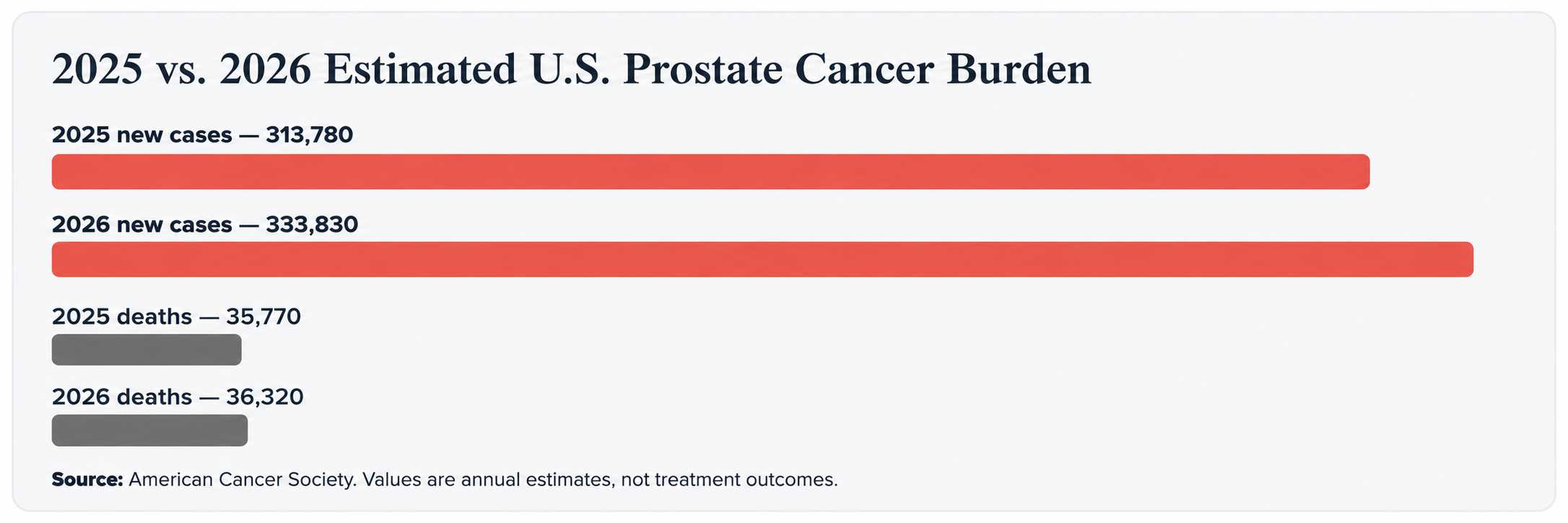
Advanced prostate cancer remains clinically important despite major improvements in treatment. American Cancer Society estimates show an increase in expected U.S. prostate cancer diagnoses from 313,780 in 2025 to 333,830 in 2026. These figures describe U.S. disease burden and should not be interpreted as Mexican treatment-volume or medical-tourism statistics.
Estimated U.S. Prostate Cancer Diagnoses: 2025–2026
Source: American Cancer Society, 2025 and 2026 prostate cancer estimates.
The American Cancer Society currently reports a 38% five-year relative survival rate for U.S. patients classified with distant-stage prostate cancer and diagnosed during 2015–2021. Population survival statistics cannot predict what will happen to an individual patient because prognosis varies with cancer biology, metastatic burden, treatment response, age, health, and newer therapies introduced after the historical diagnosis period.
How Are Bone Metastases Managed in Advanced Prostate Cancer?
Bone is one of the most common places prostate cancer spreads, so protecting mobility, controlling pain, and preventing skeletal complications can become an important part of treatment.
Doctors may use systemic cancer treatment alongside external-beam radiation for painful or threatening lesions. Bone-modifying medicines may also be appropriate in certain clinical settings, particularly when fracture and skeletal-event risks are significant.
| Problem | Possible approach | Why doctors consider it |
|---|---|---|
| Painful bone metastasis | External-beam radiation and systemic treatment | Reduce pain and control disease at the symptomatic site |
| Risk of skeletal complications | Bone-directed supportive therapy in appropriate patients | Reduce selected treatment- or cancer-related skeletal complications |
| Selected symptomatic bone-predominant castration-resistant disease | Radium-223 may be considered under appropriate indications | Targets areas of increased bone turnover associated with metastatic disease |
| Possible spinal cord compression | Emergency imaging and oncology/spine assessment | Neurologic damage can become permanent if treatment is delayed |
What Tests Should Be Reviewed Before Starting Treatment in Mexico?
A strong second opinion begins with confirming exactly what disease you have and what treatment you have already received. Advanced prostate cancer should not be managed from PSA results alone.
Biopsy report, Gleason score or Grade Group, pathology review, and any available tissue-testing results.
Current PSA plus previous values and dates to show how quickly the marker has changed.
CT, MRI, bone scan, PET or PSMA PET reports and preferably the original imaging files.
Hormone treatments, surgery, chemotherapy, radiation, targeted drugs, radiopharmaceuticals, and dates of progression.
Tumor molecular testing and hereditary or germline testing when recommended for metastatic disease.
Blood counts, kidney and liver function, cardiovascular history, medications, performance status, and current symptoms.
Ask the Mexican oncology team to provide a written interpretation of these records before you purchase flights whenever possible. The proposed treatment should explain your disease state, treatment objective, why you are eligible, major alternatives, expected monitoring, and what happens if the cancer progresses.
How Much Does Metastatic Prostate Cancer Treatment Cost in Mexico?
There is no medically responsible single price for treating metastatic prostate cancer in Mexico. Unlike a one-time surgical procedure, metastatic cancer treatment can continue for months or years and may change when the disease responds, progresses, or produces new symptoms.
Reliable official Mexican sources do not provide one standardized private international-patient price covering all modern metastatic prostate cancer regimens. For that reason, a fixed national USD estimate should not be presented as though it applies to every patient.
| Cost component | What may be included | Pricing guidance |
|---|---|---|
| Initial oncology review | Record review, examination, treatment planning | Request an itemized USD quote |
| Imaging and staging | CT, MRI, PET/PSMA PET, bone imaging as required | Confirm whether radiotracer and interpretation fees are included |
| Systemic medication | Hormonal, chemotherapy, targeted, or other medicines | Ask for drug name, brand/generic status, number of planned cycles, and pharmacy fees |
| Radiation therapy | Planning, simulation, treatment delivery, physician review | Confirm total number of sessions and whether planning is separate |
| Radioligand treatment | Radiopharmaceutical, nuclear-medicine services, laboratory monitoring | Obtain a written quote for every planned cycle and required imaging |
| Supportive care | Pain care, bone management, transfusion support, hospitalization if required | Ask which complications generate additional charges |
| Travel expenses | Flights, hotel, local transport, companion expenses | Keep these separate from the medical quote |
How Should You Choose a Prostate Cancer Hospital in Mexico?
For metastatic prostate cancer, hospital capability matters because treatment may require medical oncology, urologic oncology, radiation oncology, nuclear medicine, radiology, pathology, emergency care, and laboratory services working together.
Mexico's NOM-048-SSA2-2017 establishes national criteria concerning prostate-cancer prevention, diagnosis, treatment, and monitoring across the Mexican health system. Patients should still independently verify the facility and the specific services involved in their treatment.
| What to verify | What to ask the hospital |
|---|---|
| Facility authorization | What health authority licenses or authorizes this facility and the service I will receive? |
| Cancer capability | Do you routinely manage metastatic prostate cancer rather than only localized prostate disease? |
| Multidisciplinary review | Will my case be reviewed by medical oncology, urology, radiation oncology, and nuclear medicine when relevant? |
| Emergency support | Is emergency care available on site or through a defined hospital-transfer agreement? |
| Nuclear medicine | If PSMA radioligand treatment is proposed, what authorizations, radiation-safety systems, and nuclear-medicine specialists support the program? |
| Aftercare | Who reviews blood tests, side effects, scans, and treatment complications after I return home? |
How Can You Verify a Prostate Cancer Specialist in Mexico?
You should independently verify the professional credentials of every physician directing your cancer treatment. A website biography alone is not enough.
- Check the professional license. Mexico's Registro Nacional de Profesionistas allows patients to verify whether a professional has a registered title and cédula profesional.
- Check current specialist certification. CONACEM provides a public search system for confirming current medical-specialty certification.
- Match certification to the treatment. Relevant specialists can include medical oncologists, urologists, radiation oncologists, radiologists, pathologists, and nuclear-medicine physicians.
- Ask about metastatic prostate cancer experience. Experience with localized prostate surgery does not automatically establish expertise in systemic treatment of metastatic disease.
- Ask who handles complications. You should know who can be contacted outside regular office hours and where you would be admitted if emergency treatment became necessary.
Who Considers Traveling to Mexico for Advanced Prostate Cancer Care?
International patients considering Mexico may be seeking a second opinion, access to a particular specialist, a different treatment strategy, shorter travel distances, or a more manageable self-pay arrangement. However, reliable public datasets breaking down metastatic prostate cancer medical travelers to Mexico by country, age, and treatment are not currently available.
For that reason, claims such as “most prostate cancer patients come from a specific country” should not be presented as statistics without a credible patient-flow dataset. For practical medical-tourism planning, patients traveling from the United States and Canada often need to think particularly carefully about continuity between their home oncologist and the Mexican treating team.
International Patient Decision Profile
Confirm diagnosis and treatment eligibility remotely.
Keep copies of medication, imaging, laboratory, and discharge records.
Arrange PSA, testosterone, blood-test, imaging, and toxicity monitoring in advance.
Note: This figure is a clinical travel-planning framework, not a statistical representation of Mexican medical-tourism demographics.
What Questions Should You Ask Before Traveling to Mexico?
A useful consultation should leave you with a written strategy rather than simply the name of a treatment. These questions can help you evaluate whether the recommendation is individualized and medically defensible.
- Is my cancer metastatic hormone-sensitive or metastatic castration-resistant?
- Where has the cancer spread?
- What is the goal of the treatment you are recommending?
- Why am I a candidate for this treatment?
- What standard alternatives should I consider?
- Do I need PSMA PET or other additional imaging?
- Do I need germline or tumor genomic testing?
- What evidence supports this treatment for my exact disease state?
- What side effects require emergency medical attention?
- How frequently will PSA, testosterone, blood counts, kidney function, and liver function be checked?
- What happens if the treatment stops working?
- Who will manage my care after I return home?
- What is included and excluded from the written quote?
- Can I receive copies of all treatment and imaging records in English?
Frequently Asked Questions About Metastatic Prostate Cancer Treatment in Mexico
Can stage 4 prostate cancer still be treated?
Yes. Metastatic prostate cancer has several established treatment options. Treatment may include hormone suppression, androgen-receptor pathway therapy, chemotherapy, radiation, targeted treatment, radiopharmaceutical therapy, and supportive care depending on the disease state. Treatment is individualized according to cancer biology, previous therapy, symptoms, health, imaging, and molecular findings.
What is usually the first treatment when prostate cancer has spread?
Androgen-deprivation therapy is a central treatment for many newly diagnosed metastatic prostate cancers. Current treatment strategies frequently combine hormone suppression with an additional androgen-pathway drug and, for selected patients, chemotherapy or another systemic approach. The exact strategy depends on disease volume, health, symptoms, and individual risk factors.
Can metastatic prostate cancer be cured?
Widely metastatic prostate cancer is generally approached as a long-term advanced cancer rather than assuming cure is possible. Treatments can sometimes control disease for meaningful periods, reduce symptoms, and delay progression. Prognosis differs considerably between patients, so population statistics should not be used as an individual prediction.
Is chemotherapy always necessary for metastatic prostate cancer?
No. Chemotherapy is one important treatment option, but not every patient receives it at the same stage. Hormone sensitivity, metastatic burden, previous treatment, symptoms, age, physical fitness, other medical conditions, and availability of alternative systemic treatments can influence whether chemotherapy is recommended.
Can radiation help if prostate cancer has spread to the bones?
Yes. External-beam radiation can be used to treat painful or threatening bone metastases and may provide substantial symptom relief. Radiation can also be considered in other carefully selected metastatic situations. The radiation oncologist chooses the target and schedule based on symptoms, anatomy, previous radiation, and treatment goals.
What is PSMA therapy for metastatic prostate cancer?
PSMA-directed radioligand therapy uses a molecule that binds to prostate-specific membrane antigen and delivers radiation to PSMA-expressing cancer cells. Eligibility requires appropriate clinical assessment and usually PSMA imaging. Previous treatments, organ function, blood counts, disease distribution, and local regulatory authorization may also determine suitability.
Should I get genetic testing if my prostate cancer has spread?
Genetic assessment can be particularly relevant in metastatic prostate cancer because certain inherited or tumor-specific DNA-repair alterations may affect treatment choices. Your oncology team can determine whether germline testing, tumor genomic testing, or both are appropriate and how the results could influence treatment.
How do I know whether a prostate cancer doctor in Mexico is qualified?
Verify the doctor's professional license through Mexico's Registro Nacional de Profesionistas and check current specialty certification through CONACEM. You should also ask about experience specifically treating metastatic prostate cancer, hospital privileges, multidisciplinary support, complication management, and who provides follow-up after international patients return home.
How much does stage 4 prostate cancer treatment cost in Mexico?
There is no single reliable national price because treatment may involve months or years of medication, imaging, laboratory monitoring, radiation, chemotherapy, radiopharmaceutical treatment, or hospitalization. Request an itemized USD quote based on your actual medical records and separate one-time fees from recurring treatment expenses.
What medical records should I send to a Mexican oncologist?
Send your pathology report, PSA history, staging scans, previous treatment records, medication list, recent laboratory results, and genomic-testing reports when available. Original imaging files may also be requested. A complete history helps the oncologist determine your disease state and avoid recommending treatment based on incomplete information.
Should I stop my current prostate cancer treatment before traveling?
Do not stop hormone therapy, cancer medication, steroids, anticoagulants, or other prescribed medicines solely because you are seeking treatment abroad. Treatment interruptions can have medical consequences. Ask your current oncologist and the receiving medical team to coordinate any necessary transition in therapy.
When should someone with metastatic prostate cancer seek emergency care?
Urgent evaluation is important for new leg weakness, numbness, bowel or bladder-control problems, severe back pain, inability to urinate, uncontrolled pain, confusion, breathing difficulty, or significant infection symptoms. Patients receiving chemotherapy or other immune-suppressing treatment should follow their oncology team's specific emergency instructions.
Explore Your Prostate Cancer Treatment Options
A metastatic prostate cancer diagnosis may involve several possible treatment paths, and the right sequence depends on your medical history rather than one treatment being suitable for everyone.
PlacidWay can help you compare healthcare providers, request treatment information, understand potential costs, and prepare questions for clinics in Mexico.
Disclaimer
Disclaimer: This information is for educational purposes only and does not replace professional medical advice. Always consult a qualified healthcare provider before making medical decisions.
References
- Hormone Therapy for Prostate Cancer – National Cancer Institute
- Key Statistics for Prostate Cancer – American Cancer Society
- Prostate Cancer Survival Rates – American Cancer Society
- Lutetium Lu 177 Vipivotide Tetraxetan Approval – U.S. Food and Drug Administration
- NOM-048-SSA2-2017 for Prostate Disease and Prostate Cancer – Diario Oficial de la Federación, Mexico
- Medical Specialist Certification Search – CONACEM Mexico









.png)
.png)








.png)









Share this listing