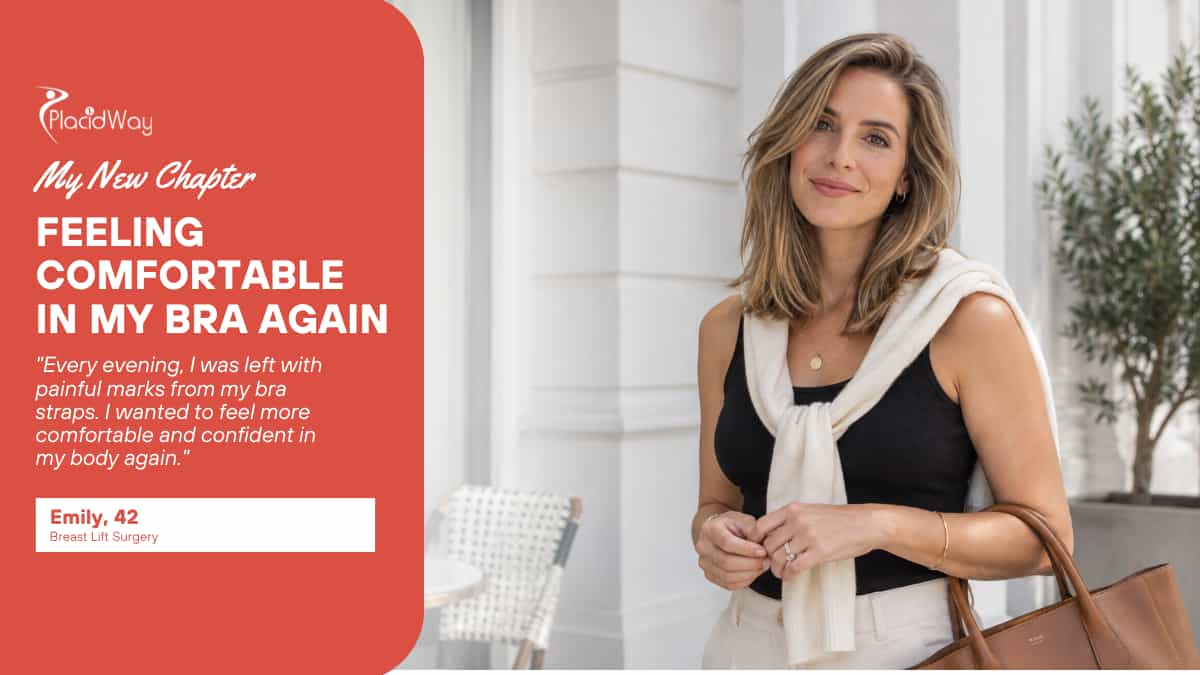
The Bra Straps Left Marks Every Evening: An American Patient’s Breast Lift Surgery in Medellin

Publish date: Modified date: Medically reviewed by: Dr. Lorenzo Halverson on Sep 11, 2026 Author: Amelia Pricilia

American Patient’s Breast Lift Surgery in Medellin 

Patient Profile

Name: Emily Carter

Age: 42

Condition: Breast Ptosis (Grade II–III) and post-partum involution

Treatment: Mastopexy (Breast Lift) with potential augmentation

Destination: Medellin, Colombia

Journey at a Glance

Main problems: Shoulder and back discomfort from unsupported tissue, bra fit difficulties, and loss of upper pole fullness.

Previous care: Consulted regional U.S. plastic surgeons yielding out-of-pocket quotes of USD 12,000–18,000 and 6–12 month waitlists.

Travel driver: Need for timely surgical restoration at a manageable price point within a dual-board certified medical infrastructure.

Treatment explored: Mastopexy in JCI-accredited or internationally certified facilities.

Personal goal: Reclaim physical agency without destabilizing the family's financial security.

Breast Ptosis in American Women: Why Thousands Are Choosing Medellin for Surgical Restoration

You start by pulling the bra strap a half-inch tighter each morning.

You retire certain fitted shirts to the back of the closet.

You fold your arms across your chest when answering the front door.

You blame gravity.

You blame age.

You blame the natural aftermath of nursing your children.

You research exercise routines that target pectoral muscles.

You realize muscle sits beneath the problem, not inside it.

"You don't need to change anything."

"It's just what happens as we get older."

"I think you look perfectly fine."

Your physical world has quietly become smaller.

And the hardest part is not the daily discomfort or the prohibitive cost, but the indefinite waiting.

Meet Emily Carter.

Emily Carter is not a real patient of any particular clinical facility.

She is a fictional composite built entirely from the specific delays, financial barriers, and clinical realities women face every day.

Emily is forty-two years old and lives in suburban Cincinnati, Ohio.

She manages a household budget, drives her teenagers to evening practices, and works a standard corporate schedule.

She carries the physical weight of unsupported tissue under her collarbones every single day.

She explained the deep ache in her shoulders as poor desk posture.

New bras.

Wider straps.

Posture correctors.

Chiropractic visits.

Acceptance.

A mastopexy, commonly known as a breast lift, is a surgical procedure that removes excess skin and tightens the surrounding tissue to reshape and support the new breast contour . The procedure is clinically indicated when ptosis affects physical comfort and posture, though domestic insurance systems almost universally classify it as a cosmetic intervention.

The surgeon handed her the finalized out-of-pocket estimate:

"Elective."

She looked at the twelve-month waiting list and asked herself one question:

"When?"

The system doesn't measure her daily reality.

The average cost of a breast lift in the United States routinely exceeds USD 12,000 when factoring in facility fees, anesthesia, and recovery garments, while surgical wait times in metropolitan regions often stretch from six to twelve months .

But Emily doesn't experience the domestic healthcare market as a national statistic.

She sits on the edge of the bed, rubbing the deep red indentations on her shoulders.

"I can't wear this for another year."

"I just don't have the energy today."

"We need this money for the roof."

She has already tried to be patient.

She spent eighteen months saving a dedicated portion of her salary.

She drained that exact account when the family car required a new transmission.

She applied for medical credit and stared at the punishing monthly interest rate.

"I am being selfish."

"Other people manage this without complaining."

She recognized the shift in her own thinking:

From "Can I tolerate this?" to "How much of my life am I prepared to organise around it?"

The conventional route requires an impossible trade-off.

The conventional domestic route requires a financial compromise her family cannot safely absorb.

Taking on twelve thousand dollars of high-interest consumer debt is technically possible.

But price should never dictate a medical strategy, and borrowing against your family's stability introduces an entirely different kind of stress.

She sat at the kitchen table with her husband, Mark.

"We can put it on the cards if you really need it."

"There is a difference between paying for something and affording it."

She isn't searching for Colombia yet.

Cost of breast lift near me.

Financing options for cosmetic surgery.

Does insurance cover breast lift for back pain.

Safe alternatives to US plastic surgery.

Medical tourism breast lift Medellin.

The search engine populates with images of medical facilities in Colombia.

She closed the laptop screen.

"I'm not going abroad just because something is cheaper."

That instinct is entirely correct and clinically sound.

Why does Medellin keep appearing?

Medellin has deliberately constructed a medical infrastructure that aligns with international safety standards and caters directly to North American patients.

High-volume surgical centers in Colombia frequently maintain accreditation from international bodies, ensuring their operating theaters meet the same sterility and emergency protocols as U.S. hospitals .

But the essential reframe is understanding how healthcare actually functions.

A country does not perform an operation.

A specific board-certified surgeon, operating with a dedicated clinical team inside an audited facility, performs the operation.

There is a tangible, verifiable reality to evaluate.

Patients are strongly advised to independently verify the credentials of any foreign provider and to consult with a domestic physician before making travel arrangements .

Her first question was: How much?

The indicative cost for a mastopexy in Medellin generally ranges between USD 4,000 and 7,000, varying based on surgical complexity, the need for implants, and the duration of the supervised recovery stay .

Her mother's voice echoed in her head:

You get exactly what you pay for.

"What exactly am I getting?"

Does this include the anesthesiologist's fee?
Are the pre-operative blood panels handled at the clinic?
Who pays if I need an extra night in the recovery house?
Is the specialized surgical garment provided or purchased separately?
Does the quote cover the initial consultation, or just the table time?
What happens to the deposit if my pre-op EKG shows an irregularity?
Are post-operative medications dispensed directly on-site?
Does this include daily nursing checks at the hotel?
Will I have a dedicated medical translator present during the surgical prep?
Does the fee include the mandatory medical travel insurance policy?
Is transportation from the airport to the clinic handled by specialized staff?
Who manages the telemedicine follow-up when I return to Ohio?

The advertised number is only the beginning of the conversation.

What does a mastopexy actually involve?

A standard mastopexy requires incisions that allow the surgeon to elevate the breast mound, reposition the nipple-areolar complex, and remove inelastic skin to restore anatomical projection . The procedure typically lasts two to three hours under general anesthesia, followed by a closely monitored immediate recovery period.

Then she realized the most complicated aspect wasn't the surgery itself.

"Wait. Does that mean...?"

The part the brochures rarely put on the front page.

Traveling for surgery means recovering in an unfamiliar environment while navigating strict physical limitations.

Current official guidance on flying after major surgery varies considerably, with some authorities recommending a minimum of two weeks of ground recovery before boarding a pressurized aircraft to mitigate deep vein thrombosis risks .

The variation in regulatory advice is exactly the lesson.

This constraint must be fully integrated into the financial and logistical plan before any deposit is paid.

"Wait. Does that mean I can't lift my own luggage?"

Possibly, depending on the specific post-operative clearance protocols of your chosen surgeon.

Can I lift my carry-on bag into the overhead bin?

Who changes the surgical dressings on day four?

What if I develop a fever in the hotel room?

How do I manage the surgical drains while walking?

Is the local pharmacy equipped with the exact prescriptions I need?

Will the mattress in the recovery suite accommodate a propped-up sleeping position?

How do I wash my hair when I cannot raise my arms above my shoulders?

Who monitors the incision lines for early signs of tissue necrosis?

Can I safely handle a three-hour flight back to Houston or Miami?

What happens if the flight is delayed and my pain medication runs out?

This isn't tourism in the usual sense.

Mark isn't just coming along.

Mark is the invisible second participant in this entire endeavor.

He will carry the luggage, manage the flight connections, and track the medication schedule.

He will need to memorize the emergency contact numbers for the local clinical coordinator.

He must understand the signs of post-operative complications when they are resting in a foreign hotel room.

Standard domestic health insurance plans do not cover complications arising from elective procedures performed overseas, requiring the purchase of specialized medical complications insurance .

He is part of the clinical care system too.

Then comes the uncomfortable conversation about risk.

Any surgical intervention carries inherent physiological risks, including infection, hematoma, adverse anesthesia reactions, and delayed wound healing .

Emily learns to immediately distrust websites that use certain phrases.

Completely safe. No risk. Guaranteed success.

Informed consent means understanding the probability of complications, not just visualizing the hoped-for aesthetic outcome.

Emily's questions become better.

She stops asking "How much is it?" and starts demanding specifics.

How many times have you performed this specific anchor-incision lift this year?
Where is the nearest tertiary hospital if the clinic loses power?
Can I see your active board certification documents?
Who is legally responsible if an implant ruptures during the first year?
What is your specific protocol for managing a post-operative hematoma?
Do you use FDA-approved sutures and implants?
How do we communicate if I have a concern at two in the morning?
What percentage of your international patients require a revision surgery?
Will you be the one answering my telemedicine calls in six weeks?

She doesn't only want someone willing to do the operation.

She wants a surgeon willing not to.

Have I exhausted my options at home?

Patients have the right to challenge insurance denials and request a formal review if a procedure is deemed medically necessary for chronic pain or dermatological conditions .

Could a physical therapist document my shoulder pain to build a case for coverage?

Will my current primary care doctor write a letter of medical necessity?

Can I consult an in-network reconstructive specialist instead of a cosmetic surgeon?

Is there a regional teaching hospital with a supervised residency clinic?

Have I fully explored domestic financing options through my local credit union?

Medellin should be compared with Emily's real alternatives at home, not with a worst-case assumption about the domestic system.

The night before the decision.

The kitchen table is covered in paper again.

Printed emails from the Medellin patient coordinator. Flight itineraries through Miami. A highlighted copy of the surgeon's clinical CV. The specialized medical complication insurance policy.

"It feels different this time."

"Because you actually know what you're looking at."

The research didn't make her more afraid; it made her more capable of deciding.

What Emily actually wants isn't plastic surgery.

If her brother asks her why she is doing this, she might say she wants to lower her back pain.

But that isn't entirely accurate.

She wants to buy a regular bra from a standard department store.

She wants to sit at a desk without rolling her shoulders back to relieve the tension.

She wants to step out of the shower without turning away from the mirror.

Not the airplane ticket. Not the surgical facility. Not the stitches or the recovery garments. Not the financial savings in Colombia.

It comes down to one core requirement:

Autonomy.

And underneath that:

Peace.

Medellin might be the answer. It might not be.

You might look at the travel logistics and decide the domestic waitlist is preferable.

You might discover your primary care physician advises against the travel due to a minor health variable.

You might find the anxiety of being away from your children outweighs the financial savings.

You might simply decide you are not ready.

You might save for another year and stay in Ohio.

Choosing not to board the plane is a completely valid choice.

Moving forward requires accepting the travel, acknowledging the risks, and signing the consent forms without feeling rushed.

Any of those can be an informed decision.

The goal of researching overseas medical options isn't to persuade you to leave the country; it is to make sure your frustration doesn't make the decision for you.

The decision is yours.

Maybe you have a folder full of domestic quotes hidden in your desk.

Maybe you are tired of adjusting your clothes in public.

Maybe you feel guilty for even thinking about spending money on yourself.

Maybe you are exhausted by a healthcare system that views your daily physical discomfort as an elective luxury.

Maybe you are ready to look at alternatives.

You do not need to decide today.

What exactly is my physical threshold for waiting?

Who is operating the facility I am looking at?

How will I handle the transition back to my normal life?

What are the specific logistics of international recovery?

Am I chasing a cheap price, or am I searching for a capable clinical team?

Who can I talk to who has actually navigated this path?

What is my plan if the recovery takes longer than two weeks?

You are not just comparing prices.

You are comparing paths forward.

Hope isn't the promise that everything will be fixed.

Hope is not a glossy brochure promising a perfect silhouette.

Hope is not a discount code valid for the next forty-eight hours.

Hope is not the illusion that crossing a border makes surgical risks disappear.

Hope is having enough transparent information to make a decision that feels entirely yours.

You can read the accreditations.

You can ask the difficult questions.

You can calculate the true cost of travel and aftercare.

You can demand verifiable credentials.

You can choose to walk away.

It shifts the foundation of the problem:

From "I suppose I'll just have to keep waiting."

To "What other informed options do I have?"

PlacidWay — Your Way to Hope.

PlacidWay helps individuals explore international medical options, compare facility credentials, and prepare the rigorous questions necessary for informed healthcare decisions. We provide the structural framework for understanding global care alternatives, allowing patients to evaluate cross-border procedures with clarity and caution. For someone like Emily, a surgical facility in Medellin isn't a promise of perfection; it is one carefully vetted route worth understanding.

Your Way to Hope.

Medical disclaimer

This article is provided for educational and informational purposes only and does not recommend that any individual undertake travel for medical procedures. Individual clinical suitability, anatomical considerations, and physiological risks require direct professional assessment by a qualified physician. Readers should consult their own domestic clinician or medical adviser before making any healthcare decisions, independently verify the current regulatory status and accreditation of any international facility, and obtain appropriate specialized medical travel protection or insurance.

The Bra Straps Left Marks Every Evening: An American Patient’s Breast Lift Surgery in Medellin

About Article

  • Treatment: Cosmetic/Plastic Surgery
  • Country: Colombia
  • Overview Emily Carter’s breast ptosis causes shoulder discomfort, deep strap marks and difficulty finding supportive clothing. US quotes of USD 12,000–18,000 lead her to compare mastopexy in Medellin. Important decisions include whether implants are necessary, the likely scar pattern, possible changes in sensation or breastfeeding, anesthesia and facility standards, clot prevention, recovery assistance and the financial plan for complications or revision.

Trusted Medical Tourism Platform Since 2007

60+
Countries
2k+
Clinics
19.5k+
Reviews
2.5k+
Qualified Doctors
1.1M+
Patients Served Since 2007