
Finding a hospital for CAR T-cell therapy is very different from choosing a hospital for routine cancer treatment. You need a center that can confirm your disease target, collect or receive cells appropriately, manage lymphodepleting treatment, administer the CAR-T product or research therapy, and respond immediately if cytokine release syndrome or neurological toxicity develops.
China has developed a substantial CAR-T treatment and research ecosystem for leukemia, lymphoma, multiple myeloma and, more recently, selected solid tumors. This guide specifically includes Beijing Bioocus International Medical Center and Beijing Jingdu Children's Hospital, while explaining an important distinction: there is no authoritative national ranking that establishes one institution as the universally “best” CAR-T hospital for every patient.
Quick Summary of CAR T-Cell Hospitals in China
- Best hospital: No government or independent clinical authority publishes a definitive ranking of China's CAR-T hospitals. The most appropriate center depends on your diagnosis, age, antigen target and treatment pathway.
- Beijing Bioocus International Medical Center: Bioocus publicly describes a Beijing-based cellular-therapy network working with hospitals involved in CAR-T treatment. International patients should verify the exact licensed hospital where their treatment would occur rather than relying on the Bioocus name alone.
- Beijing Jingdu Children's Hospital: A tertiary pediatric hospital in Beijing with hematology-oncology, transplantation and hospital-reported CAR-T capabilities for children with complex blood cancers.
- Main established targets: Commercially approved Chinese CAR-T products include therapies targeting CD19 and BCMA, while China approved a CLDN18.2-directed CAR-T treatment for a defined gastric/GEJ cancer indication in 2026.
- Ideal candidate: Eligibility is disease-specific and may involve relapsed or refractory B-cell ALL, certain lymphomas, multiple myeloma or another NMPA-approved or properly authorized research indication.
- Safety: Cytokine release syndrome, neurological toxicity, severe infections, prolonged cytopenias and other complications require experienced hematology and critical-care support.
- Recovery and monitoring: CAR-T is a multi-stage treatment. Hospital observation and follow-up vary according to product, complications, immune recovery and protocol.
- Estimated cost: A standardized authoritative national USD price is not available. Request an itemized quotation covering evaluation, leukapheresis, cell product or manufacturing, lymphodepletion, hospitalization, complication care and follow-up.
What Makes a Hospital Suitable for CAR T-Cell Therapy in China?
A suitable CAR-T hospital must offer much more than access to a cell infusion. Your medical team needs to determine whether the cancer expresses an appropriate target, whether CAR-T is approved or investigational for your condition, and whether you are medically fit enough to proceed.
Hospitals also need systems for leukapheresis, laboratory testing, blood-product support, infection management and rapid treatment of immune-related complications. A center treating high-risk leukemia may additionally need hematopoietic stem cell transplantation capability because transplantation can remain part of treatment planning for selected patients.
| CAR-T Hospital Capability | Why It Matters | What You Should Verify |
|---|---|---|
| Hematology-oncology expertise | Eligibility and treatment depend on the exact leukemia, lymphoma or myeloma diagnosis. | Specialist credentials and experience with your exact disease. |
| Cellular therapy capability | CAR-T requires controlled collection, processing, storage and administration. | Which CAR-T product or research protocol will actually be used. |
| Intensive monitoring | CRS and neurotoxicity can progress rapidly. | 24/7 hematology coverage, ICU access and emergency protocols. |
| Transplant program | Some leukemia patients may require HSCT before or after CAR-T depending on their circumstances. | Autologous and allogeneic transplantation availability where relevant. |
| Clinical research oversight | Many next-generation CAR-T approaches remain investigational. | Trial registration, ethics approval and applicable regulatory authorization. |
Beijing Bioocus International Medical Center for CAR T-Cell Therapy
Beijing Bioocus is relevant to international CAR-T searches because Bioocus Medical Group publicly focuses on cellular immunotherapy and facilitates access to CAR-T programs in Beijing and other Chinese treatment centers.
However, patients should understand an important verification issue. The exact legal hospital entity called “Beijing Bioocus International Medical Center” was not independently confirmed in the authoritative government sources reviewed for this guide. Bioocus public materials describe a Beijing-based medical group and relationships with hospitals providing hematology and CAR-T services.
What International Patients Should Verify With Beijing Bioocus
| Verification Question | Why You Need the Answer |
|---|---|
| What is the exact treating hospital? | Bioocus may coordinate with partner institutions; the treating hospital must be clearly identified. |
| Is the CAR-T product commercially approved or investigational? | Commercial products and investigator-led CAR-T protocols have different regulatory pathways. |
| What antigen is targeted? | Targets such as CD19, BCMA, CD7 or others apply to different diseases and evidence levels. |
| Where are the cells manufactured? | Manufacturing identity, quality controls and chain-of-custody should be documented. |
| Who manages CRS and ICANS? | These toxicities require immediate specialist assessment and treatment. |
| Is stem cell transplantation available if required? | Some high-risk hematologic cases may require a transplant strategy after CAR-T. |
Bioocus may therefore be most useful to view as an access and coordination pathway until the actual licensed treating institution, CAR-T construct and regulatory status are confirmed for your case.
Beijing Jingdu Children's Hospital: Advanced Pediatric Care & CAR T-Cell Therapy
Beijing Jingdu Children's Hospital is particularly relevant when the patient is a child or adolescent with a complex hematological malignancy. The institution is listed as a tertiary hospital in China's Clinical Trial Registry and operates a pediatric hematology-oncology program with transplantation facilities.
Hospital materials state that its hematology and oncology center treats childhood leukemia and lymphoma and uses approaches including hematopoietic stem cell transplantation, immunotherapy and CAR-T therapy. These are hospital-reported capabilities and should be verified against the child's exact diagnosis before travel.
Why Beijing Jingdu May Be Considered for Pediatric CAR-T
- Pediatric-focused hematology and oncology rather than an adult oncology unit treating occasional children
- Care for childhood acute lymphoblastic leukemia and other hematological diseases
- Hospital-reported CAR-T and immunotherapy capability
- Hematopoietic stem cell transplantation infrastructure
- Pediatric intensive-care and multidisciplinary support within a children's hospital
- International patient services and multilingual support according to hospital information
CAR-T Questions Parents Should Ask Beijing Jingdu Children's Hospital
- Which pediatric CAR-T products or protocols are currently available?
- Is the proposed therapy NMPA-approved for my child's age and diagnosis?
- If the treatment is investigational, what is the registered protocol number?
- Is CD19, CD22, dual-target or another CAR being proposed?
- What tests confirm that the target remains present on the leukemia cells?
- What happens if the child's disease progresses during cell preparation?
- How is severe CRS managed in a pediatric patient?
- Does the hospital recommend CAR-T alone or CAR-T followed by HSCT?
- What follow-up will be required after returning home?
How Beijing Bioocus and Beijing Jingdu Differ for CAR T-Cell Therapy
The two names should not be treated as interchangeable. Beijing Jingdu is a pediatric hospital, while Bioocus functions publicly as a cellular-therapy medical group and international access network whose treating partner hospital must be confirmed for each patient.
| Factor | Beijing Bioocus International Medical Center | Beijing Jingdu Children's Hospital |
|---|---|---|
| Primary structure | Beijing-based cellular-therapy medical group/access network; exact treating hospital should be confirmed. | Tertiary pediatric hospital in Beijing. |
| Main patient population | Depends on partner hospital and specific CAR-T program. | Children and adolescents requiring pediatric specialty care. |
| CAR-T focus | Publicly focuses on cellular therapy across several hematologic diseases. | Hospital-reported pediatric leukemia and hematology CAR-T capability. |
| HSCT capability | Depends on treating partner hospital. | Pediatric hematology program includes transplant infrastructure. |
| Most important verification | Exact legal hospital, CAR-T product and regulatory pathway. | Child-specific eligibility, exact CAR-T construct and current regulatory status. |
Which Cancers Can Be Treated With CAR T-Cell Therapy in China?
CAR-T therapy has its strongest established role in defined blood cancers, although China has expanded commercial development into additional indications. Approval of one CAR-T treatment does not mean the same product can be used for every cancer.
| Disease | Common CAR Target | China Treatment Context |
|---|---|---|
| B-cell acute lymphoblastic leukemia | CD19 | China has approved CD19-directed products for defined adult and pediatric/young-adult indications. |
| Large B-cell lymphoma and related B-cell lymphomas | CD19 | Several approved Chinese CAR-T products target CD19. |
| Multiple myeloma | BCMA | Chinese expert consensus published in 2026 notes three BCMA-directed products approved by NMPA. |
| T-cell ALL or T-cell lymphoma | CD7 and other experimental targets | Research remains active; specific trial and approval status must be verified. |
| Acute myeloid leukemia | Investigational targets including CD7 in selected disease | Experimental research continues; not equivalent to an established broad AML indication. |
| Advanced gastric/GEJ cancer | CLDN18.2 | China approved satricabtagene autoleucel in June 2026 for a defined CLDN18.2-positive indication. |
What Happens During CAR T-Cell Therapy at a Chinese Hospital?
CAR-T treatment is a multi-stage medical process. Even when the cell infusion itself is brief, evaluation, cell production, disease control and post-infusion monitoring can extend over several weeks or longer.
| Timeframe | Biological or Clinical Process | Possible Patient Experience | Activity Level | Action Required |
|---|---|---|---|---|
| Eligibility review | Pathology, target expression, disease burden and organ function are assessed. | Consultations, blood tests, imaging or marrow testing | Depends on disease status | Provide complete original medical records. |
| Leukapheresis | T cells are collected from circulating blood for an autologous product. | Several hours connected to an apheresis system | Limited during collection | Follow collection and vascular-access instructions. |
| Cell preparation | Cells are genetically engineered and expanded according to the platform. | No direct sensation from laboratory manufacturing | Depends on cancer status | Remain available for bridging treatment if needed. |
| Lymphodepletion | Preparatory treatment reduces competing immune cells before infusion. | Fatigue, nausea or blood-count changes may occur. | Reduced | Follow infection-prevention instructions. |
| CAR-T infusion | Engineered cells are infused intravenously. | Infusion may be relatively brief compared with the overall pathway. | Monitored | Remain under specialist observation. |
| Early monitoring | CAR-T cells expand and immune activation can produce toxicity. | Fever, fatigue or neurological symptoms can develop. | Restricted according to clinical status | Report all symptoms immediately. |
| Long-term follow-up | Response, blood counts, infection risk and late effects are assessed. | Recovery differs substantially between patients. | Gradual return when medically cleared | Maintain hematology follow-up after returning home. |
What Does Recent Chinese Pediatric CAR-T Research Show?
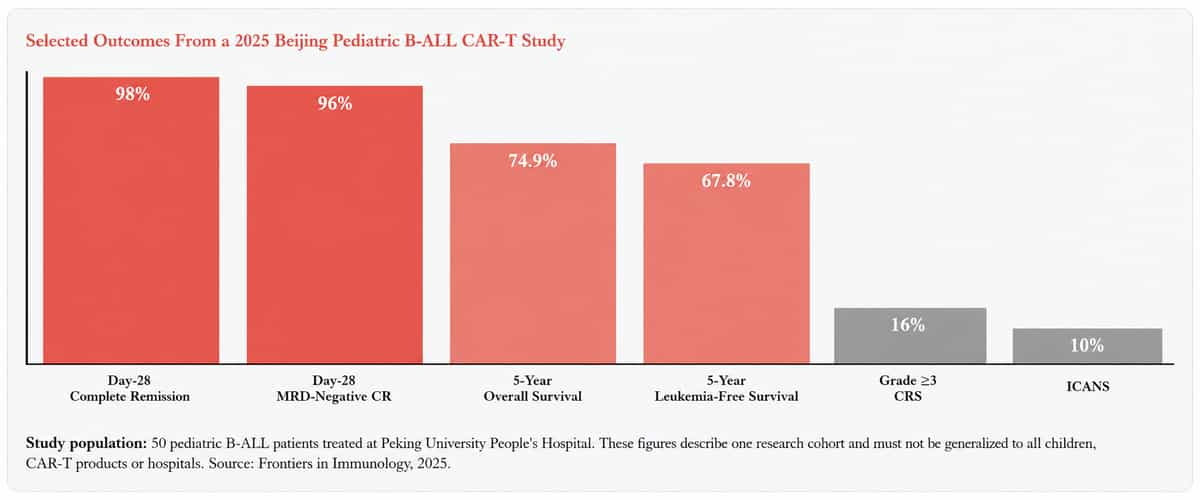
Recent Chinese research illustrates both the potential and limitations of CAR-T therapy in children with B-cell acute lymphoblastic leukemia. These figures should not be interpreted as predicted results at Beijing Jingdu, Bioocus or any other individual hospital.
A 2025 study from Peking University People's Hospital evaluated 50 pediatric B-ALL patients with measurable residual disease positivity or chemotherapy intolerance who received CD19 CAR-T therapy. Day-28 complete remission was 98%, while MRD-negative complete remission was 96%.
What Does 2026 Chinese Research Show About Dual-Target Pediatric CAR-T?
Dual-target CAR-T approaches are being studied because leukemia can escape treatment by losing or changing a single target antigen. Chinese researchers have investigated CD19/CD22 strategies in selected pediatric relapsed or refractory B-ALL populations.
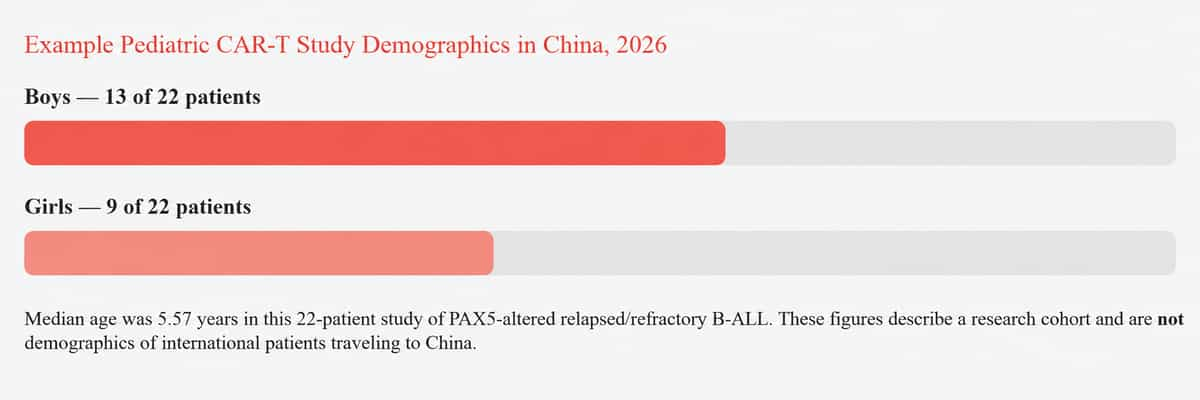
A 2026 study of 22 children with PAX5-altered relapsed or refractory B-ALL reported 100% complete remission and MRD negativity at 30 days in both treatment groups. Long-term event-free survival declined over time, illustrating why an early complete response should not be interpreted as guaranteed durable cure.
Overall and Event-Free Survival in a 2026 Chinese Pediatric Dual-Target CAR-T Study
Red: Overall survival Teal: Event-free survival
Study included 22 children with PAX5-altered relapsed/refractory B-ALL. Results are specific to this small research population and cannot predict an individual child's outcome. Source: Journal of Clinical Pediatrics, 2026.
What Are the Major Risks of CAR T-Cell Therapy in China?
CAR-T can produce powerful immune activation, which is why hospital capability matters as much as the cell product itself. Some complications can become life-threatening without rapid recognition and treatment.
| CAR-T Complication | What May Happen | Hospital Capability to Verify |
|---|---|---|
| Cytokine release syndrome | Fever, low blood pressure, breathing problems or organ dysfunction may develop. | Rapid toxicity grading, appropriate medications and ICU access. |
| ICANS | Confusion, language difficulty, reduced alertness, seizures or other neurological changes can occur. | Frequent neurological assessment and emergency management. |
| Prolonged cytopenias | White cells, red cells or platelets may remain low. | Blood bank, transfusion and infection support. |
| Serious infections | Immune suppression can increase bacterial, viral or fungal infection risk. | Microbiology testing and rapid antimicrobial management. |
| B-cell depletion | CD19 CAR-T can also affect normal B cells. | Long-term immune and immunoglobulin monitoring. |
| Relapse | Cancer may return despite an initial complete response. | MRD testing, marrow follow-up and salvage-treatment planning. |
How Much Does CAR T-Cell Therapy Cost in China?
An authoritative standardized total price for CAR-T therapy across Chinese hospitals is not available. The final amount depends on the CAR-T product, whether treatment is commercial or investigational, the patient's disease status, bridging treatment, hospitalization and complications.
Public product prices and private treatment packages can also change. A product's list price is not the same as the total episode-of-care cost, so international patients should request a written USD estimate for the complete treatment pathway.
| Cost Component | China | United States | Canada |
|---|---|---|---|
| Eligibility assessment | Patient-specific USD quotation required | Hospital and insurance dependent | Provincial referral and eligibility pathway |
| CAR-T product or cell preparation | Depends on exact product or research protocol | Product and insurance dependent | Public program and indication dependent |
| Leukapheresis | May be included or billed separately | Facility and insurance dependent | Program dependent |
| Lymphodepletion and infusion | Hospital-specific | Hospital-specific | Public treatment pathway |
| Hospitalization | Depends on length of stay and clinical status | Highly variable | Healthcare system dependent |
| ICU or severe complication care | May substantially increase the final bill | Coverage dependent | Public care pathway differs from private self-pay comparison |
How Should International Patients Verify a CAR-T Hospital and Doctor in China?
Provider verification should begin with Chinese regulatory credentials rather than international marketing labels. Ask the hospital for documentation that can be matched to the institution actually administering treatment.
Verify the CAR-T Hospital in China
- Exact legal Chinese hospital name
- Government healthcare institution license
- Hospital grade or classification where applicable
- Cellular therapy capability
- Blood bank and transfusion access
- ICU or critical-care availability
- Infection-management capability
- Clinical-trial authorization where relevant
- CAR-T product documentation
- Written complication-management pathway
Verify the CAR-T Hematologist in China
- Chinese physician registration
- Hematology or pediatric hematology specialization
- Experience with your precise malignancy
- Experience with the proposed CAR-T target
- CRS management experience
- ICANS management experience
- HSCT experience when relevant
- Responsibility for long-term follow-up
- Ability to communicate with your home oncologist
- Written explanation of treatment alternatives
JCI or another international accreditation can provide additional institutional information when current, but international accreditation is not a substitute for Chinese licensing, product authorization and disease-specific CAR-T expertise.
Who Travels to China for CAR T-Cell Therapy?
Reliable national data describing the country of origin, age and gender of international patients traveling to China specifically for CAR-T therapy are not publicly available. A geographic tourism chart would therefore require assumptions and is not included.
International inquiries generally involve patients seeking treatment after relapse, refractory disease, lack of access to a suitable product at home or interest in a clinical research program. However, these are clinical reasons for inquiry rather than verified national medical-tourism statistics.
What Should You Prepare Before Traveling to China for CAR T-Cell Therapy?
CAR-T eligibility should ideally be reviewed before you book international travel. The Chinese treatment team will usually need original diagnostic and treatment documentation to understand whether the therapy is medically appropriate.
Before Traveling to China
- Pathology and bone marrow reports
- Flow cytometry and antigen-expression results
- Cytogenetic and molecular findings
- Complete treatment history
- HSCT history if applicable
- Recent imaging
- Current blood counts and chemistry
- Infection screening
- Medication list
- Written CAR-T eligibility opinion
- Itemized treatment quotation
Before Returning Home
- Exact CAR-T product or construct name
- Cell infusion date
- Manufacturing information available to the patient
- CRS and neurological toxicity history
- Medication and transfusion records
- Post-treatment marrow results
- MRD results
- Infection history
- Discharge summary
- Emergency instructions
- Long-term monitoring schedule
Frequently Asked Questions About the Best Hospitals for CAR T-Cell Therapy
Which hospital is best for CAR T-cell therapy in China?
There is no authoritative national ranking identifying one hospital as best for every patient. The right center depends on your age, malignancy, CAR target, commercial product or trial access, disease burden and whether the hospital can manage severe CAR-T complications.
Does Beijing Bioocus International Medical Center provide CAR T-cell therapy?
Bioocus publicly focuses on CAR-T and other cellular therapies and works with hospital partners. International patients should request the exact licensed treating hospital because the legal healthcare institution responsible for collection, infusion and inpatient care should be identified before treatment.
Does Beijing Jingdu Children's Hospital offer pediatric CAR T-cell therapy?
The hospital publicly reports CAR-T capability within its pediatric hematology-oncology program. Parents should confirm which product or protocol is currently available, whether it is approved for the child's age and diagnosis, and what regulatory pathway applies.
Which childhood cancers can be treated with CAR-T therapy in China?
The strongest established pediatric indication is CD19-positive relapsed or refractory B-cell acute lymphoblastic leukemia. Other pediatric CAR-T approaches, including dual-target and solid-tumor programs, may remain investigational and require protocol-specific eligibility assessment.
Is CAR T-cell therapy in China approved or experimental?
Both situations exist. China has multiple NMPA-approved commercial CAR-T products, while numerous next-generation therapies remain in clinical research. Patients should ask whether the proposed treatment follows an approved product label or an authorized investigational protocol.
Can CAR-T therapy treat multiple myeloma in China?
Yes, NMPA-approved BCMA-directed CAR-T products are available for defined relapsed or refractory multiple myeloma populations. A 2026 Chinese expert consensus notes three BCMA-targeted CAR-T products approved for clinical use in multiple myeloma.
Can CAR-T therapy treat solid tumors in China?
China approved satricabtagene autoleucel in June 2026 for a specific CLDN18.2-positive advanced gastric or gastroesophageal junction cancer indication. That approval does not mean CAR-T is established for other solid tumors such as lung, breast, brain or pancreatic cancer.
What is the most serious risk after CAR-T infusion?
Cytokine release syndrome and immune effector cell-associated neurotoxicity syndrome are major acute concerns. Severe infection, prolonged blood-count suppression and other complications can also occur, which is why experienced inpatient and critical-care support is important.
Will a child need stem cell transplantation after CAR-T?
Not every child requires transplantation after CAR-T. The decision depends on leukemia biology, previous transplant history, CAR-T persistence, MRD response, relapse risk and the treating team's strategy. This should be discussed before treatment rather than assumed automatically.
How much does CAR T-cell therapy cost in Beijing?
There is no reliable standardized hospital-wide price. Costs vary by CAR-T product or trial, disease status, cell preparation, bridging therapy, hospitalization and complications. Request an itemized USD quotation directly from the institution responsible for treatment.
Can international patients enter CAR-T clinical trials in China?
Eligibility is protocol-specific. Some studies may not accept international participants, and publication of a clinical trial does not prove current enrollment. Ask for the current registry entry, recruiting status, investigator contact and written confirmation that overseas patients can be screened.
Should I get a second opinion before traveling to China for CAR-T?
A second hematology opinion is particularly useful because CAR-T is complex and disease-specific. Provide pathology, flow cytometry, molecular testing, prior treatment, transplant history and the proposed Chinese CAR-T protocol so the independent specialist can assess whether the plan is reasonable.
Compare CAR T-Cell Therapy Hospitals in China With PlacidWay
If you are comparing Beijing Bioocus, Beijing Jingdu Children's Hospital or other CAR-T programs in China, PlacidWay can help you request treatment information, compare proposed pathways, understand estimated costs and prepare questions about product authorization, hospital credentials and complication management.
Before traveling, have a qualified hematologist familiar with your diagnosis review the proposed CAR-T product or clinical protocol and confirm that the treating institution has the appropriate medical infrastructure.
Medical Disclaimer for CAR T-Cell Therapy
Disclaimer: This information is for educational purposes only and does not replace professional medical advice. Always consult a qualified healthcare provider before making medical decisions.
References for CAR T-Cell Therapy in China
- CAR T Cells: Engineering Patients' Immune Cells to Treat Cancer – National Cancer Institute
- Equecabtagene Autoleucel Approved With Conditions – National Medical Products Administration
- Ciltacabtagene Autoleucel Approved for Marketing – National Medical Products Administration
- Puzolcabtagene Autoleucel: Pediatric First Approval – Paediatric Drugs, 2026
- Chinese Expert Consensus on CAR-T Therapy for Multiple Myeloma – Chinese Medical Association, 2026
- CD19 CAR-T in Pediatric B-ALL With MRD Positivity or Chemotherapy Intolerance – Frontiers in Immunology, 2025
- China Approval of Satricabtagene Autoleucel for a Solid Tumor – Shanghai Pudong Government, 2026






















Share this listing