

If you are considering dental treatment in Thailand from China, the attraction is easy to understand: short-haul travel, a large private healthcare sector, international-patient experience and access to restorative, cosmetic and implant dentistry in cities such as Bangkok.
Cost needs closer examination, however. Published 2026 Thai private-hospital fees show substantial variation, and China's dental implant pricing reforms have reduced the cost of routine implants at participating facilities. Before choosing Thailand primarily for savings, verify the dentist through the Thai Dental Council, check the facility's licensing or accreditation status where applicable, request an itemized quote and establish how follow-up will work after you return to China.
Quick Summary for Chinese Patients Considering Dental Care in Thailand
- Chinese patient visibility: a 2025 Thai dental-language study reported that participating dentists encountered foreign patients monthly, with Chinese patients the most commonly encountered foreign group.
- Travel market: China remained Thailand's largest international visitor source market in 2026, although overall tourism statistics should not be interpreted as dental-tourism statistics.
- Single dental implant with crown: current Thai private-hospital examples reviewed for 2026 range roughly from $1,430 to $4,070, depending on implant system and provider.
- Other Bangkok price examples: porcelain veneers are roughly $490–$550 per tooth, all-ceramic crowns around $610–$700, and root canal treatment approximately $365–$610 in one current hospital fee schedule.
- Dentist verification: use the Thai Dental Council licence-search service rather than relying only on a clinic profile or social-media account.
- Facility verification: ask for the clinic's legal name and facility licence. If treatment is in a hospital, check relevant Thai Healthcare Accreditation Institute status where applicable.
- Important caution: Thailand is not automatically cheaper than China for every procedure. Compare complete, patient-specific quotes after including imaging, grafting, temporary restorations, flights, accommodation and possible return visits.
What Evidence Supports Thailand's Popularity Among Chinese Dental Patients?
Recent evidence supports increasing visibility and accessibility of Thailand for Chinese healthcare consumers, but there is no current national database proving a specific annual growth rate for Chinese dental tourists. This distinction matters when discussing medical tourism accurately.
A 2025 pilot study involving Thai dentists found that participating dentists encountered foreign patients monthly and identified Chinese patients as the most common foreign group. Separately, a 2025 study of 100 Chinese nationals living in Bangkok and nearby areas found substantial use of private healthcare services and identified communication and information provision as areas requiring attention.
Broader travel data strengthens the accessibility argument. China was Thailand's largest visitor source market during 2026. That creates a substantial travel corridor through which dental travel can occur, but ordinary tourist arrival numbers cannot be used as a proxy for the number of people receiving dentistry.
2026 Chinese Visitor Flow to Thailand
Source context: Tourism Authority of Thailand. These figures show cumulative Chinese visitor arrivals, not dental patients. They are included to demonstrate the size and accessibility of the China–Thailand travel corridor.
Why Chinese Patients Consider Thailand for Dental Treatment
Chinese patients may consider Thailand when they want to compare private dental options outside their home market, particularly for restorative, cosmetic or implant-related treatment. Bangkok's international travel infrastructure and large private healthcare sector make consultations and multi-specialty dental care relatively accessible.
The decision is not simply about finding a lower price. Patients also look at appointment availability, treatment materials, dental technology, communication, privacy, the ability to combine several procedures and whether the clinic is accustomed to coordinating treatment for people who will leave the country afterward.
Dental Treatment Costs in Thailand for Chinese Patients in 2026
Thailand does not have one national private dental price, so current fees should be treated as planning examples rather than guaranteed averages. Published 2026 Bangkok hospital schedules show that the procedure, implant brand, restorative material and complexity can change the bill substantially.
The ranges below are converted to US dollars using exchange rates available on August 27, 2026. They do not include every clinic in Thailand and should not replace a personalized written quote.
| Dental Treatment | 2026 Thailand Planning Example | Important Cost Detail |
|---|---|---|
| Porcelain veneer | About $490–$550 per tooth | Confirm whether temporary restorations, scans and additional tooth treatment are separate. |
| All-ceramic crown | About $610–$700 per tooth | Material, laboratory technique and need for a core or post affect cost. |
| Root canal treatment | About $365–$610 | Molar treatment generally costs more; the final crown may be additional. |
| Single implant with crown | About $1,430–$4,070 | Brand, abutment, crown type, CT scan, grafting and surgical guide can change the total. |
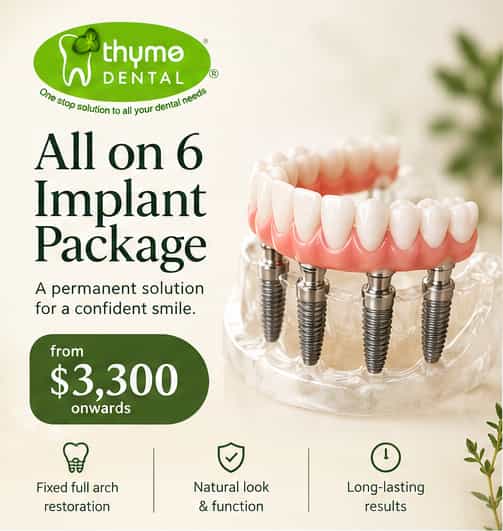
| All-on-4 full arch | About $7,600–$17,900 per arch in one current hospital schedule | Confirm whether the quotation includes temporary and final prostheses and what materials are used. |
| Professional whitening | About $425 in one current Bangkok hospital package | Whitening is cosmetic and does not treat decay, infection or gum disease. |
Is Dental Treatment in Thailand Cheaper Than China?
Not always. China's National Healthcare Security Administration reported that dental implant pricing reforms reduced the overall cost of a routine single implant at participating Chinese facilities to roughly $890–$1,040 when converted at current exchange rates. That historical national policy figure is useful context, not a guaranteed 2026 quote for every Chinese clinic.
This means the older assumption that Chinese patients automatically save 30–50% by getting implants in Thailand is no longer defensible as a general statement. Savings may still exist for certain private, cosmetic or complex treatment plans, but the only meaningful comparison is between two complete written plans for the same clinical problem.
Dental Treatments Chinese Patients May Consider in Thailand
Thailand offers the same broad categories of dentistry found in other developed dental markets, but not every procedure is equally suitable for a short medical trip. Treatments requiring months of adjustment or repeated emergency access deserve more careful planning than a single restorative visit.
| Treatment | What It Does | Travel Consideration |
|---|---|---|
| Dental implants | Replace missing teeth using an implant placed in the jawbone and a later restoration. | Frequently staged; healing and restoration may require separate visits. |
| Veneers | Change the visible surface of selected teeth for specific aesthetic indications. | Requires careful diagnosis, tooth-preparation decisions and bite assessment. |
| Crowns and bridges | Restore damaged teeth or replace missing teeth using fixed prostheses. | Laboratory work and bite adjustments may require additional appointments. |
| Root canal treatment | Treats infected or inflamed dental pulp inside a tooth. | Complex teeth may require more than one appointment and later restoration. |
| Full-arch implant rehabilitation | Uses several implants to support replacement teeth across an arch. | Requires substantial planning, postoperative monitoring and a clear final-prosthesis schedule. |
| Orthodontics | Moves teeth gradually using braces or aligners. | Long-term follow-up makes one-time overseas treatment less practical unless care is coordinated. |
How Chinese Patients Can Check Dental Clinics in Thailand
Start with legal and professional verification rather than social-media popularity. Ask the provider for its complete registered facility name, licence information, physical address and the names of every dentist who may perform your procedure.
Thailand's Healthcare Accreditation Institute maintains accreditation information for participating healthcare facilities. HA accreditation can provide additional information about organizational quality systems for applicable hospitals, but it is not a substitute for the treating dentist's professional licence, and not every legitimate dental clinic will hold hospital-level accreditation.
| Check | What to Request | Why It Matters |
|---|---|---|
| Facility identity | Legal clinic/hospital name, address and licence information | Helps establish who is legally responsible for providing treatment. |
| Dentist licence | Full Thai and English professional name | Allows independent Thai Dental Council verification. |
| Specialist involvement | Which dentist performs surgery, endodontics, prosthodontics or orthodontics | Complex cases may involve several clinicians. |
| Sterilization | Written infection-control procedures | Dental surgery requires appropriate instrument processing and infection control. |
| Emergency plan | Emergency number and hospital-transfer pathway | Important if bleeding, infection, allergic reaction or another urgent problem develops. |
| Written quote | Itemized treatment and exclusion list | Prevents comparison of incomplete and complete packages. |
How to Verify a Thai Dentist Before Travelling From China
Thailand's Dental Council provides a public dentist-search service specifically so patients can check whether a dentist holds a licence. Ask the clinic for the treating dentist's complete name before transferring a deposit.
A valid licence confirms professional authorization, but it does not tell you how much experience someone has with your exact procedure. For implants, extensive prosthetic rehabilitation or complex surgery, ask additional questions about training, current clinical work and responsibility for complications.
Verify Professionally
- Thai Dental Council licence status
- Full professional name
- Relevant specialist qualification where applicable
- Who personally performs each stage
Ask Clinically
- Experience with your proposed procedure
- Approximate annual case volume
- How complications are managed
- Who provides follow-up after you leave Thailand
Mandarin Communication and Dental Consent in Thailand
Communication deserves the same attention as price and credentials. Dental treatment often involves choices between materials, irreversible tooth preparation, surgical alternatives and different long-term maintenance requirements. You should understand those choices clearly before consenting.
A 2025 pilot study involving Thai dentists specifically investigated a Thai-English-Chinese dental terminology resource. Respondents reported regular contact with foreign patients, with Chinese patients the most commonly encountered foreign group. The study itself highlights why specialized terminology matters rather than assuming everyday translation is sufficient for clinical consent.
- A written treatment plan you can understand
- Mandarin interpretation if you need it for informed consent
- The exact implant, crown or restorative material being proposed
- Alternative treatment options
- Risks, limitations and expected maintenance
- A written aftercare plan for use by your dentist in China
Planning a Dental Trip From China to Thailand
Build your travel schedule around dentistry, not around the shortest possible holiday. The correct timeline depends on diagnosis, laboratory requirements, healing, whether surgery is involved and whether the treatment can safely be completed in one visit.
| Timeframe | Biological or Clinical Process | Patient Sensation | Activity Level | Action Required |
|---|---|---|---|---|
| Before travel | Diagnosis and preliminary planning | No procedure yet | Normal | Send recent imaging and medical information; obtain a provisional plan. |
| Arrival/consultation | Clinical examination and confirmation of diagnosis | Usually no postoperative symptoms | Normal | Do not assume the online estimate will remain unchanged after examination. |
| Procedure period | Restoration, endodontics or surgery depending on the case | Sensitivity, soreness or swelling may occur depending on treatment | Follow clinician-specific advice | Follow written postoperative and dietary instructions. |
| Before departure | Early review, bite check or prosthetic assessment | Should generally be improving after uncomplicated treatment | Case dependent | Obtain records, implant details, X-rays and emergency instructions. |
| Following months | Implant osseointegration or long-term restorative monitoring where relevant | Varies | Usually progressively normal in uncomplicated cases | Attend required reviews in Thailand or with a coordinated dentist in China. |
Dental Implant and Treatment Risks for Chinese Medical Tourists
Dental tourism does not change the biological risks of dentistry, but distance can complicate how those risks are managed. Implant treatment can involve infection, failure to integrate with bone, peri-implant inflammation, mechanical complications and problems involving nearby anatomical structures.
A 2025 systematic review and meta-analysis examining peri-implant diseases identified previous periodontitis and smoking among significant risk indicators, while diabetes was also associated with peri-implantitis. Your dentist should consider your medical history, gum health, smoking status, oral hygiene and available bone before recommending implants.
| Issue | Why It Matters Abroad | Question to Ask |
|---|---|---|
| Implant integration failure | May require removal, healing or replacement treatment. | What does the revision policy actually cover? |
| Peri-implant disease | Requires long-term professional monitoring. | Who will monitor the implant when I return to China? |
| Crown or bridge complication | Components may need adjustment, repair or replacement. | Can a dentist in China obtain compatible components? |
| Postoperative infection | May need prompt local assessment rather than waiting for an overseas reply. | What symptoms require urgent care? |
| Bite or aesthetic dissatisfaction | Corrections can require repeated physical appointments. | How many adjustment visits are realistically available? |
What Do We Know About Chinese Patient Demographics in Thailand?
Reliable national statistics separating Chinese dental tourists by age, gender, city of origin and dental procedure are currently not available. Claims such as "most Chinese dental tourists are women aged 30–50" should therefore not be stated as fact without a supporting dataset.
A useful but limited 2025 study examined 100 Chinese nationals in Bangkok and surrounding areas. It was a healthcare-utilization study rather than a national survey of dental tourists, so its findings should be used as context rather than market-share estimates.
Should You Travel From China to Thailand for Dental Care?
Thailand may be worth considering when the clinical plan, provider credentials, communication and total cost make sense together. It may be less practical when the treatment requires frequent adjustment, the saving disappears after travel expenses or you cannot establish dependable follow-up in China.
Thailand May Be Worth Comparing When
- You have a confirmed diagnosis rather than only a cosmetic request.
- The treating dentist's licence is independently verifiable.
- You receive a detailed written quote and treatment sequence.
- Language support is sufficient for informed consent.
- The provider explains complication and revision responsibilities.
- You can return for required stages or arrange coordinated care in China.
Staying in China May Be More Practical When
- A comparable local treatment plan costs the same or less.
- You need frequent adjustments or ongoing orthodontic care.
- Your health condition requires close multidisciplinary monitoring.
- You cannot remain in Thailand for an adequate postoperative review.
- The overseas quote is vague about final restorations or additional fees.
- You cannot identify a dentist willing to manage follow-up after returning home.
Frequently Asked Questions About Thailand Dental Tourism for Chinese Patients
Why are Chinese patients considering Thailand for dental treatment?
Thailand has a large China–Thailand travel corridor, an established private healthcare sector and dental providers that treat international patients. Recent Thai research also shows regular interaction between dentists and Chinese patients. Individual reasons vary and may include treatment choice, scheduling, privacy or cost comparison.
Is dental treatment in Thailand cheaper than China?
Not necessarily. China's implant price reforms have substantially reduced routine implant costs at participating facilities. Thailand may still be financially attractive for some private, cosmetic or complex treatment plans, but patients should compare complete written quotes rather than assume a fixed percentage saving.
How much does a dental implant cost in Thailand in 2026?
Current Thai private-hospital examples reviewed for 2026 range from roughly $1,430 to $4,070 for a single implant with a crown. Prices vary according to implant system, restorative material, imaging, grafting, surgical guides and other clinical requirements.
How can a Chinese patient verify a dentist in Thailand?
Ask for the dentist's complete professional name and search the Thai Dental Council's public licence database. For complex care, also ask about relevant specialist training, experience with your procedure, responsibility for each treatment stage and the dentist's complication-management process.
Do dental clinics in Thailand have Mandarin-speaking staff?
Some international-patient providers offer Mandarin coordinators or interpretation, but availability varies. Confirm language support before travelling. For surgery or irreversible treatment, make sure the interpretation is sufficient for you to understand risks, alternatives, costs and aftercare before giving consent.
Is Thailand safe for dental implants?
Safety depends on your health, diagnosis, dentist, facility, treatment plan and aftercare rather than destination alone. Verify professional licensing, infection-control arrangements, diagnostic imaging, implant documentation and the provider's emergency and complication-management procedures before proceeding.
How long should I stay in Thailand after dental treatment?
The appropriate stay depends on the procedure and your clinical response. Simple restorative work differs greatly from implant or full-arch surgery. Ask the treating dentist how many in-person reviews are required and when it is clinically reasonable to travel.
Can dental implants in Thailand be completed in one trip?
Some selected patients may receive temporary teeth during an early treatment stage, but conventional implant therapy commonly involves biological healing before the final restoration. Do not assume that a one-trip protocol is appropriate until the dentist has assessed bone, gum health and implant stability.
What should be included in a Thai dental treatment quote?
The quote should identify consultation, imaging, surgery, laboratory work, implant components, crowns or bridges, temporary restorations, grafting if expected, follow-up and exclusions. Also ask what happens financially if the treatment plan changes after your clinical examination.
What happens if a dental implant fails after I return to China?
The response depends on why the implant failed and the provider's written revision terms. Before treatment, clarify who pays for diagnostic care, implant removal, replacement components, grafting and travel, and identify a dentist in China who can provide appropriate local assessment.
Should I choose a Thai dental clinic because it has JCI accreditation?
International accreditation can be an additional organizational quality indicator for applicable facilities, but it is not mandatory for every legitimate dental clinic and does not guarantee a specific outcome. Thai facility requirements and the treating dentist's professional credentials remain fundamental checks.
What records should I bring back to China after dental treatment in Thailand?
Request your treatment summary, relevant X-rays or scans, implant manufacturer and component information, restorative material details, invoices and written aftercare instructions. These records can make it easier for a dentist in China to understand and maintain your treatment.
Compare Dental Treatment Options in Thailand
PlacidWay can help you compare provider information, review estimated treatment costs and prepare questions for dental clinics in Thailand. Your final treatment decision should be based on an individual assessment by a qualified dental professional.
Submit Your Request | Get Healthcare Providers Specific to Your NeedsDisclaimer
Disclaimer: This information is for educational purposes only and does not replace professional medical or dental advice. Costs are planning examples and can vary according to diagnosis, clinic, dentist, procedure complexity, materials, exchange rates and package inclusions. Always consult a qualified healthcare provider before making medical decisions.
References
- Thailand 2026 Tourism Outlook and Chinese Arrivals – Tourism Authority of Thailand
- China Market and 2026 Visitor Arrivals – Tourism Authority of Thailand
- Dentist Licence Search – Thai Dental Council
- Healthcare Facility Accreditation Certificate Status – Healthcare Accreditation Institute Thailand
- The Utilization of Health Services and Medical Tourism by Chinese in Thailand – MCU Buddhist Review Journal, 2025
- Utilization and Satisfaction With Three Languages of Dental Terminology E-book – Oral Sciences Reports, Chiang Mai University, 2025
- Prevalence, Incidence and Risk Indicators for Peri-Implant Diseases – AO/AAP Systematic Review and Meta-Analysis, 2025
- Dental Implant Price Governance and Procurement Information – National Healthcare Security Administration of China
.jpg)


-2-(7).png)

.png)
.png)
.png)
.png)



.png)

.png)
.png)








Share this listing