
For Greek patients facing prostate cancer, the search for additional treatment options can lead far beyond home. Mexico has become a destination of interest for patients exploring immunotherapy, but understanding what is approved, what remains investigational, and how to evaluate providers is essential.
1. What “finding new strength” should mean
For a Greek man living with advanced prostate cancer, prostate cancer immunotherapy in Mexico may appear to offer access, personalization, or a different treatment philosophy. “New strength,” however, should describe the patient’s ability to ask better questions and make a controlled decision—not a promised response, cure, or extension of life. The safest starting point is a joint review by the treating oncologist in Greece and the proposed Mexican team.
Prostate cancer behaves very differently across patients. Localized low-risk disease may be monitored with active surveillance, while higher-risk localized disease may require surgery or radiation with hormone therapy. Metastatic disease usually needs systemic treatment. When cancer grows despite testosterone suppression, it is called metastatic castration-resistant prostate cancer, or mCRPC. That is the setting in which specific immune approaches may enter the conversation, alongside—not automatically ahead of—standard options.
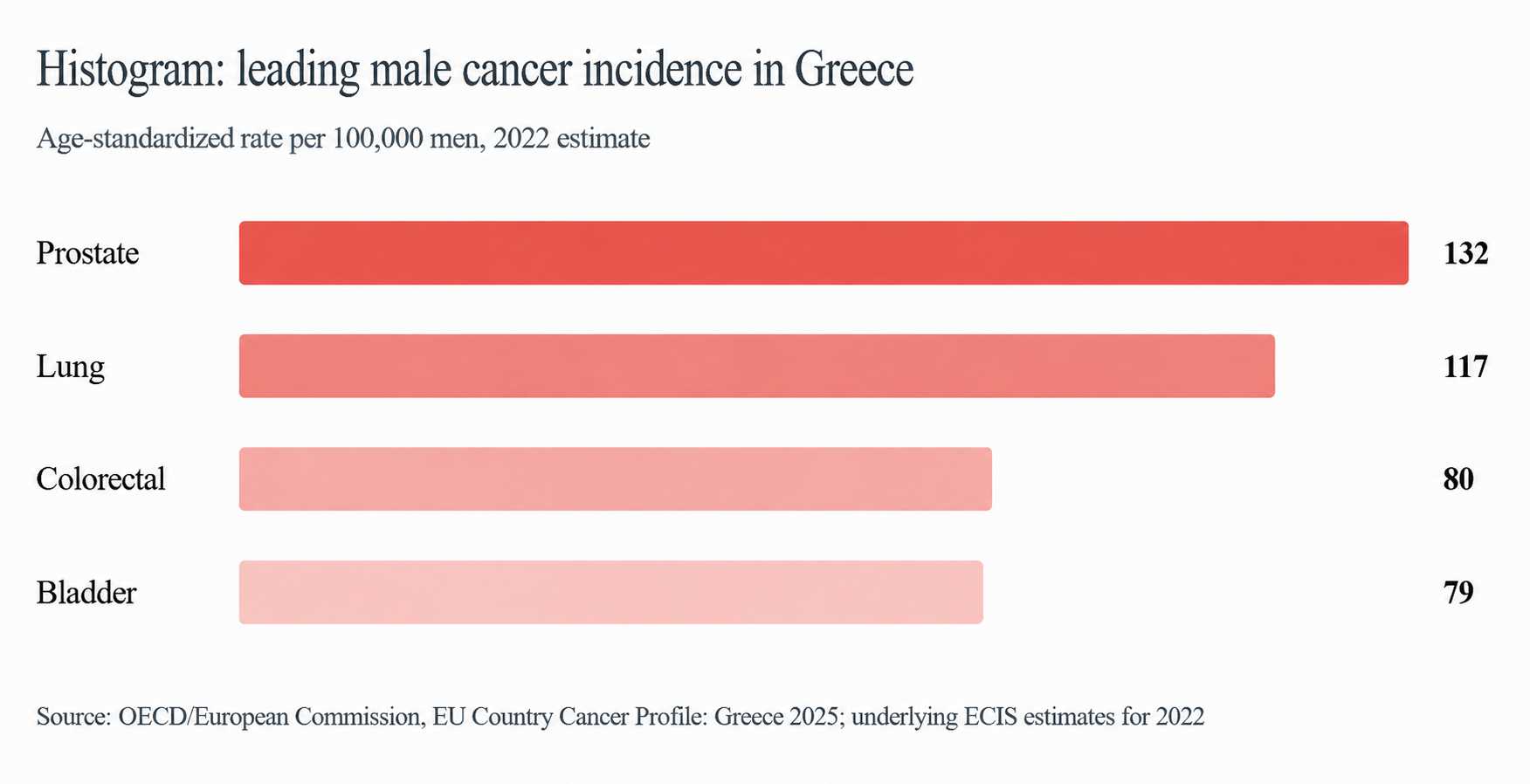
No reliable public registry reports how many Greek patients travel to Mexico for prostate immunotherapy, their ages, or their outcomes. Claims about a “growing wave” of Greek travelers should therefore be treated as marketing narrative unless supported by verifiable data. What is known is that prostate cancer is a major Greek health issue: the 2025 Greece Country Cancer Profile estimated a prostate cancer incidence rate of 132 per 100,000 men in 2022, representing 20% of male cancer incidence.
2. The real role of immunotherapy in prostate cancer
Immunotherapy helps the immune system recognize or attack cancer, but prostate tumors are often immunologically “cold”: they may have relatively few immune-visible mutations and an environment that suppresses immune activity. As a result, the dramatic checkpoint-inhibitor responses seen in some melanoma or lung cancers are not typical for unselected prostate cancer.
Sipuleucel-T: an established but narrow indication
Sipuleucel-T is an autologous cellular immunotherapy. A patient’s immune cells are collected by leukapheresis, processed with a prostate-associated antigen and immune-stimulating protein, and reinfused. The U.S. Food and Drug Administration indication is asymptomatic or minimally symptomatic mCRPC. Its pivotal studies showed an overall-survival benefit but did not demonstrate a significant delay in disease progression. It is not a preventive vaccine, a general treatment for localized disease, or proof that any dendritic-cell product is equivalent.
European context matters. The European Commission withdrew Provenge’s EU marketing authorization in 2015 at the authorization holder’s request after commercial availability was discontinued. That historical withdrawal does not mean all immune treatment is ineffective; it does mean Greek patients should not assume that a Mexican cell preparation is the same product, manufactured to the same specification, or supported by the same trial evidence.
Checkpoint inhibitors: biomarker-led, not routine
Pembrolizumab may be considered under tumor-agnostic indications for certain unresectable or metastatic solid tumors with deficient mismatch repair or high microsatellite instability after prior treatment when satisfactory alternatives are absent. A separate U.S. indication covers tumor mutational burden-high solid tumors under defined conditions. These biomarkers occur in only a minority of prostate cancers. PD-L1 staining alone should not be presented as universal proof of benefit in prostate cancer.
Before discussing checkpoint therapy, request pathology review and validated molecular testing for MSI/MMR and, where appropriate, tumor mutational burden. Germline and somatic testing for BRCA1, BRCA2, and other homologous-recombination repair genes may instead identify eligibility for PARP-targeted treatment. PSMA imaging can guide selected radioligand pathways. These are different biological questions and should not be blended into a vague “personalized immunotherapy” label.
3. What Mexican programs may offer—and how to classify it
Mexican oncology and integrative centers may describe dendritic-cell vaccines, natural killer cell infusions, cytokines, peptide vaccines, checkpoint inhibitors, or multi-week combinations. Some programs are delivered as regulated clinical research; others are private clinical services. The label “immunotherapy” does not reveal whether the intervention is an approved medicine, an individually prepared biological product, an authorized research protocol, or an unproven supportive treatment.
| Approach | Evidence position in prostate cancer | Essential verification |
|---|---|---|
| Sipuleucel-T | FDA-approved for selected asymptomatic or minimally symptomatic mCRPC; EU authorization withdrawn in 2015. | Exact brand, lawful Mexican access, chain of identity, manufacturing site, release testing, and emergency plan. |
| Pembrolizumab or another checkpoint inhibitor | Not routine for unselected prostate cancer; may fit uncommon biomarker-defined situations. | Exact indication, validated biomarker report, drug registration, pharmacy source, and immune-toxicity capacity. |
| Custom dendritic-cell vaccine | Product-specific; cannot borrow sipuleucel-T evidence. Often investigational. | Protocol authorization, ethics approval, cell-processing controls, sterility, potency, and published results for the exact product. |
| NK cells, cytokines, peptides, exosomes, or combinations | Experimental or insufficiently established for routine prostate cancer care unless used in a valid trial. | Trial registration, scientific rationale, independent evidence, interaction review, stopping rules, and no outcome guarantee. |
A program may also include nutrition, exercise, counseling, symptom management, or rehabilitation. These can support well-being when clinically appropriate, but should not be described as tumor-eradicating immune treatments. Ask the center to separate supportive services from anticancer interventions in both the treatment plan and invoice.
4. Who may be a candidate—and who needs caution
Candidate selection begins with the disease state, not the destination. The Mexican oncologist should review the original biopsy, Gleason Grade Group, current stage, sites of metastasis, PSA trend, testosterone level, prior surgery or radiation, hormone treatments, chemotherapy, targeted therapy, radioligand therapy, symptoms, performance status, and treatment goals. A rising PSA alone is not enough to choose an immune protocol.
Potential candidates for an evidence-based immune option may include a narrowly defined mCRPC population matching the exact product indication or an advanced solid tumor with a qualifying biomarker and no satisfactory alternative. The decision must still account for availability, product authorization in Mexico, previous treatments, disease tempo, symptoms, organ function, and patient preferences. A biomarker can support eligibility; it does not guarantee response.
Checkpoint inhibitors need particular caution in people with active autoimmune disease, prior organ transplant, severe lung disease, uncontrolled infection, or a history of serious immune-related toxicity. Cell collection may be difficult in patients with poor venous access, severe anemia, unstable cardiac disease, or limited functional reserve. Travel itself may be unsafe with uncontrolled pain, spinal cord compression risk, new neurological symptoms, severe shortness of breath, active bleeding, fever, or rapidly failing organs.
5. Greece’s prostate cancer context in two data views
The OECD and European Commission’s 2025 profile estimated 63,176 new cancer diagnoses in Greece in 2022. Among men, the overall age-standardized cancer incidence rate was 650 per 100,000, with prostate cancer the leading type at 132 per 100,000. The profile also notes that Greece lacks a population-based national cancer registry, which limits detailed outcome and demographic analysis. These figures describe national cancer burden—not the number of medical tourists or their likely response to treatment.
6. Mexico, Greece/EU, and U.S. access and cost comparison
Cost comparisons can mislead when one figure represents a multi-week package and another represents a medicine, hospital claim, or insured episode. Current PlacidWay content for this topic lists comprehensive Mexican immunotherapy packages at approximately USD 18,000–30,000. That is a planning range, not a quote or a quality indicator. The exact therapy, number of collections and infusions, laboratory work, medicines, accommodation, and complication coverage determine the final total.
| Destination | Useful cost benchmark | Access and coverage reality | Main hidden costs |
|---|---|---|---|
| Mexico | USD 18,000–30,000 platform-listed range for some comprehensive programs; individualized quote required. | Broader private offerings may include investigational cell-based protocols. Exact COFEPRIS status must be verified. | Athens–Mexico flights, companion, lodging, local transport, repeat trips, translation, emergency admission, and Greek follow-up. |
| Greece / EU | No valid like-for-like public self-pay package benchmark for a custom Mexican protocol. | Evidence-based medicines may be accessible under approved indications and national reimbursement rules. Sipuleucel-T has no current EU authorization. | Private molecular testing, travel within Europe, waiting time, and non-covered services. |
| United States | No fair single benchmark: drug acquisition, leukapheresis, infusion, hospital, insurer contracts, and patient cost-sharing differ. | FDA-labeled sipuleucel-T and biomarker-defined checkpoint pathways exist, subject to clinical and insurance criteria. | Facility charges, diagnostics, travel, network status, deductibles, and toxicity management. |
Ask for an itemized quote in both U.S. dollars and Mexican pesos, the refund policy, and the financial consequence if collection fails, treatment is delayed, or the oncologist stops therapy. Confirm whether the quote includes pathology review, molecular tests, apheresis, cryopreservation, medications, physician fees, hospital care, taxes, accommodation, airport transfer, interpretation, and post-treatment calls.
Greek EOPYY rules are unusually important here. Its 2025 guidance states that prior authorization for planned care in a non-EU country may be granted only under defined conditions and not for an experimental or research method. Where treatment is available in an EU country but the patient chooses a non-EU destination, the page states that the Greek statutory service covers only 20% of actual healthcare costs. Obtain a written, case-specific determination before paying a deposit; do not infer coverage from a clinic’s assurance.
7. Safety, side effects, and evidence standards
Risk depends on the exact intervention. Sipuleucel-T commonly causes short-lived chills, fever, fatigue, nausea, headache, and muscle or joint symptoms; infusion reactions and collection-related problems can occur. A custom cell product adds product-specific risks such as contamination, identity error, inconsistent potency, clotting, allergic reaction, infection, and uncertain biological activity. “Autologous” means the cells came from the patient; it does not mean the process is risk-free.
Checkpoint inhibitors can cause rash, diarrhea, and fatigue, but their defining risks are immune-related adverse events. Inflammation may affect the bowel, lungs, liver, thyroid, pituitary, pancreas, kidneys, skin, nerves, joints, or heart. Some reactions are severe or life-threatening and can start after a patient returns to Greece. Every traveler needs written instructions identifying symptoms, a 24-hour clinical contact, the exact drug and administration dates, baseline laboratory results, and an agreed emergency pathway in Greece.
Evidence should match the exact product and patient population. A clinic should provide peer-reviewed studies, trial registration, primary endpoints, denominators, adverse-event reporting, follow-up length, and whether results were independently reviewed. PSA decline, radiographic response, progression-free survival, overall survival, and quality of life are different outcomes. Testimonials and before-and-after scans cannot establish a response rate without complete cohort data and standardized assessment.
8. How to verify a clinic, oncologist, and cell protocol in Mexico
COFEPRIS is Mexico’s federal health-risk regulator. A clinic’s general operating permission does not, by itself, establish that each biological product or prostate protocol is authorized. For an intervention described as research, request the COFEPRIS protocol authorization, public trial registration, ethics committee approval, research committee approval, and biosafety review where applicable. Verify document numbers directly rather than accepting a logo on a brochure.
- Verify the physician. Search the Secretaría de Educación Pública’s National Registry of Professionals for the general and specialist cédula. Then check current oncology certification through CONACEM or the Mexican Board of Oncology. Match the legal name on every record.
- Verify the facility. Request its legal entity name, physical address, responsible health officer, applicable sanitary license or operating notice, emergency transfer agreement, laboratory accreditation, and hospital privileges.
- Verify the product. Ask for generic and brand names, manufacturer, country of manufacture, Mexican registration or research status, batch-release criteria, sterility and endotoxin testing, chain of identity, storage conditions, and traceability.
- Verify the evidence. Ask which published study used this exact formulation, dose schedule, stage, and combination. Request complete outcomes—not a selected case—and all serious adverse events.
- Verify accountability. Read consent forms, complaint process, privacy rules, refunds, liability, aftercare, data access, and the name of the hospital that will manage a severe reaction.
International accreditation can add information about organizational processes, but it is optional and does not replace government authorization, oncology credentials, or product-level evidence. A clean website, English-speaking coordinator, hotel transfer, or “European-trained” claim is not a clinical credential.
9. Treatment journey, monitoring, and return to Greece
A responsible pathway begins before travel with multidisciplinary review. Greek records should include pathology, operative and radiation summaries, serial PSA and testosterone results, imaging files in DICOM format, molecular reports, full medication and allergy lists, cardiovascular and autoimmune history, recent blood counts and organ-function tests, and the treating oncologist’s contact details. Use professional English or Spanish translation for critical reports when requested.
| Phase | Typical tasks | Safety checkpoint |
|---|---|---|
| 2–6 weeks before | Remote case review, second opinion, biomarker confirmation, credential and regulatory checks, itemized quote, insurance decision. | Greek oncologist confirms travel fitness and that standard treatment will not be dangerously delayed. |
| Arrival and baseline | Examination, medication reconciliation, laboratory review, imaging/pathology confirmation, final consent. | Patient may decline or pause if the final plan differs from the written proposal. |
| Collection/treatment | Apheresis if required, product preparation, infusion, observation, symptom and laboratory monitoring. | Document lot, dose, dates, concomitant medicines, reaction management, and discharge criteria. |
| First 72 hours | Monitor temperature, hydration, pain, breathing, bowel symptoms, rash, and neurological changes. | Remain within safe access to the treating facility; know the emergency hospital and contact route. |
| Before flying home | Clinical clearance, discharge summary, product record, laboratory results, prescriptions, fit-to-fly advice. | Confirm thrombosis precautions and airline support based on individual risk—not a generic timetable. |
| Back in Greece | Oncology review, toxicity checks, PSA/testosterone trend, imaging at clinically appropriate intervals. | Do not judge effectiveness from one early PSA value; use the predefined assessment plan. |
Recovery is not one-size-fits-all. Flu-like symptoms may settle quickly after some cellular products, while checkpoint toxicity can emerge weeks or months later. The return date should reflect treatment type, reaction history, disease stability, flight duration, clot risk, mobility, and access to emergency care—not a package calendar.
10. Practical travel planning from Greece to Mexico
Greek patients face long flights, time-zone change, and often at least one connection. Choose a Mexican city based on the clinical team and emergency infrastructure, not tourism appeal. Confirm current entry requirements with official Mexican consular sources, and never rely on a clinic to interpret immigration rules. A companion is strongly advisable for people with limited mobility, fatigue, opioid use, cognitive changes, or a higher complication risk.
Build a total-trip budget with flexible flights, accessible accommodation, ground transport, food, translation, data roaming, companion costs, extended stay, repeat visits, and an emergency reserve. Standard travel insurance commonly excludes planned cancer treatment and related complications. Obtain written confirmation of coverage, exclusions, repatriation, and pre-existing-condition rules. Carry essential medicines in hand luggage in original labeled packaging with a doctor’s letter.
Protect continuity by agreeing who owns each decision: the Mexican oncologist manages the intervention, the Greek oncologist manages the broader cancer plan, and a named clinician responds after return. Use a secure transfer method for DICOM imaging and medical records. Request discharge documentation in English and retain Spanish originals, invoices, payment receipts, consent forms, prescriptions, product identifiers, and laboratory results.
PlacidWay can help patients review cancer treatment centers in Mexico, compare prostate immunotherapy options and cost questions, and organize an initial information request. Directory presence is a starting point; patients and their physicians must independently confirm suitability, credentials, authorization, and evidence.
11. A 15-question decision checklist
- What is my exact stage, hormone-sensitivity status, symptom burden, and treatment objective?
- Which standard-of-care options remain available in Greece or the EU?
- What is the exact generic, brand, or laboratory name of every proposed anticancer product?
- Is each item approved care, off-label care, or research in Mexico?
- What COFEPRIS authorization or registration applies to this product and protocol?
- Which biomarker makes me a candidate, and was it measured by a validated laboratory?
- What evidence supports this exact protocol for patients like me?
- What outcome is realistic: symptom control, response, delayed progression, survival, or research knowledge?
- What are the common, serious, delayed, and unknown risks?
- Who treats an infusion reaction or immune toxicity at night?
- Are the oncologist’s cédula and specialty certification current?
- What is included, excluded, refundable, and payable if treatment stops?
- Will EOPYY authorize any costs in writing before travel?
- Will my Greek oncologist receive a complete treatment and product record?
- What is the alternative plan if the cancer progresses or toxicity occurs?
12. Frequently asked questions
Is immunotherapy a cure for prostate cancer?
No. No immune treatment should be presented as a guaranteed cure. Specific immunotherapies may help selected patients, but benefit varies and many prostate cancers do not respond.
Is immunotherapy standard treatment for every advanced case?
No. Standard management may include hormone therapy, androgen-receptor pathway inhibitors, chemotherapy, PARP inhibitors for selected mutations, PSMA-targeted radioligand therapy for selected patients, radiation, and supportive care. Immunotherapy has narrow roles.
Is a Mexican dendritic-cell vaccine the same as sipuleucel-T?
Not necessarily. Cell source, antigens, manufacturing, release testing, dose, schedule, and evidence may differ. Ask for the exact product specification and never transfer evidence from one preparation to another.
Why might pembrolizumab be considered?
It may fit certain advanced tumors with qualifying MSI-H/dMMR or TMB-high biomarkers under defined regulatory indications. These features are uncommon in prostate cancer, and eligibility does not guarantee benefit.
How much does prostate cancer immunotherapy in Mexico cost?
Current PlacidWay content lists some comprehensive packages at about USD 18,000–30,000. The exact product, cycles, laboratory processing, hospital services, accommodation, and follow-up can change the total substantially.
Will EOPYY reimburse treatment in Mexico?
Only a case-specific written decision can answer that. EOPYY’s 2025 guidance requires prior authorization for planned non-EU care under stated conditions and excludes experimental or research methods from that pathway.
How can I check a Mexican oncologist?
Match the physician’s full legal name in the SEP National Registry of Professionals, then confirm current specialty certification through CONACEM or the Mexican Board of Oncology. Verify hospital privileges directly.
Does COFEPRIS oversight mean every clinic protocol is approved?
No. A facility permission is not proof that every product or use is authorized. Ask for documentation tied to the exact biological product and, for research, the specific protocol and ethics approvals.
How long should I stay in Mexico?
It depends on the intervention, collection and infusion schedule, reaction risk, disease stability, and flight fitness. The treating teams should provide individualized discharge and travel clearance.
Can I stop hormone therapy before cell treatment?
Do not stop androgen-deprivation therapy or any prescribed cancer medicine unless the responsible oncology team documents why and coordinates the change. Abruptly interrupting effective treatment can create avoidable risk.
How will we know whether treatment worked?
Agree in advance on clinically appropriate PSA and testosterone testing, imaging, symptom review, and standardized response criteria. A single PSA reading, anecdote, or nonspecific immune marker is not enough.
What records should I bring back to Greece?
Bring the discharge summary, diagnoses, product and batch details, treatment dates, doses, collection and infusion notes, laboratory and imaging results, adverse events, prescriptions, emergency instructions, invoices, and follow-up schedule.
Compare options without committing to treatment
Share your diagnosis, prior treatment, and questions to request information from Mexican providers. Keep your Greek oncologist involved before any deposit or travel decision.
Request information from PlacidWayMedical disclaimer
Disclaimer: This information is for educational purposes only and does not replace professional medical advice. Always consult a qualified healthcare provider before making medical decisions.
Authoritative references
- National Cancer Institute. Prostate Cancer Treatment (PDQ®)—Patient Version.
- U.S. Food and Drug Administration. PROVENGE (sipuleucel-T): indication and product information.
- European Medicines Agency. Provenge: withdrawn EU marketing authorization.
- National Cancer Institute. Immune Checkpoint Inhibitors
- U.S. Food and Drug Administration. MSI-H/dMMR tumor-agnostic pembrolizumab approval and TMB-high solid-tumor indication.
- COFEPRIS. Clinical trials and research protocols in humans.
- Mexico professional verification: SEP National Registry of Professionals and CONACEM specialist certification search.
- OECD and European Commission. EU Country Cancer Profile: Greece 2025.
- Hellenic National Contact Point for Cross-border Healthcare, EOPYY. Planned healthcare outside the EU.







.png)


.png)















Share this listing