

If you are undergoing cancer treatment in Houston or Dallas but are looking at supportive cancer therapy in Mexico, the first question is not whether one country offers a longer list of therapies. It is whether the proposed care can safely help with pain, fatigue, nausea, nutrition, mobility, emotional stress, treatment side effects, or quality of life without interfering with your oncology plan. Costs vary widely, so request an itemized quote rather than relying on a package price. You should also verify the facility's applicable COFEPRIS status and confirm that oncology specialists hold appropriate Mexican professional and specialty credentials.
Quick Summary: Supportive Cancer Therapy in Mexico
- What supportive care means: Services intended to control symptoms, treatment side effects, functional problems, emotional distress, and other burdens associated with cancer.
- Who may consider it: Patients receiving chemotherapy, immunotherapy, radiation, surgery, hormonal treatment, targeted therapy, or long-term cancer follow-up who need additional symptom or quality-of-life support.
- Cost: No authoritative standardized USD price exists for a complete supportive cancer program in Mexico. Costs depend on which services you need, how long you stay, laboratory or imaging requirements, medications, and whether hospital care is involved.
- Doctor credentials: Verify the physician's Mexican professional license and relevant specialty certification. Oncology specialists can be checked through CONACEM and the corresponding specialty council.
- Facility verification: Ask which COFEPRIS license, operating notice, or other authorization applies to the specific services being provided.
- Travel caution: Active cancer treatment can affect immune function, blood counts, hydration, energy, and infection risk. Obtain travel guidance from the oncology team that knows your condition.
- Most important distinction: Supportive or integrative care should not automatically be treated as a substitute for evidence-based cancer-directed treatment.
What Supportive Cancer Therapy in Mexico Actually Means
Supportive cancer therapy focuses on helping you function and feel as well as possible while living with cancer or undergoing treatment. The term can include palliative care, symptom management, nutritional support, rehabilitation, psychological care, pain management, and selected complementary therapies.
Palliative care does not mean that treatment has stopped or that a patient is necessarily approaching the end of life. It can be introduced at different stages of cancer and can accompany treatment intended to control or cure the disease.
| Supportive need | Possible service | What it is intended to address |
|---|---|---|
| Pain | Palliative medicine, medication review, rehabilitation, or selected procedures | Cancer-related or treatment-related discomfort and functional limitation |
| Nausea or appetite problems | Medical symptom management and oncology nutrition | Treatment toxicity, poor intake, dehydration risk, and weight changes |
| Fatigue or weakness | Medical evaluation, nutrition, physical therapy, and rehabilitation | Reduced endurance and daily activity |
| Anxiety or distress | Psychology, counseling, psycho-oncology, or social support | Emotional burden associated with diagnosis and treatment |
| Loss of mobility | Cancer rehabilitation and physical therapy | Deconditioning, surgery recovery, neuropathy, or prolonged inactivity |
| Treatment side effects | Oncology assessment and symptom-specific management | Problems related to chemotherapy, immunotherapy, radiation, surgery, or other treatments |
Why Houston and Dallas Patients May Consider Cancer Support in Mexico
A cancer diagnosis can turn your schedule into repeated cycles of appointments, scans, treatments, laboratory tests, and recovery days. Some Houston and Dallas patients therefore investigate care in Mexico when they want another supportive-care opinion, a private-pay program, additional rehabilitation, integrative services, or an environment where multiple supportive services can be coordinated during one trip.
Texas also shares a long border and transportation links with Mexico. That can make Mexico geographically practical compared with distant international destinations. However, convenience should never outweigh continuity with your treating oncologist or access to emergency care.
- Seeking additional symptom-management support during or after cancer treatment.
- Looking for rehabilitation after surgery, prolonged hospitalization, chemotherapy, or radiation.
- Wanting nutritional, psychological, or palliative services incorporated into a broader care plan.
- Comparing private-pay care when particular supportive services are difficult to coordinate locally.
- Investigating complementary approaches while continuing standard oncology care.
- Seeking a second professional opinion about persistent symptoms or quality-of-life concerns.
Texas Cancer Demographics and 2025-2026 Patient Context
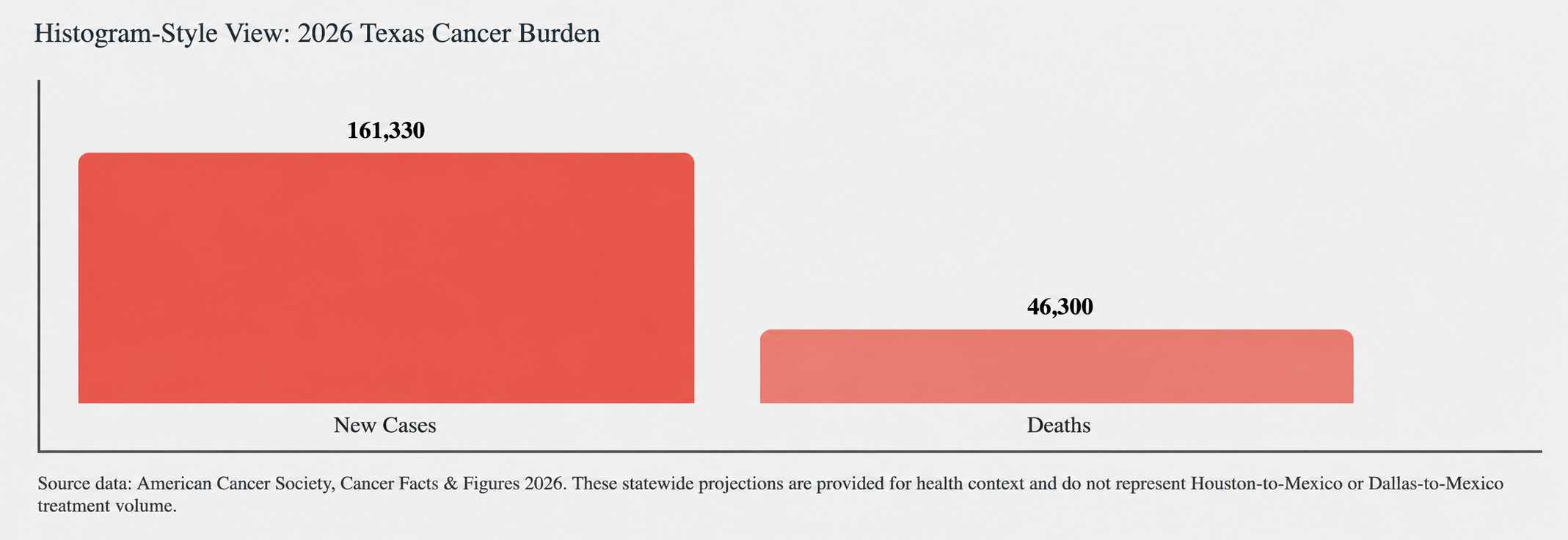
The cancer burden in Texas helps explain why supportive care remains relevant to patients throughout the state, including major metropolitan areas such as Houston and Dallas. American Cancer Society projections estimated 150,870 new cancer cases in Texas in 2025 and 161,330 in 2026.
ACS also projected approximately 46,300 cancer deaths in Texas during 2026. These figures describe statewide disease burden. They do not indicate how many patients use supportive therapy or travel to Mexico.
Line Graph: Projected New Cancer Cases in Texas
Source data: American Cancer Society, Cancer Facts & Figures 2025 and 2026. Estimates are model-based projections. Two annual projections should not be interpreted as proof of a measured one-year incidence trend.
Supportive-care needs also cannot be predicted from age or gender alone. A younger patient receiving intensive treatment may need extensive symptom support, while an older patient with stable disease may remain highly independent.
Supportive Cancer Therapies Patients May Encounter in Mexico
A useful supportive-care program starts with a defined medical problem rather than a menu of therapies. If fatigue is caused by severe anemia, dehydration, infection, endocrine toxicity, malnutrition, or disease progression, those causes require medical evaluation rather than generic wellness treatment.
Likewise, nausea, neuropathy, pain, diarrhea, appetite loss, insomnia, and weakness can have multiple causes. Your treatment should be selected after determining what is actually producing the symptom.
| Supportive approach | Possible role | What to verify |
|---|---|---|
| Palliative medicine | Pain, nausea, breathing symptoms, fatigue, sleep, appetite, emotional concerns, and care goals | Provider training, medication plan, follow-up, and emergency contact |
| Oncology nutrition | Weight loss, poor intake, swallowing problems, gastrointestinal symptoms, and nutrition planning | Qualified professional, individualized assessment, and communication with oncology |
| Physical rehabilitation | Strength, balance, mobility, surgery recovery, deconditioning, and functional independence | Bone metastases, fall risk, surgery restrictions, neuropathy, and medical clearance |
| Psychological support | Anxiety, adjustment, caregiver stress, sleep problems, and coping | Professional qualifications and referral pathway for urgent mental-health needs |
| Massage or acupuncture | May be used as complementary symptom-support approaches for selected patients | Evidence for the intended symptom, infection risk, platelet count, anticoagulants, tumor sites, and practitioner training |
| Hydration or nutritional infusions | May be medically appropriate in specific circumstances | Clinical indication, ingredients, kidney and heart function, interactions, sterility, and monitoring |
| Integrative therapies | May support selected symptoms or wellbeing when used appropriately with conventional care | Human evidence, risks, interactions, regulatory status, and whether disease-control claims are being made |
When Supportive Cancer Therapy in Mexico Should Complement Standard Oncology
The distinction between supportive care and cancer-directed treatment matters. Supportive care may help you manage symptoms or side effects, while surgery, radiation, chemotherapy, immunotherapy, targeted therapy, hormonal therapy, cellular therapy, or other evidence-based oncology treatments may be intended to control the cancer itself.
Integrative medicine combines conventional treatment with complementary practices that have evidence of safety and usefulness. Alternative therapy, by contrast, is used instead of standard medical treatment. That substitution can be dangerous when the alternative treatment has not been shown to control your cancer.
Supportive Role
A therapy is used to reduce symptoms, improve function, manage treatment effects, or support quality of life while your oncology plan remains medically coordinated.
Disease-Control Claim
A therapy is claimed to shrink tumors, reverse metastasis, replace chemotherapy, reactivate the immune system against cancer, or cure disease. These claims require cancer-specific human evidence.
Red flags when evaluating cancer programs in Mexico
- The same therapy is described as effective for many unrelated cancer types and stages.
- The provider recommends stopping oncology treatment before reviewing your complete medical record.
- Testimonials are offered instead of published human clinical evidence.
- You cannot obtain the exact names, ingredients, manufacturers, or regulatory status of treatments.
- The program guarantees tumor shrinkage, remission, detoxification, immune activation, or survival.
- The provider cannot explain how serious complications will be managed.
Supportive Cancer Therapy Costs in Mexico Compared With Texas
There is no single price for supportive cancer therapy because the term covers very different services. A nutrition consultation cannot reasonably be compared with several weeks of multidisciplinary rehabilitation, repeated medical infusions, imaging, laboratory monitoring, or inpatient palliative care.
Reliable national sources do not publish a standardized private-pay cost for an entire supportive cancer program in Mexico or a directly comparable Houston or Dallas package. Specific dollar ranges should therefore come from individualized written quotes rather than assumptions.
| Cost component | Mexico | Houston or Dallas |
|---|---|---|
| Initial medical assessment | Request an individualized private-pay fee. | Patient cost varies with provider, insurance network, deductible, and coverage. |
| Laboratory and imaging | Confirm whether tests are necessary and included. | Charges and patient responsibility vary by facility and insurance. |
| Nutrition, rehabilitation, psychology | Ask whether services are priced individually or bundled. | Coverage varies substantially by benefit plan and medical indication. |
| Medications or infusions | Request exact product names, indications, pharmacy costs, and monitoring fees. | Cost depends on drug, setting, insurance, and medical necessity. |
| Travel and lodging | Usually a separate patient expense unless explicitly stated. | May be minimal for local care but depends on distance from the treatment center. |
Ask for an itemized Mexico cancer-support quote
- Physician consultation fees.
- Laboratory and imaging tests.
- Every medication, infusion, supplement, or medical product.
- Nutrition, rehabilitation, psychology, and palliative-care sessions.
- Facility or procedure charges.
- Emergency or hospital costs.
- Follow-up consultations.
- Transportation and accommodation.
- Costs that would apply if treatment must be extended or interrupted.
How Houston and Dallas Patients Can Verify a Cancer Facility in Mexico
Do not evaluate a center only by its website, photographs, testimonials, or treatment menu. Ask which Mexican health regulations apply to the services you will receive and request identifying information you can verify independently.
COFEPRIS oversees health-related establishments and regulated medical activities at the federal level. Certain services, including surgery, radiotherapy, nuclear medicine, tissue and cell activities, blood services, and regenerative-medicine establishments, may require specific sanitary authorization.
| Verify | Question to ask | Why it matters |
|---|---|---|
| Facility regulatory status | “Which COFEPRIS license, authorization, or operating notice applies to these services?” | Requirements differ according to the activities performed. |
| Emergency plan | “Where would I be treated if I develop an infection, severe dehydration, bleeding, breathing problems, or another emergency?” | Cancer patients can deteriorate quickly depending on disease and treatment. |
| Medication documentation | “What exactly will I receive, who manufactures it, and why is it medically indicated?” | You need accurate records for safety and continuity with your U.S. oncologist. |
| Laboratory capability | “Which blood tests are checked before treatment and who reviews abnormal results?” | Blood counts, kidney function, liver function, electrolytes, and other findings can affect treatment safety. |
| Medical records | “Will I receive complete treatment and discharge records in a format my Texas oncologist can review?” | Cross-border continuity depends on accurate documentation. |
International accreditation can provide additional information about institutional systems when applicable, but it should not replace Mexican licensing, appropriate professional credentials, emergency capability, and treatment-specific evidence.
How to Verify Cancer Doctors and Supportive-Care Specialists in Mexico
If the program involves oncology decisions, start by verifying who is medically responsible for your care. Ask for the physician's full legal name, professional license information, specialty training, and current certification where applicable.
CONACEM provides a public search for current specialist certification in Mexico. For oncology, the Consejo Mexicano de Oncología evaluates specialists including medical oncology, surgical oncology, pediatric oncology, gynecologic oncology, and pediatric surgical oncology.
Medical Oncologist
Should understand your cancer diagnosis, active treatment, interactions, laboratory risks, and whether supportive therapies could interfere with oncology care.
Palliative-Care Clinician
May help manage pain, nausea, appetite, fatigue, sleep, emotional burden, family concerns, and complex symptom combinations.
Nutrition Professional
Should base recommendations on your cancer, treatment, symptoms, weight pattern, laboratory findings, swallowing ability, and gastrointestinal function.
Rehabilitation Team
Should know about surgery restrictions, fractures, bone metastases, neuropathy, cardiovascular limitations, and fall risk before prescribing activity.
Questions to ask before choosing the clinical team
- Who is the physician responsible for my overall medical plan?
- What professional and specialty credentials does each clinician hold?
- How often does the team care for patients receiving my specific cancer treatment?
- Will you review my pathology, latest imaging, laboratory results, and treatment history?
- Which therapies are standard supportive care and which are complementary?
- Does anything you recommend interact with my anticancer medications?
- What evidence supports each intervention for my particular symptom?
- How will you communicate with my oncologist in Houston or Dallas?
Travel Planning From Houston or Dallas for Cancer Care in Mexico
Cancer can change travel risk even when you feel reasonably well. Active chemotherapy and some other treatments can suppress immune function, while anemia, dehydration, thrombosis risk, pain, fatigue, or recent surgery may affect your ability to travel safely.
CDC guidance for immunocompromised travelers recommends individualized pre-travel assessment. Patients should also plan medication supply carefully and avoid unexpected interruptions in essential treatment.
| Timeframe | Clinical process | What you may feel | Activity level | Action required |
|---|---|---|---|---|
| 1-3 weeks before travel | Oncology review and travel assessment | Depends on current disease and treatment | Individual | Confirm travel timing, medication supply, and recent test results. |
| Before leaving Texas | Medical-record preparation | No specific effect | As tolerated | Carry treatment summary, medication list, allergies, pathology, scans, and emergency contacts. |
| During Mexico stay | Assessment and supportive treatment | Symptom-dependent | Follow clinician guidance | Keep a written record of every treatment, medication, infusion, and test. |
| After returning home | Follow-up and reassessment | Varies | Individual | Give your Texas team complete records and report new symptoms promptly. |
Safety Risks and Warning Signs During Supportive Cancer Therapy in Mexico
Supportive treatment is not automatically low risk. A patient may have low white blood cells, low platelets, kidney dysfunction, liver abnormalities, blood-clot risk, weakened bones, immune-related toxicity, infection, or other complications that make seemingly simple interventions inappropriate.
The medical team should evaluate new or worsening symptoms rather than automatically attributing everything to detoxification, healing reactions, inflammation, or expected treatment effects.
| Warning sign | Why it matters | What to do |
|---|---|---|
| Fever or shaking chills | May indicate infection, particularly when immunity is suppressed. | Follow your oncology team's urgent-care instructions. |
| New shortness of breath or chest pain | Can have several serious causes requiring medical evaluation. | Seek urgent medical assessment. |
| Confusion, seizure, weakness, or difficulty speaking | May represent a neurologic emergency. | Seek emergency care. |
| Persistent vomiting or severe diarrhea | Can lead to dehydration and may represent treatment toxicity. | Contact the oncology team promptly. |
| Unusual bleeding or rapidly developing bruising | May be associated with platelet or coagulation abnormalities. | Seek medical evaluation according to oncology instructions. |
This list provides general educational examples. Your oncology team may give you different emergency thresholds based on your diagnosis and treatment.
Coordinating Mexico Supportive Therapy With Your Houston or Dallas Oncologist
Cross-border supportive care is safer when both teams know what the other is doing. Before traveling, tell your Texas oncologist what therapies you are considering and provide the Mexican team with an accurate treatment history.
After each treatment period in Mexico, obtain written records rather than relying on memory. Your U.S. team needs to know what medications, supplements, procedures, and infusions you received before interpreting symptoms or adjusting cancer treatment.
Your Cross-Border Cancer Care Checklist
- Confirm your diagnosis and current oncology plan.
- Ask whether you are medically stable to travel.
- Send records before paying for treatment.
- Verify doctors and facility requirements.
- Request the exact ingredients of every proposed therapy.
- Check for medication and supplement interactions.
- Understand emergency and hospitalization arrangements.
- Obtain an itemized written quote.
- Get complete treatment records before returning to Texas.
- Schedule follow-up with your home oncology team.
The goal should be continuity rather than two disconnected treatment plans. If one provider refuses to share records or discourages communication with your established oncologist, ask why before proceeding.
Frequently Asked Questions About Supportive Cancer Therapy in Mexico
What is supportive cancer therapy in Mexico?
Supportive cancer therapy refers to care intended to manage symptoms, treatment side effects, physical limitations, emotional concerns, nutritional problems, and quality-of-life needs. It can include palliative medicine, rehabilitation, nutrition, psychological support, and selected complementary therapies used alongside medically appropriate oncology care.
Can I receive supportive cancer therapy in Mexico while being treated in Houston?
Potentially, but the two care plans should be coordinated. Your Houston oncologist should know what medications, infusions, supplements, procedures, and complementary therapies you are considering. This helps identify interactions, treatment-timing conflicts, medical risks, and symptoms that require oncology assessment rather than supportive treatment alone.
Can Dallas cancer patients travel to Mexico during chemotherapy?
Some patients may be able to travel, but chemotherapy can affect immunity, blood counts, hydration, energy, and infection risk. Ask your treating oncologist about timing in relation to your treatment cycle and recent laboratory results before making travel arrangements.
Does supportive cancer care mean I have to stop chemotherapy or immunotherapy?
No. Supportive and palliative care can be provided alongside cancer-directed treatment. A provider recommending that you stop an established oncology treatment should be able to explain the medical reason and coordinate that decision with the oncology specialists managing your cancer.
How much does supportive cancer therapy in Mexico cost?
There is no standardized national cost because supportive programs vary substantially. Your expenses depend on medical consultations, tests, rehabilitation, nutrition, medications, infusions, accommodation, treatment duration, and other services. Request an itemized USD quote based on your medical needs before comparing providers.
How do I check whether a Mexican cancer doctor is certified?
Ask for the physician's full name, professional license, specialty, and certification status. CONACEM provides a public specialist-certification search. Oncology specialists may also be certified through the Consejo Mexicano de Oncología in the relevant oncology specialty.
What COFEPRIS information should I request from a cancer center in Mexico?
Ask which sanitary license, authorization, operating notice, or other regulatory requirement applies to the specific services you will receive. Requirements can differ for general medical care, surgery, radiotherapy, regenerative medicine, tissue or cell services, and other regulated activities.
Are integrative cancer therapies in Mexico scientifically proven?
Evidence varies by therapy and intended purpose. Some complementary approaches may help selected symptoms, while evidence that a therapy directly controls cancer requires separate evaluation. Ask for human clinical evidence relevant to your cancer type and never assume symptom support equals anticancer effectiveness.
Can supplements interfere with chemotherapy or immunotherapy?
Yes, interactions are possible. Herbal products, vitamins, supplements, and other substances can affect drug metabolism, bleeding risk, organ function, or other aspects of treatment. Give your oncology team a complete list before starting any complementary product.
What records should Houston or Dallas patients take to Mexico?
Bring your diagnosis, pathology, recent imaging reports, laboratory results when relevant, treatment history, current medications, allergies, previous treatment complications, and contact information for your oncology team. The Mexican provider may request additional records depending on the supportive services being considered.
What should I receive from the Mexican clinic before returning to Texas?
Request a treatment summary listing every medication, infusion, supplement, procedure, laboratory result, imaging study, adverse event, and follow-up recommendation. Give these records to your Houston or Dallas oncology team so future treatment decisions are based on complete information.
Compare Supportive Cancer Care Options in Mexico
If you are considering supportive cancer care in Mexico from Houston or Dallas, PlacidWay can help you request information from providers, compare proposed services and costs, and prepare questions about physician credentials, facility requirements, medical evidence, treatment interactions, and follow-up. Provider comparison should support—not replace—guidance from the oncology team responsible for your cancer care.
Disclaimer for Supportive Cancer Therapy Information
Disclaimer: This information is for educational purposes only and does not replace professional medical advice. Always consult a qualified healthcare provider before making medical decisions.
References
- Palliative Care in Cancer – National Cancer Institute
- Complementary and Alternative Medicine – National Cancer Institute
- Immunocompromised Travelers, CDC Yellow Book 2026 – Centers for Disease Control and Prevention
- Cancer Facts & Figures 2025 – American Cancer Society
- Cancer Facts & Figures 2026 – American Cancer Society
- Licencia Sanitaria de Servicios de Salud – COFEPRIS, Government of Mexico
- Public Search for Certified Medical Specialists – CONACEM
- Oncology Specialist Certification 2026 – Consejo Mexicano de Oncología











.png)
.png)





.png)
.jpg)









Share this listing