
If your melanoma has spread, returned, or continued growing after immunotherapy, the next decision is not simply where to receive another treatment. You need to know why the cancer progressed, whether your tumor carries an actionable mutation, whether newer post-PD-1 options apply to you, and whether a Tijuana oncology center can safely deliver the level of care your condition requires. For patients considering advanced melanoma treatment in Tijuana, Mexico, provider licensing, Mexican oncology certification, emergency support, pathology review, molecular testing, and access to evidence-based systemic therapy matter more than a treatment label or package price.
Quick Summary: Advanced Melanoma Treatment in Tijuana
- Who may be considering care: Adults with unresectable stage III, metastatic stage IV, recurrent, or treatment-resistant melanoma who need another oncology opinion or treatment strategy.
- Established treatment pathways: PD-1-based immunotherapy, dual checkpoint inhibition, BRAF/MEK targeted therapy for appropriate BRAF V600-positive tumors, local treatment for selected metastases, and newer cellular or intralesional therapies for selected previously treated patients.
- After PD-1 progression: Options depend on previous therapy, BRAF status, tumor location, performance status, brain metastases, available tumor tissue, and whether a newer therapy or clinical trial is accessible.
- Estimated cost: A dependable standardized USD price for metastatic melanoma treatment in Tijuana is not available from authoritative public sources. Drug choice, imaging, pathology, molecular testing, hospital care, number of cycles, and complications can change the total substantially.
- Credentials to verify: Mexican professional license or cédula profesional, current oncology specialty certification through a CONACEM-recognized council such as the Consejo Mexicano de Oncología, and appropriate COFEPRIS authorization for the facility and regulated services.
- Medication verification: Ask for the exact generic drug name, indication, manufacturer, and Mexican sanitary-registration information rather than accepting descriptions such as “advanced immunotherapy.”
- Important caution: Hyperthermia, ozone or oxygen-based interventions, supplements, non-standard vaccines, or other integrative therapies should not be presented as proven substitutes for treatments shown to control metastatic melanoma.
Why Patients Consider Advanced Melanoma Treatment in Tijuana, Mexico
Patients usually start looking beyond their local oncology system after receiving difficult news: scans show new metastases, anti-PD-1 therapy has stopped controlling the cancer, targeted therapy has failed, or their oncologist says the next options are limited. Tijuana attracts particular attention because it sits directly across the border from Southern California and has an established private medical sector.
That geography can make second opinions and cross-border consultations practical for some U.S. patients. However, advanced melanoma is not a condition where destination convenience should determine treatment. Your disease biology, previous drugs, metastatic sites, symptoms, laboratory results, and access to emergency oncology care should drive the decision.
- A second review after progression on immunotherapy.
- Interest in treatments unavailable or difficult to access locally.
- A desire to compare private-pay oncology options.
- Access to Tijuana from California and other western U.S. states.
- Interest in combining oncology care with supportive or integrative services.
- Seeking another multidisciplinary opinion before accepting that treatment options have been exhausted.
How Metastatic Melanoma Treatment Works After the Cancer Spreads
Metastatic melanoma means melanoma cells have traveled beyond the original skin site and regional area to distant organs or tissues. Common clinically important sites can include distant lymph nodes, lungs, liver, brain, bone, and other tissues. Treatment therefore usually needs to address cancer throughout the body rather than only removing one visible lesion.
Modern melanoma care primarily uses your immune system or specific molecular weaknesses inside the cancer. The National Cancer Institute lists checkpoint immunotherapy and signal-transduction inhibitors among major systemic options for unresectable stage III, stage IV, and recurrent melanoma.
| Treatment approach | How it targets melanoma | When it may be considered | Important limitation |
|---|---|---|---|
| PD-1 immunotherapy | Removes inhibitory immune signaling that can allow T cells to attack melanoma. | Common systemic treatment for unresectable or metastatic melanoma. | Some tumors never respond or eventually develop resistance. |
| Dual checkpoint therapy | Targets more than one immune checkpoint, such as PD-1 with CTLA-4 or LAG-3. | Selected patients based on prior therapy and clinical situation. | Combination therapy can produce significant immune-related toxicity. |
| BRAF + MEK inhibition | Blocks growth signaling created by certain BRAF V600 alterations. | Only when molecular testing confirms an appropriate BRAF alteration. | Resistance can develop; mutation testing is essential. |
| Tumor-infiltrating lymphocyte therapy | Expands immune cells recovered from the patient's tumor before reinfusion. | Selected previously treated patients with unresectable or metastatic melanoma. | Complex manufacturing and intensive supporting treatment require specialized infrastructure. |
| Local treatment | Targets particular metastases through surgery, radiation, radiosurgery, or intralesional therapy. | Selected accessible, symptomatic, oligometastatic, brain, bone, or compressive lesions. | Local therapy alone generally does not address widespread microscopic disease. |
Advanced Melanoma Options When Anti-PD-1 Treatment Fails
Progression after pembrolizumab, nivolumab, or another PD-1-based regimen creates a more complex treatment decision, but it does not automatically place every patient into the same “refractory melanoma” pathway. Your oncology team first needs to determine whether progression is confirmed, how rapidly it is occurring, which organs are involved, and what therapies you have already received.
For BRAF V600-positive melanoma, BRAF/MEK combinations may remain relevant depending on previous treatment. For other patients, changing the immunotherapy strategy, considering tumor-infiltrating lymphocyte therapy, treating particular metastases locally, or entering an appropriate clinical trial may be discussed.
Tumor-infiltrating lymphocyte therapy for refractory melanoma
Lifileucel is an individualized tumor-infiltrating lymphocyte, or TIL, therapy. NCI describes its use for adults with unresectable or metastatic melanoma previously treated with a PD-1-blocking antibody and, when BRAF V600-positive, appropriate BRAF-targeted treatment. The process requires tumor tissue collection, cell manufacturing, lymphodepleting chemotherapy, T-cell infusion, and specialized supportive care.
That infrastructure requirement is particularly important when comparing international centers. A clinic offering a vaguely described “T-cell treatment” is not necessarily providing an authorized TIL product or the hospital-level conditioning and toxicity management required for established cellular therapy.
A new 2026 post-PD-1 melanoma development
In August 2026, the U.S. FDA granted accelerated approval to vusolimogene oderparepvec-wtpg in combination with nivolumab for adults with unresectable advanced cutaneous melanoma that progressed on a PD-1-based regimen. Vusolimogene is an engineered oncolytic viral therapy delivered into tumors. Accelerated approval means continued authorization can depend on confirmation of clinical benefit.
Metastases in the brain, bone, or other critical locations
Treatment may need to combine systemic therapy with local control. Brain metastases may require neurosurgical evaluation, stereotactic radiosurgery, radiation oncology, and systemic treatment planning. Radiation can also be used to relieve symptoms from selected bone metastases, spinal involvement, or other painful lesions.
If you have neurologic symptoms or rapidly progressive disease, choose a center based on emergency capability and multidisciplinary access rather than convenience alone.
What 2025-2026 Melanoma Data Mean for Patients Considering Tijuana
The American Cancer Society estimated 112,000 new invasive melanoma cases and 8,510 melanoma deaths in the United States in 2026. Its 2025 estimate was 104,960 invasive cases and 8,430 deaths. These annual figures are projections rather than a count of patients seeking treatment abroad, so they should not be interpreted as medical-tourism statistics.
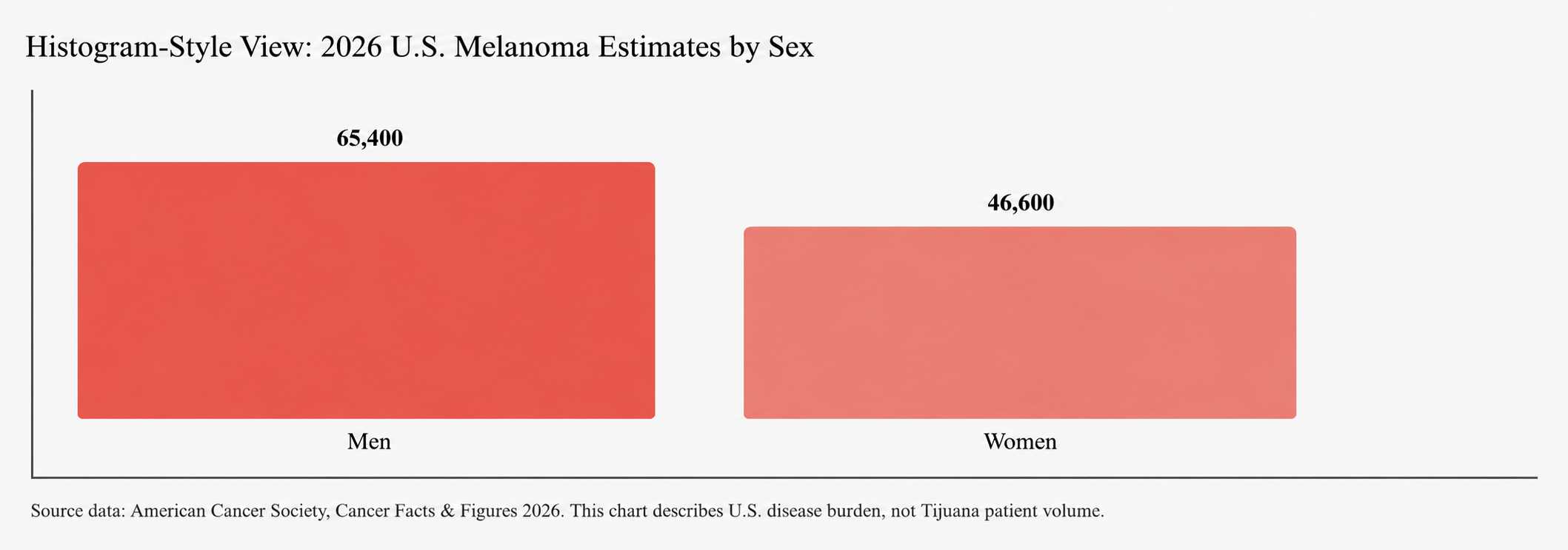
The 2026 report also shows approximately 65,400 projected invasive melanoma cases among men and 46,600 among women. The ACS notes that melanoma incidence differs by both age and sex, with rates considerably higher in men at older ages.
Line Graph: Projected U.S. Invasive Melanoma Cases
Interpretation: These are separate annual ACS projections. Two estimates alone should not be treated as a measured year-to-year incidence trend.
There is no authoritative public dataset showing the age, sex, stage, previous treatment, or home country of patients specifically traveling to Tijuana for metastatic melanoma. Publishing such percentages as if they were established patient demographics would therefore be misleading.
Advanced Melanoma Treatment Costs in Tijuana Compared With the United States
There is no medically meaningful single price for advanced melanoma treatment. A patient receiving periodic checkpoint-inhibitor infusions has a different cost structure from someone requiring tumor surgery, stereotactic radiation, molecular testing, hospitalization, or intensive cellular therapy.
Authoritative sources do not provide a standardized 2026 private-pay Tijuana price for an entire metastatic melanoma treatment episode. For that reason, presenting a broad dollar range as though it applied to all patients would be unreliable.
| Cost question | Tijuana, Mexico | United States |
|---|---|---|
| Standardized full-treatment price | Information not available from authoritative public sources. | No single comparable price; insurance, hospital, regimen, drug acquisition, and site of care vary. |
| Imaging and staging | Request separate prices for PET/CT, CT, MRI, pathology, and specialist interpretation. | Charges and patient responsibility depend strongly on network and coverage. |
| Systemic medication | Confirm whether the quote includes the actual registered drug, infusion, pharmacy, and monitoring. | Drug and infusion costs vary by regimen, insurer, assistance arrangements, and treatment setting. |
| Complication care | Determine whether hospitalization, ICU care, transfer, and emergency consultation are excluded. | Coverage depends on insurance and provider network. |
What an itemized Tijuana melanoma quote should show
- Medical oncology consultation and multidisciplinary review.
- Pathology review and molecular testing.
- CT, MRI, PET/CT, or other required staging.
- Exact drug or biologic and number of planned administrations.
- Infusion-center and pharmacy charges.
- Laboratory monitoring before each treatment.
- Professional fees.
- Radiation or surgery if recommended separately.
- Management of treatment-related toxicity.
- Follow-up imaging, telemedicine, travel, lodging, and border transportation.
How to Choose a Tijuana Hospital or Clinic for Metastatic Melanoma
For advanced melanoma, a clinic should be evaluated as an oncology system rather than simply a place offering an infusion. The facility should be able to explain its regulatory status, treatment protocols, pharmacy chain of custody, emergency response, referral arrangements, and what happens if your condition deteriorates between scheduled visits.
COFEPRIS regulates health establishments and specific higher-risk medical services in Mexico. Facilities performing surgery, radiotherapy, nuclear medicine, tissue or cell-related activities, and other regulated services may require corresponding sanitary authorization. Ask which authorization applies to the care you will actually receive.
| Verify | Question to ask | Why it matters |
|---|---|---|
| COFEPRIS status | “What is the facility's current sanitary authorization or operating notice for these services?” | Shows the provider understands Mexican health-regulatory requirements. |
| Pharmacy controls | “Can you document the drug manufacturer and Mexican registration?” | You need to know exactly what drug or biologic will be administered. |
| Emergency support | “Is emergency assessment available 24/7, and where would I be admitted?” | Checkpoint, cell, targeted, and other therapies can produce serious complications. |
| Multidisciplinary care | “Who reviews brain metastases, radiation needs, surgery, pathology, and systemic therapy?” | Metastatic melanoma often requires more than one specialty. |
| Outcome documentation | “How will response be measured using imaging and accepted response criteria?” | Testimonials cannot establish tumor response or survival benefit. |
International accreditation such as JCI may be an additional institutional signal when applicable, but it is not a substitute for Mexican legal authorization, appropriately certified specialists, oncology-specific capability, or a treatment plan supported by evidence.
How to Verify a Melanoma Oncologist in Tijuana, Mexico
Start with the physician's legal identity and specialty credentials. Ask for the doctor's full name, professional license number, specialty, and current oncology certification. Mexico's CONACEM maintains a public specialist-certification search, while the Consejo Mexicano de Oncología evaluates certification in medical oncology and surgical oncology among other oncology specialties.
Certification should be relevant to the treatment being proposed. A physician practicing another specialty is not automatically qualified to design complex systemic treatment for metastatic melanoma.
Medical oncologist
Ask about experience managing metastatic melanoma, checkpoint toxicity, treatment sequencing, BRAF-positive disease, and progression after PD-1 therapy.
Surgical oncologist
Relevant when disease can be resected, tissue is required, an isolated metastasis needs treatment, or tumor harvesting is part of a cellular-therapy pathway.
Radiation oncologist
Important for selected brain, bone, spinal, or symptomatic metastases and for stereotactic treatment planning.
Questions worth asking the Tijuana melanoma specialist
- What stage and melanoma subtype are you treating?
- Has my pathology been independently reviewed?
- Do you have my BRAF V600 result?
- Why do you believe my previous treatment failed?
- Is your recommendation standard, off-label, investigational, or complementary?
- What published evidence supports it specifically for metastatic melanoma?
- How will you determine whether the cancer is responding?
- What serious adverse events can occur?
- Where would I be hospitalized if toxicity develops?
- Will you coordinate with my oncologist at home and provide complete medical records?
Integrative and Alternative Melanoma Treatments Offered in Mexico: What to Check
Some patients researching cancer treatment in Mexico encounter programs involving hyperthermia, oxygen-related therapies, dietary interventions, supplements, immune-support protocols, non-standard vaccines, or other integrative approaches. The most important distinction is whether a therapy is being used to support symptoms and quality of life or is being presented as a treatment capable of shrinking metastatic melanoma.
NCI distinguishes complementary care used alongside standard medical treatment from alternative therapy used instead of standard treatment. Many complementary interventions have limited evidence for direct cancer control, and supplements or other products may interact with anticancer medications.
| Claim you may encounter | What you should request |
|---|---|
| “Strengthens your immune system against melanoma” | Human melanoma trials showing objective tumor response and clinically meaningful outcomes. |
| “Targets cancer without toxicity” | Published adverse-event data, contraindications, drug interactions, and regulatory status. |
| “Works when immunotherapy fails” | Evidence specifically involving anti-PD-1-refractory metastatic melanoma. |
| “Personalized cancer vaccine” | Exact product, manufacturing process, trial registration, regulatory status, and melanoma-specific evidence. |
Travel and Follow-Up Planning for Melanoma Treatment in Tijuana
Advanced cancer changes the way you should plan international travel. Some patients can travel comfortably between consultations, while others have anemia, infection risk, treatment toxicity, neurologic symptoms, pain, or rapidly changing disease that makes travel more complicated.
Ask your treating oncologist whether you are medically stable to travel and whether the proposed timing conflicts with scans, infusions, surgery, immune-related toxicity monitoring, or other treatment. CDC guidance for immunocompromised travelers also emphasizes pre-travel assessment, medication planning, and individualized vaccine advice.
| Timeframe | Clinical process | What you may experience | Activity level | Action required |
|---|---|---|---|---|
| Before travel | Records, pathology, imaging, medication and treatment review. | Varies with disease and current treatment. | Individual. | Obtain medical clearance and carry records. |
| Consultation/staging | Specialist assessment and possible repeat tests. | Usually related more to existing cancer symptoms than consultation itself. | As tolerated. | Clarify the full treatment recommendation before paying for a program. |
| During systemic treatment | Immune, targeted, cellular, or other therapy with laboratory monitoring. | Highly treatment-dependent; serious toxicity is possible. | Follow oncology instructions. | Know whom to contact 24/7 and where emergency treatment is available. |
| After returning home | Ongoing toxicity assessment and response imaging. | Delayed adverse events can occur with some cancer therapies. | Individual. | Transfer treatment summary, pathology, imaging, and medication records to your home team. |
Symptoms that should prompt urgent medical assessment
- New confusion, seizure, severe headache, weakness, or difficulty speaking.
- Severe shortness of breath, chest pain, or rapidly worsening cough.
- Persistent high fever or signs of serious infection.
- Severe or persistent diarrhea, vomiting, dehydration, or abdominal pain during immunotherapy.
- Yellowing of the skin or eyes, very dark urine, or marked weakness.
- Any rapidly worsening symptom your oncology team has identified as an emergency.
These warning signs are general educational examples and are not a substitute for your treatment team's emergency instructions.
Decision Checklist Before Starting Advanced Melanoma Treatment in Tijuana
A strong treatment decision should connect your diagnosis, previous treatment history, evidence, regulatory status, emergency support, and follow-up plan. Before committing to treatment, you should be able to answer the following questions.
Do you have the pathology report, stage, melanoma subtype, latest scans, and molecular results?
Has the Tijuana oncologist reviewed every prior immunotherapy, targeted therapy, surgery, and radiation treatment?
Can the provider show human clinical evidence for your exact stage and prior-treatment situation?
Can you verify the facility, physician, medications, and any cell or biologic treatment independently?
Is there a defined scan schedule and objective method for deciding whether treatment is working?
Do you know which hospital will manage severe toxicity or sudden progression?
Frequently Asked Questions About Advanced Melanoma Treatment in Tijuana
Can Tijuana treat stage 4 metastatic melanoma?
Private oncology services are available in Tijuana, but your suitability depends on the exact facility, specialists, medicines, technology, and hospital support required. Stage 4 melanoma should be managed through an evidence-based oncology plan with pathology, molecular testing, imaging, systemic therapy, and appropriate management of metastatic sites.
What happens if immunotherapy stops working for metastatic melanoma?
Your oncologist may reassess the diagnosis, progression pattern, BRAF status, previous checkpoint combinations, local treatment opportunities, cellular therapy eligibility, recently authorized therapies, and clinical trials. The best next step varies considerably, so progression after one treatment should not automatically be interpreted as exhaustion of all evidence-based options.
Is TIL therapy available for melanoma patients in Tijuana?
Availability should be verified directly rather than assumed. True TIL therapy requires tumor harvesting, specialized cell manufacturing, lymphodepleting treatment, cell infusion, and intensive clinical support. Ask whether the proposed product is an authorized TIL therapy and where manufacturing and hospital-level supportive care occur.
Can BRAF-targeted therapy help melanoma that has metastasized?
BRAF and MEK inhibitor combinations are established options for selected unresectable or metastatic melanomas with an appropriate BRAF V600 alteration. Molecular testing must confirm the mutation before this strategy is used. The timing relative to immunotherapy depends on your previous treatments and clinical situation.
Are alternative cancer therapies in Tijuana proven to stop melanoma metastasis?
A therapy should not be assumed to control metastatic melanoma because it is described as holistic, immune-boosting, non-toxic, or personalized. Ask for peer-reviewed human evidence showing objective responses in comparable melanoma patients. Complementary care may have supportive roles but should not automatically replace effective oncology treatment.
How much does advanced melanoma treatment cost in Tijuana?
There is no authoritative standardized USD price for a complete metastatic melanoma treatment episode in Tijuana. Costs vary with medication, molecular testing, scans, infusions, surgery, radiation, hospitalization, treatment duration, and complications. Request an itemized written estimate based on your actual oncology plan.
How do I check whether a Tijuana oncologist is certified?
Request the doctor's full legal name, professional license, specialty credentials, and current certification. Mexico's CONACEM public search can be used to check specialist certification. Oncology certification may be issued through the Consejo Mexicano de Oncología for relevant oncology specialties.
How can I verify an immunotherapy drug used in Mexico?
Ask for the generic name, brand where applicable, manufacturer, indication, lot documentation where appropriate, and Mexican sanitary-registration details. COFEPRIS provides public medication-registration resources. Do not rely only on a clinic's description such as “immunotherapy” or “advanced biological therapy.”
Should I travel to Tijuana if melanoma has spread to my brain?
Brain metastases require particularly careful planning. You may need neurologic assessment, MRI review, systemic therapy, neurosurgery, stereotactic radiosurgery, or radiation treatment. Discuss travel safety with your oncology team and confirm that the destination has appropriate emergency and multidisciplinary capabilities before traveling.
Can I continue follow-up with my U.S. oncologist after treatment in Tijuana?
Cross-border continuity is strongly advisable when possible. Ask the Tijuana provider for complete pathology, laboratory, imaging, medication, treatment, toxicity, and discharge records. Your home oncologist needs accurate details to interpret future scans, recognize delayed adverse events, and determine subsequent treatment decisions.
What should I send a Tijuana melanoma specialist before a second opinion?
Useful records commonly include pathology, operative reports, molecular testing, recent CT/PET/MRI images and reports, previous systemic treatments, dates and responses, laboratory results, current medications, treatment-related toxicities, and your oncologist's latest summary. The specialist may request additional information after reviewing your case.
Does FDA approval mean a new melanoma drug is automatically available in Mexico?
No. U.S. FDA approval does not automatically mean a melanoma drug is approved or commercially available in Mexico. Mexico has its own regulatory process through COFEPRIS. Before planning treatment, ask the provider to confirm the drug’s current COFEPRIS registration status, approved indication, and availability in Mexico.
Compare Advanced Melanoma Treatment Options With PlacidWay
If you are considering care in Tijuana after melanoma progression, PlacidWay can help you request information, compare treatment approaches, understand quoted costs, and prepare questions about physician credentials, facility authorization, treatment evidence, and follow-up arrangements. A provider comparison should support—not replace—medical advice from a qualified oncology team familiar with your diagnosis.
Disclaimer for Advanced Melanoma Treatment Information
Disclaimer: This information is for educational purposes only and does not replace professional medical advice. Always consult a qualified healthcare provider before making medical decisions.
References
- Melanoma Treatment (PDQ®), Health Professional Version – National Cancer Institute
- FDA Grants Accelerated Approval to Vusolimogene Oderparepvec-wtpg With Nivolumab for Melanoma – U.S. Food and Drug Administration
- Cancer Facts & Figures 2026 – American Cancer Society
- Licencia Sanitaria de Servicios de Salud – COFEPRIS, Government of Mexico
- Visor de Registros Sanitarios de Medicamentos – COFEPRIS, Government of Mexico
- Public Search for Certified Medical Specialists – CONACEM
- Complementary and Alternative Medicine in Cancer Care – National Cancer Institute
- Immunocompromised Travelers, CDC Yellow Book 2026 – Centers for Disease Control and Prevention










.png)







.jpg)








Share this listing