After Five Failed Rehabs: Daniel Cooper’s Opioid Use Disorder Ibogaine Treatment Story from the United States to Mexico

Publish date: Modified date: Medically reviewed by: Dr. Hector Mendoza on Aug 31, 2026 Author: Iqra Naseer

Daniel Cooper’s Opioid Use Disorder Ibogaine Treatment Story 

Patient Profile

Name: Daniel Cooper

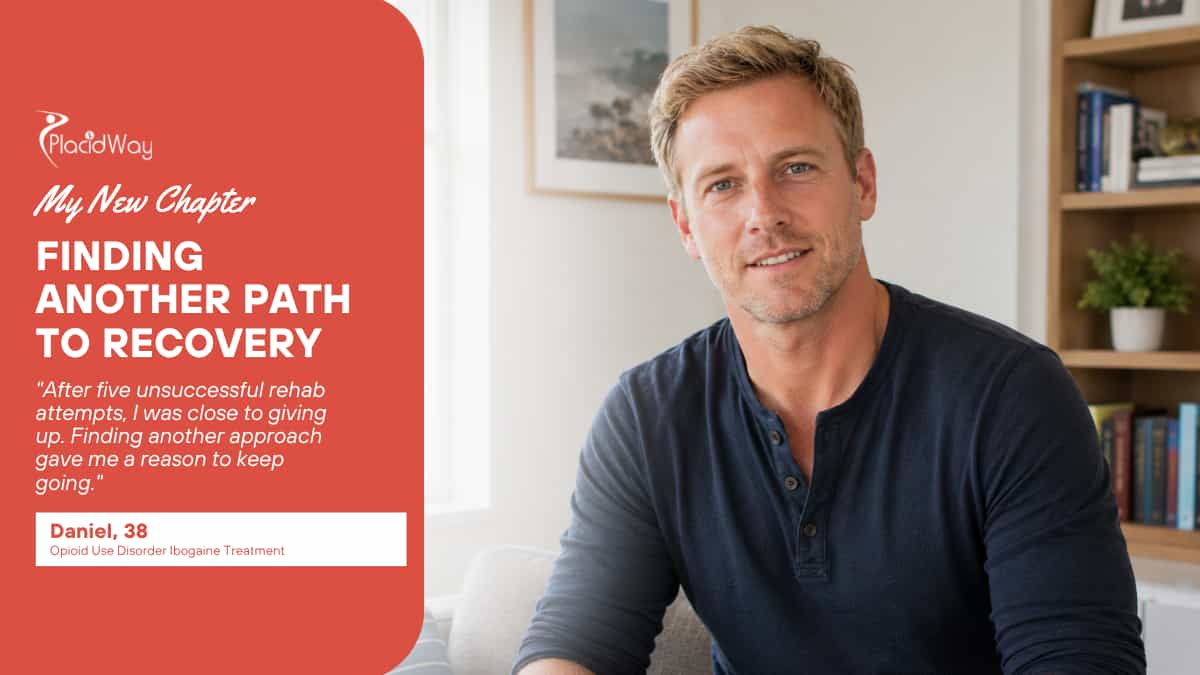
Age: 38

Condition: Treatment-resistant Opioid Use Disorder

Treatment: Ibogaine-assisted detoxification with cardiac screening and long-term integration support

Destination: Cancun, Mexico

Journey at a Glance

Main problems: Opioid cravings unresponsive to standard medication-assisted therapy; Repeated relapse after 28-day inpatient programs; Psychological dependence with co-occurring trauma, anxiety, depression; Severe withdrawal symptoms during detoxification

Previous care: Multiple inpatient rehabilitation programs (28–90 day cycles); Medication-assisted treatment (methadone, buprenorphine) with inconsistent adherence; Outpatient counseling and 12-step programs

Travel driver: Legal access to an evidence-supported intervention unavailable domestically; exhaustion of domestic treatment options; cost containment; reputation for higher success rates in treatment-resistant populations

Treatment explored: Ibogaine-assisted detoxification with cardiac screening and long-term integration support

Personal goal: Interrupt the relapse cycle and rebuild stable family, housing and employment routines.

You stopped going to the family holiday dinners last year.

You muted the text thread with your siblings.

You stopped answering calls from unknown local numbers.

You started parking down the street from your own apartment building.

You stopped looking your supervisor in the eye.

You agreed to let your mother watch the kids on weekends.

You agreed to let her watch them on weekdays.

You stopped asking when they could come back home.

"We just want the old you back."

"Take the time you need to get right."

"We can't keep doing this every single month."

Your world has quietly become smaller.

The hardest part is not the physical pain of withdrawal, but rather:

the waiting.

We need to meet the person navigating this maze.

Daniel Cooper is a fictional composite built from the very real situations, clinical histories, and exhausted questions that countless patients face every year.

He is thirty-eight years old and lives just outside Dayton, Ohio.

He used to manage a regional logistics warehouse.

He drove his daughter to gymnastics practice every Tuesday evening.

He paid his mortgage on time and kept the lawn mowed.

The escalation of the problem was slow, until it wasn't.

He explained it away as a necessary prescription for a warehouse back injury.

He called it a difficult month of stress.

He insisted he could stop whenever the pain subsided.

The escalation pathway became evident:

Outpatient behavioral counseling. Emergency room detoxifications. Twenty-eight days in a residential facility. Twelve-step evening meetings. County clinic waitlists. Relapse.

Medication-assisted treatment combining buprenorphine or methadone with counseling is considered the standard of care for opioid use disorder, typically implemented when acute behavioral interventions fail to prevent a return to substance use.

He has cycled through this standard of care five times in three years.

The billing department delivers the final verdict regarding his residential care:

"Your insurance will not cover a sixth admission."

When?

The systemic failure feels deeply personal.

Up to 85 percent of individuals treated for severe opioid use disorder may face relapse within a year of standard conventional interventions.

But Daniel Cooper does not experience the addiction treatment infrastructure as a national statistic.

He experiences it as a receptionist sliding his insurance card back through a glass partition.

"Your deductible reset on the first of January."

He experiences it as an empty car seat sitting in the back of his Honda.

"The court says supervised weekend visits only."

He experiences it as a calendar marking twelve months until a subsidized medication slot opens at the county health department.

"Try calling back in early November."

He has already tried to be patient with the process.

He is not an impulsive consumer looking for an effortless exit.

He spent thirty thousand dollars of his own depleted savings on his fourth rehabilitation stint.

He sat in cold folding chairs drinking burnt coffee for two hundred evenings in a row.

He drove forty miles round-trip every day to the only pharmacy authorized to dispense his temporary transition medication.

He tolerated the physical discomfort, the insomnia, and the profound anhedonia.

"I did everything they asked me to do."

"It just didn't hold when I came home."

He used to ask if he could simply tolerate the cycle for another year.

Now he looks at the calendar and asks:

How much of my life am I prepared to organise around it?

The nearest alternative requires resources he no longer has.

The conventional recommendation for his profile is an extended out-of-pocket residential stay lasting ninety days or more.

It costs fifty thousand dollars in cash.

It requires him to abandon his logistics job entirely, triggering the strict termination ultimatum his employer handed down last week.

His sister Sarah sits across the kitchen table and names the quiet reality:

"We can't drain the house equity again."

"Not for something that hasn't worked five times."

He isn't searching for an international medical trip yet.

His late-night internet searches begin as quiet attempts to understand his symptoms and alternatives.

How to stop severe Suboxone withdrawals.

Rapid opiate detox clinics near Ohio.

Why do I keep relapsing after 28 days.

Alternative treatments for severe opioid craving.

Ibogaine treatment clinical success rates.

Cost of ibogaine therapy in Mexico.

The search results continually point away from the Midwest and toward clinical centers operating in Cancun.

He reads about a single-administration protocol designed to interrupt receptor binding and reset craving neurocircuitry.

His immediate response is defensive:

"I'm not going abroad just because it's cheaper."

His skepticism is entirely appropriate.

Why does Cancun keep appearing in his recovery forums?

Ibogaine remains classified as a Schedule I controlled substance in the United States with no federally approved medical application.

Because domestic access is legally prohibited, dedicated clinical infrastructure has matured in jurisdictions where the alkaloid is regulated differently.

The question is never whether a specific country is universally good or bad.

Countries do not administer complex psychedelic detoxification protocols.

Clinical teams do.

Attending cardiologists do.

Medical directors do.

There is always a specific, verifiable medical credential at the center of the care.

Patients considering specialized care abroad are advised to conduct rigorous independent research on provider credentials and consult their domestic primary care physician before traveling.

His first question was inevitably about the financial reality.

An intensive 5-to-7 day ibogaine-assisted detoxification protocol in a clinical setting currently requires an indicative investment of USD 8,000–15,000, driven heavily by the inclusion of comprehensive cardiac screening, concurrent medical staff, and aftercare integration therapy.

He remembers a piece of blunt wisdom his father used to repeat:

"You get exactly what you pay for."

"What exactly am I getting in this package?"

Eleven critical questions the advertised price may or may not address.

Does this include the mandatory pre-treatment electrocardiogram?
Who reads the comprehensive metabolic bloodwork before admission?
Is the cost of the recovery accommodation separate from the clinical fee?
Does the payment cover emergency transfer protocols if my heart rate drops?
Am I paying for an advanced life support specialist to be in the room?
Does the package include supervised transport from the Cancun terminal?
Are the post-treatment integration coaching sessions conducted online afterward?
Is intravenous hydration part of the standard base price?
Does it cover specialized meals tailored to someone experiencing withdrawal nausea?
Who pays for the secondary prescription medications to manage residual insomnia?
Is the deposit fully refundable if I fail the cardiac screening upon arrival?

The advertised number is only the beginning of a much longer conversation.

The questions clarify the actual scope of the medical undertaking.

They force the facility to document their clinical boundaries.

They prevent financial surprises when physical vulnerability is highest.

What does this specific therapy actually involve?

Ibogaine therapy is a profound metabolic and psychoactive intervention designed to interrupt opioid receptor binding and reset specific neurocircuitry, allowing for rapid detoxification with significantly reduced acute physical withdrawal symptoms.

It is emphatically not a relaxing wellness retreat.

It is physically exhausting and psychologically demanding.

It involves a deeply disorienting acute phase lasting anywhere from twelve to twenty-four hours.

"Wait. Who manages my luggage while I'm completely incapacitated?"

The operational reality the brochures rarely put on the front page.

Current guidance regarding the standardization of ibogaine administration varies significantly between jurisdictions and independent clinical associations.

The variation itself is the most important lesson.

This operational constraint must be part of the travel plan before committing, not discovered upon arrival.

"Wait. Does that mean I'm just left in a hotel room with a single nurse?"

Possibly, depending entirely on the specific operational license of the provider you select.

Where is the emergency crash cart located in relation to the treatment bed?

Who translates medical instructions if the night nurse only speaks Spanish?

Is the dedicated treatment room heavily soundproofed against outside triggers?

What exact protocol is followed if I vomit during the onset of the medicine?

Can my sister stay in the room during the acute psychoactive phase?

How do I secure my passport and wallet while cognitively impaired?

Are the clinic bathrooms equipped with grab bars and continuous monitoring?

Who physically walks me to the restroom when my motor skills are severely compromised?

Is the clinic located inside a multi-specialty hospital or isolated in a residential villa?

What time of day is the primary alkaloid administration scheduled?

Who monitors the continuous telemetry readouts while I sleep?

This is not medical tourism in any conventional sense of the word.

The logistics require strict clinical boundaries.

The environment must prioritize safety over aesthetics.

The execution must be rigid, boring, and highly controlled.

Sarah isn't just coming along for moral support.

She is the invisible second participant in the entire medical process.

She will carry the thick folder of printed medical records.

She will explicitly remember the timing of his last buprenorphine dose.

She will notice if his breathing shallows during the night.

She will be responsible for dialing the international health insurance hotline if something goes wrong.

Standard travel insurance policies routinely exclude complications arising from treatments for substance use disorders or the administration of unapproved therapies.

She is an active, vital part of the clinical system too.

Then comes the uncomfortable conversation about clinical risk.

Ibogaine administration carries documented, severe risks of bradycardia, QT interval prolongation, and potentially fatal cardiac arrhythmias, making continuous medical monitoring strictly non-negotiable.

He learns to aggressively distrust certain specific marketing phrases:

Completely safe. No risk. Guaranteed success. A miracle cure.

Informed consent means understanding the mechanics of the danger, not just the hoped-for outcome.

State plainly that price should not answer a medical question, and that the goal is not to persuade.

You should not substitute clinical rigor for a lower price tag.

Daniel Cooper's consultation questions become markedly better.

He stops asking how soon he can fly and how cheap the room will be.

What is your specific protocol for treating a dangerously prolonged QT interval?
How far in minutes is the nearest acute cardiac care facility?
Do you have a fully stocked crash cart and a defibrillator in the actual treatment room?
Who is the attending physician and what is their exact medical specialty?
How many patients are actively treated simultaneously on a given day?
What are the strict medical exclusion criteria for your program?
How do you safely manage patients transitioning directly from long-acting synthetic opioids?
What structured psychological support is provided during the critical integration phase?
Can you provide transparent data on your specific facility's outcome rates?
What would you see on my EKG that would make you tell me not to proceed?

He does not only want a facility willing to administer the treatment.

He desperately wants a facility willing to tell him no.

A willing provider is easy to find.

A cautious provider is the one worth traveling for.

A provider who says no demonstrates clinical integrity.

Have I genuinely exhausted my viable options at home?

Patients have the legal right to request comprehensive case reviews and file external appeals for treatment coverage when insurance providers issue denials for extended care.

Is there a different medication formulation we haven't tried yet?
Can you refer me to an intensive outpatient program with immediate availability?
What are the actual statistical odds of a sixth residential admission working for someone with my clinical history?
Are there any federally funded clinical trials for addiction therapies currently recruiting in this state?
Will you continue to support my local aftercare if I choose an alternative medical path abroad?

Ibogaine treatment should be compared with Daniel Cooper's real alternatives, not with a worst-case assumption about the domestic health system.

The night before the final decision is made.

He sits at the same kitchen table with Sarah, but the surface is covered in different paperwork.

Electrocardiogram readouts. Comprehensive metabolic panels. Printed emails from a medical director in Mexico. A translated list of local emergency hospital numbers.

"I know it is not a magic bullet."

"But it feels like a genuine reset switch."

The diligent research served a singular, unexpected purpose:

It made them capable of deciding.

What Daniel Cooper actually wants is not a psychedelic experience.

"Are you sure you want to go through something this intense?"

The expected answer is that he simply wants to stop craving pills.

The real answer is that he wants to pick up his daughter from gymnastics without trembling.

He wants to sleep through the night without sweating through the bedsheets.

He wants to answer his phone without assuming it is a collections agency or a probation officer.

He wants to keep his steady job at the warehouse.

Not a spiritual awakening. Not an alkaloid extracted from an African shrub. Not an all-inclusive medical package. Not a warm week in Cancun.

Agency.

And underneath that:

Fatherhood.

Cancun might be the answer, but it might not be.

He might fail the initial medical screening and be rightfully denied admission.

He might decide the cardiac risks severely outweigh the potential neurochemical reset.

He might find a domestic clinical trial that accepts his specific profile.

He might secure a sudden, subsidized opening at the county MAT clinic.

He might travel, complete the grueling protocol, and return home only to face the exact same triggers.

He might undergo the intensive protocol, experience the profound interruption of withdrawal, and finally find the clarity needed to engage meaningfully in long-term therapy.

Any of those outcomes can represent a deeply informed, rational decision.

The goal isn't to persuade, it is to make sure profound frustration doesn't make the decision for him.

We must state plainly that exploring this option never obligates you to choose it.

Now you have to look at your own paperwork.

Maybe you have memorized the hold music for your insurance company's prior authorization department.

Maybe you have unpacked your suitcase after a twenty-eight day program, only to relapse before the week was over.

Maybe you have lied to your family about why your pupils are pinned.

Maybe you have accepted that your hometown clinic simply cannot offer you a different outcome.

Maybe you are simply exhausted.

You do not need to decide today.

What exactly is my physical cardiac baseline right now?

Who am I trusting to review my medical records objectively?

What clinical safeguards are in place if my body reacts poorly?

How will I handle the extreme psychological vulnerability afterward?

Who is traveling with me to hold the boundaries?

What does my local support system look like on day thirty post-treatment?

Am I choosing this out of panic or out of strategy?

This is not just a search for cheap detox beds abroad.

A search for a sustainable path forward.

Hope isn't the promise that the addiction will be instantly cured.

It is not a glossy marketing brochure from a tropical clinic.

It is not a guarantee of lifelong sobriety after a single week.

It is not an escape hatch from the brutal, daily work of recovery.

Hope is having enough accurate information to make a decision that finally feels like yours.

You can demand absolute clinical transparency. You can insist on speaking directly to the attending physician. You can require independent domestic cardiac clearance. You can walk away immediately if the answers are vague. You can take control of the timeline.

You move from a place of resignation:

"I suppose I'll just have to keep waiting."

To a place of quiet command:

What other informed options do I have?

PlacidWay — Your Way to Hope

PlacidWay helps patients safely explore international treatment alternatives, compare clinical facilities, understand complex logistical requirements, and prepare the rigorous questions needed for responsible medical travel.

We do not provide clinical advice, endorse specific psychedelic protocols, or guarantee medical outcomes.

For someone navigating the exhaustion of repeated relapse, ibogaine treatment in Mexico isn't a guaranteed promise, it is one specific route worth understanding comprehensively.

Your Way to Hope.

Medical disclaimer

Disclaimer: This article is strictly educational and does not recommend or endorse that any individual undertake ibogaine therapy or any specific medical intervention abroad. Ibogaine carries severe, documented cardiac risks and is illegal in many jurisdictions. Individual medical suitability and risk require rigorous, independent professional assessment. The reader should always consult their own primary clinician or qualified medical adviser, verify the current regulatory and legal status of any treatment, and obtain appropriate travel protection or medical insurance before making healthcare decisions.


After Five Failed Rehabs: Daniel Cooper’s Opioid Use Disorder Ibogaine Treatment Story from the United States to Mexico

About Article

  • Treatment: Addiction Treatment
  • Country: Mexico
  • Overview This educational overview follows Daniel Cooper, a composite American patient exploring Ibogaine Treatment in Cancun, Mexico. It summarizes daily-life effects, previous care and why treatment abroad is being considered. Candidacy, safety, recovery and follow-up remain central to informed decision-making.

Trusted Medical Tourism Platform Since 2007

60+
Countries
2k+
Clinics
19.5k+
Reviews
2.5k+
Qualified Doctors
1.1M+
Patients Served Since 2007