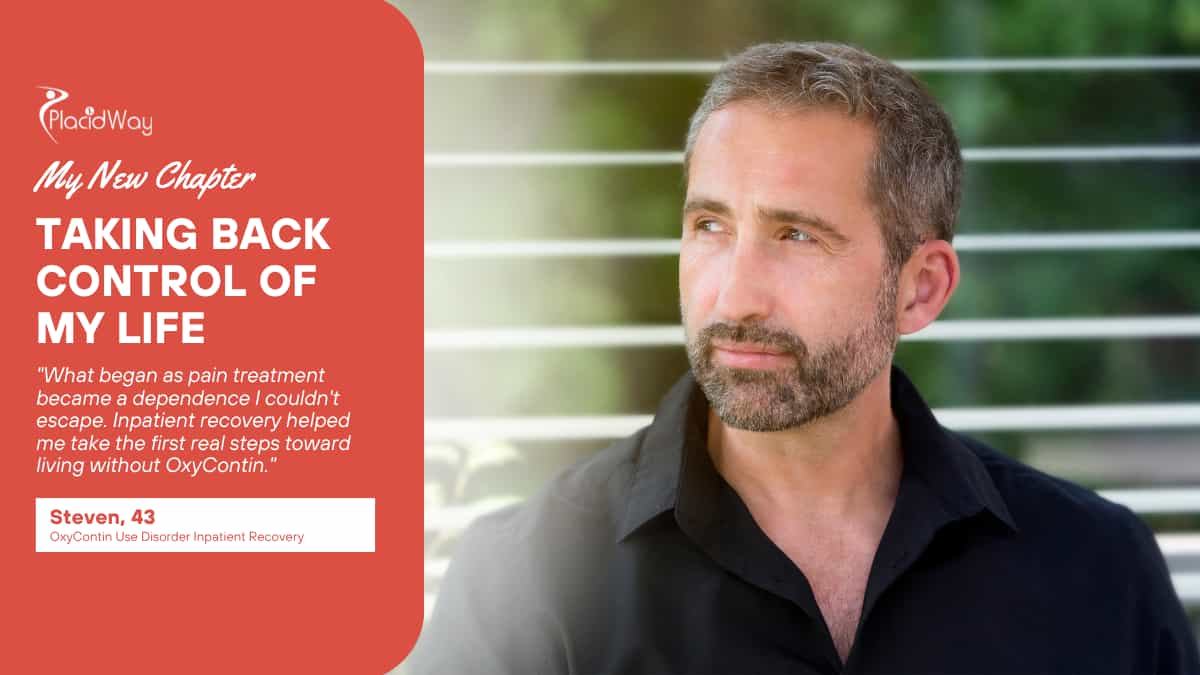
The Back Injury That Became Dependence: Steven Parker’s OxyContin Use Disorder Inpatient Recovery Story from the United States to Mexico

Publish date: Aug 28, 2026 Medically reviewed by: Dr. Hector Mendoza on Aug 28, 2026 Author: Alejandro Ramirez

Steven Parker’s OxyContin Use Disorder Inpatient Recovery Story 

Patient Profile

Name: Steven Parker

Age: 43

Condition: OxyContin-related Opioid Use Disorder

Treatment: Inpatient detoxification, medication-assisted treatment and longer-term residential recovery

Destination: Tijuana, Mexico

Journey at a Glance

Main problems: Physical dependence with escalating tolerance to opioids; Withdrawal symptoms (sweating, anxiety, muscle aches, insomnia); Inability to stop use despite repeated attempts; Loss of work productivity or employment

Previous care: Multiple outpatient detox programs (failed due to inadequate support or relapse triggers); Emergency room detoxification followed by discharge without follow-up care; Medication-assisted treatment (MAT) with buprenorphine or methadone—often…

Travel driver: Immediate access to intensive, affordable, extended treatment without waitlists; family proximity for integrated therapy; escape from local triggers and enabling social networks; privacy and discretion; treatment intensity matched to severity of…

Treatment explored: Inpatient detoxification, medication-assisted treatment and longer-term residential recovery

Personal goal: Break dependence created after a back injury and rebuild family and employment stability.

You stop making long-term plans.

You start counting pills before breakfast.

You switch pharmacies to avoid familiar faces.

You stop volunteering to drive the kids to practice.

You find reasons to leave family dinners early.

You learn exactly which urgent cares ask the fewest questions.

You memorize the excuses you give your employer.

You stare at the ceiling while everyone else sleeps.

"You just seem tired lately."

"I can take the morning shift."

"Maybe you should see the doctor."

Your world has quietly become smaller.

And you realize that the hardest part is not the physical ache:

It is the waiting.

Meet Steven Parker.

Steven Parker is not a real patient, but rather a fictional composite built from the exact situations and questions American adults face when confronting opioid dependence.

He is forty-three years old and lives in a mid-sized town in Ohio.

He used to manage residential construction sites before a beam fell on his lower back.

He drove a company truck, coached a youth basketball team, and pitched a tent in the backyard with his two daughters on holiday weekends.

How the escalation happened.

He told himself the pain was just stubborn.

A legitimate prescription.

A sanctioned refill.

A slightly higher dose.

A lost weekend.

A missed deadline.

A borrowed pill.

A panicked morning.

Clinical guidelines for opioid use disorder typically indicate that residential treatment should be considered when outpatient interventions fail to manage physical dependence and withdrawal safely.

The assessment eventually delivers a clear instruction:

"You need inpatient medical detox followed by residential rehab."

Which leads directly to the next question:

When?

The reality of the domestic queue.

Nationwide data indicates that fewer than one in four individuals with opioid use disorder receive specialized treatment, often facing waitlists that span several months for accredited beds in local facilities.

But Steven Parker doesn't experience the fragmented healthcare network as a national statistic.

He sits in an emergency room holding a discharge paper.

"They can't keep you here just for withdrawal."

He calls an intake coordinator from the cab of his truck.

"We might have a bed open in November."

He looks at a denial letter from his insurance provider.

"Twenty-eight days is the maximum authorized limit."

He has already tried to be patient.

People seeking residential addiction care are rarely acting out of impulsive consumerism.

He completed the outpatient taper schedule.

He attended the evening support groups in the basement of the local church.

He sat in silence through the painful family intervention.

He tried transitioning to buprenorphine until his insurance abruptly changed the preferred pharmacy network.

He white-knuckled through four days of sweating on the living room floor before giving up.

"I just need one more try at this."

"I can beat it this time."

The focus of his problem shifts:

From "Can I tolerate this?" to:

"How much of my life am I prepared to organise around it?"

The nearer alternative.

He looks closely at a private residential center three hours away in Pennsylvania.

It has immediate availability.

But it requires a massive upfront deposit because they consider his specific policy out-of-network.

He sits at the kitchen table with his wife, Sarah.

"We could take a second mortgage."

"There is a difference between finding the money and surviving the debt."

He isn't searching for Tijuana yet.

Oxy withdrawal timeline.

Outpatient detox near me.

How to appeal insurance denial for rehab.

Cost of 90 day inpatient treatment without insurance.

Affordable addiction centers abroad.

The search engine begins returning results just south of the California border.

He pushes the laptop away.

"I'm not crossing a border just because something is cheaper."

His instinct is entirely appropriate.

Why does Tijuana keep appearing?

The structural reality is that Mexico's private medical sector has built extensive infrastructure along the border specifically to serve underinsured Americans seeking immediate access to care.

But the destination itself is not a credential.

Countries do not deliver cognitive behavioral therapy.

Addiction medicine specialists do, psychiatric nurses do, clinical teams do.

There is something concrete to verify.

Official guidance advises patients seeking cross-border medical care to research individual facilities thoroughly and maintain communication with their domestic primary care provider.

His first question was about the numbers.

An intensive 60-to-90-day inpatient program in Tijuana commonly carries an indicative cost of USD 8,000–15,000, varying based on the duration of medical detox, the specific psychiatric medications required, and the level of private accommodation.

He remembers his grandfather's advice.

"You get what you pay for, unless you don't know what you're buying."

"What exactly am I getting?"

Is medical detoxification handled on-site?

Are there US-trained addiction specialists on staff?

How frequently does the psychiatrist round?

Is medication-assisted treatment included in this base rate?

What happens if withdrawal complications require hospital transfer?

Are the daily therapy sessions conducted in English?

How many individual counseling hours happen per week?

Is cognitive behavioral therapy part of the core curriculum?

Does the fee cover all meals and basic living supplies?

How are family therapy sessions integrated across a border?

Are there hidden fees for laboratory testing?

Is aftercare coordination included in the discharge plan?

The advertised number is only the beginning of the conversation.

What does extended residential care actually involve?

Medical professionals define effective opioid use disorder treatment as a continuum of care beginning with supervised detoxification, followed by extended behavioral therapy and medication management lasting a minimum of 90 days to significantly reduce relapse rates.

It is a grueling physical and psychological reconstruction.

"Wait, how do I actually get there when I'm sick?"

The part the sales decks rarely put on the front page.

Current guidance states that the logistics of crossing international borders while in active withdrawal or carrying prescribed addiction medications require precise documentation and coordination.

The variation in how clinics handle this is the lesson.

This constraint must be part of the plan before committing, not afterward.

"Wait. Does that mean...?"

Possibly, depending on the facility's specific transport protocols.

Who picks me up from the San Diego airport?

Are they medically trained if I start withdrawing in the vehicle?

How do we handle customs with my current prescriptions?

What happens to my passport while I am in residential care?

Can I keep my phone to call my children?

Who decides when I am medically cleared to leave?

What is the exact physical distance to the nearest general hospital?

How do my family members visit without international travel headaches?

Who coordinates with my employer regarding medical leave paperwork?

What happens if I decide to walk out on day three?

Is there a secure perimeter around the facility?

How do I get my continued psychiatric prescriptions back across the border?

This isn't tourism in the usual sense.

Sarah isn't just coming along.

The invisible second participant carries the administrative weight of the crisis.

She will hold the emergency contacts.

She will monitor the joint bank account.

She will explain the absence to the school teachers.

She needs to know the exact transfer protocol if a medical emergency exceeds the clinic's capacity.

Standard travel protection policies may explicitly exclude coverage for complications arising from addiction treatment or pre-existing psychiatric conditions.

She is part of the care system too.

Then comes the uncomfortable conversation about risk.

The transition from active opioid dependence to medically assisted recovery carries inherent risks of precipitated withdrawal, severe depression, and relapse during the vulnerable early stages.

Price should not answer a medical question, and marketing cannot eliminate biology.

Steven Parker learns to distrust certain phrases.

Completely safe. No risk. Guaranteed success. Cured in thirty days.

Informed consent means understanding more than the hoped-for outcome.

His questions become better.

He stops asking "How soon can I arrive?" and begins asking:

What is your exact protocol for managing precipitated withdrawal?
Who is the attending physician at 2:00 AM?
What is your staff-to-patient ratio during the night shift?
Can you provide a detailed weekly schedule of clinical hours?
How do you handle patients who smuggle substances into the facility?
What happens to my deposit if I am medically discharged early?
Which US-based aftercare providers do you currently collaborate with?
How is family therapy conducted if my wife remains in Ohio?
Do you utilize buprenorphine, methadone, or naltrexone?
What is your protocol for managing comorbid severe depression?
What would you see in my medical history that would make you tell me not to proceed?

They don't only want someone willing to admit him:

They want someone willing not to.

Have I exhausted my options at home?

Domestic healthcare policies often include appeal processes for denied residential treatment, and state-funded programs occasionally have expedited entry for individuals in imminent crisis.

He writes a list of questions for his current primary care provider.

Is there an out-of-network exception we haven't filed yet?

Can the hospital social worker locate a state-subsidized bed?

Would a peer-to-peer insurance review change the authorization?

Are there partial hospitalization programs that step down to intensive outpatient?

Can you bridge my medication prescription while I wait for a domestic bed?

Tijuana should be compared with Steven Parker's real alternatives, not with a worst-case assumption about the home system.

The night before the decision.

They sit at the same kitchen table.

The printed emails from the clinical director in Mexico.

The final denial letter from the US insurance provider.

The list of questions Sarah wrote in a notebook.

The logistics itinerary for the San Diego border crossing.

The emergency contact sheet.

"I know exactly what they do if my blood pressure drops."

"That's the first time you've sounded certain in a year."

The research didn't make them more afraid; it made them more capable of deciding.

What Steven Parker actually wants isn't a residential rehab program.

"What are you paying for?"

The expected answer is a clean medical detox.

The real answer is waking up without immediate panic.

He wants to hold a steady job again.

He wants to look his daughters in the eye.

He wants to stop lying to his wife.

Not the facility.

Not the medication-assisted treatment protocol.

Not the cost savings.

Not the border crossing.

Freedom.

And underneath that:

Dignity.

Tijuana might be the answer. It might not be.

The facility cannot handle his specific cardiac history.

He secures a sudden cancellation bed at the Pennsylvania clinic.

The insurance appeal is unexpectedly successful.

He realizes he is not ready to leave his family for 90 days.

He finds a local physician willing to manage a rigorous outpatient taper.

Or he decides that the immediate availability and intensive therapy structure in Mexico align exactly with his closing window of willingness.

Any of those can be an informed decision.

The goal is not to persuade you to go abroad, it is to make sure frustration doesn't make the decision for you.

Your turn to ask the questions.

Maybe you have memorized the pharmacy opening hours.

Maybe you have practiced the speech you give your boss.

Maybe you have hidden bottles in the garage.

Maybe you have watched the mail for another medical bill.

Maybe you are tired of negotiating with intake coordinators.

You do not need to decide today.

What specific clinical support do I require to survive detoxification safely?

Who is objectively reviewing my medical suitability for travel?

How will I sustain my recovery once I cross back into my daily life?

What is the true cost of delaying this intervention another six months?

Are there domestic leverage points I have not yet pulled?

What does my family need to feel secure about this choice?

Who is helping me translate the clinical brochures into reality?

Not just prices.

Paths forward.

Hope isn't the promise that everything will be fixed easily.

Hope is not a glossy brochure from a foreign clinic.

Hope is not the assumption that geography cures addiction.

Hope is not ignoring the very real risk of relapse.

Hope is having enough accurate information to make a medical decision that finally feels like yours.

The capacity to ask difficult clinical questions.

The right to demand transparency about risk.

The ability to plan beyond the next twenty-four hours.

The strength to involve your family in the logistics.

The clarity to choose a path rather than being forced down one.

From:

"I suppose I'll just have to keep waiting."

To:

"What other informed options do I have?"

PlacidWay — Your Way to Hope.

PlacidWay helps individuals and their families explore global healthcare alternatives, compare accredited facilities, and prepare the rigorous questions necessary for informed consent. We do not provide clinical advice or guarantee medical outcomes. For someone trapped in the holding pattern of domestic addiction care, traveling to Tijuana isn't a promise, it is one route worth understanding.

Your Way to Hope.

Medical disclaimer

This article is for educational purposes only and does not recommend that any individual undertake cross-border travel for medical or psychiatric treatment. Addiction medicine carries substantial risks, and individual suitability requires comprehensive professional assessment. Readers should always consult their own qualified domestic clinician, verify the current regulatory status of any international facility independently, and obtain appropriate medical travel insurance before committing to care.

The Back Injury That Became Dependence: Steven Parker’s OxyContin Use Disorder Inpatient Recovery Story from the United States to Mexico

About Article

  • Treatment: Addiction Treatment
  • Country: Mexico
  • Overview This educational overview follows Steven Parker, a composite American patient exploring OxyContin Addiction Care in Tijuana, Mexico. It summarizes daily-life effects, previous care and why treatment abroad is being considered. Candidacy, safety, recovery and follow-up remain central to informed decision-making.

Trusted Medical Tourism Platform Since 2007

60+
Countries
2k+
Clinics
19.5k+
Reviews
2.5k+
Qualified Doctors
1.1M+
Patients Served Since 2007