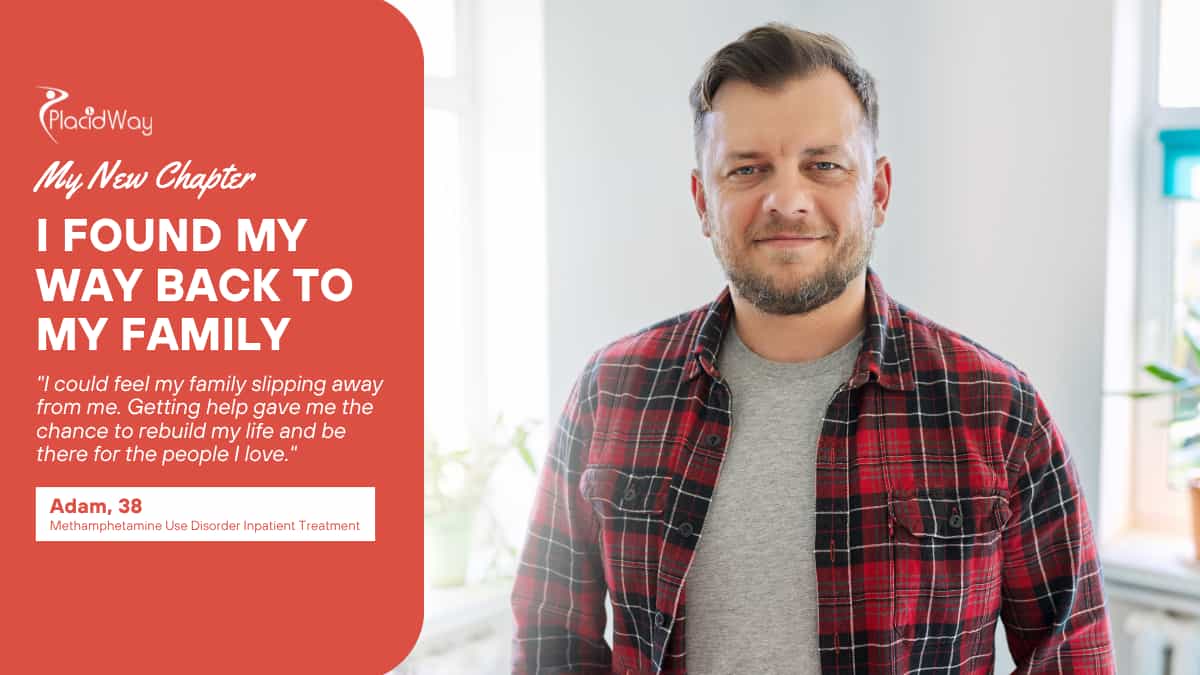
Patient Profile
Name: Adam Fletcher
Age: 38
Condition: Methamphetamine or amphetamine use disorder
Treatment: Inpatient addiction treatment with medical oversight, dual-diagnosis care and behavioral therapy
Destination: Granada, Spain
Journey at a Glance
Main problems: Compulsive drug-seeking behavior and loss of control over use; Severe sleep disruption, hyperactivity, paranoia, or psychosis; Cognitive decline, memory loss, attention deficits; Physical deterioration: weight loss, dental decay, skin infections
Previous care: Multiple failed self-detox attempts or cold-turkey quits; Community support groups (NA, AA) without clinical backing; Referral to NHS addiction services; placed on waitlist
Travel driver: AUDIENCE HOME CONTEXT
Treatment explored: Inpatient addiction treatment with medical oversight, dual-diagnosis care and behavioral therapy
Personal goal: Stabilize his health and rebuild family, work and financial security.
You tell yourself it is just a difficult phase.
You manage to hide the exhaustion at the Monday morning meeting.
You find a way to explain the sudden weight loss to your mother.
You delete the browser history before handing your phone to your daughter.
You stop answering calls from unknown numbers.
You stop opening the post.
You start taking a different route to work to avoid a specific street.
You tell your partner you just need one quiet weekend to reset.
You tolerate the night sweats and the heart palpitations alone in the spare room.
"You look so tired these days."
"I can take the kids this weekend if you're not feeling up to it."
"We just want the old you back."
Your world has quietly become smaller.
The hardest part is no longer the physical exhaustion or the financial strain, but the waiting.
Meet Adam Fletcher
Adam Fletcher is not a real PlacidWay patient.
He is a fictional composite built entirely from the clinical realities, logistical hurdles, and profound questions faced by British adults seeking addiction treatment outside the UK.
He is thirty-eight years old, lives in Manchester, and spent the last decade managing a regional logistics firm.
He used to coach Sunday league football, restore vintage radios on his workbench, and remember his nephew's birthdays without a calendar reminder.
Now, his days are measured entirely by the distance between his last dose of amphetamine and his next.
The escalation
He explains the initial prescription away as a temporary crutch for long driving shifts.
When the prescription runs out, he sources alternatives.
He tries tapering his doses on a notepad.
He pours his stash down the kitchen sink.
He attends a local community support group and sits by the radiator without speaking.
He locks himself in a hotel room for three days with bottled water and ibuprofen.
He stays sober for a month.
He finds himself staring at the ceiling at 4:00 AM, his jaw clenched, starting the cycle again.
Standard clinical protocols for severe stimulant dependence involve intensive residential detoxification combined with dual-diagnosis psychiatric care, because outpatient stepped-care models frequently fail patients experiencing severe psychological withdrawal and anhedonia.
The local addiction service assessor reviews his file, hands him a leaflet, and delivers the verdict:
"You meet the criteria for inpatient funding, but the list is extremely long."
When?
The reality of the waitlist
Adults requiring residential rehabilitation in England frequently wait between six and eighteen months for a funded bed, as local authorities ration increasingly scarce treatment budgets.
But Adam Fletcher doesn't experience the structural deficit of the national health system as a statistic.
He experiences it staring at the custody paperwork on his kitchen table, realizing he will miss another school play.
"I can't let him stay with you while you're like this," his ex-partner Sarah tells him by the front door.
He experiences it noticing the slight tremor in his hands while trying to sign a delivery manifest at work.
"Just take a few weeks of sick leave and sort yourself out," his manager says, looking at the floor.
He experiences it sitting in the NHS waiting room, calculating how many months of his son's childhood will pass before his name reaches the top of the clipboard.
"We will call you if a cancellation comes up," the receptionist offers kindly.
He has already tried to be patient
There is a persistent assumption that patients who look abroad for medical care are simply impatient shoppers refusing to wait their turn.
Adam Fletcher waits.
He fills out the assessment forms, attends the preliminary counseling sessions, and checks in with his assigned key worker every fortnight.
He endures the acute depression of stimulant withdrawal while trying to maintain the facade of a functioning adult.
I just need to hold on a little longer.
If I can just make it to the summer, a bed will open up.
He reaches a threshold where endurance is no longer a virtue, shifting his internal framework:
From "Can I tolerate this wait?" to "How much of my life am I prepared to organise around it?"
The domestic alternative fails quietly
The obvious solution is to book a private rehabilitation clinic in the UK.
He finds a highly rated facility in Surrey that can admit him on Monday.
The admissions coordinator emails the fee schedule, and Adam Fletcher reads the bottom line.
It costs GBP 12,000 for a single week of residential care.
A standard 28-day program would consume his entire life savings and require a high-interest personal loan.
He sits across from Sarah at the kitchen table, tracing the rim of a cold coffee mug.
"I have the money in the savings account, technically," he says.
"But if you spend it all on rehab, you won't have a deposit," she replies.
He cannot buy his recovery by bankrupting the future he is trying to recover for.
He isn't searching for Spain yet
His late-night browsing history traces the geography of his desperation:
Severe amphetamine withdrawal timeline
NHS addiction inpatient wait times Manchester
Cheapest private rehab UK
How to detox from stimulants safely at home
Affordable residential rehab Europe
A targeted search reveals a cluster of accredited international addiction clinics in Granada, Spain.
The concept feels immediately absurd to him.
"I'm not going abroad just because a clinic is cheaper," he mutters to his laptop screen.
His instinct to resist medical travel based purely on price is entirely correct.
Medical decisions should never be answered by a discount.
Why does Granada keep appearing?
Spain has developed a mature, heavily regulated private healthcare infrastructure that frequently serves Northern European expatriates, creating a high concentration of English-speaking psychiatric and addiction medicine professionals.
The fundamental reframing of medical travel requires separating the geography from the practitioner.
Countries do not treat addiction.
Clinical teams do, psychiatric nurses do, and accredited inpatient facilities do.
There is something highly concrete to verify before ever booking a flight.
Independent advisory bodies explicitly recommend verifying the registration of any overseas clinic with the local health ministry and consulting a UK GP before committing to international treatment.
His first question was: "How much?"
An intensive 28-day residential addiction program in Spain currently carries an indicative cost of EUR 8,000 to EUR 15,000, varying based on the requirement for acute medical detoxification, the intensity of psychiatric support, and the specific facility amenities.
If it sounds too good to be true, you haven't read the fine print.
"What exactly am I getting?"
Twelve things the advertised price may or may not cover.
Does this fee cover the initial psychiatric evaluation?
Is the medical detox supervised by a physician 24 hours a day?
Are medications like bupropion or naltrexone included in the baseline cost?
How many hours of one-on-one trauma-informed CBT are scheduled per week?
Does the clinic use a dual-diagnosis approach for co-occurring depression?
Are meals and nutritional rehabilitation factored into the daily rate?
What happens if I require transfer to a general hospital for an emergency?
Is there an English-speaking therapist on staff, or will I be using a translator?
What aftercare support is provided once I return to Manchester?
Does the program include family therapy sessions via video link?
Will I have a private room or a shared ward?
Who pays for the airport transfer and local logistics?
The advertised number on a clinic's website is only the beginning of a much longer conversation.
What does the treatment actually involve?
Effective treatment for severe stimulant use disorder is not simply a matter of geographic isolation and enforced abstinence.
It requires a structured phase of physical stabilization followed by intensive psychological intervention, as the brain's dopamine pathways slowly begin to heal from chemical exhaustion.
The protocol usually begins with a medicated stabilization period to manage the acute lethargy, paranoia, and severe depressive symptoms characteristic of amphetamine withdrawal.
Patients then transition into a structured daily routine of cognitive behavioral therapy, motivational interviewing, and psychoeducation designed to identify relapse triggers and rebuild emotional regulation.
"How do I actually get there in this state?"
The part the brochures rarely put on the front page
The operational reality of traveling for addiction treatment is heavy with friction.
Different jurisdictions maintain varying guidelines regarding the prescription and transport of psychiatric medications across borders.
This variation itself is the lesson.
These logistical constraints must be mapped and solved before committing to a departure date, not managed from a departure lounge in a state of withdrawal.
"Wait. Does that mean I have to manage my own medication at the airport?"
Possibly, depending on your current prescriptions and the clinical handover arrangements.
Do I need a fit-to-fly certificate from my local GP?
What happens if a flight delay causes me to miss my intake appointment?
Who takes custody of my passport during the residential stay?
Am I allowed to keep my mobile phone, or is it confiscated upon entry?
Can the clinic guarantee a specific diet for my recently developed digestive issues?
How is medical information transferred back to my NHS record?
Will the clinical notes be translated into English by a certified medical translator?
What happens if I decide to leave the program against medical advice on day three?
Who coordinates the flight home if my discharge date changes?
This isn't tourism in any usual sense.
Sarah isn't just coming along
There is always an invisible second participant in the recovery logistics.
Sarah will not board the flight to Granada, but she will carry the weight of the administrative anxiety in Manchester.
She will be the one checking her phone at work, waiting for the clinic's promised weekly update.
She will need to know exactly who to contact if Adam Fletcher experiences a psychological crisis during detox.
She will hold the physical copies of the clinic's emergency protocols and the contact details for the local Spanish consulate.
Standard travel insurance explicitly excludes claims arising from pre-existing medical travel or addiction treatment, meaning specific medical complication coverage must be secured independently.
She is part of the clinical care system too.
Then comes the uncomfortable conversation about risk
International medical treatment carries inherent risks, including disrupted continuity of care, complications from sudden medication changes, and the profound psychological vulnerability of undergoing trauma therapy far from home.
Adam Fletcher learns to actively distrust any clinic representative who uses specific phrases:
Completely safe. No risk. Guaranteed success.
Informed consent means understanding the mechanics of what can go wrong, rather than just subscribing to a hoped-for outcome.
His questions become better
He stops asking "How fast can I get there?" and "How much will it save me?"
Can you provide your most recent independent facility inspection report?
What is the precise ratio of psychiatric nurses to inpatients at night?
How do you handle acute psychotic episodes during stimulant withdrawal?
Who holds the ultimate clinical liability for my treatment plan?
Can I speak directly to the lead psychiatrist before transferring a deposit?
What specific protocols do you have for patients who attempt to leave early?
How do you integrate family members into the discharge planning process?
Do you provide a detailed discharge summary formatted for my UK doctor?
What local emergency hospital do you transfer patients to if required?
What would you see in my medical file that would make you tell me not to proceed?
He doesn't only want to find someone willing to take his money.
He wants someone willing not to.
Have I exhausted my options at home?
Before looking at international flight schedules, a patient must interrogate the boundaries of their local healthcare system.
UK patients possess legal rights regarding maximum waiting times for specialist care, and mechanisms exist to request funding for alternative domestic providers if local services fail to meet these timelines.
Is there an unadvertised cancellation list I can join today?
Can my local authority secure a spot in a different regional trust?
Are there domestic charities or non-profits that subsidize residential care?
Can I fund a private outpatient medical detox while waiting for NHS counseling?
If I travel for treatment, will my local NHS trust refuse subsequent aftercare?
Granada should be compared with Adam Fletcher's real alternatives, not with a worst-case assumption about the domestic health system.
The night before the decision
The kitchen table is covered in paperwork again.
A printed email from the Spanish clinic's lead psychiatrist. A translated copy of the facility's regional health registry certification. A signed leave-of-absence form from his employer. A carefully structured aftercare agreement drafted with a local Manchester counselor.
"You actually look calm for once," Sarah says, leaning against the doorframe.
"I know exactly what is going to happen on Monday," he replies.
The research didn't make him more afraid; it made him more capable of deciding.
What Adam Fletcher actually wants isn't residential rehab
His mother asks him if he is looking forward to finally being cured.
He gives her the expected answer about looking forward to a fresh start.
The real answer is simpler:
Complete residential treatment and regain supervised weekend custody of his son.
He wants to be able to sign a document without his hand shaking.
He wants to sleep through the night without waking up soaked in sweat.
He wants to look in the mirror and recognize the person looking back.
Not the flight to Spain. Not the cognitive behavioral therapy modules. Not the Mediterranean climate. Not the cost savings.
Capability.
And underneath that:
Dignity.
Spain might be the answer, but it might not be
You might discover that your local authority finally approves your funding request.
You might realize the logistical strain of international travel is too high right now.
You might secure a manageable payment plan with a clinic in the UK.
You might decide that outpatient stabilization with a private psychiatrist is a better first step.
You might conclude that you are not quite ready to commit to twenty-eight days away from your family.
Choosing to proceed with an intensive inpatient addiction treatment program in Granada only makes sense if the clinical standards, logistical support, and financial realities align perfectly with your specific recovery needs.
Any of those can be an informed decision.
The goal is not to persuade you to board a plane.
The goal is to ensure that frustration with a waitlist does not make the decision for you.
Taking the next step
Maybe you've memorized the local addiction service phone number.
Maybe you've hidden another empty packet in the bottom of the bin.
Maybe you've run the numbers on private rehab until your eyes ached.
Maybe you've tried to quit on a Monday and failed by Wednesday afternoon.
Maybe you are simply exhausted from fighting the cycle alone.
You do not need to decide today.
You must consult your local doctor about the specific facility and independently verify its international credentials before transferring any funds.
You must ask yourself one question:
Am I running toward a solution or just running away from a waitlist?
What are the actual credentials of the overseas clinic?
Who manages the clinical handover when I return?
How do I protect my physical health during the transition?
What does my local doctor say about this specific facility?
Do I have the energy to manage the logistics of travel?
What happens on day twenty-nine?
You are no longer just comparing prices.
You are comparing paths forward.
Hope is a practical requirement
Hope isn't the promise that the withdrawals won't hurt.
Hope isn't the promise that your relationships will instantly repair themselves.
Hope isn't the promise that a change of scenery will erase the underlying trauma.
Hope is possessing enough factual information to make a medical decision that actually feels like yours.
You can read the facility inspection reports.
You can interview the clinical director.
You can secure independent medical travel insurance.
You can map out your domestic aftercare plan in advance.
You can choose your own timeline.
A quiet shift happens in the dark:
From "I suppose I'll just have to keep waiting." To "What other informed options do I have?"
PlacidWay — Your Way to Hope.
PlacidWay helps individuals and families explore international medical options by providing access to verified clinic profiles, treatment frameworks, and essential logistical information.
We facilitate the comparison of global healthcare providers so that you can understand your alternatives, prepare the right questions, and structure consultations with accredited clinical teams.
For someone navigating the intense pressures of stimulant addiction, traveling to Granada is not a promised cure; it is simply one highly structured route worth understanding thoroughly.
Your Way to Hope.
Medical disclaimer
This article is for educational and informational purposes only and does not recommend that any individual undertake medical travel or specific addiction treatments. Individual clinical suitability and risk require comprehensive professional assessment. Readers must consult their own qualified clinician or medical adviser, independently verify the current regulatory status of any international provider, and obtain appropriate medical travel protection or insurance prior to making healthcare decisions.



.png)







.png)
.png)

.png)




.png)










Share this listing