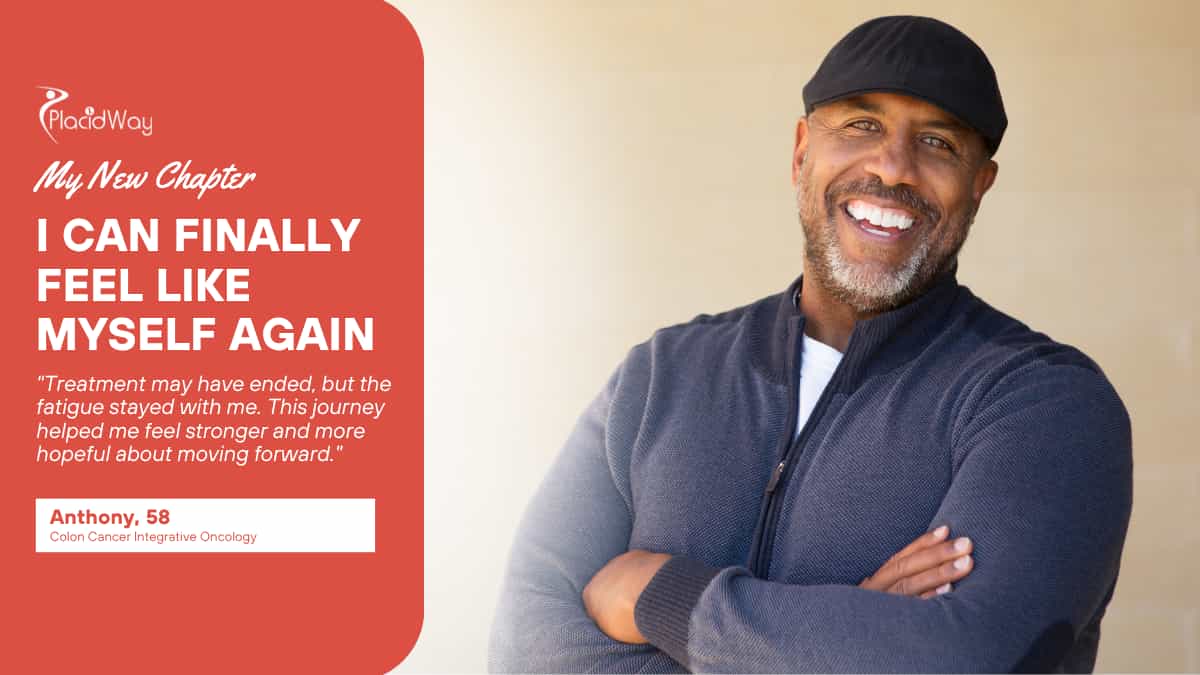
When Cancer Treatment Ended but the Fatigue Did Not: Anthony Rivera’s Colon Cancer Integrative Oncology Story from the United States to Mexico

Publish date: Aug 28, 2026 Medically reviewed by: Dr. Orhan Sencan on Aug 28, 2026 Author: Rizal Aditya

Anthony Rivera’s Colon Cancer Integrative Oncology Story 

Patient Profile

Name: Anthony Rivera

Age: 58

Condition: Colon cancer treatment sequelae including fatigue, pain and neuropathy

Treatment: Integrative oncology coordinated with conventional cancer care

Destination: Tijuana, Mexico

Journey at a Glance

Main problems: Severe chemotherapy/radiation side effects (nausea, fatigue, neuropathy, cognitive impairment); Immune system suppression post-treatment; Psychological distress and anxiety about recurrence; Unmanaged pain despite conventional pain management

Previous care: Conventional oncology treatment (surgery, chemotherapy, radiation); Out-of-pocket US-based acupuncture, massage, nutritional counseling; High-dose vitamin C infusions at private US clinics ($3,000–$5,000 per session)

Travel driver: Access to coordinated, affordable integrative oncology care unavailable or unaffordable in

Treatment explored: Integrative oncology coordinated with conventional cancer care

Personal goal: Manage treatment-related symptoms and recover daily function without replacing evidence-based oncology care.

You stopped scheduling morning meetings before ten o'clock.

You stopped carrying the heavy laundry basket up the stairs.

You stopped committing to weekend dinners with friends.

You agreed to wait three more weeks for the next blood test.

You accepted that waking up entirely exhausted is just how mornings work now.

You stopped asking the clinical nurse when the tingling in your fingers will finally go away.

You learned to politely nod when well-meaning colleagues suggest drinking more water.

You stopped telling your spouse how much your joints actually ache by mid-afternoon.

"You look so much better lately."

"I'm sure the fatigue will pass soon."

"You just need to give your body time."

Your world has quietly become smaller.

The hardest part is not the lingering pain or the out-of-pocket cost, but the inevitable requirement of the current system:

Waiting.

Meet Anthony Rivera.

Anthony Rivera is not a real PlacidWay client.

He is a fictional composite built from the exact situations, frustrations, and questions American cancer patients face every day.

He is fifty-eight and lives in a quiet suburb outside Phoenix.

Before the colon cancer diagnosis and the subsequent rounds of chemotherapy, he managed a regional logistics fleet.

He pitched batting practice to his ten-year-old grandson.

He drove six hours to the mountains without thinking about the stiffness in his back.

He remodeled his own kitchen over a single long weekend.

He explained the initial physical decline away as a temporary phase.

He told himself the neuropathy in his feet was just the result of a bad pair of shoes.

He reasoned that the sudden mid-day brain fog was just a symptom of poor sleep.

Acupuncture.

CBD oil.

Massage therapy.

Vitamin C packets.

Online support groups.

Functional medicine podcasts.

Meditation apps.

Standard post-treatment oncological care focuses primarily on monitoring for acute recurrence rather than the comprehensive management of chronic sequelae. This framework leaves many survivors reliant on fragmented, localized symptom management strategies that rarely address the compounding effects of treatment.

The verdict from his oncology team always arrives with the same reassuring finality:

"There is no evidence of active disease right now."

When?

The statistical reality of recovery rarely matches the lived experience.

Up to forty percent of cancer survivors experience significant, persistent chronic pain or profound fatigue long after their active, insurance-covered treatment concludes.

But Anthony Rivera does not experience the healthcare system as a national statistic.

He experiences it sitting in his own driveway for ten minutes before finding the physical energy to walk to the front door.

He experiences it watching his wife carry the heavy grocery bags while he leans heavily against the kitchen counter.

"I've got this bag, don't worry."

He experiences it staring blankly at a denial letter for an out-of-network nutritional counseling session.

"They said it isn't medically necessary."

He has already tried to be the perfect, patient consumer.

He spent weeks researching domestic integrative medicine programs near his home.

He mapped out the drive times to three different private wellness clinics in Scottsdale.

He paid completely out-of-pocket for two sessions of high-dose vitamin C infusions.

He filled out seventy pages of exhaustive intake forms for a local functional medicine doctor.

"I am not trying to cure anything."

"I just want my stamina back."

The fundamental framework of his daily life has shifted:

From "Can I tolerate this?" to "How much of my life am I prepared to organise around it?"

The local alternative fails on a very quiet mathematical reality.

The premier integrative oncology center in his city offers a beautiful facility and highly credentialed practitioners.

It is also completely disconnected from his insurance network.

A customized, domestically delivered program of IV nutrient therapy, oncology acupuncture, and specialized nutritional support costs roughly USD 28,000 for a three-month protocol.

Price alone should never answer a complex medical question.

But a medical solution you cannot realistically pay for is not actually a solution.

"We could pull it from the retirement account," his wife says quietly over morning coffee.

His response names the critical distinction:

"Being able to drain the savings doesn't mean we can afford it."

He isn't searching for a border crossing just yet.

How to repair immune system after chemotherapy

Integrative oncology programs near me

Out of pocket cost for cancer wellness programs

Mexico integrative cancer treatment cost

Tijuana oncology clinics legitimate

The internet algorithm inevitably begins serving targeted advertisements for integrative medical facilities located just across the border in Tijuana.

"I'm not going abroad just because something is cheaper."

His instinct to push back against the marketing is entirely correct.

Why does this specific destination keep appearing in the algorithm?

Mexico has developed a long-established infrastructure of private hospitals explicitly designed to cater to medical tourists from the United States and Canada, operating under different regulatory frameworks for the administration of complementary therapies.

The critical reframe requires abandoning generalities.

The question is never whether a country is good at medicine.

Countries do not administer specialized IV infusions.

Specific licensed clinicians do.

Coordinated medical teams do.

There is always something concrete and verifiable to investigate behind the glossy advertising.

US health authorities explicitly recommend that patients considering cross-border medical care take a specific preliminary step before committing:

Schedule a pre-travel consultation with your domestic physician.

His first question was exactly what yours would be.

Indicative pricing for a one-to-two-week intensive integrative oncology protocol in Tijuana commonly varies between USD 8,000–15,000, depending heavily on the specific IV modalities selected, lodging inclusions, and the extent of required diagnostic testing.

"If a deal looks too good to be true, it usually is."

"What exactly am I getting?"

Is the comprehensive initial bloodwork included in this base rate?
Are the IV vitamin C infusions dosed specifically for my current body weight?
How many acupuncture sessions are actually scheduled per week?
Does the quoted price cover my wife's daily meals at the clinic?
Who translates my domestic medical records for the local team?
Is the psychological support program led by a licensed clinical therapist?
Are the proprietary herbal supplements provided for my post-treatment recovery at home, or just while I am in the facility?
What exactly happens if I require emergency conventional care while inside the wellness facility?
Are the airport transfers from San Diego private, or will we be in a shared shuttle?
Does the quote include the processing fees for a medical crossing pass?
Is the three-month follow-up consultation via video included without additional charges?
Do I have a dedicated English-speaking case manager assigned to my file?

The prominently advertised number is only the very beginning of the conversation.

What does this kind of intensive program actually involve?

Integrative oncology is a patient-centered, evidence-informed field of cancer care that systematically utilizes mind and body practices, natural products, and lifestyle modifications alongside conventional cancer treatments. The primary aim is to optimize health, quality of life, and clinical outcomes across the cancer care continuum.

It is a grueling daily schedule of long infusions, radical dietary overhauls, and physical therapies, not a relaxing spa vacation.

"But how do I physically get there?"

The part the beautifully designed sales decks rarely put on the front page.

The unglamorous operational reality is defined almost entirely by the physical friction of international travel.

Guidance regarding the safety and efficacy of specific complementary therapies varies widely between professional medical societies, meaning patients often must navigate conflicting advice on their own while managing complex logistics.

The logistical constraints of getting to the clinic must be a foundational part of the medical plan before committing, not an afterthought.

"Wait. Does that mean I'm disconnected from my local oncologist?"

Possibly, depending entirely on your domestic doctor's willingness to review foreign medical records.

Who actually drives the rental car across the border?

How long is the typical medical lane wait at the San Ysidro crossing on a Monday?

What happens if profound fatigue hits hard during the short flight to San Diego?

Who is physically capable of carrying the heavy luggage into the facility?

Can the clinic's kitchen accurately accommodate a strict low-residue diet?

Are the hotel beds adjustable to accommodate severe lower back pain?

How strong is the facility's wifi for calling anxious family members back home?

What is the clinical protocol if I catch a high fever while traveling?

Where is the absolute nearest tertiary hospital to the wellness clinic in case of a severe reaction?

Is the immediate neighborhood around the clinic safe to walk in at night?

This isn't tourism in the usual sense.

His wife isn't just coming along for moral support.

She is the invisible second participant in the entire endeavor.

She is the secondary patient, the reliable memory bank, and the relentless logistics coordinator.

She will carry the massive three-ring binder of translated medical history.

She will notice if his breathing suddenly changes during a long IV infusion.

She will be solely responsible for knowing exactly who to call if something goes wrong in the middle of the night.

Standard US health insurance typically does not cover emergency complications arising from unapproved treatments received outside the country, making standalone medical travel complication insurance a critical, non-negotiable consideration for the family.

She is a vital part of the care system too.

Then comes the uncomfortable conversation about medical risk.

Traveling for complementary care shortly after major conventional treatment introduces distinct, non-trivial risks of opportunistic infection, deep vein thrombosis from travel, and dangerous care fragmentation.

Anthony Rivera quickly learns to aggressively distrust certain phrases from patient coordinators:

Completely safe. No risk. Guaranteed success.

Real informed consent means understanding the specific mechanisms of clinical failure, not just visualizing the hoped-for outcome.

The goal is not to convince you to go to Mexico.

Going abroad might be the absolute worst possible choice for your specific physical condition.

Anthony Rivera's questions eventually become much better.

He stops asking if the clinic is nice, and starts demanding clinical specifics.

How many American patients with my specific cancer stage have you treated this year?
Can I speak directly to the conventional oncologist on your staff before arriving?
What exact protocol do you follow if I react poorly to the targeted immune support infusion?
How do you practically coordinate with my primary doctor in Phoenix when I return?
What specific emergency equipment do you have on-site for sudden cardiac events?
Are your herbal protocols meticulously checked against my current prescription medications for dangerous interactions?
Who legally owns the clinic, and are they licensed medical doctors in Mexico?
Where exactly do you source your IV nutrients and compounds?
What is your strict clinical protocol for port-a-cath hygiene during daily infusions?
What specific marker would you see in my medical file that would make you tell me not to proceed?

He doesn't only want a doctor willing to perform the treatment.

He desperately wants a doctor willing not to.

Have I actually exhausted my practical options at home?

Patients possess the fundamental right to request alternative case managers, apply for hospital financial hardship programs, or seek formal second opinions within their regional networks before assuming supportive care is entirely unavailable.

Can my current oncology clinic formally refer me to a palliative care specialist for symptom management?
Does my existing insurance cover a licensed clinical social worker for the crippling anxiety?
Are there state-funded rehabilitation programs specifically designed for post-chemotherapy neuropathy?
Will my current doctor agree to coordinate with a local acupuncturist if I pay out of pocket?
Can we systematically adjust my current pain management dosage instead of seeking alternatives?

The alternative in Tijuana should be compared with Anthony Rivera's real alternatives at home, not with a worst-case assumption about the US healthcare system.

The night before the decision feels entirely different.

It is Thursday evening, and the kitchen table is covered in paper again.

The clinic's verified medical board credentials. The medical travel insurance exclusion list. The local IV therapy comparison spreadsheet. The video consultation question list.

"I think I know what I'm going to ask them."

"Let's go through the list one more time."

The exhaustive research didn't make him more afraid; it made him more capable of deciding.

What Anthony Rivera actually wants isn't a medical product at all.

"Why do you want to do this?" his daughter asks gently on Sunday.

The expected, polite answer is to feel a little bit better.

The real answer is brutally simple:

To walk up the driveway without stopping.
To sleep through the night without waking in a cold sweat.
To lift his grandson without wincing.
To stop feeling like a fragile glass object in his own home.
Not the clinic. Not the IV bags. Not the comprehensive package. Not Mexico.

Control.

And underneath that:

Agency.

This path might be the right answer, or it might not be.

Integrative oncology in Tijuana might genuinely be the answer he needs.

It might not be.

He might decide the profound fatigue of international travel is too high a physical price to pay.

He might finally find a local doctor willing to prescribe a cheaper, manageable supportive regimen.

He might discover his insurance will eventually approve the local physical therapy appeals.

He might decide he prefers the absolute safety net of his home hospital, even if it means enduring the side effects a while longer.

He might speak to the clinic in Mexico and simply dislike their communication style.

Any of those outcomes can be a perfectly sound, informed decision.

The goal is not to persuade you to cross a border, but to ensure that exhaustion with the current system does not automatically make the decision for you.

The path forward.

Maybe you've stopped scheduling meetings before ten o'clock too.

Maybe you've stared blankly at a very similar insurance denial letter.

Maybe you are deeply tired of being told to just give your recovery more time.

Maybe you are quietly wondering if there is a different way to navigate the aftermath of treatment.

Maybe you just want to feel somewhat like yourself again.

You do not need to decide today.

What exactly is my physical limit for travel right now?

Who would come with me, and are they fully prepared for the responsibility?

What does my local oncologist honestly think of this specific protocol?

Can I afford the financial worst-case scenario if something goes wrong abroad?

Am I running away from my local doctors, or running toward a clearly defined solution?

What is the minimum physical improvement I need to make this trip worthwhile?

What will I do if this alternative approach doesn't work either?

You are not just comparing clinic prices.

You are comparing paths forward.

Hope isn't the promise that everything will be magically fixed.

Hope isn't the promise that the crushing fatigue will vanish overnight.

It isn't the promise that a single clinic in Mexico holds a secret cure your doctors missed.

It isn't the promise that the road back to normal will be easy.

Hope is having enough transparent information to make a medical decision that actually feels like yours.

It is knowing exactly what questions to ask. It is knowing exactly when to say no. It is demanding absolute clarity over comforting sales pitches. It is finally trusting your own competence as a patient.

The narrative eventually changes:

From "I suppose I'll just have to keep waiting."

To the only question that matters:

"What other informed options do I have?"

PlacidWay — Your Way to Hope.

PlacidWay helps patients systematically explore global medical options, compare international facilities, and prepare the exact questions needed for a rigorous medical consultation. We provide the framework for understanding complex cross-border care landscapes, but we never offer clinical advice or guarantee medical outcomes. For someone navigating the aftermath of cancer treatment, an integrative oncology program in Tijuana isn't a guaranteed promise; it is simply one route worth understanding fully before making a choice.

Your Way to Hope.

Medical disclaimer

This article is strictly educational and does not recommend that any individual undertake medical travel or specific medical treatments. Individual clinical suitability and travel risk require direct professional assessment. The reader must consult their own primary care clinician or oncologist, independently verify the current regulatory status of any international facility, and obtain appropriate medical travel protection or insurance before proceeding.

When Cancer Treatment Ended but the Fatigue Did Not: Anthony Rivera’s Colon Cancer Integrative Oncology Story from the United States to Mexico

About Article

  • Treatment: Cancer Treatment
  • Country: Mexico
  • Overview This educational overview follows Anthony Rivera, a composite American patient exploring Integrative Oncology in Tijuana, Mexico. It summarizes daily-life effects, previous care and why treatment abroad is being considered. Candidacy, safety, recovery and follow-up remain central to informed decision-making.

Trusted Medical Tourism Platform Since 2007

60+
Countries
2k+
Clinics
19.5k+
Reviews
2.5k+
Qualified Doctors
1.1M+
Patients Served Since 2007