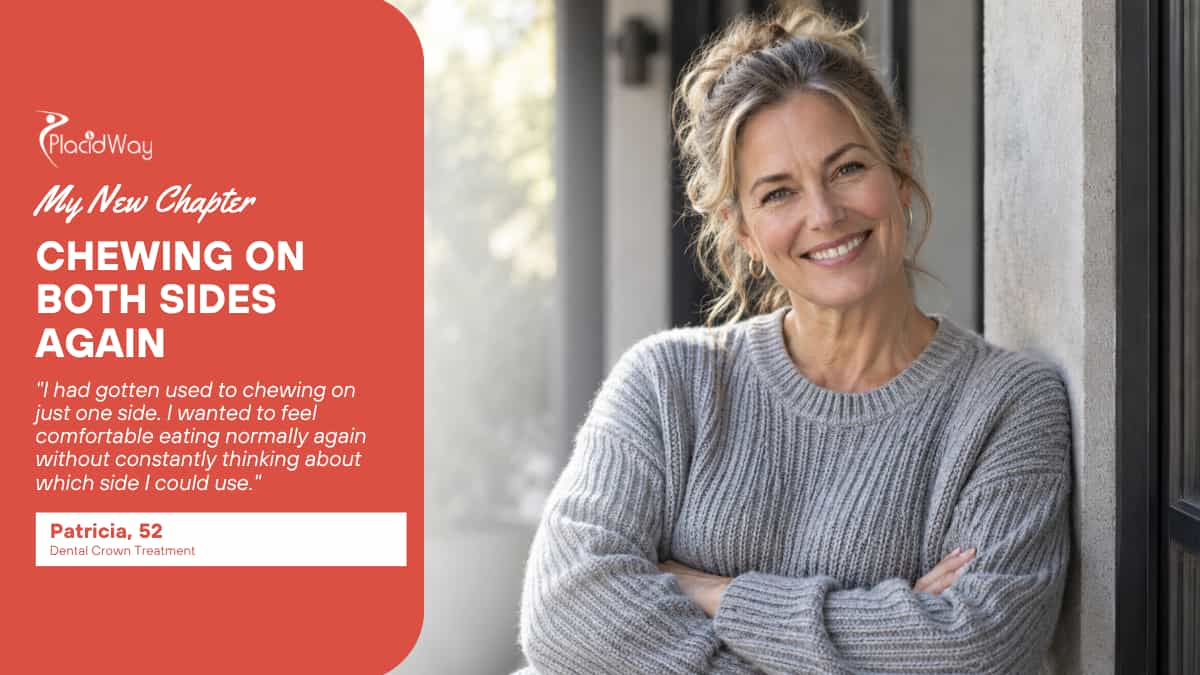
Chewing on One Side Became Patricia Johnson’s New Normal Before Dental Crown Treatment in Medellin from the United States

Publish date: Modified date: Medically reviewed by: Dr. Octavio Delacruz on Sep 14, 2026 Author: Rizal Aditya

Dental Crown Treatment in Medellin from the United States 

Patient Profile

Name: Patricia Johnson

Age: 52

Condition: Severe tooth decay requiring restorative intervention

Treatment: Comprehensive dental crown restoration

Destination: Medellin, Colombia

Journey at a Glance

Main problems: Cracked and severely decayed molars causing chronic pain; difficulty chewing hard foods; out-of-pocket costs of USD 2,700 after exhausted insurance maximums.

Previous care: OTC pain management; chewing exclusively on one side of the mouth; negotiating unsuccessful payment plans with local dentists; researching discount dental plans.

Travel driver: Escaping percentage-based insurance gaps and securing necessary restorative care without sacrificing family savings.

Treatment explored: Full-coverage dental crowns (zirconia or porcelain-fused-to-metal) with digital imaging and placement.

Personal goal: Regain the ability to eat and socialize comfortably without incurring debilitating debt.

You gave up the ice water first.

Then you started chewing exclusively on the left side of your mouth.

You declined the roasted almonds at the party.

You began ordering the soup instead of the steak.

You started smiling with your lips firmly closed in photographs.

You learned to brush your back teeth with terrifying gentleness.

You woke up to a dull, familiar throbbing in your jaw.

You checked your bank balance before daring to call the clinic.

"I just have a little sensitivity."

"It's probably just a sinus thing."

"I'll get it looked at after the holidays."

Your world has quietly become smaller.

The hardest part is not the physical pain or the looming cost, but the waiting.

You have learned the quietest lesson of all:

Your world has quietly become smaller.

Reclaiming Your Smile: Why Americans Are Choosing Medellin for Affordable Dental Crowns

Meet Patricia Johnson.

Patricia Johnson is not a real PlacidWay client.

She is a fictional composite built entirely from the specific situations, financial constraints, and quiet frustrations that middle-income Americans face every single day.

She is 52 years old.

She lives in rural Kentucky.

You know exactly what has changed:

The geography of her own mouth.

She manages a busy local hardware store.

She sings in the community choir.

She saves diligently for her first grandchild's college fund.

She used to move through the world with one primary assumption:

That her body would keep up with her.

The escalation of a quiet ache.

It started as a twinge on a Tuesday afternoon.

She explained it away as a popcorn kernel stuck in her gum.

Advil.

Orajel.

Warm salt water rinses.

Clove oil on a cotton swab.

Avoiding hot coffee entirely.

Canceling a dinner date with friends.

Comprehensive dental crown restorations are the standard clinical remedy when severe decay or structural damage compromises a tooth's integrity, typically recommended to prevent imminent tooth loss and dangerous localized abscesses .

The dentist's verdict is unequivocal:

"Two full-coverage crowns, as soon as possible."

When?

The weight of a national statistic.

Over half of American adults with private dental insurance encounter restrictive annual benefit caps, often set around USD 1,200 to USD 1,500, which barely cover basic preventive care and leave patients fully exposed to the costs of major restorative work .

But Patricia doesn't experience the U.S. dental system as a national statistic.

She experiences it in the pharmacy aisle, weighing a heating pad against stronger over-the-counter pain relievers.

"Is this the strongest one you carry?"

She experiences it at the family dinner, pushing a piece of roast beef around her plate.

"I'm just not very hungry tonight, thank you."

She experiences it sitting in her car outside the clinic, looking at a printed estimate of USD 3,600.

"My insurance is only going to cover nine hundred dollars."

The reality of the insurance policy is stark:

A maximum annual benefit that hasn't changed since 1998.

She has already tried to be patient.

People in this position are rarely impatient consumers or careless shoppers.

She negotiated payment plans with three different local dentists.

She sought out sliding-scale community health centers, only to find a six-month waitlist.

She researched discount dental plans that ultimately excluded major restorative crowns.

She explored temporary dental bonding, learning quickly it was purely cosmetic.

She delayed a much-needed knee procedure just to hoard her sick leave.

"I just need to hold on a little longer."

"Maybe I can get a second job for the winter."

She realizes the old question has expired.

The shift in her thinking is profound:

From "Can I tolerate this?" to "How much of my life am I prepared to organise around it?"

The nearer alternative at the kitchen table.

The conventional option at home is straightforward but paralyzing.

She could finance the USD 2,700 out-of-pocket gap using a high-interest medical credit card.

This path fails not because she lacks credit, but because taking on debt would mean halting her contributions to her grandchild's college fund.

It is the insidious difference between technically being able to pay for something and actually being able to afford it.

Her husband Tom looks at the kitchen table and sighs:

"We can pay for it, but we can't afford it."

She isn't searching for Medellin yet.

Her early late-night research is purely domestic.

Tooth nerve pain relief fast
Cheapest dental crowns in Kentucky
Dental schools near me taking patients
Can a cracked molar heal itself
Mexico dental work prices
Affordable dental care in Colombia

Then the destination enters the discussion.

She looks at the screen with intense skepticism.

"I'm not going abroad just because something is cheaper."

Her instinct is entirely correct.

Price should never be the factor that answers a clinical or medical question.

Why does Medellin keep appearing?

Medellin keeps appearing because it has deliberately built a regulated infrastructure for international healthcare over the past decade.

The Colombian Ministry of Health enforces stringent operational and sterilization standards that parallel North American requirements for accredited facilities .

But the necessary reframe is crucial.

The question is never whether a country is good at dentistry.

Countries do not prepare teeth.

Individual clinical teams do.

There is something highly specific and concrete to verify.

The CDC explicitly advises traveling patients to independently verify the specific credentials, facility accreditation, and infection control protocols of their chosen provider before booking flights .

Her first question was: "How much?"

The indicative cost for a dental crown in Medellin commonly varies between USD 400–700 per tooth, driven by the choice of material—such as zirconia versus porcelain-fused-to-metal—and the specific technology utilized by the clinic .

"If a deal looks too good to be true, you need to read the fine print."

"What exactly am I getting?"

Is the initial consultation included?

Does the quote cover the 3D panoramic x-rays?

Are the temporary crowns billed separately?

What specific brand of zirconia is being used?

Is the local anesthesia included in this flat rate?

Does this cover the final fitting and bite adjustment?

Are there additional fees for the dental laboratory expediting the crown?

What happens if the tooth requires an unexpected root canal before the crown is placed?

Is ground transportation from the airport part of the package?

Does the clinic provide an English-speaking patient coordinator?

Are post-operative medications included in the cost?

Who pays for the extra hotel nights if the lab needs more time?

The advertised number is only the beginning of the conversation.

What does a dental crown actually involve?

Comprehensive crown restoration requires precise physical intervention.

The dentist reduces the compromised tooth to create a stable abutment, takes digital or physical impressions, and bonds a custom-fabricated prosthetic cap to restore full anatomical function and occlusal harmony .

"How long do I actually have to stay?"

The part the brochures rarely put on the front page.

The unglamorous operational reality is that international dental care is exhausting.

Official guidance on recovery times varies wildly depending on whether a lab operates on-site or off-site, and that variation itself is the most important lesson.

This geographic constraint must be part of the logistical plan before committing, not an afterthought discovered on day three.

Going abroad is a logistical burden that demands more energy, not less, and it is not a suitable path for everyone.

"Wait. Does that mean I might be stuck in a hotel room in pain?"

Possibly, depending on how your body responds to the initial tooth preparation.

Who is going to pick up soup from the local grocery store?

How reliable is the hotel's Wi-Fi if I need to stream a movie while my mouth is numb?

What if my temporary crown falls out while I'm eating dinner in the city?

Can I easily contact the dentist on a Sunday?

Do I have the physical stamina to navigate an airport two days after a dental procedure?

Are the local pharmacies open late if I need a different mouthwash?

What is the specific emergency protocol if I develop a fever?

Will the altitude in Medellin affect my sinus pressure after the dental work?

How comfortable is the hotel bed for someone who needs to sleep propped up?

This isn't tourism in the usual sense.

The true cost of travel is measured in a different currency:

Your physical resilience during recovery.

It requires stamina, preparation, and an acceptance of profound inconvenience.

Tom isn't just coming along.

He is the invisible second participant in this medical journey.

He will carry the passports, remember the dosage times for the antibiotics, notice if Patricia is shivering, and be responsible for communicating with the clinic if she cannot speak clearly.

He needs to know exactly what the escalation protocol is if something goes wrong in the middle of the night.

Standard travel insurance frequently excludes complications arising from elective medical or dental procedures undertaken abroad, requiring specialized medical tourism coverage .

He is part of the care system too.

Then comes the uncomfortable conversation about risk.

All invasive dental work carries inherent physiological risks, including localized infection, nerve damage requiring subsequent endodontic therapy, or mechanical failure of the prosthetic crown .

She learns to instantly distrust certain phrases on clinic websites:

Completely safe. No risk. Guaranteed success. Permanent fix.

Informed consent means understanding far more than just the hoped-for outcome.

Patricia's questions become better.

Her initial worries fade into highly specific clinical demands.

What is the exact infection rate at your specific facility over the last year?
Can I see the sterilization room during my first visit?
Where did the attending prosthodontist complete their specialty training?
What happens if the crown cracks six months after I return to Kentucky?
Do you use a recognized international brand for your zirconia blocks?
Will I be provided with my complete dental records and x-rays in English?
How many identical procedures has this specific dentist performed this month?
What is the protocol if my bite feels misaligned right before my flight home?
Are your digital impression scanners calibrated weekly?
What would you see on my x-ray that would make you tell me not to proceed?

She doesn't just want a dentist who is eager to take her case, but one who possesses the clinical integrity to tell her not to proceed if she is a poor candidate.

She doesn't only want someone willing to do it.

She wants someone willing not to.

Have I exhausted my options at home?

Patients maintain the explicit right to request detailed out-of-pocket estimates and challenge insurance claim denials through formal appeal processes before looking elsewhere .

Is there any way to code this differently for the insurance provider?

Can we use a less expensive material without compromising the tooth?

Are there any upcoming clinical trials at the state dental school?

Could a partial crown or onlay suffice instead of full coverage?

Will my local dentist agree to perform standard cleanings if I get the crowns done abroad?

Medellin should be compared with Patricia's real alternatives, not with a worst-case assumption about the home system.

The night before the decision.

The kitchen table is entirely covered.

The printed itinerary for the direct flight from Miami. The translated credentials of the Colombian prosthodontist. The itemized quote for two zirconia crowns. The confirmation of the specialized travel insurance policy. The mapped distance between the recovery hotel and the clinic.

"I think we actually have all the pieces now."

"I think we do, too."

The research didn't make her more afraid; it made her more capable of deciding.

What Patricia actually wants isn't a dental crown.

Her sister asks if she's excited to finally get her teeth fixed.

Patricia gives the expected answer about saving money.

But the real answer is entirely different:

THE ABILITY TO EAT A STEAK WITHOUT FLINCHING.
Smiling with her teeth showing in the family Christmas photo.
Sleeping through the night without a dull ache in her jaw.
Protecting the savings account meant for her granddaughter.
Not the zirconia material. Not the clinic in Medellin. Not the all-inclusive travel package. Not the dental crown itself.

Relief.

And underneath that:

Control.

Medellin might be the answer. It might not be.

She might secure a sudden approval on her insurance appeal.

She might find a local dental school with an unexpected opening.

She might decide the logistical stress of travel outweighs the financial savings.

She might realize she isn't comfortable leaving her hardware store for a week.

She might choose a different international destination entirely.

She steps forward only when the facts align with her tolerance for disruption.

Any of those can be an informed decision.

Our goal here is not to persuade you to board a plane, but to make sure that financial frustration doesn't make the decision for you.

You have time to figure this out.

Maybe you've been eating exclusively on the left side of your mouth for a year.

Maybe you've memorized exactly how much your insurance policy won't pay.

Maybe you've felt the distinct shame of hiding your smile behind your hand.

Maybe you've stared at a quote from your local dentist that felt like a ransom note.

Maybe you've started wondering if there is a different way to solve this.

You do not need to decide today.

What exactly is the current state of my underlying tooth decay?

What is my absolute maximum budget for this repair?

Do I have the physical and emotional bandwidth to travel right now?

Who in my life could support me during a recovery abroad?

What does my local dentist think of my travel plan?

Am I choosing this out of panic, or out of strategy?

What happens if I simply do nothing for another six months?

Not just prices.

Paths forward.

Hope isn't the promise that a cheap flight will fix everything.

Hope isn't the promise that a cheap flight will solve a complex medical problem.

Hope isn't a glossy brochure featuring a perfect smile on a beach.

Hope isn't ignoring the real risks of international medical travel.

Hope is having enough verified information to make a decision that feels like yours.

The capability to ask difficult clinical questions.

The capability to walk away from a hard-sell tactic.

The capability to demand transparency in pricing.

The capability to involve your family in the logistical planning.

The capability to reclaim your own physical comfort.

The shift is quiet but absolute:

From "I suppose I'll just have to keep waiting." to "What other informed options do I have?"

PlacidWay — Your Way to Hope.

PlacidWay helps individuals explore international healthcare options, compare accredited facilities, and prepare the rigorous questions required for cross-border medical travel.

We do not provide clinical advice, medical diagnoses, or guarantee any specific treatment outcomes.

For someone in Patricia's position, Medellin isn't a promise of perfection, it is one heavily researched route worth understanding.

Medical disclaimer

This article is strictly educational and does not recommend that any individual undertake cross-border medical or dental travel. Individual suitability and clinical risk require professional assessment. Readers should always consult their own qualified clinician or domestic healthcare adviser before making medical decisions, independently verify the current regulatory status of any international provider, and obtain appropriate medical travel protection or insurance.


Chewing on One Side Became Patricia Johnson’s New Normal Before Dental Crown Treatment in Medellin from the United States

About Article

  • Treatment: Dentistry
  • Country: Colombia
  • Overview Patricia Johnson now chews on one side because cracked, decayed molars cause pain and her dental benefits are exhausted. Medellin enters her search for crown restoration at a manageable total cost. The plan starts by determining whether each tooth can be saved and whether root-canal or periodontal care is needed, followed by material choice, bite design, laboratory standards, appointment timing and access to repairs at home.

Trusted Medical Tourism Platform Since 2007

60+
Countries
2k+
Clinics
19.5k+
Reviews
2.5k+
Qualified Doctors
1.1M+
Patients Served Since 2007