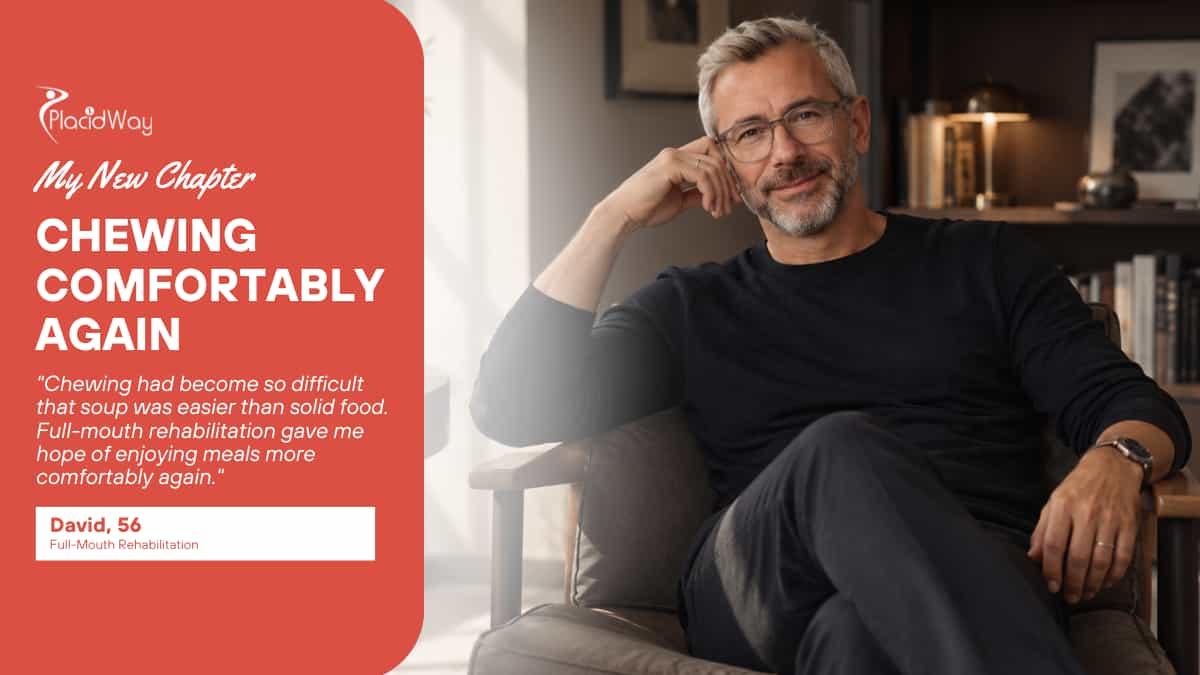
Soup Became Easier Than Chewing for David Wilson: An American Patient’s Full-Mouth Rehabilitation in Costa Rica

Publish date: Medically reviewed by: Dr. Octavio Delacruz on Sep 10, 2026 Author: Rizal Aditya

American Patient’s Full-Mouth Rehabilitation in Costa Rica 

Patient Profile

Name: David Wilson

Age: 56

Condition: Severe generalized dental caries and periodontal disease requiring full-mouth rehabilitation

Treatment: Full-mouth rehabilitation (dental implants, bone grafting, crowns/bridges)

Destination: San Jose, Costa Rica

Journey at a Glance

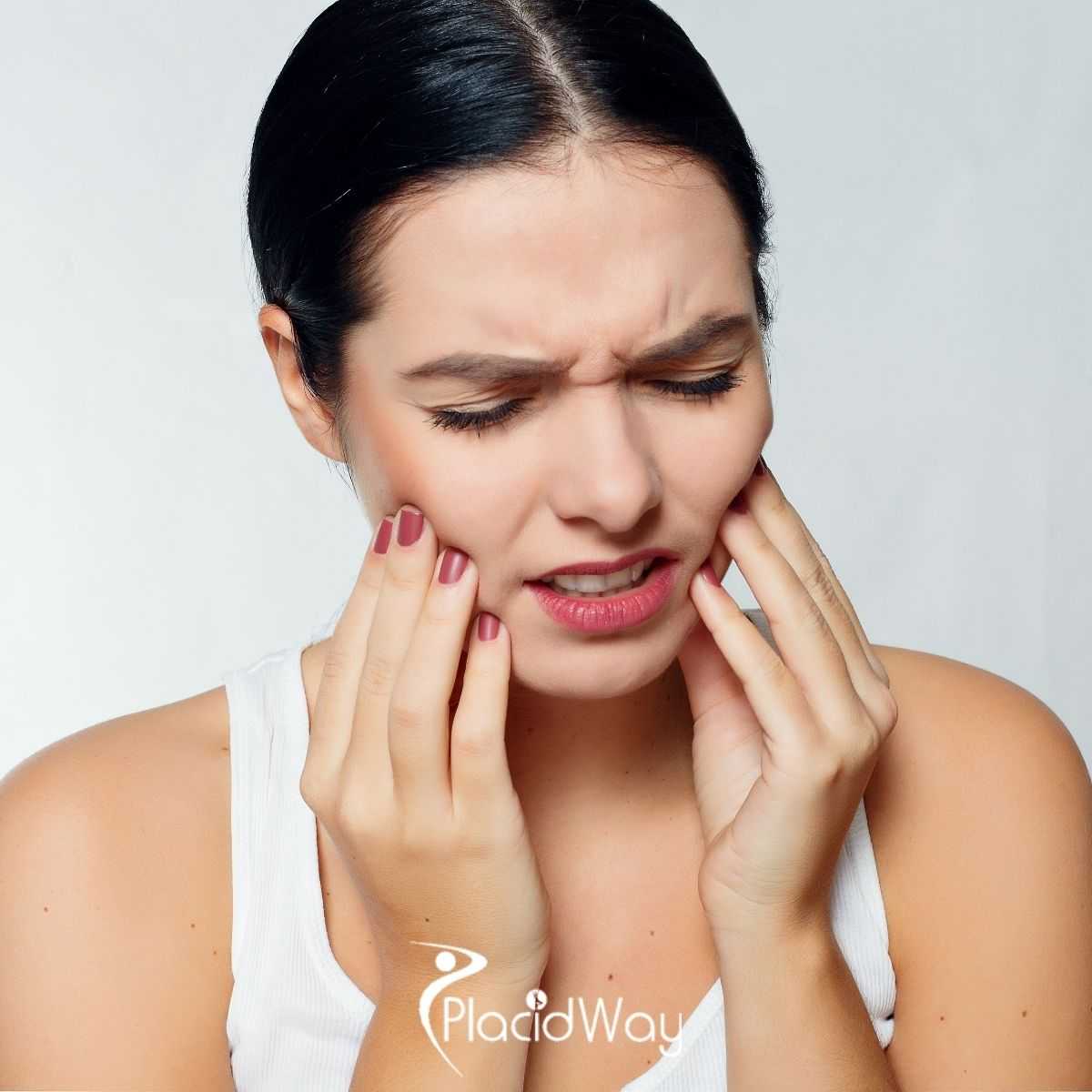
Main problems: Missing or severely decayed teeth; difficulty chewing and eating solid foods; speech changes; visible gaps causing deep social embarrassment; mounting costs from failing partial fixes.

Previous care: Extracted problem teeth; attempted to manage with ill-fitting partials; exhausted annual dental insurance maximums; sought U.S. financing only to be quoted USD 35,000–60,000+.

Travel driver: Seeking comprehensive, specialist-led full-mouth rehabilitation to restore function without permanently crippling his retirement savings.

Treatment explored: Full-mouth rehabilitation combining extraction, implant placement, and prosthetic integration over 1–3 visits spanning 6–12 months.

Personal goal: Regain the ability to eat, speak, and smile with dignity while maintaining financial independence.

Reclaiming Your Smile: How Americans Are Rebuilding Their Teeth and Confidence in Costa Rica

You start by chewing only on the left side.

You tell yourself the failing bridge will hold together for just one more year.

You stop ordering steak when you take your partner out to dinner.

You learn to smile without ever parting your lips.

You begin avoiding family photographs entirely.

You decline invitations to extended holiday gatherings.

You practice speaking carefully so the growing gaps do not show.

You stop looking at your own reflection in the rearview mirror.

"You're just quiet tonight," your daughter says.

"I'm just tired," you reply.

"We can leave early," your spouse offers.

Your world has quietly become smaller.

The hardest part is not the mounting physical pain, but the endless waiting.

David Wilson is not a real patient.

He is a fictional composite built entirely from the specific situations, financial realities, and medical questions you may currently face.

David is fifty-six years old and lives in rural Oklahoma.

He manages a local hardware store.

He unloads heavy pallets of soil in the morning.

He helps his neighbors fix their plumbing leaks in the afternoon.

He sweeps the wide concrete aisles before locking up at dusk.

The steady escalation of a problem you cannot ignore.

He explained the dull throb away as a passing sinus headache.

A filling replaced.

A crown cemented.

A root canal financed.

A molar extracted.

A partial denture fitted.

A second extraction.

Silence.

According to the American Dental Association, full-mouth rehabilitation utilizing dental implants is typically indicated when severe generalized decay or advanced periodontal disease has compromised the majority of the dentition, rendering conservative partial restorations unviable .

He watched his reality narrow down to one undeniable fact:

"You need comprehensive reconstruction."

When?

You are not the only one fighting this battle.

Nearly one in six adults over the age of sixty-five in the United States has lost all of their teeth, while millions more face severe partial tooth loss that basic insurance policies will routinely refuse to cover .

But David doesn't experience the domestic dental economy as a national statistic.

He experiences it standing in the employee breakroom, pouring his morning coffee in complete silence.

"Did you want a bagel, Dave?"

He experiences it flipping through a dated magazine in the waiting room while his wife drives.

"Are you going to ask them about a payment plan this time?"

He experiences it reviewing his retirement account balance at midnight in the dark.

"We can push the roof repair to next spring."

He has already tried to be patient.

He is not an impulsive consumer looking for a quick cosmetic shortcut.

He has maximized his corporate dental insurance every single year for a decade.

He has absorbed the punishing eighteen percent interest rates on medical credit cards.

He has sat in crowded discount clinics hoping for temporary patches.

He has endured the physical toll and blistered gums of mismatched partials.

"I just need a few more years out of these teeth."

"I can't keep doing this every six months."

He has watched his core question shift:

From "Can I tolerate this?" to "How much of my life am I prepared to organise around it?"

The domestic alternative works flawlessly for those who can afford it.

Domestic full-mouth reconstruction is the obvious, standard clinical path.

The medical infrastructure in his home state is undeniably excellent.

The local prosthodontist is highly credentialed and conveniently located twenty minutes from his house.

But the treatment plan estimate sits heavily on the kitchen table at USD 48,000.

The barrier is not a lack of trust in American dentistry.

The barrier is the fragile mathematics of a middle-class retirement.

"We could take out a home equity loan," his wife Sarah says softly.

"We can't afford what it does to our retirement," David answers.

He isn't searching for Costa Rica yet.

Fix failing dental bridge options.

How to eat properly with missing back teeth.

Full mouth dental implants actual cost.

Cheapest state for major dental work.

Dental implants Mexico or Costa Rica.

The search algorithms inevitably begin serving him targeted advertisements for clinics in San Jose.

His instinct tells him exactly what to think:

"I'm not going abroad just because something is cheaper."

His instinct is entirely correct.

Price should never answer a surgical question.

Why does San Jose keep appearing in his research?

Costa Rica has spent over two decades building a mature, regulated medical tourism infrastructure specifically designed to accommodate North American dental patients.

The country's national health authorities actively oversee private clinics, many of which voluntarily seek out rigorous independent international benchmarks for quality and sterilization .

But a geographic border does not guarantee clinical competence.

Countries do not perform complex oral surgeries.

Individual prosthodontists do, dedicated surgical teams do, and accredited clinics do.

There is always a concrete professional history to verify before boarding a plane.

The Centers for Disease Control and Prevention formally advises prospective medical tourists to independently verify international facility credentials and consult their home provider before traveling .

His first question was obviously about the money.

Indicative pricing for full-mouth rehabilitation in San Jose commonly ranges between USD 8,000–16,000, depending heavily on the need for preliminary bone grafting and the specific implant system utilized by the surgeon .

If a deal looks too good to be true, it usually is.

"What exactly am I getting?"

Does this initial quote include the necessary cone-beam CT scans?
Are the required tooth extractions billed separately per tooth?
Is the synthetic bone grafting material fully included?
Who actually manufactures these specific titanium posts?
Are the temporary acrylic prosthetics included in the first surgical phase?
How many days of necessary intravenous antibiotics are covered?
Are the abutments custom-milled for my jaw or merely stock parts?
What exact material is being used for the final permanent arch?
Is the local anesthesiologist billed as a separate daily fee?
Does this package cover the local laboratory fabrication costs?
Are the airport transfers and daily clinic shuttles part of the agreement?
What happens to the total cost if a single implant fails to integrate?

The advertised number is only the beginning of the conversation.

What does full-mouth rehabilitation actually involve?

The procedure requires the extraction of remaining compromised teeth, the surgical placement of multiple titanium posts deeply into the jawbone, and a mandatory healing period of several months before permanent ceramic or zirconia arches can be securely attached .

"How do I eat while I'm waiting for the permanent teeth?"

The part the glossy brochures rarely put on the front page is the recovery.

Dental reconstruction is not a weekend vacation.

It is a multi-stage surgical intervention requiring prolonged, careful physical recovery.

Current guidance regarding the required healing time for osseointegration varies widely between three to six months depending on individual bone density and the grafted volume involved .

That clinical variation itself is the lesson.

This biological constraint must be built into your logistical plan before committing, not afterward.

"Wait. Does that mean I have to fly back to Costa Rica twice?"

Possibly, depending on the immediate loading protocols your unique anatomy safely allows.

Can I take a total of three weeks off work this year?

Who will manage the hardware store while I am recovering away from home?

Can I genuinely tolerate soft foods for four straight months?

What happens if I develop an infection after returning to Oklahoma?

Will my local dentist agree to perform basic maintenance on foreign dental implants?

Do I have an active passport ready for international travel?

Can I handle the physical exhaustion of flying seventy-two hours after major oral surgery?

How will I reliably communicate with the Costa Rican clinic during the healing phase?

Is there a local periodontist willing to take my case if a serious complication arises?

This isn't tourism in the usual sense.

Sarah isn't just coming along for the ride.

She is the invisible second participant in this massive medical journey.

She will carry the heavy luggage through the terminal when he cannot lift it.

She will remember the strict post-operative medication schedule.

She will notice if his facial swelling is increasing rather than decreasing.

She will be solely responsible for navigating the hotel corridors and communicating with the local concierge.

She needs to know exactly what to do if an unexpected emergency occurs.

The U.S. Department of State formally advises travelers undergoing procedures abroad to secure specific medical evacuation insurance, as standard travel policies universally exclude planned surgeries .

She is part of the clinical care system too.

Then comes the uncomfortable conversation about risk.

All oral surgical interventions carry inherent risks of severe infection, permanent nerve damage, sinus perforation, and catastrophic implant failure .

David learns to instantly distrust specific phrases:

Completely safe. No risk. Guaranteed success. The perfect solution.

The goal of clinical research is never to persuade you to undergo a procedure.

Informed consent means understanding the mechanics of clinical failure just as clearly as the hoped-for outcome.

David's questions become drastically better.

He no longer asks if they can fix his smile; he asks how they manage complications.

How many full arches did this specific surgeon successfully place last month?
Can I speak directly with a former patient who experienced a complication?
What brand of implants do you use, and are the replacement parts readily available in the US?
Who financially pays for the revision surgery if a titanium post fails in the first year?
Is the surgical facility physically attached to an accredited hospital?
What is your exact protocol for managing severe post-operative pain?
How do you physically verify my jaw bone density before I book a flight?
Who precisely will be fabricating my permanent teeth in the laboratory?
Do I have direct communication access to the surgeon after returning home, or only a coordinator?
What happens if my biological healing takes six months instead of four?

They do not only want someone willing to perform the surgery:

They want someone willing not to.

You should not proceed if a clinical protocol feels rushed or purely transactional.

Have I truly exhausted my options at home?

Before looking outward, David must look closely at what he is leaving behind.

Certain states and federal programs maintain specific hardship exceptions for medically necessary oral surgeries, though standard Medicare continues to explicitly exclude routine dental reconstruction .

Is there a university dental school within driving distance that takes complex patient cases?

Will my current dentist offer a phased treatment plan spread over three years?

Can my standard medical insurance cover the extractions and bone grafts, leaving only the implants out-of-pocket?

Are there local community grant programs for seniors requiring functional reconstruction?

What is the absolute minimum surgical intervention required to safely restore my chewing function?

The realization shifted his entire perspective:

Costa Rica should be compared with David's real alternatives, not with a worst-case assumption about the home system.

The night before the final decision.

The kitchen table is covered once again.

A printed email thread from a clinic coordinator in San Jose.

A freshly signed U.S. passport application.

A worn notebook filled with scribbled timelines.

A local prosthodontist's initial estimate.

A required medical clearance form from his primary cardiologist.

"You seem calmer than you did last month," Sarah observes.

"I finally know what we're actually dealing with," David replies.

The exhaustive research didn't make them more afraid; it made them more capable of deciding.

What David actually wants isn't dental implants.

"Are you excited to get your teeth fixed?" his sister asks over the phone.

"I'm just ready to get it over with," is the expected, tired answer.

The real answer is entirely different:

He wants to order a steak.

He wants to smile proudly in his daughter's wedding photos next year.

He wants to speak to his hardware store customers without constantly covering his mouth.

He wants to stop frantically calculating the lifespan of his remaining molars.

Not the threaded titanium posts. Not the polished zirconia crowns. Not the all-inclusive medical tourism package. Not Costa Rica.

Dignity.

And underneath all of those practical desires:

Freedom.

San Jose might be the answer, but it might not be.

He might ultimately decide the travel logistics are simply too demanding.

He might choose to adapt to a removable partial denture in Oklahoma instead.

He might realize his specific bone density requires a domestic specialist's immediate intervention.

He might find a local dental university that sufficiently reduces the domestic cost burden.

He might choose to tolerate the discomfort and wait another year to save more cash.

If he does book the flight, he does so knowing exactly what the surgical timeline requires of his body.

Any of those outcomes can be an informed, respectable decision.

Do not let financial exhaustion make a medical decision for you.

The goal of this research isn't to persuade you, it is to make sure deep frustration doesn't make the decision for you.

Where does your research go from here?

Maybe you have already maximized your own annual insurance limits.

Maybe you have memorized the staggering cost of single implants in your hometown.

Maybe you are tired of hiding your smile in every family photo.

Maybe you are dreading your next inevitable toothache.

Maybe you are simply exhausted from waiting for the situation to magically improve.

You do not need to decide today.

Is my current situation physically sustainable for another year?

What exact clinical procedure do my local dentists say I desperately need?

Who will provide local care for me when I return home?

Am I genuinely healthy enough for international travel and extensive oral surgery?

What does a failed implant abroad mean for my remaining finances?

Can my partner handle the intense travel logistics if I am recovering?

Am I willing to do the necessary, demanding independent research?

You are no longer just comparing prices.

You are comparing paths forward.

Hope isn't the promise that your teeth will be easily fixed.

Hope is not a glossy, retouched brochure from a clinic in San Jose.

Hope is not a guaranteed, effortless surgical outcome.

Hope is not the magical erasure of all medical risk.

Hope is having enough accurate, unvarnished information to make a decision that finally feels like yours.

You are capable of asking the hard, uncomfortable questions. You are capable of demanding transparent, documented answers. You are capable of saying no to a clinic coordinator that rushes you. You are capable of fiercely protecting your own health. You are capable of rebuilding your life on your own terms.

His internal monologue finally shifts from "I suppose I'll just have to keep waiting:"

"What other informed options do I have?"

PlacidWay — Your Way to Hope.

PlacidWay helps patients deliberately explore international medical options, compare facility credentials, understand logistical requirements, and prepare the critical questions needed for independent consultations. PlacidWay does not provide clinical advice, endorse specific surgical outcomes, or practice medicine. For someone like David, Costa Rica isn't a promise, it is one route worth understanding thoroughly before taking the next step.

Medical disclaimer

This article is strictly educational and does not recommend that any individual undertake travel for dental reconstruction or oral surgery. Individual suitability, bone density requirements, and surgical risk require direct professional assessment. Readers should always consult their own primary clinician, thoroughly verify current international regulatory status independently, and obtain appropriate medical evacuation insurance before traveling.

Soup Became Easier Than Chewing for David Wilson: An American Patient’s Full-Mouth Rehabilitation in Costa Rica

About Article

  • Translations: EN ES
  • Treatment: Dentistry
  • Country: Costa Rica
  • Overview David Wilson relies on failing partial fixes as decay, missing teeth and periodontal disease make solid food difficult. US estimates of USD 35,000–60,000 lead him to compare full-mouth rehabilitation in San Jose. The sequence may include extractions, implants, bone grafting and crowns, so diagnosis, temporary teeth, healing trips, material choice, hygiene and long-term maintenance need to be mapped before treatment.

Trusted Medical Tourism Platform Since 2007

60+
Countries
2k+
Clinics
19.5k+
Reviews
2.5k+
Qualified Doctors
1.1M+
Patients Served Since 2007