

Evaluating Medical Tourism in Azerbaijan for Your Care Journey
A couple sits at their kitchen table in the UK, sorting through a folder of clinical records and flight schedules to Baku. They have exhausted local fertility protocols and are now mapping out a time-sensitive IVF cycle that requires them to synchronize international travel with strict biological windows. Their focus is not on sightseeing, but on medication timing, clinical communication across time zones, and the hope of a successful embryo transfer.
A professional from Kazakhstan takes a different path, scheduling a rhinoplasty in Azerbaijan during a carefully negotiated leave of absence from work. They are balancing the appeal of specialized aesthetic surgeons with the practical reality of recovering in a hotel room. Their primary concern is securing flight clearance before returning home, managing post-operative swelling, and ensuring follow-up care can be handled remotely.
Meanwhile, an expatriate based in the Middle East is coordinating a full-mouth dental implant restoration, mapping out a multi-stage process that will require at least two separate visits. They are weighing the lower upfront cost of clinical care against the compounding expenses of multiple flights, hotel stays, and the logistical burden of pausing their normal routine twice in six months.
All three people are dealing with medical tourism in Azerbaijan, but their actual journeys, decisions, and experiences differ significantly.
How do you evaluate whether a specific clinic in Azerbaijan possesses the clinical capability, logistical infrastructure, and aftercare support required for your specific medical timeline?
Reframing Your Search Before You Look at Options
Your search likely did not begin with a desire to navigate international healthcare logistics. It began with a barrier you are trying to overcome.
Maybe you have spent months waiting for a consultation in your home country, and the timeline for IVF treatment is slipping past what your specialists recommend.
Perhaps you have been researching rhinoplasty or hair transplants for years, but the surgical fees in the USA or UK simply do not align with your current financial reality.
Maybe you require extensive dental implants, and your local provider has quoted a price that would deplete your savings, prompting you to look toward emerging medical hubs.
Perhaps you live in a neighboring region like Russia or the Middle East, and traveling to Baku feels like an accessible, culturally familiar alternative to Western Europe.
Maybe you simply want privacy during your recovery, preferring to undergo a cosmetic procedure far from your daily social and professional circles.
Which sounds most like you?
"I cannot afford the treatment locally, but I am terrified of compromising on safety just to save money."
This reader is prioritizing verification over speed. They need to understand how to validate a surgeon’s credentials and clinic safety protocols in Azerbaijan before comparing initial cost estimates.
"My biological clock is ticking, and I need a fertility clinic that can act immediately and competently."
This reader is balancing speed with capability. Their decision hinges on a clinic’s responsiveness, their lab technology, and how smoothly they manage international patients during critical IVF cycles.
"I only have two weeks of vacation time to travel, have surgery, and recover enough to fly back."
This reader is heavily focused on convenience and timeline. They must carefully evaluate whether a two-week window is genuinely safe for flight clearance after rhinoplasty or a hair transplant.
"I need extensive dental work, and I need to know the total cost including flights, not just the price of the implants."
This reader is evaluating the total journey cost. They understand that a low upfront clinical fee might be offset by the need for repeat access and multiple stays in Baku.
This is why choosing medical tourism in Azerbaijan should begin with your situation, not a generic ranking, slogan, or price comparison.
One Destination. Several Different Real-World Paths.
Medical care in Azerbaijan is not a uniform system where every clinic operates under identical standards. The landscape consists of varying environments, ranging from highly modernized private hospitals in central Baku to smaller, specialized boutique practices.
Current health infrastructure data indicates that while private healthcare in Azerbaijan has expanded rapidly, regulatory frameworks and quality control remain heavily localized. Official guidance notes that accreditation and accountability depend largely on the individual facility rather than sweeping national mandates.
Capability, quality, timing, and support can differ substantially between providers, locations, or models. A clinic offering advanced IVF cryopreservation will have a vastly different operational structure than a high-volume hair transplant center.
This is a planning consideration, not a guarantee. You must look past the marketing language and identify the specific clinical pathways established for cross-border patients.
Here is what those differences can feel like in real life.
IVF TREATMENT: When Biological Timelines Force a Cross-Border Transition
You are reviewing an email from a fertility coordinator in Baku, trying to match their proposed medication schedule with your own menstrual cycle and available flight dates. The logistics are daunting.
This option attracts readers who are constrained by high costs, age limits, or long wait times for IVF in their home countries. Azerbaijan has cultivated specialized fertility clinics aiming to capture this exact demographic.
These clinics often promise immediate scheduling and personalized attention. However, fertility treatment is inherently unpredictable, and biological responses do not always align with pre-booked flights.
Hidden costs often emerge in extended hotel stays if ovarian stimulation takes longer than expected. The less obvious reality is the emotional weight of undergoing hormone treatments while isolated in a foreign environment.
Before you decide, ask:
- Who exactly manages my protocol adjustments if my body does not respond on the projected timeline?
- Are all required medications legally available in Azerbaijan, or must I transport them across borders?
- How is emergency care handled if I experience ovarian hyperstimulation syndrome (OHSS) after hours?
- Does the clinic have a secure, verified system for transferring prior medical records and genetic testing results?
- What is the exact protocol and cost if we must freeze embryos and return for a frozen transfer months later?
Convenience can change the calculation. It should not end the research.
DENTAL IMPLANTS: When Functional Needs Require Complex Staging
You are looking at a treatment plan that outlines titanium posts, bone grafting, and porcelain crowns, realizing this requires two separate trips separated by a four-month healing period. The initial cost savings look incredible on paper.
This route appeals to readers facing massive dental estimates in the USA, UK, or Middle East. Dental tourism in Azerbaijan frequently markets "full mouth restorations" at a fraction of Western prices.
The promise is a transformed smile and restored function without crippling debt. Yet, bone integration cannot be rushed, regardless of the destination.
The hidden reality involves managing temporary prosthetics while navigating daily life back home. If a temporary crown breaks, or an implant site becomes inflamed, your treating dentist is now a flight away rather than a short drive down the road.
What matters here isn’t just the brand of the implant.
- What specific contingency plans exist if an implant fails to integrate during the healing phase?
- Will my local dentist at home agree to monitor my healing, or will they refuse to touch international work?
- Are the implant brands used in Azerbaijan readily supported by restorative components in my home country?
- Who assumes financial responsibility for the corrective work if the initial surgical phase encounters complications?
- How many days must I remain in Baku after the extraction and placement phase before it is safe to fly?
The best option is not always the closest, cheapest, fastest, or most visible.
AESTHETIC PROCEDURES: When Visual Goals Meet Logistical Realities
You are trying to calculate exactly how many days of swelling will persist after a rhinoplasty, or how long the redness from a hair transplant will last before you have to board a commercial flight. You want the results, but you fear the transit.
This path draws individuals seeking cosmetic enhancements who are attracted by the highly marketed expertise of surgeons in the region. Hair transplants and rhinoplasty dominate the visual marketing of medical tourism.
These clinics often bundle hotel stays, VIP transfers, and surgery into a seamless package. It creates an expectation of a vacation that happens to include a medical procedure.
The unadvertised truth is that recovery is rarely glamorous. Navigating airport security with a swollen face or a bandaged scalp, managing post-operative bleeding in a hotel room, and dealing with the risks of deep vein thrombosis from flying post-surgery are significant medical realities.
Before you commit to a package, ask:
- Who exactly determines my fitness to fly home, and what criteria do they use?
- Does the clinic provide an official "fit to fly" certificate required by many airlines after facial surgery?
- If I experience a complication like an infection two weeks after returning home, how is follow-up managed?
- Is the individual performing the hair transplant extraction a licensed physician or a technician?
- Where will I spend my recovery time, and does the accommodation have immediate access to medical help?
Attractive packages can make the experience easier. They cannot replace critical safety requirements.
The Person Beside You Has a Role Too
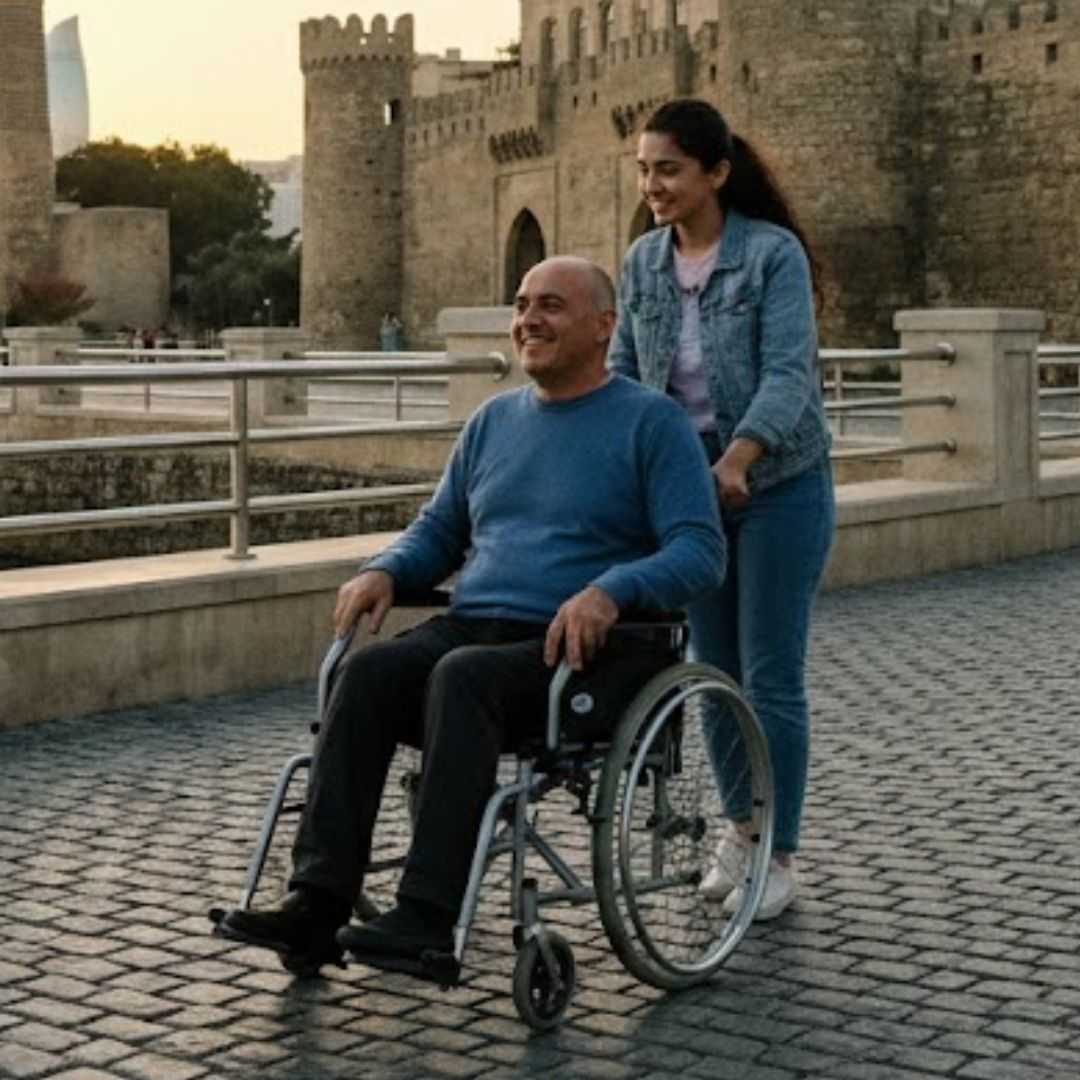
There is often another person missing from guides like this. It is the partner carrying the bags, the family member tracking the medication schedule, or the friend helping you navigate a foreign city.
Traveling to Azerbaijan for medical care rarely happens in isolation. Your companion is managing the logistics when you are under anesthesia.
They are the ones communicating with clinic staff, figuring out the exchange rate for a taxi, and recognizing if your post-operative pain seems abnormal. They absorb the stress of delayed flights, missing documents, and language barriers.
A responsible decision process must include them. They need direct access to the clinic's emergency contact numbers and clear instructions on what to do if you need urgent help outside of clinical hours.
They must understand the expected timeline, knowing exactly when you will be discharged and what physical limitations you will have once back at the hotel.
Better decisions consider everyone affected, not only the person making the purchase or undergoing the procedure.
Moving Past the Search for the "Best" Clinic
The most common question people ask is: "What is the best clinic in Azerbaijan for this procedure?"
This question feels natural. When we are uncertain, we seek definitive rankings to alleviate our anxiety. We want a clear winner.
But a simple answer can be deeply misleading. "Best" is subjective. The best clinic for a healthy 30-year-old seeking a minor hair transplant is entirely different from the best clinic for a 45-year-old requiring high-risk IVF with genetic screening.
Instead of searching for broad superlatives, shift your focus to specific capability requirements tailored to your situation.
- For a first-time cosmetic traveler: Who owns the responsibility if the surgical result requires a revision?
- For a complex dental patient: How many similar full-mouth restorations does this specific prosthodontist complete annually?
- For an IVF patient with a tight window: What is the clinic’s protocol for weekend monitoring and emergency consultations?
- For patients from the USA or UK: How does the clinic legally protect and transfer your medical data across borders?
Different people require fundamentally different answers to ensure their safety and success.
Verifying Accountability Beyond the Marketing
Trust in medical tourism must be built on evidence, not aesthetics. A beautiful website does not equate to clinical excellence.
"We offer internationally certified, world-class treatments."
When you see claims like this, you must ask: Certified by whom? Who is legally responsible for my care, and where can I independently check their standing?
In Azerbaijan, you should verify the facility's registration with the local Ministry of Health. Do not rely solely on badges that look official but are essentially paid memberships. Look for genuine medical licenses for your specific physician, not just the overarching clinic brand.
Trust comes from identifiable responsibility, verified evidence, and clear legal accountability.
Before you commit, try the 3-Pillar Baku Care Test
Before wiring a deposit or booking a flight, test the reality of your plan against these three practical checkpoints:
- The 2 AM Communication Test: If you experience severe bleeding or a medical reaction at 2 AM in your Baku hotel room, who exactly answers the phone, what language do they speak, and how quickly can a doctor reach you?
- The Continuity Test: If you return home and your local doctor refuses to manage a complication from your rhinoplasty or dental implants, what is your exact step-by-step contingency plan?
- The True Consent Test: Will you receive your medical consent forms in your native language with enough time to read them before arriving at the clinic, or will you be pressured to sign them upon arrival?
That is the medical tourism test.
Show the Topic Through Different Reader Eyes
To understand the breadth of medical travel, consider how the same destination serves entirely different priorities.
"I am a UK resident seeking affordable IVF after exhausting NHS limits."
Best research direction: Focus heavily on clinic lab standards, embryologist qualifications, and legal regulations regarding donor materials in Azerbaijan.
Warning: Do not assume that lower cycle costs translate to total savings if multiple trips are required for monitoring.
"I am a patient from the Middle East requiring extensive dental implants."
Best research direction: Investigate clinics that specialize in complex prosthodontics and have transparent, multi-stage treatment contracts.
Warning: Do not fall for "one-trip" full-mouth restorations that ignore necessary bone healing timelines.
"I am traveling from Kazakhstan for a discreet rhinoplasty."
Best research direction: Prioritize surgeons with documented board certifications and clinics that provide extended post-operative hotel monitoring.
Warning: Never underestimate the risk of flying with sinus pressure and post-surgical swelling. Insist on proper clearance.
"I am a younger professional looking for a budget hair transplant."
Best research direction: Verify exactly who performs the graft extractions and insertions—a physician or unlicensed technicians.
Warning: Do not let VIP transfers and luxury hotels distract you from verifying clinical safety standards.
Same destination. Four completely different research journeys.
Looking Beyond the Initial Quote
Eventually, almost everybody asks.
"How much cheaper is it in Azerbaijan?" It is a reasonable question, but focusing solely on the headline price obscures the financial reality of cross-border care.
What will the whole journey cost?
- Initial price: The clinic's quoted fee for the surgery or IVF cycle.
- Travel or access: Flights to Heydar Aliyev International Airport, airport transfers, and local taxis.
- Setup or implementation: ASAN visa fees (if applicable), translation services, and pre-travel medical tests required in your home country.
- Companion needs: Food, lodging, and travel expenses for the person accompanying you.
- Time commitments: Lost wages for the extra days required for safety clearance before flying.
- Follow-up requirements: The cost of local check-ups, blood work, or X-rays once you return home.
- Unexpected problems: The financial buffer needed if you require an extra week in a hotel due to slow healing or delayed embryo development.
The cheapest provider may not create the cheapest total experience.
The Reality of the Experience
Waiting in an unfamiliar terminal with your medical records clutched in your hand.
The sharp smell of antiseptic in a modern Baku clinic, distinct yet oddly comforting.
Communicating complex medical concerns through a translator app or a clinic liaison.
The slow, careful movements required to navigate a hotel bathroom after surgery.
Refreshing your email constantly, waiting for an embryologist's report on cellular development.
The reliance on a companion to fetch ice, water, and reassurance when the pain medication wears off.
The quiet relief when the final check-up is cleared, and you are finally handed your passport for the journey home.
That is still medical care. Just a very different kind.
The Questions Revealed Too Late
"I wish I’d checked if my local doctor would agree to remove my surgical drains once I got home."
"I wish I’d known that the quoted price for IVF did not include the expensive stimulation medications."
"I wish we’d planned for the physical exhaustion of a long flight immediately following a dental implant procedure."
"I wish I’d asked exactly who was performing my hair transplant, rather than assuming it was the famous doctor on the website."
"I wish I’d known how isolating it feels to recover in a hotel room in a city where I don't speak the language."
"I wish I’d checked the airline's specific medical clearance policies before showing up at the airport with facial bandages."
"Experience a seamless, pain-free medical holiday."
Real-life questions provide better guidance than promotional messages because they address the friction of reality. Marketing sells the outcome; real life demands you manage the process.
Evaluating Your Personal Fit
Medical tourism in Azerbaijan may be worth investigating when:
- You have a clear, documented diagnosis and a specific treatment plan from a local doctor to use as a baseline.
- You possess the time and capability to independently verify a provider's medical credentials.
- You have a dedicated support companion who can travel with you and advocate for your needs.
- Your budget allows for a comfortable financial buffer to cover unexpected delays or follow-up visits.
- You are realistic about the discomfort and risks of combining medical recovery with international transit.
Who Should Think Especially Carefully?
Medical tourism in Azerbaijan—or any comparable destination—may make less sense when:
- You suffer from severe underlying health conditions, such as heart disease or uncontrolled diabetes, which increase surgical risks.
- You are seeking a highly complex, experimental, or unproven medical procedure out of desperation.
- You cannot secure a commitment from a local doctor in your home country to provide post-treatment monitoring.
- Your decision is driven entirely by extreme financial pressure, forcing you to choose the absolute cheapest option available.
- You have intense anxiety about communication barriers and being separated from your familiar support system.
- You cannot afford to return to the destination if a complication or revision is necessary.
"I’m not comfortable proceeding."
Recognizing when the risks, logistics, or uncertainties outweigh the benefits is a successful outcome of your research. A responsible guide should make it easier to say no.
What brings you here?
You are struggling with long IVF waitlists at home.
Look for clinics in Baku with verified embryology labs and transparent donor protocols, and consult your local OB/GYN about monitoring.
You need multiple dental implants but cannot afford local prices.
Request a multi-stage treatment plan that clearly outlines the required healing time and the necessity of returning for a second trip.
You are seeking rhinoplasty but are concerned about aftercare.
Focus entirely on the surgeon’s complication management plan, including their policy on covering revision surgeries and local follow-up.
You are exploring hair transplants and feel overwhelmed by marketing.
Stop looking at pricing tiers. Start asking for the medical license number of the person who will actually perform the extractions.
You are planning a trip as a medical companion.
Ask the clinic for their formal emergency escalation protocol and ensure you have direct access to translated medical records.
That is not simply a guide. It is a decision environment.
Returning to the Human Decision
Maybe you are still sitting at that kitchen table, weighing the emotional cost of traveling for IVF against the fading window of opportunity at home.
Maybe you and your spouse are debating whether the financial savings of dental work abroad justify the stress of navigating a foreign healthcare system twice in one year.
Maybe you are a professional calculating whether a rhinoplasty is worth the discomfort of recovering in a hotel and explaining your absence to colleagues.
These are heavy, imperfect decisions. They should not be reduced to simple promises of saving money, getting instant results, or finding a flawless destination. The reality involves balancing practical limitations, managing risks, leaning on support systems, and committing to follow-through.
The best medical destination is not the one with the most aggressive marketing.
It is the one where:
the right clinical capability,
the right verified professional,
the right logistical support,
and a realistic path to safe follow-up
can come together for your particular situation.
"Where is medical tourism in Azerbaijan cheapest and easiest?"
"What is the next informed step that realistically fits my situation?"
Your Way to Hope
At PlacidWay, we understand that looking beyond your borders for medical care is rarely a simple choice. It is a decision usually driven by a deep need for change, healing, or progress.
Maybe it is the right path for you right now. Maybe it requires more time, more conversations with your family, or a different approach altogether.
We believe in presenting options, not pressure. Medical tourism is one possible route. Our goal is to help you navigate it with clarity, ensuring that your choice is rooted not only in hope, but in careful preparation and realistic expectations.
Are you ready to explore what your specific pathway might look like?
Request Information for Your Care JourneyDisclaimer: The information provided in this article is for educational and planning purposes only. It does not constitute individualized medical, legal, or financial advice. Healthcare regulations, clinic standards, and travel requirements in Azerbaijan are subject to change. Always verify clinical credentials, consult with your primary healthcare provider before making international medical decisions, and seek official guidance from relevant diplomatic or health authorities.
References
- Health Information for Travelers to Azerbaijan – Centers for Disease Control and Prevention (CDC)
- Guidelines on Cross-Border Reproductive Care – European Society of Human Reproduction and Embryology (ESHRE)
- Patient Safety and Medical Tourism – International Society of Aesthetic Plastic Surgery (ISAPS)
- Information on Dental Implants and Treatment Standards – FDI World Dental Federation
- Azerbaijan Health Data and Country Profile – World Health Organization (WHO)
























Share this listing