
Listen to our podcast: AI Has Made Every Medical Tourism Website Naked
Discover how AI is changing patient research, transparency, trust, and the future of medical tourism websites.
The End Of “We Are The Best” Marketing In Medical Tourism
For almost two decades, Medical Tourism marketing followed a fairly predictable formula:
-
We Are The Best Clinic.
-
Our Doctors Are World-Class.
-
We Use The Latest Technology.
-
We Have International Standards.
-
Our Success Rate Is Excellent.
-
Thousands Of Patients Trust Us.
Add photographs of a modern hospital, a smiling doctor wearing a white coat, a few patient testimonials, treatment prices, and perhaps an “internationally accredited” badge.
For a long time, that was often enough to get a patient’s attention.
It is not enough anymore.
AI and large language models have changed something much bigger than how people search.
They have changed how easily people can question what they find.
“We Are One Of The Leading Stem Cell Centers.”
They can ask:
-
Why Are They Considered Leading?
-
Who Are Their Doctors?
-
Where Did The Doctors Train?
-
Are Their Licenses Current?
-
What Kind Of Stem Cells Are They Using?
-
Is This Treatment Approved For My Condition?
-
Are Their Claimed Results Supported By Published Research?
-
Who Wrote The Article Making These Claims?
-
When Was It Last Medically Reviewed?
-
Can I Verify The Hospital’s Accreditation Somewhere Else?
-
What Are The Risks The Clinic Is Not Mentioning?
-
How Does This Provider Compare With Five Others Offering Exactly The Same Treatment?
That is the real transformation.
AI Has Made The Medical Tourism Website Naked.
Not literally.
But almost every marketing claim can now be questioned, compared, contextualized, challenged, and investigated far more easily than before.
And that is going to fundamentally change medical tourism.
The Internet Gave Providers A Website. AI Gave Patients An Investigator.
Traditional search was largely about finding pages.
A patient searched:
“Stem Cell Treatment Mexico.”
They received ten blue links, opened several websites, and read what each clinic wanted them to read.
Today’s AI-assisted search journey is different.
A patient can ask:
“Compare regenerative medicine clinics in Mexico offering treatment for knee osteoarthritis. Tell me which doctors are treating patients, what their medical specialties are, what cell source they use, whether they publish treatment protocols, whether their claims are supported by research, and what information I should verify before choosing one.”
That is a completely different consumer.
Google itself now acknowledges that people using AI search experiences are asking longer, more specific questions and follow-up questions that dig deeper. Its guidance increasingly emphasizes unique, useful, expert-led, non-commodity information rather than simply producing more pages around keywords.
The patient’s ability to investigate has increased dramatically.
The provider’s ability to hide behind generic language has decreased.
If An AI Removed Your Adjectives, What Facts Would Be Left?
Remove:
-
Leading
-
Best
-
Advanced
-
Internationally Renowned
-
State-Of-The-Art
-
World-Class
-
Exceptional
-
Premier
-
Trusted
-
Cutting-Edge
What remains?
-
Your Doctors?
-
Their Licenses?
-
Their Board Certifications?
-
Actual Treatment Protocols?
-
Hospital Accreditation?
-
Published Research?
-
Documented Patient Selection Criteria?
-
Complication Policies?
-
Follow-Up Procedures?
-
Clinical Experience?
-
Auditable Outcomes?
That is becoming your real marketing.
Medical Tourism Is A YMYL Industry. Trust Is No Longer Optional.
Healthcare sits squarely in what Google describes as Your Money Or Your Life (YMYL) content, because inaccurate information can significantly affect a person’s health, financial stability, or safety.
Google says stronger signals associated with experience, expertise, authoritativeness, and trustworthiness receive greater importance for such topics. It also makes an important distinction: E-E-A-T itself is not one single ranking factor, and trust is the most important component.
That matters enormously to medical tourism.
A blog about “10 Best Beaches in Mexico” can be wrong about a restaurant and inconvenience someone’s afternoon.
A page about experimental cancer immunotherapy can influence a life-changing medical decision.
The standard cannot be the same.
And increasingly, it isn’t.
Questions Medical Content Should Answer
-
Is The Content Written Or Reviewed By Someone Who Demonstrably Knows The Subject?
-
Is The Sourcing Clear?
-
Can The Reader Understand Who Created The Content?
-
Does The Site Provide Background About The Author?
-
Are There Factual Errors That Can Be Easily Verified?
-
Does The Content Offer Original Information Or Merely Rewrite What Already Exists?
This is where medical tourism providers need to understand the evolution of E-E-A-T.
It is not about adding a doctor’s name to the bottom of an article because the SEO team told you to.
It is about building an evidence trail.
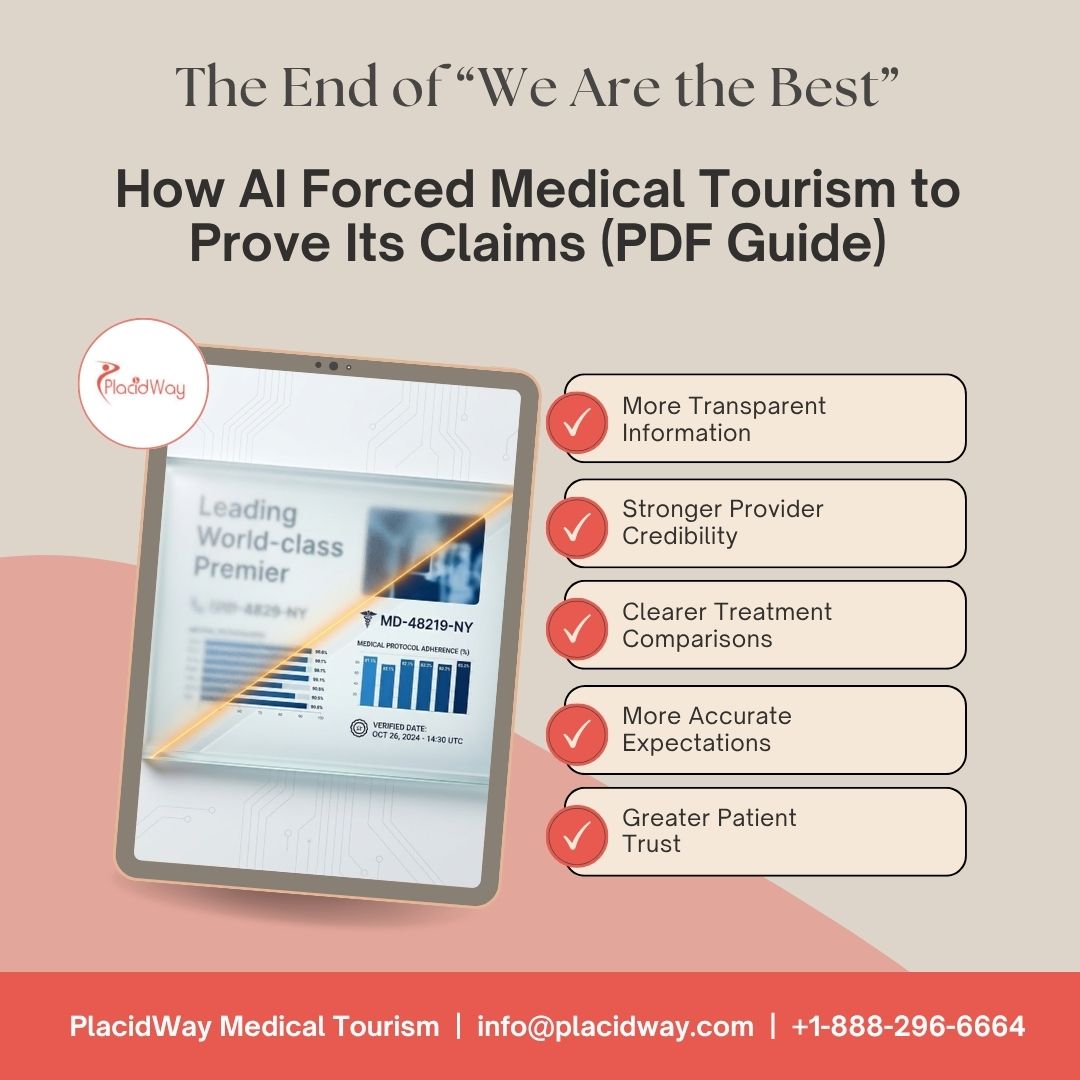
Your Author Is Becoming Part Of Your Product
For years, medical tourism content was frequently created like this:
1. SEO Team Finds Keyword.
2. Writer Receives Keyword.
3. Writer Researches The Internet.
4. Writer Produces 1,500 Words.
5. Page Goes Live.
6. Nobody Knows Exactly Who Wrote It.
7. Nobody Knows Whether A Doctor Checked It.
8. Three Years Later, It Is Still Online.
The page says:
“Stem Cell Therapy Has Shown Remarkable Success For…”
But who is saying that?
-
A Physician?
-
A Medical Researcher?
-
A Freelance Writer?
-
An AI System?
-
A Marketing Employee?
-
A Content Agency?
The answer increasingly matters.
Google recommends identifying article authors clearly and connecting them to pages that help establish who those authors actually are. Its structured-data guidance specifically recommends author information and links to identifying author profiles.
What Medical Content Should Show
Written By:
-
Name
-
Relevant Professional Background
-
Experience Covering The Subject
Medically Reviewed By:
-
Physician Name
-
Medical Specialty
-
License Or Registration Information Where Appropriate
-
Professional Profile
-
Review Date
Updated:
Date Of Meaningful Medical Update.
Sources:
-
Clinical Research
-
Regulatory Information
-
Professional Guidelines
-
Provider-Specific Documentation
Now the reader understands where the information came from.
That is credibility.
Freshness Does Not Mean Changing The Date
Another habit from traditional SEO needs to disappear.
Changing:
Updated January 2024
to:
Updated August 2026
does not magically make old medical information new.
Google explicitly warns against changing dates simply to make pages appear fresh when the underlying content has not substantially changed.
Medical content should instead explain what changed.
Example Of A Meaningful Medical Update
Medical Update – August 2026
-
Treatment Price Verified With Provider
-
Physician License Rechecked
-
Treatment Protocol Updated
-
New Exclusion Criteria Added
-
Three Outdated Studies Removed
-
Regulatory Information Reviewed
-
Recovery Recommendations Revised
Now freshness means something.
Regenerative Medicine: “Advanced Stem Cells” Is No Longer An Answer
Few industries demonstrate this shift better than regenerative medicine.
Imagine ten clinics saying:
“We Provide Advanced Stem Cell Therapy Using The Latest Technology.”
To the patient, they begin to look identical.
AI-assisted research allows the next level of questioning.
Questions Patients May Ask
-
What Cells Are Used?
-
Are They Autologous Or Donor-Derived?
-
Are They From Bone Marrow, Adipose Tissue, Umbilical Tissue, Or Another Source?
-
How Are The Cells Processed?
-
What Is Actually Administered?
-
Who Determines Eligibility?
-
Which Physician Supervises Treatment?
-
What Conditions Does The Clinic Treat?
-
What Conditions Does It Refuse To Treat?
-
What Evidence Supports Those Applications?
-
What Outcomes Are Being Measured?
-
What Adverse Events Are Discussed?
-
What Follow-Up Is Provided?
-
Does The Clinic Distinguish Experimental Treatment From Established Treatment?
Suddenly, “advanced regenerative medicine” has very little value.
Specificity Has Value.
In a crowded regenerative medicine market, the provider willing to explain the uncomfortable details may become more credible than the provider making the biggest promise.
Plastic Surgery: Beautiful Before-And-After Photos Are Not Enough
Plastic surgery traditionally relies heavily on visual evidence.
And visuals remain important.
But imagine a patient asking an AI assistant:
“I Am Considering A Facelift Abroad. Help Me Compare These Surgeons.”
What Patients May Want To Know
-
Surgeon Specialization
-
Medical License
-
Board Certification
-
Years Performing The Procedure
-
Hospital Privileges
-
Anesthesia Team
-
Facility Standards
-
Revision Policy
-
Complication Management
-
Before-And-After Consistency
-
Recovery Protocols
-
How Emergencies Are Handled After The Patient Flies Home
A provider saying:
“Our Internationally Renowned Cosmetic Surgeon Produces Natural Results.”
has made a marketing claim.
A provider saying:
“Here Is The Surgeon. Here Is The Professional Registration. Here Is Where Training Was Completed. Here Are The Procedures Primarily Performed. Here Is The Facility. Here Is Who Provides Anesthesia. Here Is Our Revision Policy.”
has created evidence.
There is a big difference.
Dental Tourism: “Save 70%” Is Becoming The Beginning Of The Conversation
Dental tourism has traditionally been driven heavily by price.
Dental Implants For A Fraction Of U.S. Prices.
That message works because affordability is real consumer intent.
But price alone will become weaker differentiation as dozens or hundreds of clinics promote similar savings.
Consider an All-on-4 patient researching treatment abroad.
What Patients Increasingly Want To Understand
-
What Implant System Is Being Used?
-
Who Manufactures It?
-
What Is Included In The Quoted Price?
-
Who Is The Implantologist?
-
Is The Final Prosthesis Zirconia, Acrylic, Or Another Material?
-
What Happens If An Implant Fails?
-
Is Bone Grafting Included?
-
How Many Visits Are Required?
-
Who Performs The Surgery?
-
Who Designs The Prosthesis?
-
Where Is The Dental Laboratory?
-
What Happens If The Bite Needs Adjustment Three Months Later?
That is the difference between:
“All-On-4 From $X.”
and:
“Here Is Exactly What You Are Buying.”
The second one will increasingly win trust.
Fertility: Success Rates Need Context
Fertility marketing presents another major credibility challenge.
A clinic can publish:
“High IVF Success Rates.”
But high compared with what?
-
Which Age Group?
-
Using Own Eggs Or Donor Eggs?
-
Per Embryo Transfer?
-
Per Cycle Started?
-
Clinical Pregnancy?
-
Live Birth?
-
Fresh Embryos?
-
Frozen Embryos?
-
What Year Is The Data From?
-
What Patient Population Was Included?
Without context, one attractive percentage can create a misleading impression.
In the AI-search era, expect consumers to ask more sophisticated questions.
Not:
“Which Fertility Clinic Has The Highest Success Rate?”
But:
“Compare Outcomes For Women Aged 39–41 Using Their Own Eggs, Explain How The Clinics Calculate Their Success Rates, And Tell Me Which Numbers Are Actually Comparable.”
Providers that publish transparent methodology will have an advantage.
Those presenting only the biggest percentage may increasingly be challenged.
Orthopedics: Patients Want The Surgeon Behind The Procedure
Consider a patient traveling abroad for knee replacement.
Traditional Marketing:
“World-Class Orthopedic Surgery At Affordable Prices.”
Modern Credibility:
-
Who Is The Surgeon?
-
How Many Knee Replacements Does The Surgeon Perform?
-
Which Implant Systems Are Used?
-
Why Is One Implant Selected Over Another?
-
What Imaging Is Required?
-
What Is The Typical Hospital Stay?
-
What Rehabilitation Begins Before The Patient Flies Home?
-
What Complications Could Delay Travel?
-
Who Manages Postoperative Problems After Returning Home?
-
How Is Continuity Of Care Handled?
The more important the procedure, the less valuable generic marketing becomes.
Cancer Immunotherapy: The Highest Standard Of All
The transparency requirement becomes even more serious in oncology.
Terms That Require Careful Explanation
-
Immunotherapy
-
CAR-T
-
NK Cell Therapy
-
Dendritic Cell Therapy
-
Personalized Vaccines
-
Cellular Therapy
-
Precision Oncology
These terms can sound incredibly promising to a frightened patient.
That is exactly why providers must communicate responsibly.
Instead of:
“Breakthrough Immunotherapy Gives New Hope To Cancer Patients.”
Patients deserve to understand:
-
Which Cancers?
-
At What Stage?
-
Under What Eligibility Criteria?
-
Is This Established Treatment, Investigational Treatment, Or Part Of A Clinical Study?
-
What Evidence Exists?
-
What Outcomes Are Realistic?
-
What Risks Are Known?
-
What Alternatives Should The Patient Discuss With Their Oncologist?
-
What Physicians Supervise Treatment?
-
What Happens If Treatment Does Not Work?
In cancer care, credibility sometimes means saying:
“You May Not Qualify.”
That sentence may create more trust than ten paragraphs of promises.
AI Has Created The Great Medical Tourism Commodity Problem
Something else is happening.
AI has made content incredibly easy to create.
Examples Of Generic AI-Style Content
-
“10 Reasons To Choose Turkey For Dental Implants.”
-
“7 Benefits Of Stem Cell Therapy.”
-
“Why Mexico Is The Best Destination For Medical Tourism.”
-
“5 Reasons To Choose Our IVF Center.”
Which means these articles are becoming commodities.
Google’s 2026 guidance for generative-AI search specifically encourages websites to produce unique, expert-led, non-commodity information that goes beyond common knowledge, rather than simply recycling what already exists or what an AI system could easily produce itself.
This is one of the biggest changes medical tourism marketers need to understand.
If An LLM Can Write Your Entire Article Without Knowing Anything About Your Organization, Why Does Your Article Need To Exist?
That is a brutal question.
But it is the right question.
What AI Cannot Simply Invent From Generic Knowledge
-
Your Doctor’s Actual Experience
-
Your Hospital’s Documented Credentials
-
Your Real Treatment Protocol
-
Your Actual Patient Selection Process
-
Your Internal Outcome Data, Presented Responsibly
-
Your Complications Policy
-
Your Patient Journey
-
Your Rehabilitation Process
-
Your Technology
-
Your Medical Team’s Explanation Of Difficult Cases
-
Your Price Inclusions
-
Your Limitations
-
Your Evidence
-
Your Point Of View
Information Generated From Reality—Not Generated From Keywords.
The Future Medical Tourism Website Is An Evidence Platform
The old medical tourism website was essentially a brochure.
The new one needs to behave more like a transparent information system.
Think of every major claim as requiring a supporting layer.
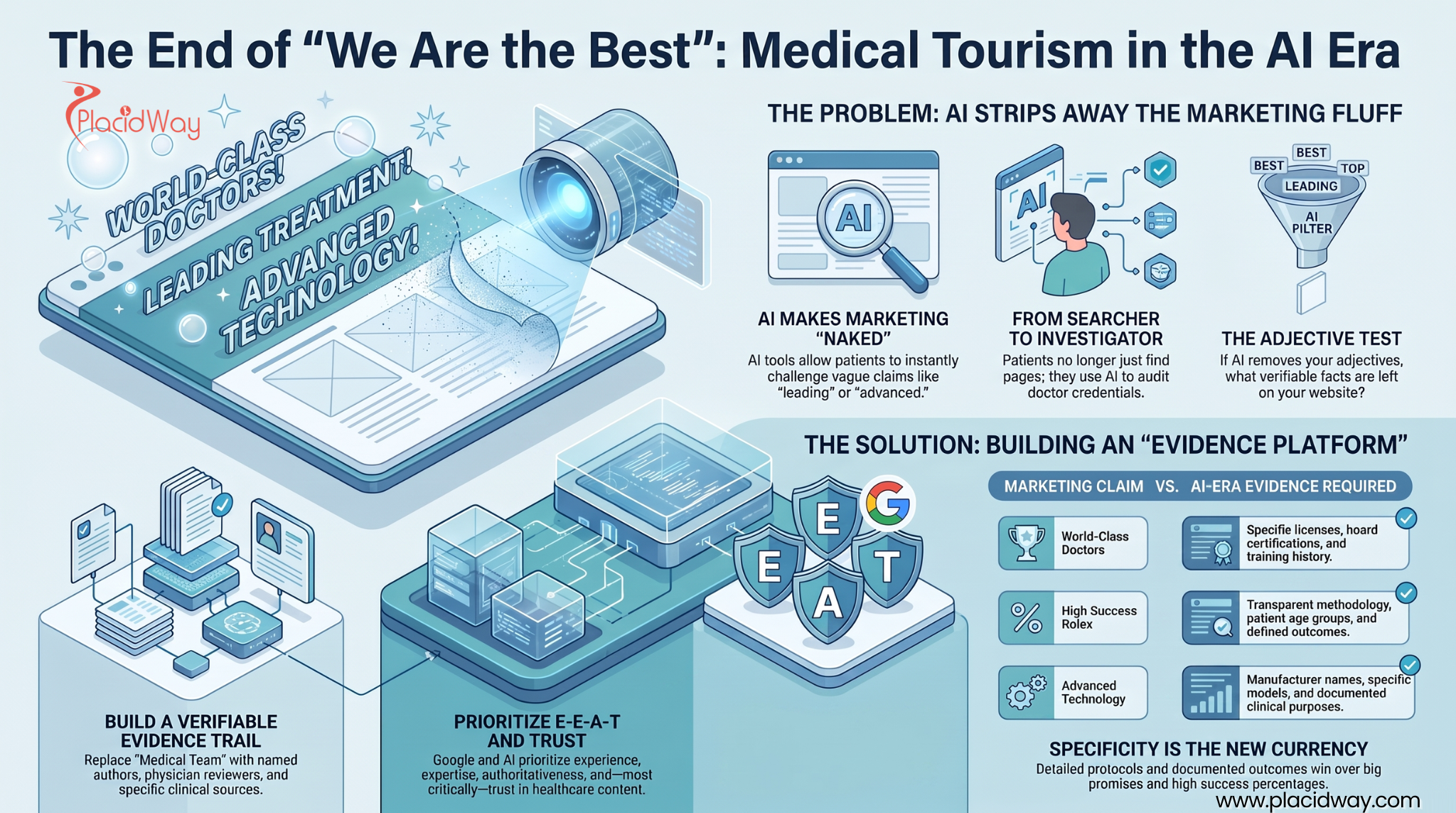
Example: Medical Claims And Evidence
Claim: Our Surgeon Is Internationally Recognized.
Evidence: Recognized By Whom?
Claim: Our Hospital Is Accredited.
Evidence: Which Accreditation? Valid Until When? Can It Be Independently Checked?
Claim: We Specialize In Regenerative Medicine.
Evidence: Which Physicians? Which Indications? Which Protocols? What Experience?
Claim: We Use Advanced Technology.
Evidence: What Technology? Manufacturer? Model? Clinical Purpose?
Claim: We Achieve Excellent Results.
Evidence: How Are Results Measured?
Claim: We Have Treated Thousands Of International Patients.
Evidence: Over What Period? From Which Countries? For What Treatments?
You do not necessarily need to publish every confidential business document online.
Ask The Most Important Question
“What Supports This Statement?”
AI Does Not Mean Providers Should Write More. It Means Providers Should Reveal More.
This may be the most important lesson.
The response to AI should not be:
“Let’s Create 5,000 More Articles With AI.”
The response should be:
“Let’s Make The Information Behind Our Medical Organization More Understandable, Structured, Current, And Verifiable.”
Google continues to say its systems prioritize helpful, reliable, people-first information, and warns against mass-producing pages primarily for search traffic or using automation without adding genuine value.
The goal should therefore move from content volume to information depth.
Information Assets Providers Should Build
-
Physician Profiles
-
Licensing Information
-
Professional Affiliations
-
Hospital Credentials
-
Accreditations
-
Treatment Protocols
-
Equipment
-
Eligibility Criteria
-
Contraindications
-
Risks
-
Expected Recovery
-
Real Pricing Inclusions
-
Patient Journey
-
International Patient Support
-
Complication Management
-
Follow-Up
-
Research
-
Clinical Evidence
-
Medical Reviewers
-
Publication Dates
-
Meaningful Content Updates
-
Documented Patient Experiences
This becomes the foundation not only for SEO, but for AI discovery, patient education, and human trust.
PlacidWay Is Evolving Too
For PlacidWay, this industry shift changes what it means to be a medical tourism platform.
Historically, medical tourism marketplaces could largely present information supplied by providers:
-
Clinic Descriptions
-
Treatments
-
Prices
-
Packages
-
Doctors
-
Photos
-
Testimonials
That model must evolve.
PlacidWay’s future direction is increasingly about encouraging providers to supply deeper, more authentic, and more verifiable information.
Show Patients Who You Are
-
Show The Physicians.
-
Show Relevant Credentials.
-
Show Licenses Where Appropriate And Legally Possible.
-
Show Hospital Certifications.
-
Show The People Responsible For Medical Content.
-
Show Who Reviewed The Information.
-
Show When It Was Reviewed.
-
Show What Changed.
-
Show The Treatment Details.
-
Show The Limitations.
-
Show Realistic Expectations.
-
Show What Makes Your Protocol Different.
-
Show What The Patient Should Verify.
-
Show Evidence Behind Important Claims.
Where something cannot be independently verified, communicate it carefully rather than converting it into a marketing superlative.
The role of platforms such as PlacidWay therefore changes from simply displaying providers to helping create a more structured environment in which consumers can understand, compare, and evaluate providers.
This may sometimes create more work for participating clinics.
That is intentional.
The future value of a medical tourism marketplace will not be measured by how many times it can say a provider is excellent.
It will be measured by how much useful information it can provide to help a patient decide whether that provider may be appropriate.
Providers Who Give More Information Will Initially Feel More Exposed
There is an understandable fear:
-
“If We Publish More Information, Competitors Will Copy Us.”
-
“If We Discuss Risks, Patients Might Leave.”
-
“If We Explain Eligibility Criteria, We Might Lose Leads.”
-
“If We Mention Limitations, Another Clinic Will Promise What We Won’t.”
Perhaps.
But the market is changing.
The providers willing to say:
-
“Here Is What We Do.”
-
“Here Is Who Performs It.”
-
“Here Is The Evidence.”
-
“Here Is What We Know.”
-
“Here Is What We Do Not Know.”
-
“Here Is Who Qualifies.”
-
“Here Is Who Probably Should Not Receive This Treatment.”
may become the providers patients trust.
Transparency can feel dangerous when an industry has spent years competing through marketing.
In a credibility economy, transparency becomes an asset.
Before Publishing “We Are The Best,” Answer These Questions
Every medical center participating in international healthcare should increasingly be able to answer:
About The Medical Organization
-
Who Owns Or Operates The Facility?
-
Where Is It Legally Registered?
-
What Licenses Or Regulatory Permissions Apply?
-
What Accreditations Or Certifications Can Be Verified?
About The Doctors
-
Who Actually Treats The Patient?
-
What Is The Doctor’s Specialty?
-
Where Did The Doctor Train?
-
What Professional Registration Or License Applies?
-
What Experience Is Relevant To This Specific Procedure?
About The Treatment
-
What Exactly Is Being Offered?
-
Who Qualifies?
-
Who Does Not?
-
What Evidence Supports It?
-
What Alternatives Exist?
-
What Are The Limitations?
-
What Are The Meaningful Risks?
About Outcomes
-
How Are Outcomes Measured?
-
What Does “Success” Actually Mean?
-
What Population Produced The Number?
-
What Timeframe Does It Cover?
-
Can The Claim Be Responsibly Substantiated?
About Content
-
Who Wrote The Page?
-
What Relevant Expertise Do They Have?
-
Was It Medically Reviewed?
-
By Whom?
-
When?
-
What Sources Support Important Medical Statements?
-
When Was The Information Materially Updated?
About The Patient Journey
-
What Happens Before Arrival?
-
What Happens During Treatment?
-
What Happens After Treatment?
-
Who Manages Complications?
-
What Happens After The Patient Returns Home?
-
What Costs Are Not Included?
If your organization cannot answer these questions, hiring another SEO writer is probably not the first problem you need to solve.
Your Next Competitor May Not Have Better Marketing. They May Have Better Evidence.
Medical tourism is becoming crowded.
-
Stem Cell Centers Make Similar Claims.
-
Dental Clinics Advertise Similar Savings.
-
Plastic Surgeons Show Similar Photographs.
-
IVF Clinics Promote Similar Success Stories.
-
Orthopedic Hospitals Advertise Similar Technology.
-
Cancer Centers Talk About Similar Innovation.
When everyone says:
“We Are The Best.”
The statement loses meaning.
The next competitive advantage may be:
“We Can Prove What We Say.”
That requires operational change—not just marketing change.
-
Marketing Teams Will Need Doctors.
-
Doctors Will Need Content Teams.
-
Credentialing Teams Will Need Platform Teams.
-
Patient Coordinators Will Need Accurate Information.
-
Provider Profiles Will Need Regular Updates.
-
Old Content Will Need Medical Review.
-
Claims Will Need Evidence.
AI has not created this need for credibility.
Healthcare always needed credibility.
AI Has Simply Made The Absence Of Credibility Much Easier To See.
Welcome To The Age Of Verifiable Medical Tourism
The last twenty years of medical tourism were largely about visibility.
-
Can Patients Find You?
-
Can You Rank?
-
Can You Advertise?
-
Can You Generate Inquiries?
The next twenty years will increasingly be about something harder:
Can Patients Believe You?
AI search does not mean every answer will always be correct. LLMs can misunderstand information and sometimes produce inaccurate conclusions.
That actually makes publishing accurate, structured, primary information even more important.
Google’s newest generative-search guidance continues to emphasize the same fundamentals: clear technical structure, unique information, expert-led content, usefulness, and information that goes beyond what can be easily generated from common knowledge.
For medical tourism providers, the lesson is simple.
Do not be afraid that AI can see your organization.
Give It Something Worth Seeing.
-
Give Patients Something Worth Verifying.
-
Give Platforms Something Meaningful To Compare.
-
Give Your Doctors Identities Beyond Stock Photographs.
-
Give Your Claims Evidence.
-
Give Your Content Authors.
-
Give Your Medical Pages Reviewers.
-
Give Your Information Dates And Real Updates.
-
Give Your Credentials Context.
-
Give Your Patients Limitations As Well As Possibilities.
And retire the phrase:
“We Are The Best.”
The future belongs to medical organizations confident enough to say:
“Here Is Who We Are. Here Is What We Do. Here Is The Evidence. You Can Verify It Yourself.”
That is not weaker marketing.
That is what medical tourism credibility will increasingly look like in the AI era.
Make Your Medical Tourism Website AI-Ready With PlacidWay
If your clinic is already registered with PlacidWay, this is the time to strengthen your provider profile with accurate credentials, detailed treatment information, verified claims, physician expertise, and meaningful patient insights. Give international patients—and the AI systems helping them research—clear, trustworthy information they can understand, compare, and verify.
