
Discover how AI is reshaping patient search behavior and why medical centers must adapt now—listen to the podcast today.
The New Reality: Patients May Never Visit Your Website
For more than two decades, medical tourism providers built their international patient acquisition strategies around one fundamental assumption: patients search, compare options, visit websites, and then make inquiries.
That assumption is rapidly changing.
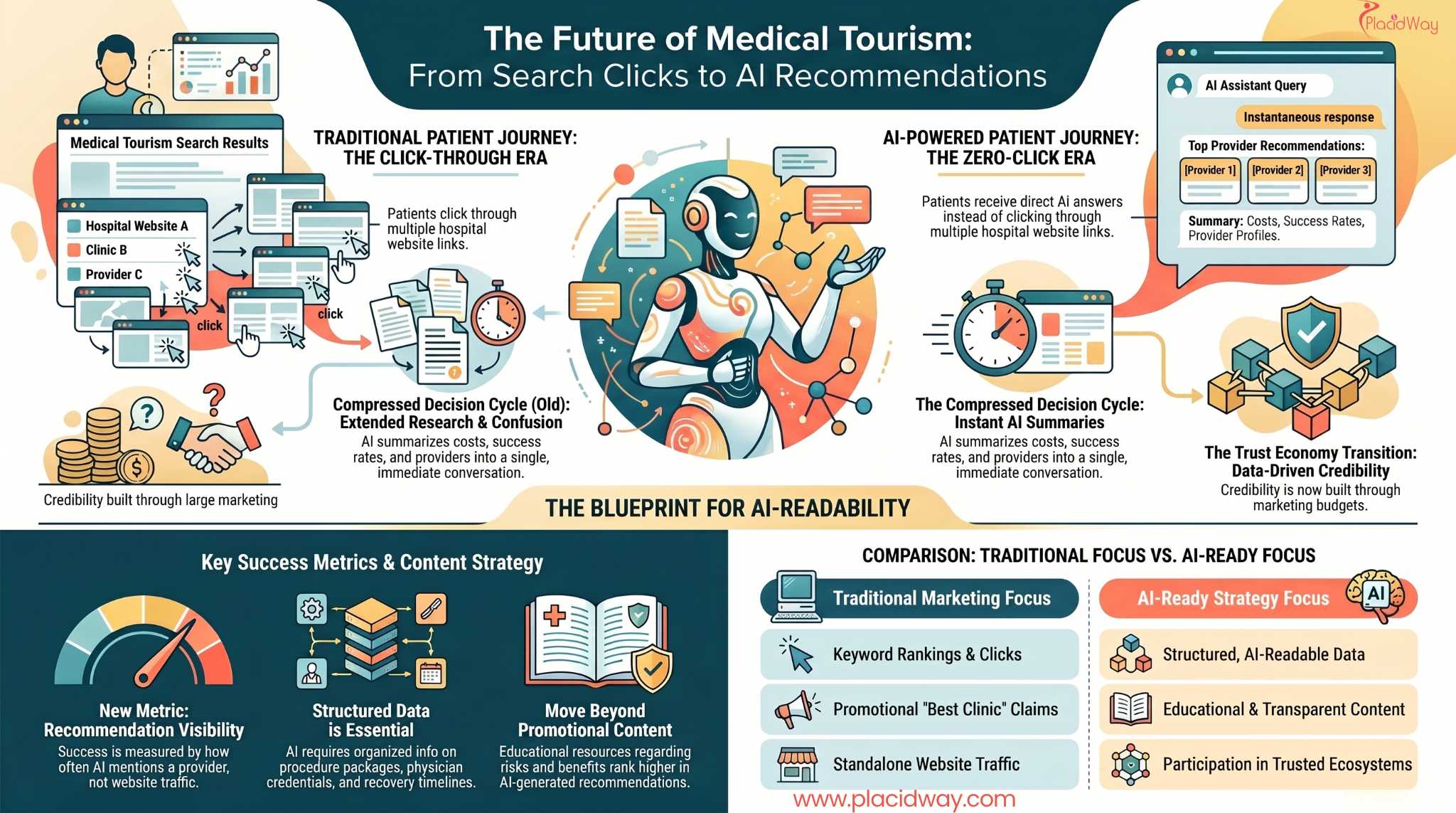
Artificial Intelligence is transforming how patients discover healthcare providers, evaluate treatment options, and make medical travel decisions. Just as hotels are experiencing declining website traffic due to Google's rise of "zero-click searches," Medical Tourism providers are entering a similar era where prospective patients increasingly receive answers directly from AI assistants without ever visiting a hospital website.
Imagine a patient in Canada searching for "best knee replacement hospitals in Mexico" or a patient in the United States asking an AI assistant, "Where can I get affordable dental implants abroad?" Instead of receiving a list of website links, they increasingly receive summarized recommendations, treatment comparisons, estimated costs, recovery timelines, and provider suggestions directly within AI-generated responses.
The implications for medical tourism are profound.
The future will not belong exclusively to hospitals with the biggest marketing budgets. Instead, it may belong to the medical centers that AI systems understand, trust, and recommend.
For healthcare providers operating in an increasingly competitive global market, the challenge is no longer just attracting clicks. It is becoming visible in a world where AI acts as the first point of contact between patients and providers.
The Rise of AI-Powered Patient Discovery
Historically, international patients conducted extensive online research before making healthcare decisions.
A typical patient journey involved:
-
Searching Google for treatment options
-
Visiting multiple hospital websites
-
Comparing prices
-
Reading testimonials
-
Contacting facilitators
-
Requesting quotes
-
Scheduling consultations
Today, AI is compressing many of these steps into a single conversation.
A patient can ask:
"Which countries offer affordable IVF treatment with high success rates?"
Within seconds, AI may provide:
-
Country comparisons
-
Estimated treatment costs
-
Success rate information
-
Travel considerations
-
Recommended providers
The patient may receive enough information to narrow their choices significantly before ever clicking a website.
This represents a fundamental shift in patient behavior.
The question medical centers must ask is no longer:
"How do we rank #1 on Google?"
Instead, it becomes:
"How do we become the provider AI systems choose to mention?"
The Healthcare Version of Zero-Click Search
The hospitality industry has already begun experiencing this transformation.
Hotels that once depended heavily on search traffic are seeing users obtain answers directly from search engines and AI-generated summaries.
Medical tourism faces a similar future.
Consider these common patient questions:
-
"What is the cost of dental implants in Costa Rica?"
-
"Which hospital in Turkey specializes in hair transplantation?"
-
"Where can I get affordable bariatric surgery?"
-
"What is the best destination for IVF treatment?"
Traditionally, patients clicked through dozens of websites to find answers.
Today, AI platforms increasingly generate direct responses.
This means medical centers that rely solely on traditional SEO strategies may experience reduced website traffic even while patient interest remains high.
The opportunity is not disappearing.
The pathway is simply changing.
Visibility Matters More Than Website Traffic
For years, digital marketing success was measured through:
-
Website visitors
-
Click-through rates
-
Search rankings
-
Lead volume
These metrics remain important, but AI is introducing a new performance indicator:
Recommendation Visibility.
In the future, a hospital may receive fewer website visitors yet generate more patient inquiries because it consistently appears in AI-generated recommendations.
Consider two hospitals:
Hospital A spends heavily on traditional digital advertising and ranks well in search results.
Hospital B has structured, transparent, AI-readable information about procedures, outcomes, physician credentials, international patient services, pricing transparency, and patient experiences.
When AI systems analyze available information, Hospital B may become easier to understand and therefore easier to recommend.
The result?
Greater visibility despite potentially lower website traffic.
This represents a major mindset shift for healthcare marketers.
Why Many Medical Centers Are Not AI-Ready
Read this PDF report to understand how medical centers can improve visibility, trust, and patient acquisition in the age of AI.
A surprising number of medical tourism providers remain difficult for AI systems to understand.
Many hospital websites still contain:
-
Outdated treatment information
-
Inconsistent pricing
-
Limited physician details
-
Missing structured data
-
Generic marketing language
-
Poor content organization
Humans can often navigate these shortcomings.
AI systems struggle with them.
Artificial intelligence relies heavily on structured, accurate, and verifiable information.
For example, AI can more easily understand:
-
Procedure descriptions
-
Treatment packages
-
Hospital accreditations
-
Physician credentials
-
Recovery timelines
-
Patient eligibility criteria
-
Cost estimates
When this information is clearly organized, the likelihood of appearing in AI-generated recommendations increases significantly.
Medical centers that fail to modernize their digital presence risk becoming invisible—not because they provide poor care, but because AI cannot confidently interpret their information.
The Trust Economy of AI Recommendations
Healthcare decisions involve a higher level of trust than hotel bookings.
Patients are not simply selecting accommodations.
They are selecting surgeons, hospitals, treatment plans, and potentially life-changing procedures.
As AI becomes a trusted advisor in healthcare research, credibility becomes a competitive advantage.
AI systems increasingly favor information that demonstrates:
-
Expertise
-
Transparency
-
Consistency
-
Authority
-
Verifiable outcomes
Medical centers that publish detailed physician profiles, treatment success data, accreditation information, and patient education resources create stronger trust signals.
The hospitals most likely to thrive in the AI era will be those that invest in becoming authoritative sources rather than simply marketing destinations.
Real-World Medical Tourism Scenarios
Scenario 1: Dental Tourism
A patient in California asks:
"Where can I get All-on-4 dental implants at an affordable cost?"
An AI assistant may instantly compare providers across:
-
Mexico
-
Costa Rica
-
Colombia
-
Turkey
If a clinic has transparent pricing, procedure explanations, dentist qualifications, and patient outcomes available in structured formats, AI can confidently include that provider in recommendations.
If another clinic has limited information hidden behind inquiry forms, it may never appear.
Scenario 2: IVF Treatment
A couple researching fertility treatment abroad may ask:
"Which countries have the highest IVF success rates for women over 40?"
AI may summarize information from multiple sources while highlighting providers with comprehensive treatment data and patient resources.
Clinics that educate and inform are more likely to be surfaced than clinics focused exclusively on promotional messaging.
Scenario 3: Orthopedic Surgery
A patient considering knee replacement abroad may ask:
"Compare knee replacement costs in Mexico, India, and Thailand."
AI can instantly generate comparisons.
Hospitals that provide clear package information, rehabilitation details, surgeon expertise, and outcome statistics gain a significant advantage.
The Growing Importance of Third-Party Platforms
Another major shift is emerging.
Patients increasingly trust independent platforms more than individual provider websites.
This is where medical tourism marketplaces and networks become critical.
Platforms that aggregate provider information, verify credentials, compare treatments, and organize patient resources are becoming highly valuable data sources for AI systems.
In many cases, AI may reference information from trusted healthcare marketplaces before referencing individual hospital websites.
This creates both a challenge and an opportunity for medical centers.
The challenge is that providers can no longer depend solely on their own websites.
The opportunity is that participation in trusted ecosystems increases discoverability.
Why PlacidWay's AI Strategy Matters
This transformation highlights the importance of platforms such as PlacidWay.
For years, PlacidWay has focused on helping healthcare providers connect with international patients through a structured, transparent marketplace model.
In the AI era, this approach becomes even more valuable.
AI systems require organized information.
They need:
-
Treatment descriptions
-
Provider profiles
-
Physician credentials
-
Pricing information
-
Patient reviews
-
Destination data
-
Service comparisons
PlacidWay's ecosystem already helps providers present this information in a consistent and accessible format.
As AI-powered search and recommendation systems continue evolving, healthcare providers listed within comprehensive medical tourism marketplaces gain additional visibility opportunities.
Rather than competing individually for every search query, providers can benefit from participating in a broader digital ecosystem designed to be understood by both patients and AI systems.
This is no longer simply a marketing advantage.
It is becoming a visibility strategy.
First-Party Data Will Become More Valuable
As traditional traffic patterns become less predictable, medical centers must strengthen direct relationships with prospective patients.
First-party data is becoming one of the most important assets in healthcare marketing.
Examples include:
-
Patient inquiry databases
-
Email subscribers
-
Consultation requests
-
Follow-up communication channels
-
Patient communities
-
Referral networks
Hospitals that build direct communication channels can reduce dependence on fluctuating search traffic and algorithm changes.
The organizations that own their patient relationships will maintain greater control over future growth.
Content Must Evolve Beyond Marketing
Many medical tourism websites still prioritize promotional content around “I am the best...”.
The AI era rewards educational content.
Medical centers should focus on creating resources that answer patient questions such as:
-
Treatment eligibility
-
Risks and benefits
-
Recovery expectations
-
Cost breakdowns
-
Travel planning considerations
-
Physician expertise
-
Alternative treatment options
Educational content serves both patients and AI systems.
The more useful and comprehensive the information, the greater the likelihood that AI can incorporate it into future recommendations.
Social Media and AI Discovery Are Converging
Patients are increasingly discovering healthcare providers through:
-
YouTube
-
TikTok
-
Instagram
-
LinkedIn
-
Quora
-
Patient communities
-
AI assistants
The future patient journey may begin with a social media video, continue through an AI conversation, and conclude with a consultation request.
Medical centers must therefore create content ecosystems rather than relying solely on websites.
Video testimonials, physician interviews, treatment explainers, and patient stories all contribute to digital visibility.
AI systems increasingly analyze these signals when evaluating credibility and relevance.
The Future Belongs to AI-Readable Healthcare Providers
The medical tourism industry stands at a pivotal moment.
The rise of AI is not eliminating patient demand.
Global demand for affordable, high-quality healthcare continues to grow.
What is changing is how patients discover providers.
The healthcare organizations that thrive in the next decade will be those that are easiest for AI systems to understand, trust, and recommend.
Success will depend less on generating clicks and more on generating visibility.
Less on keyword rankings and more on digital authority.
Less on advertising volume and more on structured, transparent information.
For medical centers, the question is no longer whether AI will impact patient acquisition.
It already is.
The real question is whether providers are preparing now to remain visible in a future where AI increasingly becomes the world's most influential healthcare referral engine.
Platforms such as PlacidWay are helping medical tourism providers make that transition by creating structured, trustworthy, and globally accessible healthcare information ecosystems.
In the AI era, being a great healthcare provider may no longer be enough.
You must also be discoverable, understandable, and recommendable by the intelligent systems that are increasingly guiding patient decisions around the world.
Why Structured Visibility Matters in the Age of AI
Structured provider information, treatment details, physician credentials, and transparent service data make it easier for AI systems to understand and surface your medical center in relevant recommendations.
Consistent provider profiles, treatment descriptions, certifications, pricing transparency, and patient education resources help establish credibility with both patients and AI-powered discovery platforms.
As AI increasingly guides patient decisions, providers with complete, accurate, and well-organized information are more likely to appear in AI-generated comparisons and healthcare recommendations.
Prepare Your Medical Center for AI-Powered Patient Discovery
The future of medical tourism visibility depends on how easily AI systems can understand, trust, and recommend your organization. By maintaining complete provider profiles, updating treatment information, showcasing physician expertise, and publishing educational content, medical centers can strengthen their digital authority and improve discoverability across emerging AI-powered search experiences. The providers that adapt today will be better positioned to attract international patients tomorrow.
