
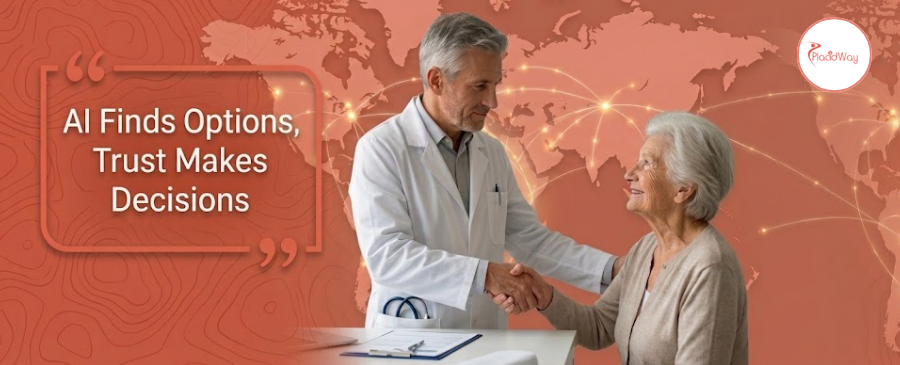
The AI Trust Gap: Reshaping the Global Patient Journey
The global healthcare landscape is currently witnessing a tectonic shift in how patients navigate their care. Just as the hospitality industry is grappling with a "discovery-booking" disconnect, the medical tourism sector is facing an unprecedented transformation. Patients are no longer just searching; they are "asking" AI to solve their most complex health challenges.
However, while discovery has moved into AI-driven environments, the actual transaction—the life-altering decision to travel across borders for surgery—remains anchored in trusted platforms. This "Trust Gap" is redefining the role of intermediaries like PlacidWay, moving them from simple directories to essential pillars of authority in an AI-dominated world.
1. The Fragmented Path: Discovery vs. Decision
In the "Search Anywhere" era, the patient journey has become non-linear. A patient in London suffering from chronic knee pain may begin their journey not on Google, but inside a conversational AI like Gemini or ChatGPT. They ask: "What are the safest options for robotic-assisted knee replacement in Turkey versus Thailand?"
The AI provides a curated list of destinations, estimated costs, and even recovery timelines. This is the Discovery Phase, and it is increasingly dominated by algorithmic relevance. However, the latest research suggests that while traffic from AI assistants converts at more than double the rate of organic search (8.26% vs 3.88%), the actual "booking" or commitment to a medical procedure requires a different layer of validation.
The discovery is fragmented across AI platforms, but the decision is unified by trust. Patients still turn to established brands like PlacidWay to bridge the gap between an AI's recommendation and a verified clinical reality.
2. The E-E-A-T Framework: Why Brands Still Matter
For a traveler booking a hotel, the risk is a bad night's sleep. For a medical tourist, the risk involves their physical life and financial security. This is why Google’s E-E-A-T framework (Experience, Expertise, Authoritativeness, and Trustworthiness) has become the gold standard for Medical Tourism content.
AI is excellent at retrieving facts, but it often falls short in handling the nuanced, high-stakes realities of clinical environments. Patients recognize this "Shadow AI" risk—where an AI might sound confident but be objectively wrong. To combat this, PlacidWay has pioneered an Operationalized E-E-A-T strategy.
Example: When a patient researches Stem Cell Therapy in Mexico, an AI might list five clinics. However, the patient will only move forward if they find third-party validation: verified doctor profiles, real patient video testimonials, and transparent outcome-based storytelling. The "trusted brand" acts as the human auditor for the AI’s suggestions.
3. The 8-Touchpoint Patient Journey
To navigate this fragmented journey, the industry is moving away from reactive "send me a WhatsApp" communication toward structured, AI-enhanced engagement. PlacidWay’s 8-Touchpoint Framework illustrates how a brand can maintain presence across the entire funnel:
-
Touchpoints 1-3 (Discovery & Inquiry): AI-powered discoverability ensures the clinic is visible in "Answer Engines" (AEO). The initial response is personalized using AI to match the patient's specific medical history with the right doctor.
-
Touchpoints 4-6 (Trust Building): This is where the human-centric "trusted platform" shines. It provides transparent pricing, case stories, and personalized human follow-ups.
-
Touchpoints 7-8 (Qualification & Logistics): AI handles the complex international logistics (multi-timezone scheduling, documentation) while the brand provides the accountability and support the patient expects.
4. Visibility in AI: The New Frontier of Distribution
If a clinic is not surfaced in an AI-driven discovery environment, it effectively does not exist in the modern patient journey. This creates a "visibility challenge" similar to what hotels face with OTAs.
Medical centers must now optimize for Answer Engine Optimization (AEO). This means structuring data so that AI agents can "read" and recommend them.
-
Multilingual Reach: AI translation models now allow clinics to reach patients in English, Spanish, Arabic, and 15 other languages with cultural precision.
-
Algorithm Matching: Proprietary recommendation systems now match patients to specific treatment packages based on predictive analytics, rather than just simple keyword hits.
5. Bridging the Accountability Gap
One of the primary barriers to end-to-end AI bookings in healthcare is accountability. When an error occurs, who is responsible—the AI developer, the medical center, or the patient?
Trust remains the key barrier because patients want clear accountability and human support. Trusted intermediaries provide a "single point of truth." They ensure that if a flight is delayed or a medical record needs verified translation, there is a human-led system ready to intervene. This reinforces the role of trusted platforms as the necessary "wrappers" around AI technology.
6. The Future: From Reactive to Predictive Care
The next phase of medical tourism is moving toward Agentic Workflows—AI that doesn't just give information but completes complex tasks on the patient's behalf. Imagine an AI agent that can navigate drug compatibility issues for a patient’s specific regimen or automate the back-office finance for international insurance claims.
However, the "Ivory Tower" of medical research often struggles to deploy these tools locally due to risk and governance issues. Platforms like PlacidWay are filling this void by building the foundational infrastructure that treats AI as a core utility, ensuring it is safe, predictable, and empathetic.
Hybrid Strategies Define Success
The AI trust gap is not a hurdle to be avoided, but an opportunity to be seized. The medical centers and platforms that will lead the industry in 2026 and beyond are those that combine:
1. AI-Driven Inspiration: Achieving high visibility in next-gen answer engines like ChatGPT, Gemini, and Perplexity.
2. Strong Distribution: Leveraging the authority of established marketplaces to turn AI discovery into actual appointments.
3. Human E-E-A-T Standards: Maintaining the expertise and empathy that algorithms cannot replicate to bridge the accountability gap.
The patient journey is indeed reshaping, but at its heart, it remains a human endeavor. Technology provides the path, but trust provides the destination.
