


Patient Profile
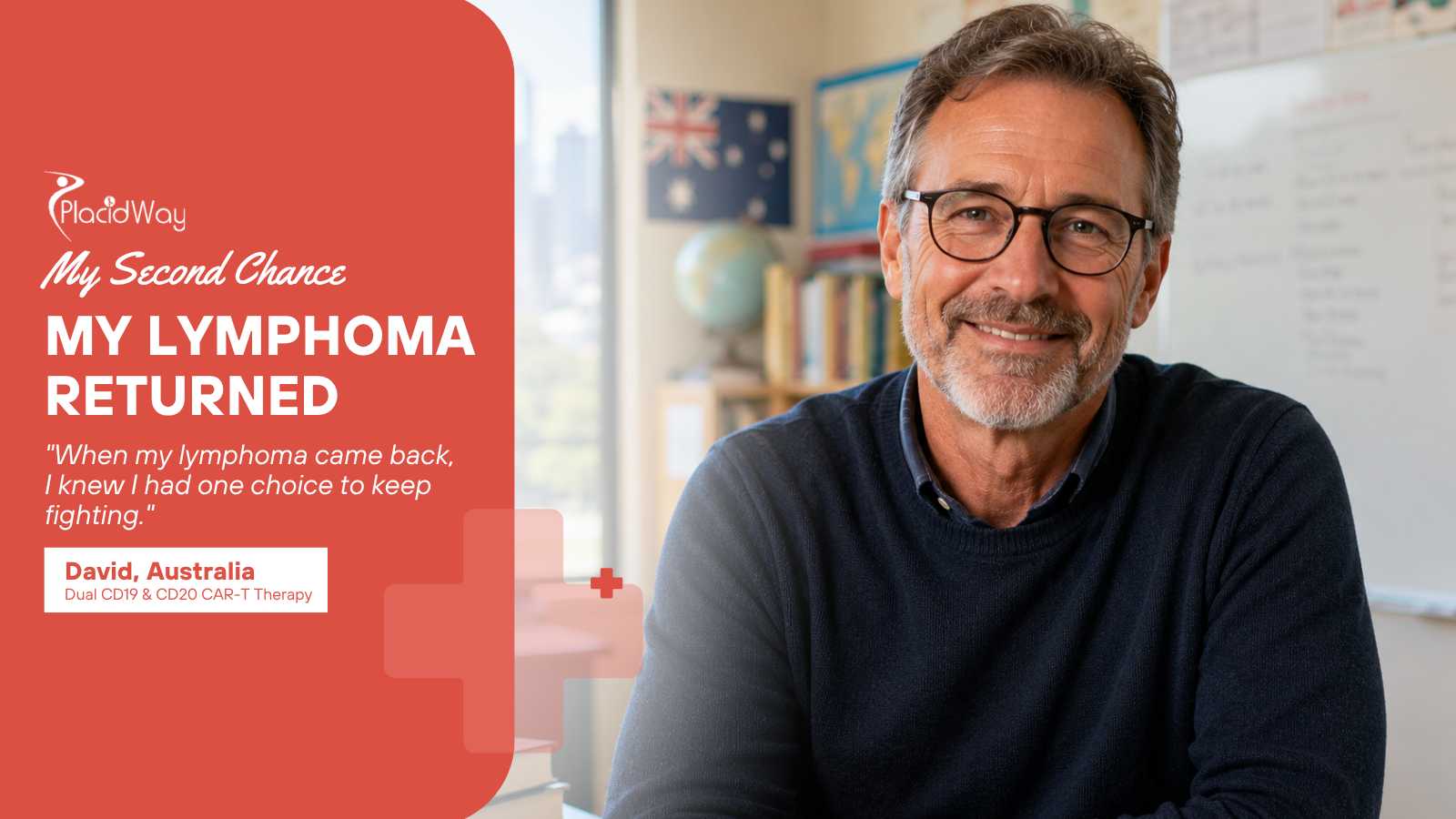
Patient name: David
Age: 59
Profession: High School History Teacher
City of residence: Melbourne
Home country: Australia
Treatment: Dual CD19 & CD20 CAR-T Therapy
Destination city: Beijing
Destination country: China
Provider: Bioocus Medical Group
Journey at a Glance
◉ Diagnosis: Diffuse Large B-Cell Lymphoma (DLBCL)
◉ Local barrier: Conventional therapies proved insufficient
◉ Reason for treatment abroad: Access to advanced dual-target clinical protocol
◉ Treatment decision: Dual CAR-T targeting CD19 and CD20 antigens
◉ Destination country: China
◉ Recovery status: Rapid cellular expansion achieved without major complications
◉ Current outcome: High complete response indicators and stabilizing immunity
Being diagnosed with Diffuse Large B-Cell Lymphoma (DLBCL) in my late fifties completely derailed my life. DLBCL is an aggressive, fast-growing type of non-Hodgkin lymphoma that attacks the lymphatic system. Like most patients, I started with the standard frontline approach at home in Australia, undergoing rigorous rounds of conventional chemotherapy. Unfortunately, my cancer proved stubborn. When the local specialists confirmed that standard therapies were no longer sufficient to keep the disease at bay, I was forced to look outside my local healthcare system for a lifeline.
Knowing that I needed a highly targeted approach for relapsed DLBCL, my family and I researched advanced immunotherapy options globally. This led me to travel to Bioocus Medical Group in Beijing, China. There, I enrolled in a specialized clinical protocol (P1549) for dual CD19 and CD20 CAR-T cell therapy. By reprogramming my own immune system to hunt the cancer using two specific markers instead of just one, the medical team gave me a fighting chance against a disease that was outsmarting conventional drugs.
When standard treatments for DLBCL finally stop working
As a high school history teacher, I was used to analyzing the past and organizing events into neat, predictable timelines. Cancer destroyed all of that. The fatigue from the DLBCL was so heavy that I had to take early retirement. I simply couldn't stand in front of a classroom anymore. I traded my lesson plans for chemotherapy schedules, enduring the nausea and the profound exhaustion, assuming it would eventually lead to remission.
Hearing your oncologist say that the chemo isn't working is a very specific type of terror. DLBCL is notoriously aggressive. When standard drugs fail, the disease can multiply rapidly. My local doctors were honest with me: routine protocols were exhausted, and I was facing a very precarious situation. I didn't have the luxury of time to sit on a domestic waiting list for a clinical trial that I might not even qualify for.
My adult children took over the research. We spent weeks scouring medical journals, trying to understand what options existed for relapsed lymphoma. During that frantic research phase, we found PlacidWay online. They stepped in to help us cut through the overwhelming administrative noise. They facilitated the transfer of my medical records and quickly coordinated a consultation with the hematology specialists at Bioocus Medical Group in Beijing.
How dual CAR-T cell therapy actually fights lymphoma
When I arrived in Beijing, the medical team sat down and explained exactly why my previous treatments had failed and how their CAR-T approach was different. To understand it, you have to understand how smart cancer can be.
CAR-T cell therapy is essentially an immune system boot camp. The doctors extract your T-cells—the soldiers of your immune system—from your blood. They send those cells to a lab, where they are genetically reprogrammed to recognize and attack a specific protein (an antigen) on the surface of your cancer cells. For lymphoma, that target is usually a protein called CD19. Once the cells are reprogrammed into "hunters," they are infused back into your body.
The problem, my doctors explained, is that DLBCL can mutate. Sometimes, the cancer drops that CD19 marker to become invisible, allowing it to escape the CAR-T cells and relapse. This is where the Bioocus protocol was completely different. They were giving me a dual CAR-T therapy.
Instead of programming my T-cells to look for just one target, they engineered them to hunt for two: CD19 and CD20. It was explained to me like giving a security system two different photographs of the same intruder. If the lymphoma tried to hide by changing one of its markers, my modified cells would still recognize the other one. It was a dual-pronged attack designed specifically to prevent the cancer from escaping.
The terrifying wait for my engineered cells to wake up
In September, after a few days of conditioning chemotherapy to make room in my body, I received the infusion of my newly engineered CAR-T cells. Watching a small bag of fluid enter my IV felt incredibly anti-climactic. You look at it and realize those microscopic cells carry your entire future.
What followed was the most stressful waiting game of my life. The doctors needed to track my blood closely to see if the CAR-T cells were surviving and multiplying. On Day 4 after the infusion, the results came back. The doctors noted a very modest presence—my CD19 and CD20 hunters made up barely half a percent of my total T-cells. They told me this was a sign of early, successful engraftment, but to me, the numbers looked pitifully small. I lay in my hospital bed terrified that my 59-year-old immune system was just too battered to multiply these cells.
But human biology is astonishing. By Day 7, the blood tests showed that the cellular expansion had suddenly accelerated. My engineered cells were waking up, tripling in number, and demonstrating robust proliferation. The doctors were very pleased with the trajectory, but it was the next milestone that truly shocked everyone.
On Day 10, the lab results revealed an explosive peak. My dual CAR-T cells had multiplied over 500 times compared to where they started just six days earlier. The CD19 and CD20 hunting cells now made up over 30% of my overall T-cells. My body had essentially built a massive, highly targeted army overnight.
Alongside this massive expansion, they noted that my cytotoxic T cells—the specific immune cells responsible for destroying tumors—were highly elevated, sitting at nearly 70%. My body was finally mounting the overwhelming defense that conventional chemotherapy could never trigger.
My ongoing recovery and what comes next for me
Before the treatment, I was heavily warned about the severe side effects of CAR-T. When those modified cells rapidly multiply and attack the cancer, they release massive amounts of inflammatory proteins. It can cause severe fevers, neurological issues, and extreme illness. Thankfully, I was incredibly lucky. I tolerated the aggressive cellular expansion very well, managing to get through the intense monitoring phase in Beijing without any major complications.
Today, my prognosis looks remarkably completely different than it did a few months ago. That rapid, 500-fold cell expansion on Day 10 is a major hallmark of successful CAR-T treatment, strongly correlating with deep and durable remissions for DLBCL patients. The clinical tests show a highly favorable complete response.
Looking Back
"When your local doctors tell you standard medicine has failed, it feels like hitting a brick wall. Seeking out complex immunotherapies abroad was daunting, but understanding the science behind the treatment gave me the confidence to take the leap."
I am not completely out of the woods. Rebuilding an immune system that was wiped out by years of chemo and intensive immunotherapy takes time. I still have days where the fatigue forces me to rest on the couch instead of going for a walk. I rely heavily on good nutrition, careful follow-ups, and the ongoing support of my family.
I'm sharing my story because if you are facing a relapsed, aggressive lymphoma, you need to know exactly how treatments are evolving. Sometimes standard medicine isn't enough, and you have to travel a great distance to find a smarter weapon. Seeing my own immune system finally win a battle it was previously losing has given me the most valuable thing of all: my future.
Exploring Advanced Lymphoma Treatments Abroad
If you are facing a relapsed condition or standard treatments are no longer effective, exploring specialized cellular therapies and international second opinions can open up new possibilities.
Request More InformationTake the time to evaluate advanced facilities, compare clinical protocols, and speak with medical coordinators to make an informed decision for your health.




.png)








Share this listing