

When lymphoma keeps returning after chemotherapy or other treatments, hearing that another option exists can change the conversation. CAR-T therapy in China has attracted attention from Canadian patients because China has expanded its regulated cellular-therapy programs and commercial CAR-T options for selected blood cancers. But traveling for CAR-T is a major medical decision. You need confirmation that your exact lymphoma is an approved or appropriately studied indication, an experienced hematology team, a licensed hospital with ICU support, clear NMPA regulatory information, and a realistic plan for complications and follow-up after returning to Canada.
Quick Summary: CAR-T Therapy in China for Canadian Lymphoma Patients
- What CAR-T is: Your T cells are collected, genetically modified so they recognize a cancer-related target, expanded, and infused back into your body.
- Who may qualify: CAR-T is used for specific blood cancers and treatment settings. Eligibility depends on lymphoma subtype, previous therapies, target expression, organ function, disease status, and the exact CAR-T product or clinical protocol.
- China regulation: Commercial CAR-T products should have authorization from China's National Medical Products Administration, or treatment should occur through a properly registered clinical study where applicable.
- Hospital verification: Request the hospital's Medical Institution Practice License and confirm that the center routinely manages cellular therapy, apheresis, lymphodepletion, CRS, neurologic toxicity, severe infections, and intensive-care emergencies.
- Cost: An official Chinese government source reported in late 2025 that some commercial CAR-T products had exceeded approximately $141,000 per dose. Your complete treatment episode can cost more because testing, hospitalization, bridging treatment, complications, travel, and follow-up may be separate.
- Canada comparison: CAR-T is available through Canadian programs for eligible patients, and provincial funding may apply. Compare clinical eligibility and access pathways before assuming international self-pay treatment is necessary.
- Major safety issue: CAR-T can cause cytokine release syndrome, neurologic toxicity, infection, prolonged low blood counts, B-cell depletion, and other serious complications requiring specialized monitoring.
The Canadian Lymphoma Story Behind Interest in CAR-T Therapy in China
A previous PlacidWay article describes a Canadian woman identified as Sarah who reportedly traveled to China after lymphoma continued despite previous treatment. According to that account, she underwent CAR-T therapy and subsequently showed a substantial treatment response.
However, publicly accessible independent medical documentation confirming the patient's identity, complete diagnosis, hospital records, CAR-T product, imaging results, or long-term outcome was not located during review. For that reason, her story should be understood as a reported patient narrative rather than clinical evidence that CAR-T will produce the same outcome for another patient.
If you are Canadian and facing recurrent lymphoma, the more useful question is not whether another patient's cancer improved. It is whether CAR-T is medically appropriate for your exact disease and whether receiving it in China offers an advantage over Canadian treatment or trial pathways.
How CAR-T Therapy in China Targets Certain Types of Lymphoma
CAR-T stands for chimeric antigen receptor T-cell therapy. It is a personalized cellular immunotherapy in which immune cells called T cells are collected from your blood and genetically engineered to recognize a particular protein associated with cancer cells.
For many B-cell lymphomas, the important target is CD19, a protein expressed on B cells. After laboratory manufacturing, the modified cells are returned to you. The engineered T cells can then identify cells carrying the target and activate an immune attack.
| CAR-T stage | What happens | What the patient should verify |
|---|---|---|
| Medical assessment | The team confirms lymphoma type, previous treatments, disease burden, organ function, and CAR-T eligibility. | Why this specific CAR-T product or protocol matches your diagnosis. |
| Leukapheresis | Blood passes through a machine that separates cells needed for manufacturing. | Where collection occurs and who controls the chain of identity and custody. |
| Manufacturing | T cells are genetically modified and expanded under controlled manufacturing conditions. | Product name, manufacturer, target, regulatory status, manufacturing site, and expected turnaround. |
| Bridging treatment | Some patients need temporary disease-control treatment while cells are manufactured. | Whether it is needed and whether its cost is included. |
| Lymphodepletion | Preparatory chemotherapy reduces existing lymphocytes before CAR-T infusion. | Where this is administered and how blood counts and infections are monitored. |
| CAR-T infusion | The manufactured CAR-T cells are infused into the patient. | Emergency drugs, trained staff, ICU access, and toxicity protocols. |
| Monitoring | The team watches closely for immune, neurologic, infectious, and blood-related complications. | How long you must remain near the hospital and what happens after discharge. |
Which Lymphoma Patients May Be Candidates for CAR-T Therapy in China
CAR-T is not a general treatment for every lymphoma. Commercially approved CD19-directed therapies are primarily relevant to selected B-cell malignancies, while other lymphoma types may require different treatments or investigational protocols.
For aggressive large B-cell lymphoma, CAR-T has become an established therapeutic option in specific relapsed or refractory settings. “Refractory” means the lymphoma did not adequately respond to treatment, while “relapsed” means it returned after an earlier response.
| Eligibility factor | Why it matters | Records commonly needed |
|---|---|---|
| Exact pathology | Different lymphomas respond differently and may have different approved indications. | Pathology report, immunohistochemistry, biopsy material when requested. |
| Previous treatment | CAR-T indications frequently specify prior lines of systemic therapy or early relapse. | Drug names, dates, doses where available, response and reason treatment stopped. |
| Current disease status | Rapidly progressing disease may require immediate disease control before cells can be manufactured. | Current PET/CT, CT, MRI where relevant, symptoms and laboratory tests. |
| Organ function | Heart, lung, kidney, liver and neurologic status influence treatment safety. | Blood work, cardiac testing and other specialist assessments when required. |
| Infection status | Active infection may make cellular therapy more dangerous. | Screening requested by the CAR-T center. |
Age alone should not be used to assume that you qualify or do not qualify. Functional status, other illnesses, previous treatment, disease biology and the specific product criteria all matter.
Why Canadian Patients Are Looking at CAR-T Therapy in China
Canada already provides CAR-T therapy for eligible lymphoma patients, so traveling to China should not be presented as the only way to obtain this treatment. Ontario, for example, operates a publicly funded CAR-T program for patients who meet defined eligibility criteria, including pathways for several relapsed or refractory lymphomas.
Patients may still investigate China when they do not meet a particular Canadian program's criteria, when treatment timing becomes a concern, when a different target or clinical trial is being investigated, or when they want another specialist opinion.
- Their lymphoma has returned after multiple previous treatments.
- They want another CAR-T eligibility assessment.
- They are researching a product or target not available through their local pathway.
- Their oncologist has discussed clinical-trial options.
- They are comparing treatment timing and manufacturing pathways.
- They are exploring private international access after reviewing Canadian options.
2025-2026 Lymphoma Statistics Relevant to Canadian CAR-T Patients
Canadian Cancer Statistics projected approximately 12,000 new non-Hodgkin lymphoma cases in Canada during 2025. The Canadian Cancer Society's updated 2026 estimate is approximately 12,100 new cases and 3,200 deaths.
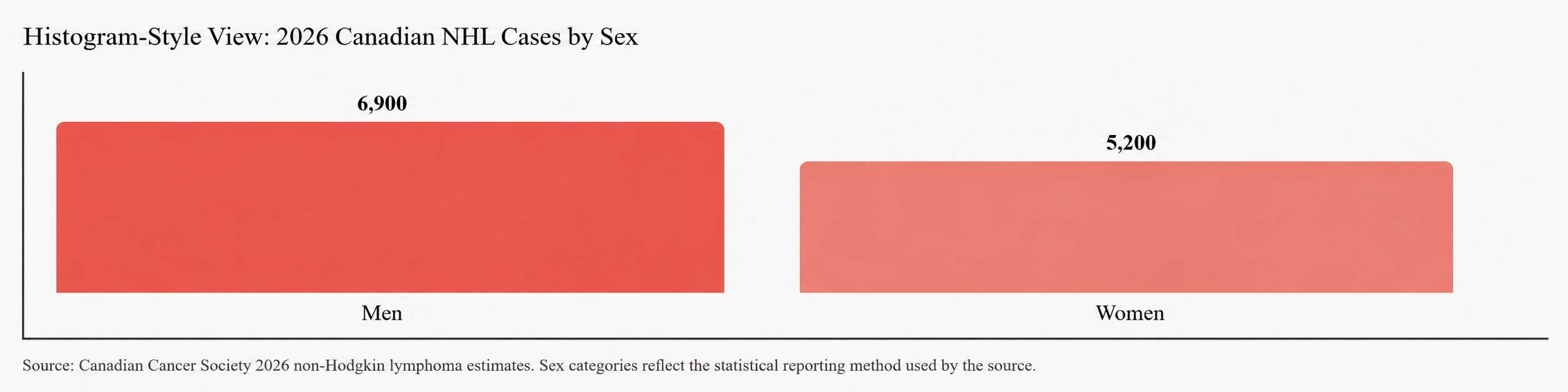
For 2026, approximately 6,900 new cases are projected among men and 5,200 among women. These national figures describe lymphoma burden; they do not indicate how many Canadians qualify for CAR-T or travel to China.
Line Graph: Projected Canadian Non-Hodgkin Lymphoma Cases
Sources: Canadian Cancer Statistics 2025 and Canadian Cancer Society 2026 estimates. These are projections and should not be interpreted as a measured change in CAR-T demand.
No authoritative dataset was located showing the number, age distribution, sex distribution, province of origin, or treatment outcomes of Canadian lymphoma patients traveling specifically to China for CAR-T therapy. Such medical-tourism percentages should therefore not be invented.
What Has Changed in China's CAR-T Therapy Landscape
China's regulated CAR-T sector has expanded rapidly since the country's first commercial CAR-T approval in 2021. The National Medical Products Administration has subsequently authorized additional cellular products for blood cancers, including therapies targeting CD19 for relapsed or refractory large B-cell lymphoma.
In July 2025, Chinese regulators approved another domestically developed CD19 CAR-T product for adults with relapsed or refractory large B-cell lymphoma after at least two previous lines of systemic therapy. Other CAR-T products in China address multiple myeloma and additional hematologic indications.
| Treatment status | What it means for a Canadian patient | What to request |
|---|---|---|
| NMPA-approved product | The product has Chinese marketing authorization for defined indication(s). | Generic name, manufacturer and approved indication. |
| Off-label use | The proposed use differs from the approved indication. | Why it is being recommended, evidence, consent process and alternatives. |
| Registered clinical trial | The treatment remains investigational for that protocol or indication. | Trial registration, protocol number, ethics approval, sponsor and eligibility criteria. |
| Unclear cellular program | Risk is difficult to assess when regulatory or clinical status cannot be established. | Do not proceed until status can be independently verified. |
CAR-T Therapy Costs in China Compared With Treatment in Canada
CAR-T cost comparisons require context because Canada and China use different funding structures. For an eligible Canadian receiving treatment through a provincially funded pathway, the patient's personal cost is not equivalent to the manufacturer's full drug price.
China can involve direct private payment for international patients. A Chinese government information source reported in December 2025 that axicabtagene ciloleucel had previously cost more than 1 million yuan, described as approximately $141,337 per dose. That figure is not a complete CAR-T episode price and should not be treated as a universal China quote.
| Cost component | China | Canada |
|---|---|---|
| CAR-T product | Some commercial products have historically exceeded approximately $141,000 per dose; current product-specific quote required. | Eligible patients may receive CAR-T through provincially funded programs. Funding rules vary by jurisdiction and indication. |
| Pre-treatment evaluation | Confirm whether consultations, pathology review, PET/CT and laboratory testing are included. | Usually managed through the provincial cancer-care pathway when clinically indicated. |
| Apheresis and manufacturing | Ask whether these are part of the quoted CAR-T price. | Handled through the treating CAR-T program for eligible funded patients. |
| Bridging therapy | May be separate and can vary substantially. | Depends on the patient's clinical treatment plan. |
| Hospital and ICU care | Clarify whether complications increase the bill. | Covered according to applicable Canadian health-system arrangements for eligible residents. |
| International travel | Flights, visa, accommodation and caregiver expenses may be additional. | Not normally applicable to local treatment, although some patients travel within Canada. |
Your China CAR-T quote should itemize
- Pathology and specialist review.
- PET/CT, MRI or other required imaging.
- Laboratory and infectious-disease testing.
- Leukapheresis.
- Cell manufacturing and the exact CAR-T product.
- Bridging therapy if required.
- Lymphodepletion chemotherapy.
- CAR-T infusion.
- Standard inpatient monitoring.
- ICU or complication-related costs.
- Discharge medications and follow-up.
- Travel, accommodation and caregiver expenses.
How to Choose a Hospital in China for CAR-T Lymphoma Treatment
CAR-T should be delivered through a hospital capable of managing complex hematologic cancer and serious immune-related toxicity. China's medical institutions must obtain legal authorization to practice, and third-grade hospitals represent the highest tier in the country's three-tier hospital classification system.
A hospital's general reputation is not enough. You should confirm that the specific hematology or cellular-therapy department has appropriate infrastructure for the exact therapy being proposed.
| Verification point | What to ask | Why it matters |
|---|---|---|
| Medical Institution Practice License | “Can you provide the hospital's current license and licensed scope of practice?” | Confirms the institution is legally registered to deliver medical services. |
| Hospital level | “What is the hospital's official grade and which authority issued it?” | Complex cellular therapy generally requires substantial hospital infrastructure. |
| NMPA product status | “Is this exact CAR-T product NMPA-approved for my condition?” | Separates commercial approved treatment from investigational or off-label care. |
| Apheresis and cell handling | “Where are my cells collected, processed, manufactured and stored?” | CAR-T requires strict chain-of-identity and manufacturing controls. |
| ICU and emergency support | “Is ICU care immediately available if severe CRS or neurologic toxicity develops?” | CAR-T toxicity can become life-threatening quickly. |
| International coordination | “Will my records be provided in English and shared with my Canadian hematologist?” | Accurate cross-border follow-up is essential after CAR-T. |
How to Verify a CAR-T Hematologist or Oncologist in China
China requires physicians to qualify and register before practicing within their authorized professional scope. Ask for the treating doctor's full legal name, registered specialty, hospital affiliation, professional role and direct experience with your lymphoma subtype and CAR-T product.
CAR-T care should involve more than one physician. Hematology, cellular therapy, intensive care, neurology, infectious diseases, pharmacy, transfusion medicine and specialist nursing may all become important during treatment.
How many patients with your specific lymphoma subtype has the physician evaluated for CAR-T?
Which CAR-T products and targets does the team routinely administer?
Who manages CRS, ICANS, severe infection and prolonged cytopenias?
Request published or audited data relevant to your lymphoma rather than individual testimonials.
CAR-T Therapy Risks Canadian Patients Must Plan for in China
CAR-T can produce major responses in appropriately selected patients, but it can also cause serious or life-threatening toxicity. The hospital must be prepared to recognize complications quickly rather than treating them as an expected “healing reaction.”
Two of the most recognized acute complications are cytokine release syndrome and immune effector cell-associated neurotoxicity syndrome. CRS occurs when immune activation triggers a large release of inflammatory signaling molecules. Symptoms can include high fever, low blood pressure and breathing problems.
| Potential complication | Possible warning signs | Why hospital capability matters |
|---|---|---|
| Cytokine release syndrome | Fever, low blood pressure, rapid heartbeat, breathing difficulty and systemic illness. | Severe cases require rapid medical treatment and sometimes intensive-care support. |
| ICANS / neurologic toxicity | Confusion, difficulty speaking, tremor, altered awareness or seizure. | Neurologic deterioration requires urgent assessment and experienced management. |
| Infection | Fever, chills, cough, urinary symptoms or other new illness. | Lymphodepletion and CAR-T can substantially alter immune function. |
| Prolonged cytopenias | Fatigue, infection risk, bruising or bleeding. | Blood counts may require continued monitoring and supportive management. |
| B-cell depletion | Reduced normal B cells and potentially low antibody levels. | Longer-term immune monitoring may be required. |
| Secondary malignancy | May not produce an early obvious symptom. | Health authorities recommend long-term surveillance after genetically modified CAR-T therapies. |
Travel and Recovery Planning From Canada to China for CAR-T Therapy
CAR-T medical travel cannot be planned like a short elective procedure. Your schedule may change if lymphoma progresses, manufacturing takes longer than expected, bridging therapy becomes necessary or treatment-related complications extend your hospital stay.
Your Canadian hematologist should ideally remain informed because infection risk, blood-count abnormalities, immune effects and relapse monitoring continue after you return home.
| Timeframe | Clinical process | Patient experience | Activity level | Action required |
|---|---|---|---|---|
| Before traveling | Eligibility review, records, pathology and imaging assessment. | Symptoms depend mainly on lymphoma and current treatment. | Individual. | Obtain medical travel advice and confirm the treatment plan in writing. |
| Cell collection/manufacturing | Leukapheresis followed by cell production. | Varies; lymphoma may still require active management. | As directed. | Understand the bridging plan and where you must stay. |
| Before infusion | Lymphodepleting chemotherapy. | Fatigue, nausea or reduced blood counts may occur. | Follow hospital restrictions. | Report new infection symptoms immediately. |
| Early post-infusion | Highest-intensity monitoring period for acute toxicity. | Experience varies; fever, weakness or neurologic symptoms can occur. | Restricted according to clinical status. | Remain within the hospital's required monitoring area. |
| Return to Canada | Ongoing response, immune and blood-count monitoring. | Fatigue and reduced stamina may continue. | Individual. | Transfer complete records to the Canadian oncology team. |
Bring these lymphoma records to China
- Original pathology report and pathology review when available.
- PET/CT, CT and relevant MRI reports and image files.
- Complete chemotherapy, antibody and immunotherapy treatment history.
- Previous stem-cell transplant records if applicable.
- Current medications and allergies.
- Recent blood counts and organ-function tests.
- Infection history.
- Contact details for your Canadian hematologist.
- Copies of any previous cellular-therapy or clinical-trial assessments.
Frequently Asked Questions About CAR-T Therapy in China for Canadians
Can Canadian patients travel to China for CAR-T lymphoma therapy?
International treatment may be possible when a Chinese hospital accepts the patient's case and immigration, clinical and regulatory requirements are satisfied. Approval for travel does not establish medical suitability. Your records should undergo specialist review before you make financial or travel commitments.
Is CAR-T therapy already available in Canada for lymphoma?
Yes. CAR-T is available in Canada for selected leukemia and lymphoma indications, and provincial programs may fund treatment for patients meeting eligibility requirements. Ask your hematologist about local, provincial, out-of-province and clinical-trial pathways before assuming you must travel internationally.
Which lymphoma types can be treated with CAR-T in China?
China has NMPA-authorized CD19 CAR-T products for defined B-cell lymphoma indications, including selected relapsed or refractory large B-cell lymphomas. Eligibility varies by product. Ask the hospital to identify the exact product, target and approved indication that matches your pathology.
How much does CAR-T therapy in China cost for a Canadian patient?
There is no single complete-treatment price. An official Chinese source reported that some commercial CAR-T products had exceeded approximately $141,000 per dose. Testing, bridging treatment, hospitalization, toxicity management, travel and follow-up can add to the total cost.
Is CAR-T therapy cheaper in China than in Canada?
A simple price comparison can be misleading. Eligible Canadians may receive CAR-T through publicly funded provincial programs, while an international patient in China may pay privately. Compare your personal financial responsibility, clinical eligibility, treatment timing and total episode costs rather than manufacturer prices alone.
How do I know if a CAR-T product in China is approved?
Request the generic product name, manufacturer, biological target and NMPA-approved indication. If treatment is experimental, request the clinical-trial registration and protocol information. Do not rely on descriptions such as “next-generation CAR-T” without regulatory and clinical documentation.
What are the most serious CAR-T therapy side effects?
Major risks include cytokine release syndrome, neurologic toxicity, infections and prolonged low blood counts. CAR-T can also affect normal B cells, and long-term safety monitoring is important. Complications can become severe, which is why treatment requires an experienced hospital team.
How long should I remain in China after CAR-T infusion?
The appropriate monitoring period depends on the specific product, hospital protocol and your clinical course. Do not book a fixed return flight based only on a package schedule. Ask the treating team how long you must remain near the hospital and what criteria determine travel clearance.
What happens if my lymphoma progresses while CAR-T cells are being manufactured?
Some patients may need bridging therapy to control disease during manufacturing. The appropriate treatment depends on your lymphoma, previous therapies and clinical condition. Ask the center to explain the bridging plan before leukapheresis and whether it changes the quoted cost.
Can my Canadian oncologist follow me after CAR-T treatment in China?
Cross-border follow-up is advisable when possible. Ask the Chinese hospital for complete English-language documentation covering the CAR-T product, manufacturing and infusion dates, complications, medications, imaging, laboratory results, discharge instructions and recommendations for long-term surveillance.
Does another patient's remission mean CAR-T will work for me?
No. Individual stories cannot predict your outcome. Response depends on lymphoma subtype, disease biology, previous treatments, tumor burden, CAR-T product, patient health and other factors. Your decision should be based on specialist assessment and clinical evidence relevant to your situation.
What should I ask before paying a Chinese CAR-T hospital?
Ask for your written eligibility assessment, exact CAR-T product, NMPA status, hospital license, treating doctors, manufacturing pathway, expected timeline, itemized costs, complication policy, ICU access, refund terms if cells cannot be manufactured and a detailed follow-up plan.
Compare CAR-T Therapy Options in China
If you are a Canadian patient exploring CAR-T therapy in China, PlacidWay can help you request information, compare proposed treatment pathways and costs, and prepare questions about the exact CAR-T product, hospital licensing, physician experience, NMPA status, complication management and follow-up. Any international treatment decision should also be reviewed with a qualified hematologist who understands your diagnosis and previous therapy.
Disclaimer for CAR-T Therapy in China
Disclaimer: This information is for educational purposes only and does not replace professional medical advice. Always consult a qualified healthcare provider before making medical decisions.
References
- CAR T Cells: Engineering Immune Cells to Treat Cancer – National Cancer Institute
- Aggressive B-Cell Non-Hodgkin Lymphoma Treatment – National Cancer Institute
- Non-Hodgkin Lymphoma Statistics – Canadian Cancer Society
- CAR T-Cell Therapy Enrolment and Availability – Ontario Health (Cancer Care Ontario)
- CAR-T Therapy Safety Review – Health Canada
- NMPA Approval of a CAR-T Product for Relapsed or Refractory Large B-Cell Lymphoma – Shanghai Medical Products Administration






















Share this listing