


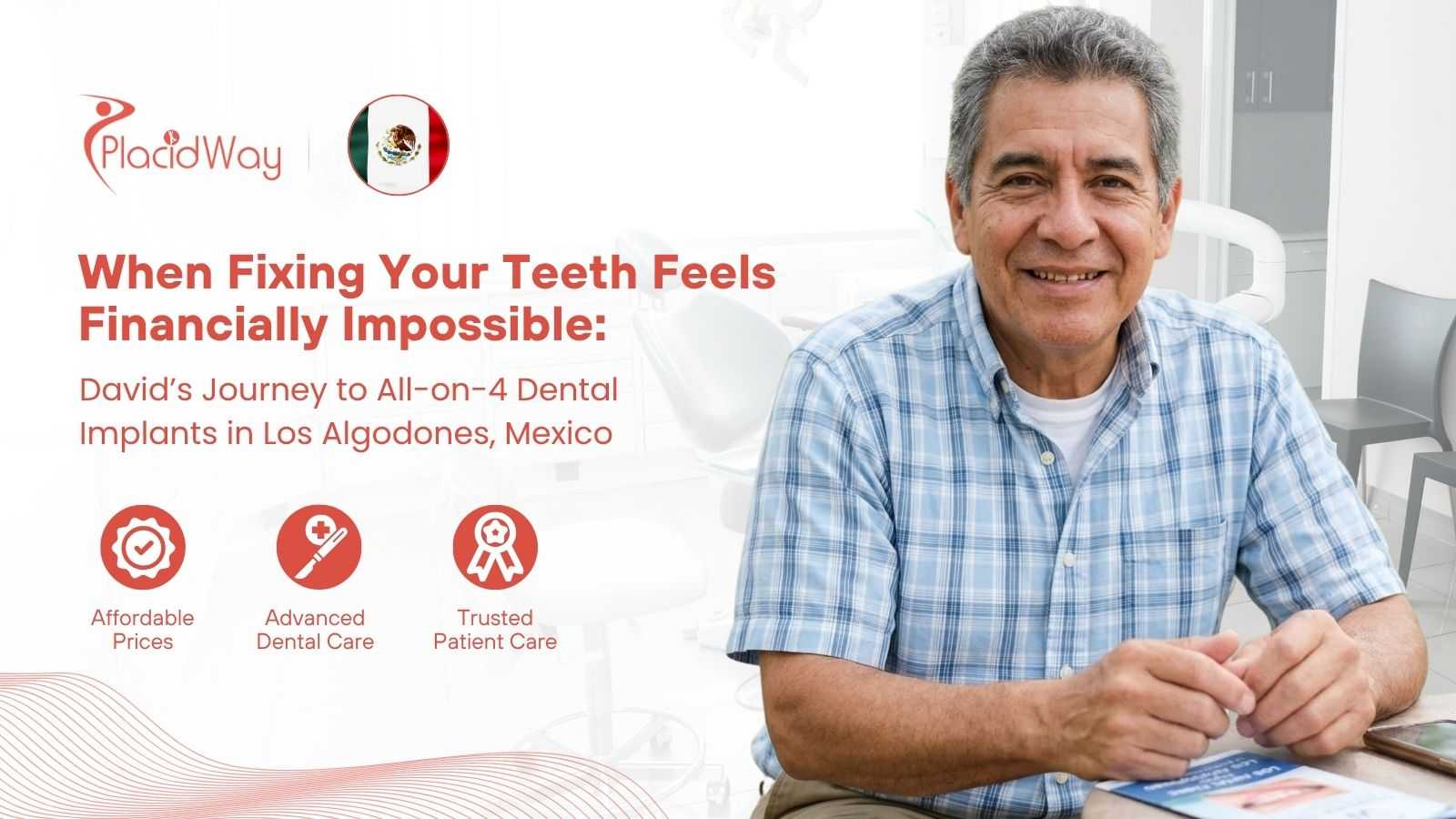
When Fixing Your Teeth Feels Financially Impossible
For Americans who have tried to save their teeth, delayed treatment, and started wondering whether there is another way.
Patient Profile
◉ Name: David
◉ Age: 62 years old
◉ Nationality: American
◉ Family: Married with grandchildren
◉ Dental History: Crowns, root canals, a bridge, extractions, and a partial denture
◉ Current Concern: Multiple failing teeth requiring extensive dental rehabilitation
◉ Primary Goal: To eat comfortably, smile confidently, and stop worrying about his teeth
Journey at a Glance
◉ U.S. Estimate: $14,000–$36,000 per arch
◉ Treatment Explored: All-on-4 Dental Implants in Los Algodones Mexico
◉ Destination: Los Algodones, Mexico
◉ Indicative Cost: $5,000–$8,500 per arch
◉ Main Concerns: Quality, safety, total cost, and follow-up care
◉ Decision: Compare options, providers, costs, and long-term care
◉ Persona: Fictional composite character, not a real PlacidWay patient
There is a particular kind of anxiety that comes with sitting in a dental chair when you already know the conversation is going to end with a number you cannot afford. You listen while the dentist explains the X-rays: another tooth needs attention, the bridge is failing, the denture isn’t fitting the way it used to, or there may be another extraction.
Then someone turns the computer screen toward you and shows you the treatment plan. You don’t really hear the next few sentences. You’re looking at the total and thinking: How am I supposed to pay for this?
For many Americans, that question isn’t unusual. Cost remains a major barrier to dental care in the United States, including among people who have insurance. KFF has reported that at least one in four insured adults experiences cost barriers to dental care, while traditional Medicare generally does not cover routine dental services.
But statistics don’t explain what that feels like. They don’t explain eating steak on only one side of your mouth. They don’t explain turning your face slightly when someone takes a photograph, or checking whether anybody is watching before taking out a denture. Nor do they capture telling your family, “I’m fine. It’s just my teeth,” when you aren’t really fine with it anymore.
Meet David
David isn’t a real PlacidWay patient. He is a fictional composite representing the experiences and questions many Americans may recognize when extensive dental work becomes financially difficult.
He is 62. For years, David didn’t think of himself as someone with “bad teeth”. He had dental problems one tooth at a time: first there was a crown, then a root canal, then another crown, a bridge, an extraction, another tooth that couldn’t be saved, and eventually a partial denture.
Each decision seemed reasonable when he made it:
-
“Let’s just fix this one.”
-
“Let’s get through this year.”
-
“Maybe insurance will cover more next time.”
-
“I’ll deal with the other side later.”
Later kept coming, and every few years, another solution seemed to fail.
The Hardest Part Wasn’t the Pain Anymore
David learned how to work around the pain. What bothered him more was how much his teeth had quietly changed his life. At restaurants, he looked at menus differently—not “What sounds good?” but “What can I chew?” Nuts were out, certain meats were difficult, and anything particularly hard came with a calculation.
At his granddaughter’s birthday, somebody called everyone together for a photograph. David smiled without showing his teeth; he’d gotten good at that. Nobody mentioned it, which almost made it worse.
Then Came the Treatment Estimate
Eventually, David reached the point where patching individual teeth no longer seemed like much of a strategy. His dentist talked about extensive rehabilitation. Implants were discussed, as were dentures, different procedures, different stages, and different costs.
David went home with paperwork and placed it on the kitchen counter. His wife asked, “What did they say?” David didn’t explain the dentistry; he told her the number, and then they both went quiet.
That’s the moment medical-tourism websites usually reduce to: “Save up to X% on dental implants in Mexico.” But that isn’t what is happening inside David’s kitchen. He’s thinking about retirement, the mortgage, their savings, whether his teeth are important enough to spend that much money on, and whether saying no means living like this permanently.
When Dental Care Starts Feeling Like a Luxury
Full-arch implant treatment can become expensive quickly in the United States. Current consumer pricing data from CareCredit places the U.S. average for All-on-4 treatment at about $15,176, with reported prices ranging from roughly $11,640 to $27,500, depending on factors such as the dentist, location, materials, and treatment complexity. Another large U.S. implant provider publishes ranges of approximately $14,000 to $36,000 per arch for fixed full-arch implant solutions.
Those are estimates, not universal prices. But when someone needs extensive treatment—especially both arches—the financial conversation can become intimidating very quickly.
David begins doing what millions of people do when the first answer feels impossible: he searches. At first, he isn’t searching for Mexico; his searches look more like this:
-
What can I do instead of dentures?
-
Can failing teeth be replaced permanently?
-
How much do full-mouth dental implants cost?
-
What if I can’t afford dental implants?
-
Are dentures my only option?
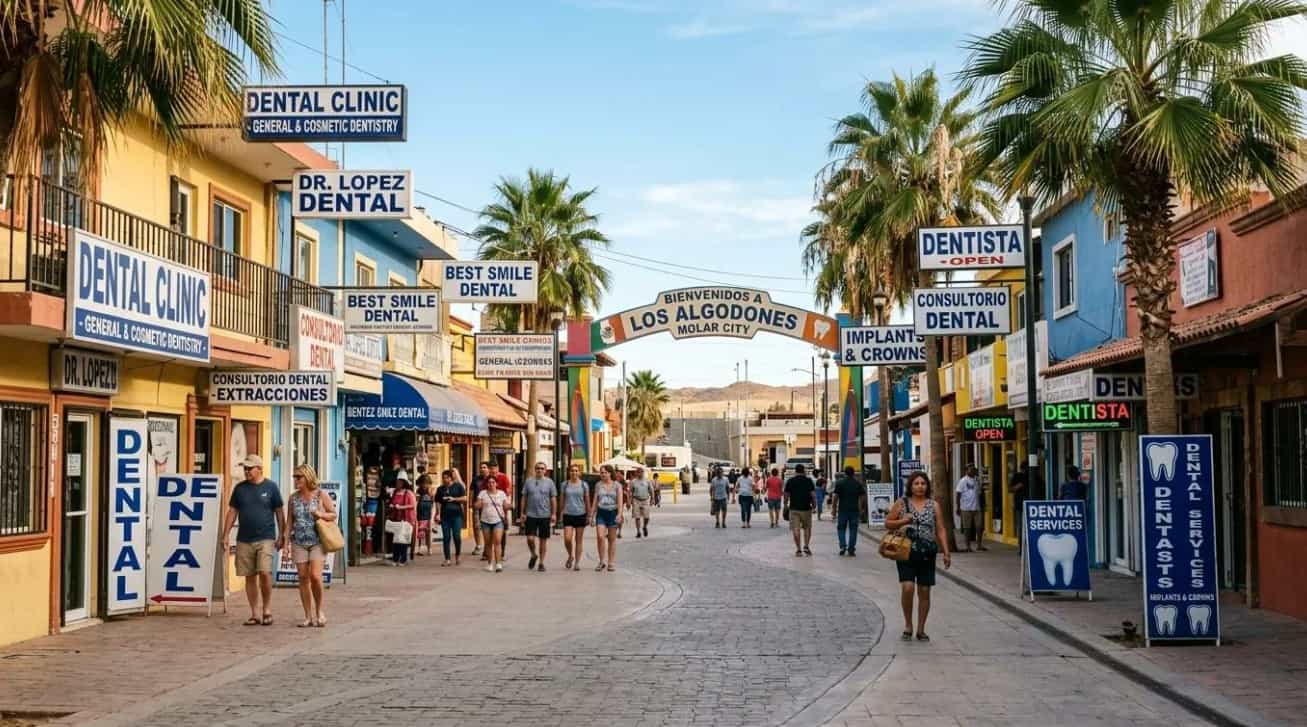
Then, somewhere between those searches, he sees a name he has never heard before: Los Algodones. And underneath it: Molar City.
“There’s really a town people go to for their teeth?”
David assumes it is marketing, then he keeps looking. Los Algodones is a small Mexican border community near Yuma, Arizona that has developed an unusually dense dental-services economy serving patients crossing from the United States and Canada. Reporting from The New Yorker has described Americans arriving by car, shuttle, and on foot specifically for dental care, while the town has become widely known as “Molar City.”
Suddenly David’s mental picture changes. He had imagined “going to Mexico for dental work” as an enormous international undertaking—airports, flights, a resort, a language he doesn’t speak, and some clinic somewhere he knows nothing about.
Los Algodones feels different. For many western U.S. travelers, the journey can involve reaching the Yuma/Andrade border area and crossing into a town where dental clinics are concentrated close together. That doesn’t make the medical decision automatically safe or sensible, but it makes the idea feel possible enough to investigate. And that’s an important difference.
Then David Discovers Something Called All-on-4
At first, the name sounds like another dental product, but it isn’t quite that simple. All-on-4 is a full-arch implant concept in which a complete fixed dental prosthesis can be supported using four strategically positioned dental implants. It is intended for certain patients who have lost most or all of the teeth in an arch, or whose remaining teeth may have a poor prognosis. Research has documented full-arch fixed rehabilitation using four implants, but treatment planning and individual anatomy matter considerably.
For David, the idea is important for another reason. For years he has been thinking, “Which tooth do we fix next?” Now the question becomes: “Is it time to stop treating my mouth one failing tooth at a time and discuss a full-arch solution?” That is a completely different conversation.
All-on-4 Isn’t "Four New Teeth"
This is worth understanding before looking at prices. The four implants are placed in the jaw and used to support a full arch of replacement teeth. Depending on the case, the treatment journey can involve:
-
Evaluation and imaging
-
Assessment of existing teeth and gums
-
Extractions when clinically necessary
-
Placement of dental implants
-
A temporary restoration in suitable cases
-
Healing and follow-up appointments
-
Placement or adjustment of the final prosthesis
Not everyone is a candidate. Some people may need another implant configuration, bone-related procedures, treatment for active gum disease, removable implant-supported dentures, or another approach entirely.
The goal should therefore never be “Find me a dentist who will sell me All-on-4,” but rather “Find out what treatment makes sense for my mouth.”
Then David Sees the Mexico Prices
This is the point where he becomes interested—and nervous. PlacidWay’s 2025 Los Algodones dental implant guide lists indicative All-on-4 pricing beginning around $5,000 per arch, with examples extending into roughly the $7,000–$8,500 range depending on the clinic and treatment details. A newer 2026 PlacidWay Mexico implant comparison also emphasizes that quotes must be checked carefully for what is actually included.
David’s first thought is, “Why would it cost so much less?” His second thought is more important: “What am I missing?” That’s exactly the question he should ask.
A Cheaper Quote Is Not Yet a Better Decision
Dental tourism shouldn’t be treated like comparison-shopping for airline tickets. If Clinic A says $18,000 and Clinic B says $6,500, the difference isn’t meaningful until you understand what each number contains. David learns to stop asking “How much is All-on-4?” and start asking “What exactly am I getting for that price?”
| Question Checklist: What Does the Quote Include? |
|---|
| Consultation, CBCT, or other imaging? |
| Extractions and bone grafting if required? |
| Four implants, abutments, and components? |
| Sedation or anesthesia when needed? |
| Temporary teeth vs. final prosthesis materials? |
| Medications, laboratory fees, and follow-up appointments? |
| Repairs, adjustments, or policies for implant failure? |
What Happens After You Cross Back Into the United States?
This is one of the least glamorous—and most important—questions in dental tourism. Dental implant treatment doesn’t necessarily end when you walk out of the clinic. Healing takes time, adjustments can be needed, and complications can occur.
The American Dental Association specifically advises travelers to think about continuity of care because significant dental procedures can require months of healing and follow-up. Potential postoperative problems can include pain, swelling, bleeding, and infection.
So David asks the Los Algodones clinic:
-
Who do I contact after I return home?
-
Can I send photographs or scans remotely?
-
If something feels wrong two weeks later, what happens? Will you communicate with my U.S. dentist?
-
When do I need to return?
-
If my temporary prosthesis breaks, who fixes it?
-
If an implant doesn’t integrate properly, what is your policy?
Now he isn’t shopping for cheap dentistry; he’s investigating care.
David’s Wife Asks the Question He Has Been Avoiding
“How do we know they’re good dentists?”
Price had been easy to research; trust was harder. A polished website didn’t prove anything, five-star reviews didn’t answer every question, and a photograph of a modern clinic didn’t tell them whether the treatment plan was appropriate. So instead of looking for a badge that says BEST DENTIST IN MEXICO, they create their own checklist.
Before Choosing a Clinic in Molar City, They Want Answers:
-
Who is actually performing the surgery? Not just the clinic name, but the dentist. What is their professional education, what implant training do they have, and how often do they perform full-arch implant rehabilitation? Who handles the restorative/prosthetic portion?
-
What happens before anyone removes a tooth? This becomes David’s biggest rule: a dramatically lower price should never become a reason to remove teeth that could reasonably be preserved. The ADA has publicly emphasized that implant treatment should be grounded in evidence-based diagnosis, treatment planning, and informed consent, particularly amid concerns about patients receiving unnecessarily aggressive implant treatment.
-
Which teeth really cannot be saved, and why? What alternatives exist, what happens if I leave them alone, and can I get a second opinion before committing? If removing teeth is irreversible, there should be no rush.
-
“Can you send me my scans and treatment plan?” This may be one of David’s simplest trust tests. He wants copies of his X-rays, CBCT files, diagnosis, implant brand/dimensions, materials used, written treatment plan, receipts, medication information, and follow-up instructions. Why? Because the border shouldn’t become a wall around his medical information. If another dentist needs to care for him later, David wants a record of what was actually placed in his mouth.
Then the Trip Starts Becoming Real
This is where a traditional dental tourism article might tell David "Top Things to See Near Los Algodones," but David isn’t planning a vacation—he’s planning dental surgery. His questions sound different:
-
Where should we stay the night before? Should we drive or fly to Yuma?
-
How much walking will there be? Can the clinic arrange transportation?
-
Will I be able to drive afterward? What should I eat after surgery?
-
Should my wife come into the consultation? Where do we go if something unexpected happens?
-
How many nights should we plan for? When is it reasonable to travel home?
-
When do I have to come back for the final restoration?
This is not traditional tourism; it is something closer to Recovery Travel. And the person traveling with David isn’t merely his vacation companion—she is part of the care journey.
What Molar City Feels Like When You’re There for Your Teeth
On the morning of his consultation, David isn’t thinking about medical tourism. He’s thinking about whether he’s making a terrible mistake, which deserves to be acknowledged. Crossing a border for dentistry for the first time can feel strange. You’re walking into another country and trusting someone you’ve only spoken to online with something permanent.
Reporting from Los Algodones captures exactly that mixture: patients describing both the apprehension of crossing the border and the financial pressure that ultimately motivated them to make the journey.
David sees older couples, people carrying dental paperwork, someone speaking with a clinic representative, another patient whose mouth is clearly swollen, and people who appear to have done this before. It doesn’t eliminate his uncertainty, but for the first time, he realizes: I’m not the only person who got a dental estimate at home and started looking for another way.
At the Clinic, David Asks Them Not to Tell Him the Price First
He surprises himself. Six months earlier, cost was his entire problem. Now he says:
“Before we talk about money, tell me what you think is wrong and what my options are.”
That’s the moment the relationship changes. He wants the dentist to show him the scan:
-
Which teeth can remain, which cannot, and why?
-
Would conventional dentures work, or could an implant-supported removable denture be appropriate?
-
Does he actually need All-on-4, or would more than four implants be preferable in his situation?
-
Does his bone support the proposed plan, what are the risks, and what happens if he does nothing?
Only after that conversation does he ask, “Okay. What does each option cost?” That’s how it should work.
Maybe the Solution Isn’t All-on-4
This may sound strange in an article about All-on-4, but it’s important. David could travel all the way to Los Algodones and discover that the right answer is to keep several teeth, treat the gum disease first, use a different implant approach, consider an implant-retained removable denture, or even don’t do anything yet.
Good medical tourism shouldn’t mean finding someone willing to perform the procedure you Googled. It should mean gaining access to credible professionals who can tell you when your original idea isn’t the right one.
And if All-on-4 is appropriate? Then David finally has a different kind of decision to make. Not “Can I somehow find $40,000?”, but:
“Do the clinical plan, provider, total cost, travel requirements, risks, and follow-up make enough sense for me to choose treatment abroad?”
Those are still serious questions, but at least there is now a possible path to examine. For someone who thought the only choices were living with failing teeth or taking on a financial burden he couldn’t manage, having another legitimate option to investigate matters.
What David Actually Wants Isn’t Perfect Teeth
This becomes obvious when his wife asks him what he hopes will change. He doesn’t say, “I want a Hollywood smile.” He says:
-
“I’d like to order whatever I want from a menu.”
-
“I’d like to stop thinking about my teeth every day.”
-
“I’d like to smile in a picture with the grandkids and not think about it.”
That’s what dental treatment can mean to a person. It isn’t twelve zirconia teeth, four titanium implants, or a before-and-after photograph. It is dinner, conversation, confidence, a photograph you don’t hide from, and not wondering which tooth will fail next. That is why the cost conversation carries so much emotion.
If You’re Where David Was, Start Here
Maybe you’ve already tried crowns, bridges, root canals, partial dentures, complete dentures, payment plans, dental insurance, putting treatment off, and fixing only the tooth that hurts today. And now someone has given you a treatment plan that feels financially impossible.
You don’t have to decide today that Mexico is the answer, nor do you have to decide that All-on-4 is the answer. But you are allowed to ask: What other options exist?
-
You can request another opinion.
-
You can ask whether your teeth truly need to be removed.
-
You can compare full-arch rehabilitation approaches.
-
You can investigate Los Algodones.
-
You can speak with dentists in the United States and Mexico.
-
You can ask for written treatment plans instead of relying on advertised prices.
-
You can calculate travel and follow-up costs—not merely procedure costs.
And then you can decide.
Questions Worth Taking to Molar City
Before choosing an All-on-4 provider in Los Algodones, consider asking:
-
Why are you recommending All-on-4 specifically for me?
-
Which teeth need removal, and why can’t they be saved?
-
What alternatives do I have?
-
Who will place my implants, and who designs and makes my prosthetic teeth?
-
What implant system will you use?
-
What will my temporary and final teeth be made from?
-
What is included in the quoted price, and could the final cost change after my examination?
-
How many trips will I need, and how long should I remain nearby after surgery?
-
What happens if I develop a problem after returning to the U.S. or if an implant fails?
-
How long have you followed your own All-on-4 patients?
-
Can I have copies of every scan and treatment record?
-
“What would make you tell me NOT to have this treatment?” (Listen carefully to that answer.)
Hope Can Sometimes Look Like a Border Crossing
For someone with a comfortable dental insurance plan and enough savings, Los Algodones may simply look like a dot on the map. For someone who has spent years repairing teeth one crisis at a time, it can represent something very different—not cheap dentistry, not a vacation, and not a miracle, but another possibility.
Maybe after investigating it, you decide to stay home. Maybe you find a different treatment, or maybe another dentist saves teeth you thought were lost. Or perhaps, after getting the scans, asking the difficult questions, checking the provider, and understanding the follow-up, you decide that full-arch implant treatment in Los Algodones makes sense for you.
The important thing is that an unaffordable estimate does not have to be the end of your search. Sometimes the next step isn’t finding a cheaper price—it’s discovering that there is another way to approach the problem.
PlacidWay — Your Way to Hope
Because healthcare shouldn’t feel like a choice between giving up and going broke.
PlacidWay helps patients explore healthcare possibilities across borders, understand treatments and destinations, compare providers, prepare better questions, and make more informed decisions with their families. Your way forward may be in your hometown, somewhere else in the United States, or across the border in a little town people call Molar City.
The point isn’t where your search ends—it’s knowing that you still have a way to continue it.
This article is for educational purposes and is not a recommendation that any individual undergo All-on-4 dental implant treatment or travel to Mexico for dental care. Dental implant candidacy, risks, and appropriate treatment alternatives require an individualized evaluation by a qualified dental professional. Prices vary substantially by patient needs, clinic, implant system, materials, and included services.
Ready to Explore Your Dental Care Options Abroad?
Don’t let high dental costs keep you from exploring the quality care you deserve. If you are considering All-on-Four Dental Implants in Los Algodones Mexico, PlacidWay can help you explore verified dental providers, compare treatment options, and understand what is included in each quote before making a decision. Receive personalized, transparent quotes based on your individual dental needs, treatment goals, and budget, while gaining a clearer understanding of the potential costs, procedures, and follow-up care involved.
Contact PlacidWay Medical TourismImportant Note About David: David is a fictional composite character created for educational and illustrative purposes. He is not a real PlacidWay patient, and his dental history, treatment considerations, costs, concerns, and journey are not based on the medical records or experience of any specific individual. His story is intended to represent common questions and considerations that some patients may encounter when exploring dental care abroad, including All-on-4 dental implants in Los Algodones, Mexico.




.png)

.png)


.png)

.png)










Share this listing