
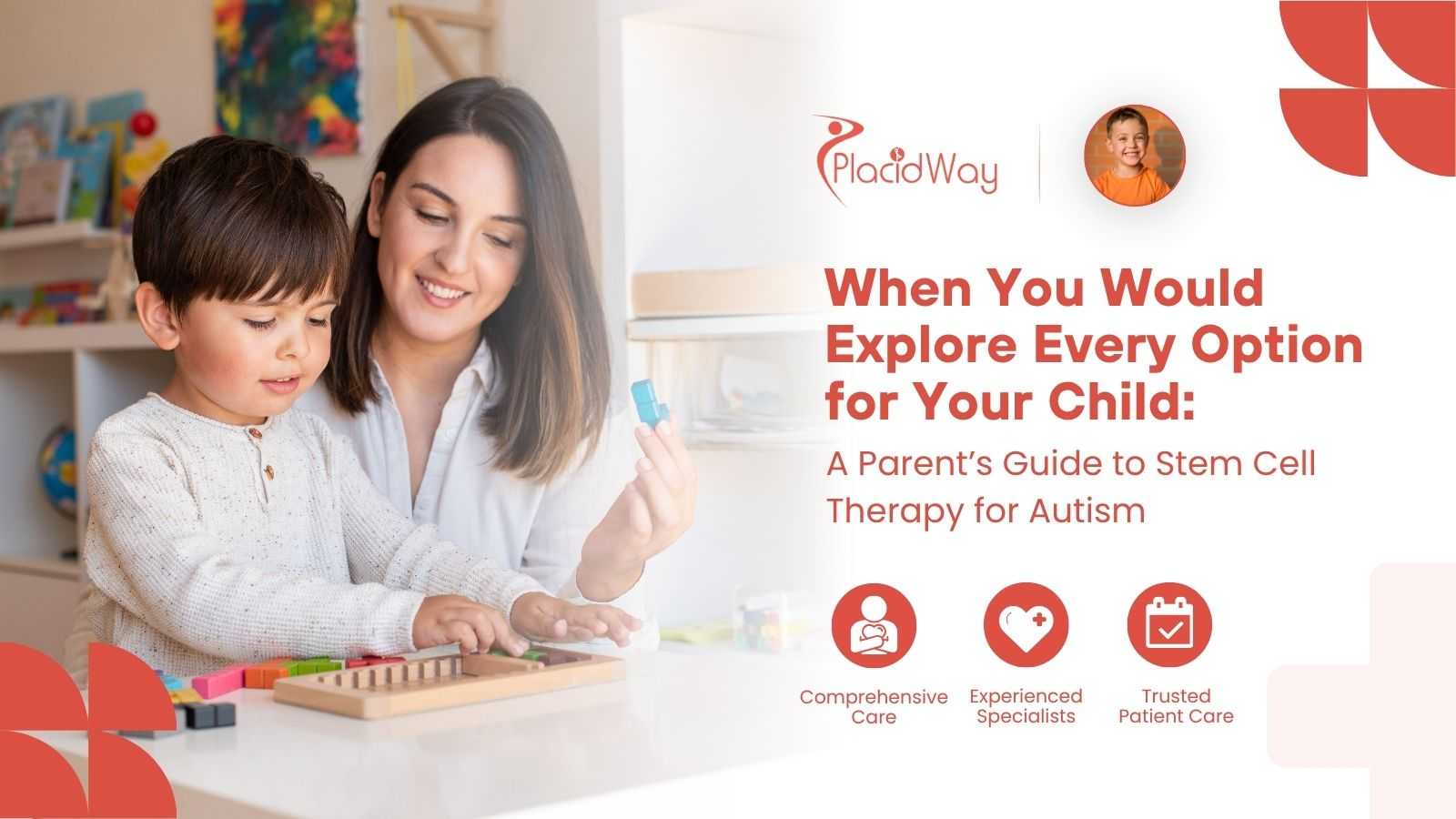
Patient Profile
-
◉ Parent: Maya, a fictional mother and composite persona
-
◉ Child: Noah, 8 years old, autistic
-
◉ Main Concerns: Communication, transitions, sleep, sensory challenges, and frustration
-
◉ Treatment Explored: Stem Cell Therapy for Autism
-
◉ Primary Questions: Safety, evidence, risks, and realistic outcomes
-
◉ Persona: Fictional composite character, not a real PlacidWay patient
Journey at a Glance
-
◉ Starting Point: Maya searches for options to support Noah.
-
◉ Discovery: She learns about Stem Cell Therapy for Autism.
-
◉ Research: She reviews evidence, risks, and treatment status.
-
◉ Questions: She evaluates providers, safety, and expected outcomes.
-
◉ Travel: She considers her child’s needs when exploring treatment abroad.
-
◉ Decision: She compares options and consults qualified healthcare professionals.
-
◉ Next Step: Make an informed decision based on evidence and medical guidance.
A Mother’s Guide to Understanding Stem Cell Therapy for Autism — Without False Promises
It usually doesn’t begin with a search for stem cells.
It begins with your child.
Maybe your son still struggles to tell you when something hurts. Maybe your daughter becomes overwhelmed in places other children seem to enjoy. Maybe you’ve spent years moving between pediatricians, therapists, specialists, school meetings and waiting lists.
You have celebrated milestones other people might not understand.
You have also had nights when everyone else in the house was asleep and you were still awake, reading.
One article leads to another.
One parent’s story leads to a video.
Then you see something you weren’t searching for:
Someone says their child communicated more afterward.
Another parent talks about better attention or interaction.
A clinic overseas says researchers are studying how certain cellular therapies might influence inflammation or neurological function.
And suddenly you’re asking a question you weren’t expecting to ask:
If that is where you are today, you deserve something better than either a miracle story or an immediate dismissal.
You deserve to understand what is known, what remains uncertain, what questions matter, and how to investigate an option without allowing hope to make the decision for you.
First, You Don’t Need to Decide Anything Today
For this article, imagine a mother named Maya.
Maya is not an actual PlacidWay patient. She is a fictional composite representing questions many parents may face when researching unfamiliar treatments.
Her eight-year-old son, Noah, is autistic.
Maya isn’t trying to change who Noah is.
She loves the way he remembers every detail about trains. She knows exactly which foods he’ll tolerate and which noises can make an ordinary afternoon overwhelming.
But she also sees the things that are hard for him.
-
Communication
-
Transitions
-
Sleep
-
Frustration when nobody understands what he needs
She has already spent years looking for ways to help him participate more comfortably in everyday life.
One evening she comes across stem cell therapy.
Her first reaction isn’t: “Where can I book it?”
It is: “Why have I never heard about this before?”
Her second: “Is this real?”
And eventually: “What if there’s even a small possibility it could help?”
That last question is where parents can become vulnerable to exaggerated promises.
So Maya decides to investigate differently.
Not: “Who says it works?”
But:
“What would I need to know before I could even consider this?”
Can Stem Cells Treat Autism?
Here is the most important answer first.
Stem cell and other regenerative medicine therapies are being researched for autism, but they are not currently established or FDA-approved treatments for autism.
The U.S. Food and Drug Administration specifically states that regenerative medicine therapies have not been approved to treat autism. The FDA also warns that unapproved human-cell and tissue products can carry serious risks.
That doesn’t mean scientists aren’t studying the subject.
They are.
But “being studied” and “proven treatment” are very different things.
And families deserve to know the difference.
What Has Research Actually Found?
The story isn’t simply “stem cells work” or “stem cells don’t work.”
Research is still developing.
For example, a randomized, double-blind, placebo-controlled Phase II trial involving 180 children with autism studied a single intravenous cord-blood infusion. Across the entire group, researchers did not find evidence that the infusion improved the primary measure of social communication or reduced autism symptoms overall. Some exploratory findings in a subgroup were interesting enough to support further research, but the investigators concluded that more study was needed.
Other smaller studies and reviews have reported possible signals of improvement on certain assessment scales. A 2022 systematic review and meta-analysis concluded that stem cell therapy might have potential, while emphasizing major limitations including small study populations, inconsistent cell types, different administration methods and doses, limited follow-up, and lack of standardized protocols.
Research continues. ClinicalTrials.gov includes studies investigating mesenchymal stromal/stem cells and related cellular approaches in people with autism, demonstrating that this remains an active research area rather than settled clinical practice.
Think of the Evidence Like This:
-
Promising research question? Yes.
-
Clinical investigation happening? Yes.
-
Proof that stem cell therapy reliably improves autism? No.
-
An established standard treatment for autism? No.
That distinction should appear prominently on any PlacidWay page discussing this topic.
“But I’ve Seen Parents Saying Their Child Improved.”
This may be one of the hardest parts of researching treatment as a parent.
A mother describing her child’s progress can feel more powerful than a clinical trial table.
You can picture her kitchen. Her child. Her relief. And you may recognize your own family in hers.
Her experience can be completely sincere. But an individual story cannot tell us why a change happened.
Children grow. Development changes. Therapy continues. School environments change. Sleep changes. Medications may change. Symptoms can fluctuate.
Parents may observe meaningful improvements that are real while still being unable to know whether a particular intervention caused them.
This is why a responsible medical-travel community needs both:
“Here is what another family experienced.”
and
“Here is what controlled research has demonstrated so far.”
One should never be disguised as the other.
Maya’s Next Question: “What Am I Actually Hoping Will Change?”
This may be one of the most valuable conversations a family can have before investigating any treatment.
Not: “Can you cure my child’s autism?”
But: “What Is Making Daily Life Hardest for My Child Right Now?”
-
Is it communication?
-
Severe sleep difficulty?
-
Self-injurious behavior?
-
Anxiety?
-
Feeding difficulties?
-
Sensory distress?
-
Attention?
-
Gastrointestinal problems?
-
Seizures?
-
Difficulty communicating pain?
-
School participation?
Every autistic child is different. CDC notes that autistic people can differ substantially in communication, learning, behavior, abilities and support needs, which is why care plans are generally individualized.
Knowing the specific problem you’re trying to address changes the conversation.
Because sometimes the best next step isn’t an experimental intervention. It might be a developmental specialist, a neurologist, a sleep evaluation, communication support, occupational therapy, behavioral intervention, assessment of another medical condition, or a combination of approaches.
Early and individualized support can make an important difference in development and daily functioning.
Why Are Families Traveling Abroad?
Sometimes parents discover treatments overseas because what they’re investigating isn’t routinely offered at home.
That can create a powerful thought: “Maybe another country knows something my country doesn’t.”
Sometimes that may lead families toward legitimate clinical research or specialized expertise. But availability abroad does not automatically mean greater scientific acceptance.
Regulatory systems differ. Definitions of experimental treatment differ. Rules governing cellular products differ. And clinics can differ dramatically in how much evidence they require before offering something commercially.
This means a parent’s question should change from:
“Which country offers stem cells for autism?”
to:
That is a much safer place to begin.
The 10 Questions Maya Would Take to a Clinic
Before discussing flights, hotels or prices, she would ask:
1. What Exactly Are You Giving My Child?
“Stem cells” is not one product. Ask for the specific cell type, source, manufacturing process and whether the cells come from the child or a donor.
2. Is This Considered Experimental in Your Country?
Ask what regulatory authorization applies specifically to the intervention being proposed.
3. Is My Child Part of a Registered Clinical Trial or Is This a Commercial Treatment?
Those are not the same thing. Being listed on ClinicalTrials.gov alone does not prove that a product is approved or legally marketed. The FDA explicitly warns consumers about this misunderstanding.
4. What Published Studies Support This Exact Treatment?
Not simply “stem cells.” Ask for evidence involving the same cell source, preparation, dose and administration route being recommended for your child.
5. What Outcomes Do You Realistically Expect?
Be cautious if the answer sounds like: “Your child will speak,” “Autism can be reversed,” “Almost every child improves,” or “There are no risks.” These claims are very different from scientifically cautious discussions of uncertainty.
6. What Are the Risks?
The FDA has reported safety concerns associated with improperly marketed regenerative products, including infections, immune or inflammatory reactions, contamination and tumor formation among other potential harms.
7. Who Will Evaluate My Child Before Treatment?
A credible evaluation should involve more than selling a package after reviewing a short online form.
8. How Will Progress Be Measured?
Ask whether standardized developmental or behavioral assessments are performed before and after treatment.
9. What Happens When We Return Home?
Ask who handles complications, communicates with your pediatrician and follows your child after treatment.
10. What Happens If We Decide Not to Proceed?
A trustworthy medical conversation should leave room for no.
What Traveling With an Autistic Child Actually Means
This is where most medical-tourism articles become surprisingly unhelpful. They tell Maya: The hospital is 20 minutes from the airport. But they don’t tell her what she really needs to know.
Noah hates crowded terminals. He becomes distressed when routines change. He only eats a few familiar foods. He sleeps badly in unfamiliar rooms. Medical environments already make him anxious.
So Maya’s destination research isn’t the same as another traveler’s.
What Will This Place Feel Like for My Child?
-
Can we arrive several days before the medical appointment so he can settle in?
-
Is the accommodation quiet?
-
Can we request the same driver throughout the trip?
-
Can the clinic provide photos or a video of the treatment room beforehand so I can prepare him?
-
How long will he need to wait inside the clinic?
-
Can I remain with him during appropriate parts of the evaluation?
-
Are staff experienced communicating with autistic children?
-
Can we bring familiar food?
-
What happens if he cannot tolerate an examination or IV placement?
-
Where is the nearest pediatric hospital if something unexpected happens?
This is what patient-centered destination content should look like. Not: “Top 5 Attractions to Visit After Stem Cell Therapy.”
And What About Maya?
Almost every article is about Noah. But Maya is traveling too. She’s the researcher, the scheduler, the person carrying medical records, the one checking passports three times, the one trying not to let Noah see that she’s nervous, and the one who will probably sleep lightly the first night after treatment.
She needs information too.
A Caregiver Guide Should Tell Her:
-
What documents to carry
-
How medical records should be organized
-
What emergency information should remain accessible offline
-
How long the family might need to remain near the clinic
-
What follow-up needs to be arranged before returning home
-
What additional costs might arise
-
Whom she can contact if she becomes worried at 2 a.m.
This isn’t a luxury travel itinerary. It is caregiver travel. And medical tourism needs much more content designed around it.
“How Will I Know Whether I’m Being Sold Hope?”
Maya writes this question at the top of her notebook. Because hope isn’t the problem. Certainty without evidence is.
A clinic discussing an experimental therapy should be comfortable saying:
-
We don’t know.
-
Research is limited.
-
Your child may not benefit.
-
These are the possible risks.
-
Here is the published evidence.
-
Here are other options you should discuss with your child’s doctor.
A clinic that cannot say those sentences deserves much greater scrutiny.
Safety Warning: In May 2026, the FDA again warned consumers about serious risks from unapproved human-cell and tissue products marketed for various conditions and noted that such products may not have had their quality, safety, purity or potency reviewed by the agency.
What Would Maya Do Next?
She doesn’t book treatment that night. She doesn’t close the browser either. Instead, she creates three columns.
What We Know
-
Stem cell and cellular therapies for autism are being researched.
-
Different approaches are being studied.
-
Some early studies have generated signals researchers consider worth investigating further.
What We Don’t Know
-
Researchers have not established that stem cell therapy reliably improves autism.
-
It remains unclear which children, if any, may benefit, from which cell products, at what dose, through which administration method and with what long-term risk-benefit profile.
What We Need to Ask
-
What is Noah struggling with most?
-
What does his developmental pediatrician think?
-
What evidence supports the specific intervention being offered?
-
Would he qualify for legitimate clinical research?
-
What are the risks?
-
Who regulates the treatment?
-
How will outcomes be measured?
-
What happens afterward?
Suddenly the question feels different. Not easier. But clearer.
Maybe Hope Doesn’t Mean Finding a Miracle
Parents are often told either: “Don’t give up hope” or “Accept reality.”
There is another possibility.
-
You can hope and ask hard questions.
-
You can investigate new research and demand evidence.
-
You can listen to another mother’s experience without assuming her outcome will be your child’s outcome.
-
You can explore treatment abroad without assuming that “available” means “proven.”
-
And you can decide after researching everything that the right answer for your child is not to proceed.
That is still a decision. That is still moving forward.
Your Way to Hope
At PlacidWay, we believe families exploring healthcare beyond their borders deserve more than treatment listings and price comparisons. They deserve to understand:
-
What might be possible.
-
What science actually says.
-
What remains uncertain.
-
What other families have experienced.
-
What questions they should ask.
-
What traveling with their child could really involve.
-
How to make the next decision without being pressured into one.
Because when you’re searching for your child, you’re not simply looking for a clinic. You’re looking for a way forward.
Explore Stem Cell Therapy Options for Your Child
Searching for a path forward can feel overwhelming, especially when every option comes with questions. Let PlacidWay help you explore available Autism Stem Cell Treatment, compare providers, and understand potential treatment costs. Request your free quote today and take the next step with information you can discuss with your child’s healthcare team.
Important Disclaimer: This article is educational and does not recommend stem cell therapy for autism or replace advice from your child’s pediatrician, developmental specialist, neurologist or other qualified healthcare professional. Stem cell and regenerative interventions for autism remain investigational. Families considering experimental treatments should discuss potential risks, alternatives and evidence with qualified clinicians and verify the regulatory status of any proposed treatment.





.png)
.png)
.png)


.jpg)








Share this listing