


Choosing to undergo the All-on-6 dental implants procedure in Turkey represents a life-changing decision for individuals suffering from severe tooth loss or deteriorating oral health. This advanced full mouth dental restoration technique utilizes six strategically placed titanium posts to permanently support a customized prosthetic arch. Patients globally are traveling to specialized clinics, such as WestDent Clinic Turkey, to access world-class surgical expertise at a fraction of domestic costs.
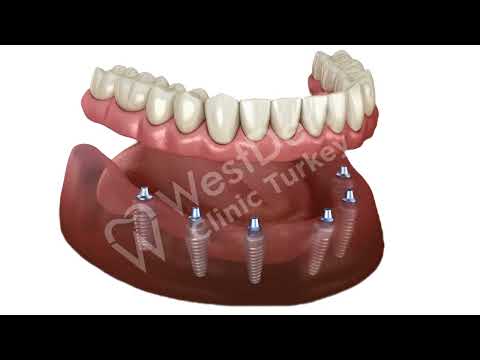
The visual animation provided offers a precise clinical representation of how a complete lower arch is secured directly to the jawbone. By analyzing the structural mechanics shown in the visual sequence starting at [00:00], patients can better understand the biomechanical foundation of this permanent tooth replacement solution. This guide comprehensively breaks down the surgical process, clinical advantages, material options, and long-term aftercare required for successful full mouth dental implants in Turkey.
Video Chapters & Quick Navigation
Understanding the Biomechanics of All-on-6 Dental Implants
The All-on-6 dental implants procedure provides an exceptional foundation for a full arch prosthesis by utilizing six points of contact within the jawbone. This distribution of mechanical stress is crucial for patients who exert heavy bite forces during mastication. As clearly demonstrated at [00:03] in the clinical animation, the six titanium posts are spaced evenly across the mandibular ridge to maximize stability.
Once inserted into the healthy bone tissue, these implants undergo a biological process known as osseointegration. During this phase, the jawbone actively fuses to the microscopic ridges of the titanium fixtures, rendering them a permanent part of the patient's anatomy. This integration prevents the rapid bone resorption that typically follows total tooth loss.
Unlike traditional removable dentures that rest on the gums and cause friction, this fixed solution is anchored securely into the skeletal structure. By utilizing six implants rather than fewer, the restorative dentist ensures that the posterior sectors of the jaw receive adequate support. This expanded support network translates directly to a more natural chewing experience and a significantly longer lifespan for the final prosthetic bridge.
The Role of Implant Angulation and Placement
Clinical precision dictates exactly where and at what angle each implant is positioned within the cortical bone. Maxillofacial surgeons rely on comprehensive 3D Cone Beam Computed Tomography (CBCT) scans to map the underlying nerve canals and sinus cavities. This detailed imaging ensures the safe and optimal placement of the titanium roots.
The anterior implants are typically inserted at a straight 90-degree angle to utilize the dense bone at the front of the jaw. The posterior implants may be slightly angled to avoid anatomical structures and to increase the anteroposterior spread. This specific angulation eliminates the need for invasive bone grafting procedures in many borderline cases.
Why Choose Full Mouth Dental Implants in Turkey for Your Restoration?
Dental tourism has expanded exponentially over the last decade, with Turkey emerging as the premier destination for complex oral surgeries. Patients seeking an affordable full mouth dental restoration routinely discover that top-tier Turkish clinics provide care that matches or exceeds Western standards. Clinics in medical hubs like Istanbul, Antalya, and Izmir invest heavily in cutting-edge dental technology.
The cost disparity is driven primarily by lower domestic operational overhead, favorable exchange rates, and government incentives for medical tourism. Patients do not compromise on the quality of the materials; internationally recognized implant brands such as Straumann, Nobel Biocare, and Osstem are standard offerings. The surgeons performing the All-on-6 dental implants procedure in Turkey are frequently board-certified with extensive international training.
Beyond the surgical excellence, specialized clinics offer comprehensive concierge packages that remove the stress of international medical travel. These packages typically bundle VIP airport transfers, luxury hotel accommodations, translation services, and all clinic visits. This streamlined approach allows the patient to focus entirely on their surgical recovery and subsequent dental transformation.
Cost Comparison: Domestic vs. Dental Tourism
Understanding the financial benefits requires a direct comparison of the full mouth dental implants cost in Turkey versus North America or the UK. The following table illustrates the average estimated costs for a single arch restoration using six implants. These figures highlight why traveling abroad is a financially sound strategy for major dental reconstruction.
| Region | Average Cost (Per Arch) | Inclusions |
|---|---|---|
| United States | $24,000 - $32,000 | Surgery and prosthesis only. |
| United Kingdom | £15,000 - £22,000 | Surgery and prosthesis only. |
| Turkey | $4,500 - $7,500 | Implants, prosthesis, hotel, and transfers. |
Step-by-Step Breakdown: The All-on-6 Dental Implant Surgery Process
The journey to a fully restored smile requires two distinct trips to Turkey, separated by a critical healing phase. The first visit focuses on the surgical extraction of any remaining failing teeth, bone contouring, and the precise insertion of the titanium implants. During this initial operation, the surgeon will secure abutments to the implants which act as connectors for the prosthetic teeth.
Immediately following the implant placement, the clinical team manufactures a temporary acrylic prosthesis. As visualized perfectly at [00:06], this arch is carefully lowered onto the freshly placed abutments. This temporary bridge allows the patient to leave the clinic with functional teeth and a complete smile on the very same day.
After returning home, the patient undergoes a three to six-month healing period where the crucial osseointegration occurs. Once the implants are fully fused and the gum tissue has stabilized, the patient returns to Turkey for the second phase. The final, ultra-durable prosthesis is permanently affixed to the implants, as depicted at [00:09], completing the restoration process.
The Importance of 3D Digital Workflow
Modern clinics rely heavily on a complete digital workflow to guarantee surgical accuracy and aesthetic perfection. Intraoral scanners capture microscopic details of the patient's oral cavity, eliminating the need for uncomfortable traditional putty impressions. This digital data is seamlessly integrated with the CBCT scan to create a comprehensive 3D surgical guide.
This surgical guide is 3D printed and placed over the patient's gums during the operation to direct the exact depth and angle of the drill. Furthermore, the digital design of the final prosthesis ensures that the new teeth align perfectly with the patient's facial aesthetics. The result is a highly predictable surgery with minimal tissue trauma and faster postoperative healing.
Comparing All-on-4 vs. All-on-6 Dental Implants for Full Arch Restoration
Patients researching total oral rehabilitation frequently encounter both the All-on-4 and All-on-6 protocols. The fundamental difference lies entirely in the number of titanium implants utilized to anchor the prosthetic bridge. While both systems deliver excellent, permanent results, specific clinical factors dictate which procedure is the safest and most effective for individual anatomical needs.
The All-on-4 system uses four implants, with the rear two severely angled up to 45 degrees to avoid the sinus cavities and mandibular nerve block. This technique is often recommended for patients presenting with moderate bone loss who wish to avoid extensive grafting. It provides a stable foundation but concentrates the entire bite force onto four distinct anatomical points.
Conversely, the All-on-6 dental implants procedure introduces two additional implants in the posterior region of the jaw. This creates superior biomechanical stability and allows for an extended bridge that includes more molar teeth for enhanced chewing capability. Dentists strongly prefer the six-implant approach for patients possessing adequate bone volume, particularly in the upper maxilla where bone density is naturally softer.
- Bite Force Distribution: Six implants disperse the immense pressure of chewing much more effectively than four, reducing long-term wear on the prosthetic components.
- Contingency Support: In the rare event that one implant fails to integrate properly, an All-on-6 structure generally maintains enough stability to survive, whereas an All-on-4 framework might fail entirely.
- Prosthesis Length: The six-implant protocol safely supports a larger, 12 to 14-tooth bridge, offering a more complete posterior bite.
Evaluating Candidacy Requirements for Full Arch Dental Implants in Turkey
Not every patient dealing with extensive tooth loss immediately qualifies for a six-implant restoration. The primary prerequisite is sufficient jawbone volume and density to securely house the titanium cylinders. Prolonged tooth absence or chronic periodontal disease leads to severe bone atrophy, which complicates the primary stability of the implants.
If a 3D scan reveals inadequate bone structure, the oral surgeon will recommend a sinus lift or supplementary bone grafting prior to implant placement. These preliminary procedures build the necessary foundation but will extend the overall treatment timeline by several months. Patients must undergo thorough diagnostic imaging before booking their dental tourism packages for implants to ensure absolute clinical viability.
Systemic health conditions also play a critical role in determining surgical candidacy. Uncontrolled diabetes, autoimmune disorders, or a history of heavy radiation therapy to the head and neck significantly impair the body's natural healing response. Furthermore, heavy smokers are routinely advised to cease tobacco use well before the surgery, as smoking drastically increases the risk of implant failure and severe postoperative infections.
The Impact of Periodontal Disease on Treatment
Active gum disease must be entirely eradicated before any implant surgery commences. The bacteria responsible for periodontitis can easily migrate to the newly inserted implants, causing a destructive condition known as peri-implantitis. This infection attacks the surrounding bone tissue and is the leading cause of late-stage implant failure.
Clinics specializing in the All-on-6 dental implants procedure in Turkey enforce strict hygiene protocols prior to surgery. Failing teeth and infected root tips are extracted meticulously, and the sockets are deeply debrided to remove all necrotic tissue. A completely sterile oral environment guarantees the highest possible success rate for the new titanium foundation.
Understanding the Premium Materials Used in Full Arch Prosthetics
The aesthetic and functional success of your new smile depends entirely on the materials selected for the final prosthetic bridge. During the healing phase, patients wear a temporary PMMA (Polymethyl Methacrylate) acrylic arch. While highly functional for initial healing, acrylic is relatively porous, prone to staining, and lacks the structural durability required for a lifetime of heavy chewing.
For the definitive restoration, top-tier clinics transition patients to monolithic zirconia or porcelain-fused-to-metal (PFM) frameworks. Zirconia dental crowns over implants represent the current gold standard in restorative dentistry. Milled from a single block of highly durable crystal, zirconia offers unparalleled fracture resistance while remaining highly biocompatible with soft gum tissues.
The visual impact of a precisely milled zirconia bridge is striking, as evident in the final animation sequence at [00:12]. The material possesses unique light-transmitting properties that mimic the exact translucency and shade of natural tooth enamel. Master ceramists in Turkish dental laboratories hand-finish these arches, applying delicate stains and glazes to replicate natural imperfections and ensure the smile looks entirely authentic.
Titanium Frameworks for Structural Rigidity
Inside the prosthetic bridge, a hidden structural framework provides the necessary rigidity to span the full arch. This internal bar connects directly to the implant abutments and acts as the structural spine of the new teeth. Without a rigid substructure, the prosthetic material could flex under heavy bite forces and eventually crack.
Medical-grade titanium is the material of choice for these internal frameworks due to its incredible strength-to-weight ratio. Advanced CAD/CAM milling machines carve these titanium bars to micrometer precision based on the patient's digital impressions. This ensures a completely passive fit over the six implants, preventing unnatural tension that could lead to bone loss.
Recovery Timeline and Aftercare for Your Dental Implant Procedure
Immediate postoperative recovery requires strict adherence to the surgeon's specialized guidelines to protect the unintegrated implants. Minor swelling, bruising, and localized discomfort are expected during the first 72 hours following the surgical phase. Clinics prescribe a regimen of anti-inflammatory medications, broad-spectrum antibiotics, and specialized antimicrobial mouthwashes to manage symptoms and prevent infection.
The most critical aspect of the initial healing period involves dietary restrictions. Patients must maintain a strictly soft food diet for up to three months while wearing the temporary acrylic prosthesis. Consuming hard, crunchy, or excessively chewy foods places premature lateral stress on the healing implants, significantly increasing the risk of micromovement and integration failure.
Long-term maintenance of your final All-on-6 restoration mirrors the care required for natural teeth but demands specific oral hygiene tools. A high-quality water flosser is absolutely essential for flushing food debris from beneath the prosthetic bridge. Patients must also commit to annual professional cleanings where the dentist removes the bridge, cleans the abutments, and inspects the health of the underlying gum tissue.
Potential Risks and How Top Turkish Dental Clinics Mitigate Them
While full mouth dental implants boast an impressive success rate exceeding 95 percent, they remain a complex surgical intervention carrying inherent risks. Nerve damage, particularly to the inferior alveolar nerve in the lower jaw, can cause permanent numbness in the lip and chin. Surgeons eliminate this risk by relying on highly accurate CBCT imaging to map the exact nerve trajectory prior to drilling.
Sinus perforation represents another potential complication when placing implants in the posterior maxilla. The bone separating the oral cavity from the sinus floor is incredibly thin, and misjudging the implant depth can puncture this delicate membrane. Experienced maxillofacial surgeons utilize 3D-printed surgical guides to lock the drill depth, entirely preventing accidental sinus breaches.
Choosing a reputable clinic with internationally recognized accreditations is the single most effective way to safeguard your investment and your health. Leading facilities for the All-on-6 dental implants procedure in Turkey adhere rigorously to international sterilization protocols and utilize authentic, high-grade implant brands. Patients must conduct thorough due diligence, requesting clinic credentials, surgeon portfolios, and verified patient testimonials prior to committing to treatment.
Ready to Restore Your Smile in Turkey?
Take the first step toward a permanent, full-mouth restoration. Connect with world-class, board-certified dental specialists to discuss your All-on-6 dental implant candidacy and receive a personalized treatment plan.
Get Free QuoteView Video Transcript & Clinical Animation Sequence
[00:00] Visual: A 3D anatomical rendering displays an edentulous (toothless) lower human jaw, highlighting the healthy gum tissue and underlying bone structure ready for surgical intervention.
[00:03] Visual: Six specialized titanium dental implants are meticulously drilled and secured into the jawbone at strategic, evenly spaced intervals. The implants act as artificial tooth roots.
[00:06] Visual: A complete, customized prosthetic dental arch featuring bright, natural-looking artificial teeth is shown hovering above the jaw. It slowly begins to lower toward the six implanted titanium abutments.
[00:09] Visual: The full arch prosthesis successfully makes contact with the implants. The internal connection mechanisms lock the bridge perfectly into place, achieving absolute stability.
[00:12] Visual: A 360-degree pan reveals the final restoration. The gum line merges flawlessly with the prosthetic arch, demonstrating a fully functional, highly aesthetic All-on-6 dental restoration.
[00:14] Visual: The animation concludes, maintaining the view of the securely fastened lower arch and the "WestDent Clinic Turkey" watermark overlay.



.png)

.png)












Share this listing