


Minimally Invasive Hallux Valgus Treatment in Beijing, China by AMCare
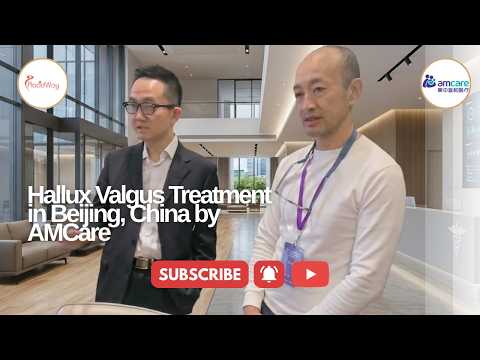
About this video: Navigating the complexities of Hallux Valgus—commonly known as bunions—requires a blend of surgical precision and diligent post-operative management. In this clinical discussion held in Beijing, China, renowned specialists Dr. Hui Du and Prof. Peter provide a masterclass on recovering from bunion correction surgery. Whether you are struggling with a severe deformity or considering international medical care for foot health, understanding these professional insights is the first step toward walking pain-free again. Watch to discover the specialized protocols that make Hallux Valgus Treatment in Beijing China a premier destination for orthopedic excellence.
Video Chapters & Quick Navigation
Hallux Valgus is more than a cosmetic concern; it is a progressive musculoskeletal condition that can significantly alter a person's gait and quality of life. In Beijing, the approach to treating this condition combines traditional orthopedic wisdom with modern, minimally invasive surgical techniques. This video highlights the critical importance of post-operative behavior and the nuances of why some cases require surgery while others are managed conservatively.
The Science of Post-Operative Walking Mechanics
One of the most immediate concerns after Hallux Valgus correction is how to bear weight without compromising the surgical site. Dr. Hui Du emphasizes at [00:13] that patients must avoid the instinct to "hook" or curl the big toe when walking. This involuntary gripping action puts unnecessary stress on the osteotomy site—the area where the bone was cut and repositioned.
Modern surgical shoes are specifically engineered with a completely rigid sole. This design ensures that the weight of the body does not translate into mechanical stress across the toe joints. As explained at [00:26], patients should confidently place their full weight on the foot as the rigid shoe protects the structural integrity of the bone while it heals.
The Critical Two-Week Recovery Protocol
The first fourteen days following a bunionectomy are vital for managing inflammation and preventing complications. Dr. Du outlines a "less is more" approach to activity during this window. At [00:46], the protocol emphasizes that while limited walking is permitted, elevation is the primary objective. Keeping the foot raised helps to drain excess fluid and reduce the risk of edema.
Cryotherapy and Elevation Guidelines:
- Icing: Apply ice for approximately 15 minutes at a time. Do not exceed this duration to avoid skin damage.
- Frequency: Perform elevation and icing 8 to 10 times daily.
- The "Little and Often" Rule: Frequent, short periods of movement followed by immediate elevation are superior to long bouts of activity [01:03].
Strategic Footwear: What to Wear After Healing
Transitioning from a surgical shoe back to standard footwear is a delicate process. A common mistake patients make is purchasing new, stylish shoes too early. Dr. Du suggests at [02:12] that the best choice is often a pair of sneakers used prior to surgery. Because the foot was wider before the correction, these "stretched" shoes provide the necessary volume for post-surgical swelling without causing friction.
| Feature | Ideal Specification |
|---|---|
| Sole Rigidity | Semi-flexible; avoid completely stiff or overly soft soles. |
| Toe Box | Wide and accommodating; no hard reinforcements on the lateral side. |
| Support | Moderate arch support to maintain neutral alignment. |
The Reality of Bunions: Why Toe Spacers Often Fail
Many patients attempt to "self-treat" using silicone toe separators or Cotton-wool balls. However, Prof. Peter and Dr. Du explain the biomechanical pitfalls of this approach. At [03:11], it is noted that when the big toe is already severely deviated, it is "stronger" than the smaller toes. Inserting a spacer often doesn't push the big toe inward; instead, it pushes the second toe further outward, exacerbating the overall deformity of the foot.
Furthermore, forced correction via external splints can increase intra-articular pressure. If the joint is already suffering from degenerative changes, these devices can actually accelerate cartilage wear and increase pain, making conservative management a double-edged sword [03:52].
The Surgical Decision Matrix: Case Selection in Beijing
Not every bunion requires immediate surgery. In the video, the specialists discuss why they may choose to operate on one foot but not the other. For the patient in the case study, the right foot was an ideal candidate for correction because the joint remained flexible, allowing for a high success rate in realignment [02:47].
Conversely, the left foot exhibited signs of advanced arthritis and joint stiffness. In such cases, the surgical outcome may be less predictable, and the risks of post-operative stiffness might outweigh the benefits of cosmetic realignment. This conservative approach highlights the commitment of Beijing’s medical teams to functional outcomes over purely aesthetic ones.
Preserving Long-Term Joint Health Through Micro-Release
A key takeaway from the Beijing surgical approach is the use of "micro-release" techniques. Rather than simply breaking and resetting the bone, the surgeons perform a minimally invasive release of the tight soft tissues on the lateral side of the joint [04:05]. This reduces the internal "pull" of the tendons, allowing the bone to stay in its new, corrected position with less tension. This holistic focus on both bone and soft tissue is what defines high-authority orthopedic care in modern China.
Ready to Resolve Your Hallux Valgus in Beijing?
PlacidWay Medical Tourism connects you with world-leading orthopedic surgeons like Dr. Hui Du at AMCare. Experience advanced, minimally invasive Foot Deformity Correction in Beijing China’s top-tier facilities.
GET A FREE QUOTEView Full Video Transcript
[00:00:00] When you step on the ground, everyone has a natural instinct to land on their heels. However, regarding the shoes for your recovery: he mentioned that the shoe itself has a slight built-in incline.
[00:00:09] When you step, do not intentionally hook your foot upward. If you hook it, your big toe will instinctively exert force. Look at that sole; it is completely rigid. When you walk and step down, it doesn't apply stress to the bone ends because the joint remains immobile.
[00:00:23] So, you can safely and confidently put your weight on it. This weight won't crush the bone structure. If you always walk on your heels or keep your foot "hooked" (flexed) while walking, your feet will tire easily after just a few steps.
[00:00:33] Over time—especially if you walk like that for two weeks straight—your ankles might become uncomfortable. You’ll find that the shoe is specifically designed for this use. Put your whole foot down confidently; don't "claw" or curl your toes.
[00:00:46] What do you need to do during these two weeks? Walking is one aspect. Another is this: when you aren't walking, keep your foot elevated. You can apply ice packs appropriately—about 15 minutes each time, not too long.
[00:00:56] Ankle pumps (hooking the foot) are very important. Once the shoes arrive, do this 8 to 10 times a day. Keep the sessions short; "small amounts but frequent" is best. Walk a bit, then elevate the foot.
[00:01:07] Regarding suggestions for shoes: [English in original: "What they stretch... if they buy new... a month before can stretch it out... new shoes to be small before"]. There isn't a specific brand recommendation.
[00:01:28] First, if you have old sneakers that you wore often before surgery—shoes that have already been stretched wide by your feet—those might be the most comfortable and loose options right now. Wear those first.
[00:01:44] Don't buy new shoes yet. New shoes will be too narrow. In the future, when buying shoes: first, the sole shouldn't be completely immobile or rock-hard. Second, there shouldn't be anything hard or rubbing against the side of the big toe. Conversely, a sole that is too soft with no support is also bad. A semi-flexible sole is best for better mobility.
[00:02:04] Patient: "The deformity in my left foot is also quite significant. What will happen if I don't have surgery on this one?"
[00:02:13] Doctor: There’s no other way besides wearing loose shoes. There are no effective conservative treatments that can reverse it. For some patients, we suggest orthotic insoles to balance the arch, but your case is actually alright.
[00:02:26] Furthermore, as Professor P mentioned, the reason he doesn't recommend surgery for this foot yet is: first, the deformity isn't as severe as the other side; second, there is already some arthritis present. The joint is less flexible than the other foot, so it is less likely to deviate further.
[00:02:40] Therefore, the progression will definitely be slower. The surgical outcome for the left foot wouldn't be as good as the right. The right foot was suitable because it was still flexible, making the correction more effective. The left joint is stiff, and since the deformity hasn't affected your ability to walk or wear shoes yet, we should leave it for now.
[00:03:01] Patient: "I’m currently using a cotton ball to wedge between the toes and then wearing socks; it feels a bit better."
[00:03:11] [English in original: "Because when you put something in there it moves the second toe... because this is stronger... it moves this that way... it pushes second one..."]
[00:03:31] Doctor: The problem with wedging something in there is that the big toe is very strong right now. Inserting a spacer won't push the big toe inward; instead, it will push the second toe outward. You can see it happening as soon as you put it in.
[00:03:42] This is why the Professor feels it isn't necessary. On this foot, you have joint issues, and the lateral tissues haven't been surgically released. If you use a device to force it back, you increase the internal pressure of the joint.
[00:03:52] You might have felt it when the Professor was manipulating your foot earlier—when it's forced over, the inside of the joint hurts more. If you use a spacer to force it long-term, it will accelerate joint aging.
[00:04:01] When we do surgery, we don't just correct the deformity; we also perform a minimally invasive release to loosen the tight soft tissues/tendons. This way, when the alignment is changed, the pressure isn't too great.
[00:04:14] This is why we don't recommend long-term use of those toe separators. It's a hassle, and if you keep prying the big toe like that, the pressure on the joint increases. That's why the orthotics you bought before aren't good...


-Using-Suture-Button-Fixation-in-Beijing,-China-by-AMCare.jpg)
-Package-for-Ankle-Osteoarthritis-in-Beijing,-China-by-AMCare.jpg)




.png)








Share this listing