

If you are comparing ovarian cancer treatment in Mexico because the cost of care at home feels financially difficult, price is only one part of the decision. Ovarian cancer often requires coordinated surgery, chemotherapy, pathology, molecular testing, and long-term follow-up, so the safest plan is the one that remains clinically coherent from diagnosis through recovery—not simply the one with the lowest initial quote.
A 2025 Mexican government consumer-finance publication cited broad annual ovarian-cancer treatment costs around MXN 300,000, rising to about MXN 350,000 in private care. Using a recent 2026 peso-dollar rate only for orientation, that is roughly $17,200 to $20,100 per year. This is not a package price, is not stage-specific, and may not include every drug, complication, ICU need, molecular test, or recurrence-related expense.
Quick Summary: Ovarian Cancer Treatment in Mexico
- Cost planning: a 2025 Mexican government source cited about $17,200 per year as a broad converted benchmark and up to roughly $20,100 in private care; your actual cost can be substantially different.
- Standard treatment: epithelial ovarian cancer commonly involves surgery and platinum-based chemotherapy, with treatment sequencing based on stage, resectability, pathology, overall health, and prior therapy.
- Specialist to look for: a gynecologic oncologist for surgical planning, supported by medical oncology, pathology, radiology, pharmacy, and critical-care services when needed.
- Mexico credentials: confirm the facility has applicable COFEPRIS authorization; check whether the hospital has current Consejo de Salubridad General certification if it claims national certification; verify the oncologist’s specialty certification through the Consejo Mexicano de Oncología.
- Drug availability: never assume that a medicine approved by the U.S. FDA is automatically registered, indicated, stocked, or reimbursed in Mexico. Verify the active ingredient and registration status through COFEPRIS and obtain written confirmation from the hospital pharmacy.
- Travel caution: cancer, recent surgery, limited mobility, and long flights can increase medical risk. Arrange local follow-up before departure and do not fly home until the treating team says it is medically appropriate.
What Does Ovarian Cancer Treatment in Mexico Usually Involve?
Ovarian cancer treatment in Mexico should be based on the same core clinical questions used in evidence-based gynecologic oncology: what type of tumor is present, how far it has spread, whether all visible disease can be safely removed, how fit you are for major surgery, and which drug options fit your tumor biology and previous treatments. For epithelial ovarian, fallopian-tube, and primary peritoneal cancers, surgery and platinum-based chemotherapy remain central parts of treatment.
That does not mean every patient needs the same operation or drug sequence. Some patients have surgery first and chemotherapy afterward. Others with advanced disease may receive chemotherapy before an interval cytoreductive operation when immediate complete or near-complete surgical removal is unlikely or unsafe. Recurrent disease requires a separate decision process that considers prior response, treatment-free interval, residual toxicities, biomarkers, and goals of care.
| Clinical situation | Common evidence-based approach | What you should verify in Mexico |
|---|---|---|
| Apparently early epithelial disease | Comprehensive surgical staging; chemotherapy may be recommended depending on stage, grade, and histology. | Gynecologic-oncology surgeon, pathology expertise, staging plan, fertility discussion when relevant. |
| Advanced disease considered resectable | Cytoreductive surgery followed by platinum-based chemotherapy is a common strategy. | Expected surgical extent, ICU access, blood bank, bowel/upper-abdominal surgical support, complication plan. |
| Advanced disease where surgery first may not be appropriate | Chemotherapy may precede interval surgery after reassessment. | Biopsy confirmation, tumor-board reasoning, reassessment timing, criteria for interval surgery. |
| Recurrent or persistent disease | Systemic therapy, selected surgery, targeted approaches, clinical trials, and symptom-directed care may be considered. | Prior-treatment records, biomarker results, exact indication of proposed drugs, COFEPRIS registration and pharmacy availability. |
How Much Does Ovarian Cancer Treatment Cost in Mexico?
There is no single reliable self-pay price for ovarian cancer treatment in Mexico because “treatment” can mean anything from diagnostic review and a limited early-stage operation to extensive cytoreduction, multiple chemotherapy cycles, maintenance treatment, recurrence therapy, ICU care, and years of surveillance. A Mexican government financial-education article published in 2025 estimated that ovarian-cancer care may reach about MXN 300,000 annually and up to MXN 350,000 in a private hospital.
For an international reader, a rough conversion using a recent 2026 peso-dollar rate places those figures at approximately $17,200 and $20,100. Treat these numbers as a planning benchmark only. They are not a quote from a hospital, do not establish the price of a specific operation or chemotherapy regimen, and should not be used to assume that complex targeted treatment is included.
| Planning item | What the available evidence supports | How to use it safely |
|---|---|---|
| Broad Mexico annual benchmark | Approximately $17,200 after rough currency conversion from the 2025 government figure. | Use only for early budgeting; request a diagnosis-specific written estimate. |
| Private-care benchmark | Up to roughly $20,100 after rough currency conversion from the cited private-care figure. | Do not assume this caps total cost; complications and high-cost medicines can change the total significantly. |
| United States comparison | A simple apples-to-apples national self-pay comparison is not available from the sources used for this guide. | Compare your actual U.S. insurer estimate or self-pay quote against the complete Mexico quote. |
| Canada / United Kingdom comparison | Public coverage, waiting pathways, eligibility, and private self-pay structures make a single national dollar comparison misleading. | Compare time-to-treatment, covered services, travel costs, and continuity—not only procedure fees. |
What should an itemized Mexico oncology quote include?
Pathology review, imaging, tumor markers, molecular or genetic testing when indicated, specialist consultations, anesthesia assessment.
Surgeon, assistants, anesthesia, operating room, hospital stay, pathology, blood products, ICU if required, implants or devices if any.
Drug name, generic name, dose basis, number of cycles, infusion fees, anti-nausea/supportive drugs, lab monitoring and management of toxicities.
Follow-up visits, wound care, imaging, emergency contact, hotel, transportation, companion expenses, return-flight changes and medical evacuation coverage.
Hidden-cost rule: ask who pays if surgery becomes more extensive than expected, the hospital stay is prolonged, an ICU bed is required, treatment is delayed because of low blood counts, or a complication occurs after you return home.
Which Tests Should Guide Ovarian Cancer Treatment in Mexico?
Before you compare hospitals, make sure you are comparing plans for the same diagnosis. “Ovarian cancer” includes different histologic subtypes and related cancers that can behave differently. Pathology review, FIGO staging, imaging, prior-treatment history, and tumor biology can all change the recommended treatment. High-grade serous cancer is not managed exactly like low-grade serous, mucinous, clear-cell, germ-cell, or stromal disease.[1]
For epithelial ovarian cancer, ask whether germline and tumor testing could affect treatment selection or family counseling. BRCA-related and other molecular findings can matter for some treatment decisions. Do not order a broad commercial panel merely because it is marketed as “precision oncology”; the clinical team should explain what each test is expected to change.
- Confirm pathology: request the written pathology report and ask whether slide/block review is recommended before major treatment.
- Confirm stage and resectability: the surgeon should explain whether surgery first or chemotherapy first is recommended and why.
- Confirm biomarker strategy: ask which germline or tumor tests are clinically relevant to your histology and treatment stage.
- Confirm medication legality and access: obtain generic drug names and verify Mexico registration and the hospital pharmacy’s ability to supply the full planned course.[5]
- Confirm goals: treatment may be intended to cure, control disease, delay progression, reduce symptoms, or support quality of life. The team should say which goal applies to you.
Are FDA-Approved Ovarian Cancer Drugs Automatically Available in Mexico?
No. U.S. Food and Drug Administration approval applies to the United States. Mexico has its own regulator, COFEPRIS, and the regulatory status, labeled indication, manufacturer, presentation, supply, and hospital formulary can differ. COFEPRIS launched a public medication-registration viewer in 2026 that allows users to check registration status and other regulatory details.
This distinction matters for targeted therapies and newer oncology drugs. A hospital may be able to obtain a medicine, may stock only certain formulations, or may propose a different agent based on local registration and clinical context. Before paying a deposit, ask for the generic drug name, brand if relevant, manufacturer, COFEPRIS registration details, intended indication, expected number of cycles, and total estimated drug cost.
How to Choose a Hospital for Ovarian Cancer Treatment in Mexico
For ovarian cancer, choose a hospital for its capability to manage complex oncology care—not because it has an attractive international-patient package. Mexico’s COFEPRIS framework includes sanitary authorization requirements for facilities performing surgical procedures, and the Consejo de Salubridad General maintains a current list of certified medical-care establishments.
National certification is a useful quality signal when current, but it should not be presented as the only marker of a safe hospital. A facility can also need service-specific permits, and ovarian-cancer surgery may require resources beyond routine gynecologic surgery.
| Hospital check | Why it matters for ovarian cancer | What to request |
|---|---|---|
| Applicable COFEPRIS authorization | Confirms required sanitary authorization for relevant services. | Current license/authorization details and issuing authority. |
| CSG certification if claimed | Provides a nationally recognized quality and patient-safety signal. | Verify current status on the official CSG list.[6] |
| ICU and emergency capability | Complex cytoreduction can involve major fluid shifts, bleeding, bowel surgery, or postoperative complications. | On-site ICU level, 24/7 physician coverage, emergency escalation pathway. |
| Blood bank / transfusion access | Major surgery can require blood products. | How blood is sourced, tested, and made available urgently. |
| Oncology pharmacy | Chemotherapy and targeted drugs require controlled preparation, storage, verification, and monitoring. | Medication source, pharmacist oversight, drug registration and contingency for shortages. |
| Multidisciplinary tumor review | Surgery, pathology, radiology and systemic therapy decisions are interdependent. | Names/specialties participating and whether your case will be discussed before treatment. |
How to Verify an Ovarian Cancer Specialist in Mexico
For suspected or confirmed ovarian cancer, the surgeon’s specialty matters. Look for a physician with formal gynecologic-oncology training rather than assuming any gynecologist, general surgeon, or medical oncologist has the same surgical scope. The Consejo Mexicano de Oncología certifies oncology specialties including gynecologic oncology and publishes a physician-search function for certified doctors.
Ask for the doctor’s full legal name, professional license details, oncology specialty certification, current certification validity, primary hospital, and the number of ovarian-cancer cytoreduction cases they personally perform. Case volume is not a guarantee of outcome, but a serious oncology program should be willing to discuss its experience and complication-management process.
- Verifiable gynecologic-oncology certification
- Clear explanation of surgery-first vs chemotherapy-first reasoning
- Willingness to share a written treatment plan
- Multidisciplinary support
- Transparent complication and transfer policy
- Guarantees of cure or survival
- Pressure to pay before records are reviewed
- “One protocol for everyone”
- Unverifiable specialist title
- Refusal to provide drug names or hospital details
Who Considers Ovarian Cancer Treatment in Mexico?
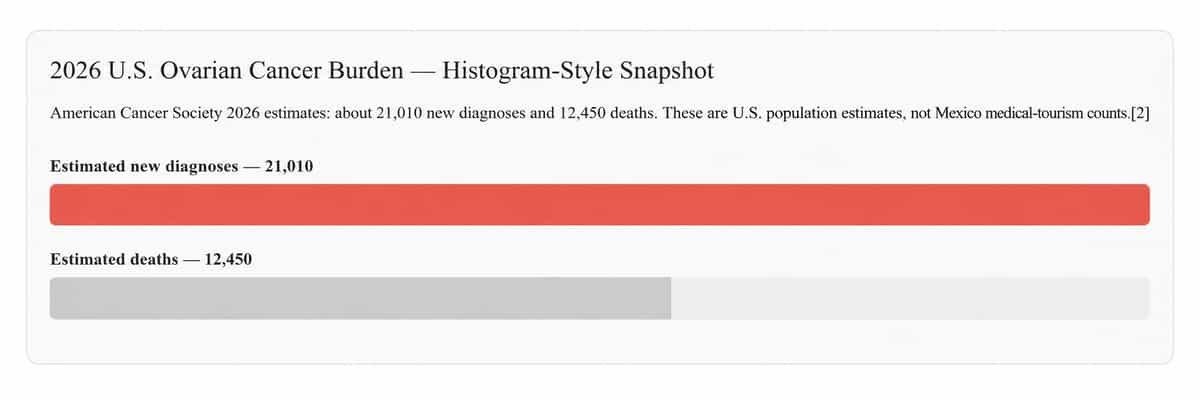
Public data do not provide a reliable ovarian-cancer-specific breakdown of international patients traveling to Mexico by country, age, stage, or treatment type, so this guide does not invent those percentages. The CDC notes that U.S. residents commonly travel to Mexico for medical care and specifically lists cancer treatment among the categories sought abroad. Geography can therefore make Mexico a practical option for some U.S. patients, while Canadians may also consider it for private care or second opinions.
Age matters clinically more than it does for marketing. The American Cancer Society’s 2026 statistics state that about half of women diagnosed with ovarian cancer are age 63 or older. Older age alone does not decide eligibility for surgery or chemotherapy; functional status, heart and lung health, kidney function, nutrition, frailty, disease burden, and personal goals all matter.
How Should International Patients Plan Travel and Continuity of Care?
Cross-border cancer treatment is not a normal short medical trip. You may need repeated cycles, blood tests, imaging, urgent toxicities managed between visits, and postoperative review. Before traveling, identify who is responsible for you in Mexico and who will resume care at home. The CDC advises medical travelers to arrange follow-up, obtain complete records, and understand that infection, blood clots, complications, and delayed care can occur after treatment abroad.[8]
Travel itself can add risk. Active cancer and recent surgery are recognized risk factors for venous thromboembolism, while long periods of immobility during travel can add further risk. Do not choose your return flight based on the cheapest fare or a package itinerary. Your surgeon and oncologist should clear you based on the operation performed, mobility, wound status, oxygen needs, blood counts, and any complications.
| Timeframe | Clinical process | What you may feel | Activity level | Action required |
|---|---|---|---|---|
| Before treatment | Diagnosis confirmation, staging, anesthesia and treatment planning. | Symptoms vary by disease and prior treatment. | As tolerated. | Share complete records; arrange home-country oncologist and emergency plan. |
| Immediately after major surgery | Pain control, bowel recovery, wound monitoring, clot prevention and pathology review. | Fatigue, pain, reduced appetite and limited mobility can occur. | Gradual mobilization per surgical team. | Remain near treating hospital until medically stable; do not assume you can fly on a fixed tourism schedule. |
| Between chemotherapy cycles | Blood-count recovery and toxicity monitoring. | Fatigue, nausea, appetite changes or neuropathy may occur depending on regimen. | Individualized. | Know where urgent labs and treatment will be obtained if symptoms develop at home. |
| After return home | Surveillance, maintenance therapy where indicated, recovery and recurrence monitoring. | Recovery is variable and can extend for weeks or longer after major surgery. | Advance gradually with clinician guidance. | Transfer operative note, pathology, medication record, discharge summary and future treatment schedule. |
What Ovarian Cancer Complications Require Urgent Medical Help?
Cancer treatment can cause urgent complications whether it is received in Mexico, the United States, Canada, the United Kingdom, or elsewhere. Before discharge, request a written list of your own warning signs and a 24/7 contact method. If you develop severe or rapidly worsening symptoms, seek emergency medical care rather than waiting for an international coordinator to reply.
- new chest pain, unexplained shortness of breath, fainting, or coughing blood;
- new one-sided leg swelling or severe calf pain;
- fever or chills during chemotherapy, especially if your oncology team has warned about low white-cell counts;
- heavy bleeding, persistent vomiting, inability to keep fluids down, confusion, or severe weakness;
- rapidly worsening abdominal pain or swelling, inability to pass stool or gas, or repeated vomiting;
- increasing wound redness, drainage, opening, or severe pain after surgery.
Your personal risk depends on the operation and drugs you receive. Ask the hospital how complications are managed after hours, whether emergency readmission is available, and who pays for unplanned treatment. If you are already home, your local emergency team needs your operative report, pathology, and complete medication record.
Mexico vs Treatment at Home: How Should You Decide?
Mexico may be worth considering when a qualified oncology team can offer a clinically appropriate plan, transparent pricing, timely access, and continuity that you can realistically maintain. It may be a poor fit when your condition is unstable, you need frequent urgent monitoring, the proposed therapy is difficult to source legally, or your home team cannot safely manage complications after you return.
Reasons some patients consider Mexico
- Potentially lower private self-pay costs for some components of care
- Geographic accessibility for many U.S. patients
- Possibility of obtaining another specialist opinion
- Access to private hospitals and bilingual coordination in major medical destinations
Reasons to keep treatment close to home
- Need for rapid emergency access or frequent monitoring
- Complex insurance coverage that does not reimburse overseas care
- Difficulty coordinating pathology, drugs, and follow-up across countries
- Medical instability that makes travel unsafe
Questions to Ask Before Booking Ovarian Cancer Treatment in Mexico
- What is my exact histologic diagnosis and FIGO stage?
- Why do you recommend surgery first or chemotherapy first in my case?
- Will a certified gynecologic oncologist perform the operation?
- Which parts of the abdomen might need surgery if disease is found there?
- Does the hospital have on-site ICU, blood bank/transfusion access, pathology and emergency surgery coverage?
- What COFEPRIS authorizations apply to the facility and proposed medicines?
- Which genetic or tumor tests could change my treatment?
- What exactly is included and excluded from the written cost estimate?
- Who pays for complications, extra hospital days, ICU care or a change in procedure?
- How long must I stay near the hospital, and what medical criteria determine when I can fly?
- Who manages me between treatment cycles or after I return home?
- Will you provide English-language copies of pathology, operative notes, medication records and discharge instructions?
Frequently Asked Questions About Ovarian Cancer Treatment in Mexico
Is ovarian cancer treatment in Mexico cheaper than in the United States?
It can be lower-cost for some self-pay patients, but there is no single valid percentage savings figure. A 2025 Mexican government source cited broad annual costs around $17,200 to $20,100 after rough currency conversion. Compare that with your actual U.S. insurer or self-pay estimate, because treatment scope, drugs, surgery complexity and complications differ.
What is the standard treatment for ovarian cancer in Mexico?
For epithelial ovarian cancer, treatment commonly includes surgery and platinum-based chemotherapy. The order depends on stage, resectability, health status and pathology. Some advanced cases receive chemotherapy before interval surgery. Recurrent disease requires a new plan based on prior response, biomarkers and previous toxicities.[1]
How do I verify an ovarian cancer doctor in Mexico?
Ask for the doctor’s full name, professional license, specialty training and current oncology certification. For ovarian-cancer surgery, look specifically for gynecologic-oncology training. The Consejo Mexicano de Oncología certifies gynecologic oncology and provides a tool for checking certified specialists.[7]
How do I verify a cancer hospital in Mexico?
Request the facility’s applicable sanitary authorization and verify any national certification it claims. COFEPRIS regulates health-service authorizations, while the Consejo de Salubridad General publishes a current list of certified medical-care establishments. Also verify ICU, blood bank, pharmacy and emergency capabilities relevant to major ovarian-cancer surgery.[4][6]
Are targeted therapies available for ovarian cancer in Mexico?
Some targeted medicines may be available, but availability is not universal and should never be assumed from U.S. FDA approval. Ask for the generic name, exact indication, COFEPRIS registration status, hospital-pharmacy availability and written cost. Treatment suitability depends on your disease setting, biomarker results and prior therapy.[5]
Can I get immunotherapy for ovarian cancer in Mexico?
Immunotherapy is not a universal standard treatment for every ovarian cancer. Its role depends on tumor biology, prior treatment, regulatory indication and sometimes clinical-trial eligibility. Be cautious if a clinic offers “immune therapy” broadly without naming the drug, biomarker rationale, evidence, regulatory status and toxicity-monitoring plan.
Should I have genetic testing before ovarian cancer treatment abroad?
Genetic and tumor testing can influence treatment and family counseling in epithelial ovarian cancer. Ask a qualified oncology team which germline and tumor tests are relevant to your exact histology and treatment stage. Testing should have a clear clinical purpose rather than being ordered only because a broad panel is marketed as “personalized.”
How long should I stay in Mexico after ovarian cancer surgery?
There is no safe universal number of days. Major cytoreductive surgery can require a substantial hospital and recovery period, especially if bowel or upper-abdominal procedures are needed. Your return date should depend on medical stability, mobility, wound status, complications and surgeon clearance—not on a fixed package itinerary.[8]
Is it safe to fly after ovarian cancer surgery?
Flying soon after major abdominal surgery can add risk, particularly because active cancer, recent surgery and prolonged immobility can increase blood-clot risk. Ask your surgical team for individualized flight clearance and a written plan for mobility, clot prevention and emergency symptoms before booking the return journey.[8]
What records should I bring home after ovarian cancer treatment in Mexico?
Bring the operative report, final pathology, imaging reports and image files, discharge summary, medication list, chemotherapy administration record, laboratory results, molecular or genetic reports, complication notes and follow-up plan. Ask for English copies when possible so your home oncology team can continue care without reconstructing the treatment history.
Can PlacidWay tell me which ovarian cancer treatment is best for me?
No medical-tourism platform should diagnose you or choose your cancer treatment. PlacidWay can help you compare providers, gather cost information and ask structured questions, but a licensed oncology team that has reviewed your records must make the medical recommendations and discuss alternatives, risks and expected goals.
Compare Ovarian Cancer Treatment Options in Mexico
If you already have a diagnosis, PlacidWay can help you organize questions, compare provider information, request itemized cost estimates and review treatment options from medical centers. The medical decision itself must remain with qualified oncology professionals who have reviewed your records.
Disclaimer
Disclaimer: This information is for educational purposes only and does not replace professional medical advice. Always consult a qualified healthcare provider before making medical decisions.
Medical-tourism safety note: Lower-cost care can involve additional risks related to travel, infection, blood clots, continuity of care, medication access, emergency treatment, insurance coverage, legal recourse, and communication between countries. Do not travel for cancer treatment without a diagnosis-specific plan, clear provider credentials, a written complication pathway, and coordinated follow-up at home.
References
- Ovarian Epithelial, Fallopian Tube, and Primary Peritoneal Cancer Treatment (PDQ®) – National Cancer Institute
- Key Statistics for Ovarian Cancer, 2026 Estimates – American Cancer Society
- El costo del cáncer de ovario: una llamada a la conciencia financiera – CONDUSEF, Gobierno de México
- Licencia Sanitaria de Servicios de Salud – COFEPRIS, Gobierno de México
- Visor de Registros Sanitarios de Medicamentos – COFEPRIS, Gobierno de México
- Establecimientos de Atención Médica Certificados – Consejo de Salubridad General, Gobierno de México
- Certificación 2026 – Consejo Mexicano de Oncología, A.C.
- Medical Tourism, CDC Yellow Book 2026 – Centers for Disease Control and Prevention





























Share this listing