


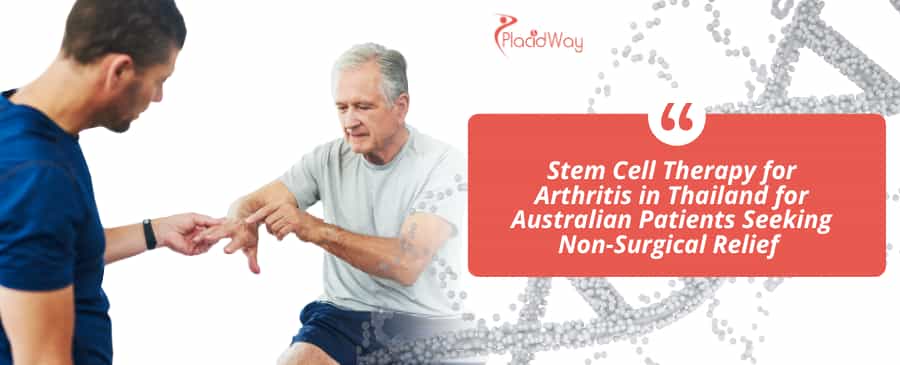
For thousands of Australians suffering from chronic joint pain, the path to relief often feels blocked by long surgical waiting lists, limited non-surgical options at home, and the restrictive costs of private regenerative care. Stem cell therapy for arthritis in Thailand has emerged as a premier solution, offering high-quality, scientifically advanced treatments at a fraction of the cost found in Western nations. By combining world-class medical infrastructure with progressive regulatory frameworks, Thailand provides Australian patients access to potent, high-dosage protocols that are often unavailable domestically.
Whether you are struggling with knee osteoarthritis in Sydney or hip pain in Melbourne, this guide explores how JCI-accredited clinics in Bangkok and Phuket are utilizing Stem Cell Therapy for Arthritis to help international patients restore mobility and delay or avoid invasive joint replacement surgery.
Key Takeaways for Australian Patients
- Significant Cost Savings: Save 50% to 70% compared to similar regenerative procedures in Australia, with packages often including luxury accommodation and airport transfers.
- Access to Expanded Cells: Unlike strict Australian regulations that often limit cell expansion, Thailand allows for culture-expanded Mesenchymal Stem Cells (MSCs), enabling therapeutic dosages of 100 million+ cells for superior results.
- Comprehensive Packages: Most treatments are all-inclusive, covering MRI/X-ray reviews, doctor fees, the procedure, and post-op physiotherapy.
- Cost Examples:
- Knee Stem Cell Injection: $7,500 – $12,000 AUD (approx.)
- Hip Joint Regeneration: $8,000 – $14,000 AUD (approx.)
- Systemic IV Therapy (Rheumatoid Arthritis): $9,000 – $16,000 AUD (approx.)
- No Wait Lists: Skip the public health queue and receive immediate treatment from specialists trained in the US and Europe.
Why Australians Choose Thailand for Regenerative Medicine
Thailand offers a unique combination of regulatory flexibility, medical expertise, and affordability, creating a superior environment for Stem Cell Therapy for Arthritis compared to the restrictive landscape in Australia.
While Australia boasts a high standard of healthcare, the Therapeutic Goods Administration (TGA) places strict limitations on "biologicals." This restricts many clinics to using only "minimally manipulated" autologous cells (cells taken from your own body and re-injected same-day), which often yields a lower cell count. In contrast, medical tourism in Thailand thrives because its regulatory bodies, including the Thai FDA, allow for the safe use of culture-expanded allogeneic cells (from donors, typically umbilical cord tissue). This key difference allows doctors in Bangkok and Phuket to administer hundreds of millions of potent, youthful cells, maximizing the potential for cartilage repair and inflammation reduction.
World-Class JCI-Accredited Facilities
Thailand was the first country in Asia to achieve JCI (Joint Commission International) accreditation. Top hospitals in Bangkok and Phuket operate with safety standards indistinguishable from private hospitals in Sydney or Brisbane. These facilities feature dedicated regenerative medicine centers equipped with GMP-certified laboratories, ensuring that stem cells are processed in a sterile, controlled environment to guarantee viability and safety.
Thailand is not just a holiday destination; it is the "Wellness Capital of Asia." Many Australian patients combine their knee arthritis treatment with a relaxing recovery holiday. The warm climate promotes better circulation and joint mobility, which can actually aid the post-treatment rehabilitation process compared to recovering in a colder climate.
Understanding the Procedure: Types of Stem Cells Used
Success depends on the cell source. Thailand specializes in high-potency Umbilical Cord MSCs, widely considered the 'gold standard' for non-surgical joint repair due to their youth and vitality.
Umbilical Cord Mesenchymal Stem Cells (UC-MSCs)
For Australian patients specifically looking for effective Stem Cell Therapy for Arthritis, UC-MSCs are the most popular choice in Thailand. These cells are harvested from the Wharton's Jelly of healthy, donated umbilical cords (after C-section births) and are ethically sourced with no risk to the mother or baby. Because they are "immunologically privileged," they do not require a donor match and have an extremely low risk of rejection. Their primary advantage is their "youth"—they replicate faster and secrete more growth factors than the older, autologous stem cells found in an elderly patient's own body.
Autologous Stem Cell Therapy
Some patients prefer using their own cells. In this protocol, doctors harvest fat tissue (via mini-liposuction) or bone marrow (from the hip) to isolate stem cells. While available in Thailand, this method is often more invasive and relies on the health of the patient's own cells, which may have diminished regenerative capacity due to age or chronic disease.
"For severe osteoarthritis of the hip or knee (Grade 3 or 4), cell count matters. A standard autologous procedure in Australia might yield 5-10 million cells. In Thailand, using expanded UC-MSCs, we can routinely administer 100 million to 200 million cells directly into the joint and systemically. This higher dosage provides a much stronger anti-inflammatory signal, which is critical for patients trying to avoid joint replacement surgery."
Detailed Cost Analysis: Thailand vs. Australia
The financial advantage of choosing Stem Cell Therapy for Arthritis in Thailand becomes clear when comparing international prices, where Australians can access premium treatments for less than the cost of basic care at home.
The table below compares the estimated costs for a standard knee or hip protocol. Prices are in Australian Dollars (AUD).
| Procedure Type | Cost in Australia (AUD) | Cost in Thailand (AUD) | Typical Inclusions (Thailand) |
|---|---|---|---|
| Single Knee Injection (Autologous) | $9,000 – $15,000 | $6,000 – $9,000 | Consultation, procedure, 1-night stay |
| High-Dose Expanded UC-MSCs (Knee/Hip) | Not widely available* | $7,500 – $13,500 | Airport transfer, hotel (3-5 days), MRI review, Physiotherapy |
| Double Knee Protocol (Both Knees) | $18,000 – $30,000 | $12,000 – $18,000 | Full medical package + rehab sessions |
| Systemic IV Therapy (Rheumatoid Arthritis) | $20,000+ | $9,000 – $16,000 | Systemic infusion, bloodwork, nutrient IVs |
*Due to TGA restrictions, high-dose expanded cell therapies are limited in Australia outside of clinical trials.
Step-by-Step Treatment Journey
Navigating medical tourism is seamless with the right guidance. Here is the typical timeline for an Australian patient traveling to Thailand for arthritis treatment.
1. Remote Evaluation
Before you book a flight, you will submit your medical history and recent imaging (X-rays or MRIs taken in Australia) to the medical team in Thailand. A specialist will review your case to determine if you are a good candidate for Stem Cell Therapy for Arthritis.
2. Arrival & Consultation
Upon landing in Bangkok or Phuket, a VIP driver picks you up. Day 1 usually involves a face-to-face consultation, blood tests, and a physical examination to finalize the protocol.
3. The Procedure
The injection is minimally invasive. For knee or hip arthritis, the doctor uses ultrasound or fluoroscopic guidance to inject stem cells precisely into the joint capsule. The process takes 1-2 hours under local anesthesia or mild sedation.
4. Recovery & Rehabilitation
Patients typically rest for 24 hours. Many packages include several sessions of physiotherapy, laser therapy, or hyperbaric oxygen therapy (HBOT) to accelerate cell activation. You can usually return to light activities within 2-3 days.
Top Destinations: Bangkok vs. Phuket
Choose between the metropolitan medical hub of Bangkok or the serene recovery environment of Phuket, both offering JCI-accredited excellence.
- Bangkok: The capital is home to massive, multi-specialty hospitals and dedicated regenerative centers. It is ideal for patients with complex medical histories who require multidisciplinary care. Flight connectivity from Sydney, Melbourne, and Perth is excellent.
- Phuket: Perfect for those wanting a "medical vacation." The relaxed atmosphere, clean air, and beachfront resorts provide a stress-free environment conducive to healing. Stem cell clinics in Phuket are highly accustomed to treating international tourists and offer extensive concierge services.
"Post-treatment care is vital. In Thailand, many packages include peptide therapy or growth factor infusions alongside the stem cells. This multimodal approach—treating the body's internal environment while targeting the joint—is rarely offered in standard Australian clinics but is standard practice in premier Thai regenerative centers."
Frequently Asked Questions
Common questions from Australian patients regarding safety, logistics, and outcomes.
Is stem cell therapy for arthritis guaranteed to work?
No medical procedure is 100% guaranteed. However, clinical data suggests that 70-85% of patients with mild to moderate osteoarthritis experience significant pain relief and improved function. The goal is often to delay or prevent the need for joint replacement.
How is this different from PRP (Platelet-Rich Plasma)?
PRP uses growth factors from your own blood to signal repair, acting like a "manager" shouting orders. Stem cells are the "workers" that actually perform the repair and regeneration. Stem cell therapy is generally more potent and suitable for more advanced arthritis than PRP alone.
Will I need a visa?
Australian passport holders generally receive a visa exemption for tourism (up to 30 or 60 days depending on current rules) upon arrival in Thailand. This is sufficient for the duration of stem cell treatment, which rarely exceeds one week.
How soon can I walk after knee injections?
Most patients can walk immediately after the procedure, though you may be advised to use crutches or a brace for 24-48 hours to offload the joint. Strenuous exercise should be avoided for at least 4-6 weeks to allow the cells to attach and begin the repair process.
Is the procedure painful?
Discomfort is minimal. Local anesthesia is used to numb the injection site. Some patients report a feeling of pressure or fullness in the joint during the injection, and mild soreness for a day or two afterward.
Ready to Restore Your Mobility?
Don't let joint pain limit your life or your finances. PlacidWay partners with the top JCI-accredited hospitals and specialized regenerative clinics in Thailand to bring you world-class stem cell packages tailored for Australian patients.
Get a free, no-obligation quote today and speak directly with our medical care team to plan your journey to recovery in Bangkok or Phuket.
Get a Quote for Stem Cell Therapy


.png)

-Patients-Are-Traveling-to-Bangkok-for-UC-MSC-Autoimmune-Stem-Cell-Therapy.png)







Share this listing