


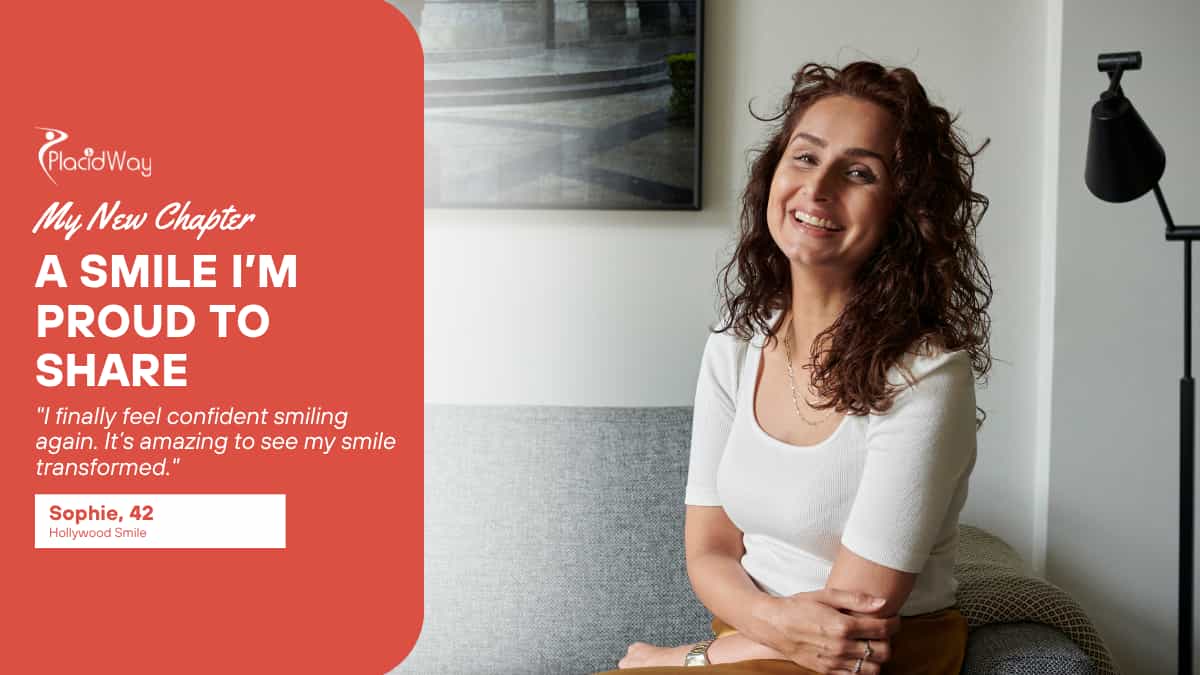
Patient Profile
Name: Sophie Williams
Age: 42
Condition: Chipped, discolored or uneven visible teeth
Treatment: Hollywood Smile plan using veneers, crowns and complementary cosmetic dentistry
Destination: Antalya, Turkey
Provider: Not specified in the source content
Journey at a Glance
Main problems: Discolored, stained, or yellowed teeth resistant to whitening; Chipped, cracked, or worn enamel visible during smiling; Misaligned or gapped teeth affecting smile confidence; Worn veneers or crowns requiring replacement
Previous care: Over-the-counter whitening strips and trays (minimal results); NHS general dentistry for functional repairs (not aesthetic refinement); Saving for private UK cosmetic dentistry (1–2 years of delayed treatment)
Travel driver: Cost accessibility combined with treatment speed and aesthetic outcome confidence
Treatment explored: Hollywood Smile plan using veneers, crowns and complementary cosmetic dentistry
Personal goal: Laugh and appear on video calls without instinctively hiding her smile.
You start by mastering the closed-mouth smile for photographs.
Covering your mouth when you laugh.
Sitting on the left side of the table so the chipped canine remains in shadow.
Declining video calls whenever humanly possible.
Turning off your camera in morning Zoom meetings.
Avoiding lipstick shades that draw attention to the lower half of your face.
Practising a tight-lipped, neutral expression in the bathroom mirror.
Deleting candid holiday photos before your partner can post them.
Looking down at your notebook when introducing yourself to new clients.
Swallowing your laughter at dinner parties.
"You always look so serious in pictures," a colleague mentions.
"Just show your teeth, it's fine," your partner says.
"Are you paying attention?" your manager asks when you look away.
Your professional world has quietly become smaller.
You are forced into a daily trade-off:
Visibility or financial security.
The hardest part is not the physical imperfection or the projected cost of fixing it, but the endless waiting.
Sophie Williams is not a real patient, but you already understand her situation.
She is a fictional composite built entirely from the situations, barriers, and questions British adults face when cosmetic dentistry feels financially out of reach.
She is forty-two years old.
She lives in a semi-detached house in Manchester.
She manages regional accounts for a mid-sized logistics firm.
She drives a reliable estate car to client meetings.
She pays her mortgage on the first of every month.
She organizes the neighborhood charity run every spring.
She attends parent-teacher evenings with a notepad and pen.
She speaks confidently about supply chain metrics and quarterly targets.
She explained the problem away for as long as she could.
She told herself the yellowing was just a natural consequence of drinking black coffee.
She blamed the uneven wear on her front incisors on stress grinding.
Over-the-counter whitening strips from the local high street pharmacy.
Activated charcoal paste applied twice a day.
At-home LED bleaching kits ordered late at night.
Avoiding apples in public.
NHS dental care provides essential functional restorations and disease prevention, but explicit policy dictates that purely cosmetic treatments like elective veneers or tooth bleaching are not provided under the public system (nhs.uk).
She receives the same unhelpful medical verdict:
"Cosmetically insufficient."
She asks herself the same exhausted question:
When?
The national statistics do not capture the daily reality of the barrier.
The private UK cosmetic dentistry market is geographically concentrated, and patients frequently encounter out-of-pocket estimates exceeding GBP 12,000 for full aesthetic restorations, leading to widespread deferral of care (gdc-uk.org).
But Sophie Williams doesn't experience the private dental market as a national statistic.
She experiences it at the office Christmas party, nursing a single drink.
"Let's get a team photo," the regional director calls out.
She experiences it preparing for a senior management interview.
"I just need to look polished," she practices saying to the mirror.
She experiences it reading her daughter's university graduation schedule.
"I'm not ruining those photographs," she whispers.
She has already tried to be extraordinarily patient.
She is not an impulsive shopper looking for a quick, thoughtless fix.
She asked her NHS dentist about private payment options three years ago.
She saved fifty pounds a month in a separate digital account.
She researched local private clinics within a twenty-mile radius.
She read the downloadable pricing PDFs late into the evening.
She realized her modest savings would take four years to match the preliminary quotes.
Her internal monologue shifts to a new baseline:
I just have to accept this.
There are more important things to spend money on.
The core question changes.
From "Can I tolerate this?"
To "How much of my life am I prepared to organise around it?"
The domestic alternative sits just twenty miles down the road.
The nearest private cosmetic clinic operates out of a beautiful period building in Cheshire.
The principal dentist has impeccable credentials and excellent local reviews.
The proposed treatment plan requires six visits spread over four months of active work.
The quote is fourteen thousand, five hundred pounds.
She could technically secure a medical finance loan to cover the entire amount.
"We could remortgage, or put it on the credit cards," her husband suggests at the kitchen table.
"I can't put us in debt for ten years," she replies.
Affording a medical procedure is very different from being able to afford it without causing structural damage to a family's long-term financial security.
She isn't searching for international dentistry yet.
She types quietly into her phone.
Cost of veneers UK private
Can NHS fix chipped front teeth
Payment plans cosmetic dentist Manchester
Cheapest way to fix smile
Hollywood smile Antalya prices
The algorithm begins offering her sponsored posts for clinics in Turkey.
She repeats the same protective boundary:
"I'm not going abroad just because something is cheaper."
That instinct is protective, rational, and entirely correct.
Price should not answer a complex medical or strategic question.
Why does this specific destination keep appearing in her feed?
Antalya has developed a robust medical tourism infrastructure, actively regulated by the Turkish Ministry of Health to attract international patients through standardized clinic accreditations (saglik.gov.tr).
The question is never whether a country is medically competent.
Countries do not place porcelain veneers.
Clinical teams do.
There is something concrete to verify beyond the glossy marketing brochures.
The UK regulatory authorities officially advise patients considering treatment abroad to conduct independent research, verify clinician registration, and consult with their domestic dentist beforehand (cqc.org.uk).
Her first question was always going to be about the money.
The indicative cost for a full cosmetic dental package in Antalya varies between GBP 2,500 and 4,500, driven by the number of units required, the material quality of the veneers, and whether temporary accommodation is included (placidway.com).
She remembers her father's voice.
"If something looks too good to be true, it usually is."
"What exactly am I getting?"
Are the return flights included in that advertised figure?
What specific grade of porcelain or zirconium is being used?
Is the required gum contouring billed as a separate surgical fee?
Does the package cover the temporary veneers while the permanent ones are milled?
Are the airport transfers truly private, or a shared minibus?
How many nights of hotel accommodation are actually paid for?
Does the initial quote include the panoramic X-rays and 3D scanning?
Who pays for the translation services in the clinic room?
Is root canal treatment extra if the surgeon discovers an underlying infection?
Are the postoperative aftercare medications provided or just prescribed?
What happens to my deposit if my flight is delayed and I miss the first consultation?
Are there hidden charges for the final bite adjustment on the last day?
The advertised number is only the beginning of the conversation.
What does the clinical protocol actually involve?
The Hollywood Smile protocol typically involves shaving a minimal layer of enamel from the existing teeth to accommodate custom-made porcelain shells, combined with professional whitening for the surrounding natural teeth (dentalhealth.org).
It requires local anaesthesia.
It causes temporary but significant sensitivity.
It alters the physical structure of the tooth permanently.
"How do I manage the logistics of being five days away from home?"
The glossy brochures rarely put the operational reality on the front page.
The unglamorous operational reality involves sitting in a hotel room with numb lips, eating soft foods, and waiting for the permanent crowns to be manufactured in the laboratory.
Official guidance on medical travel recovery timelines frequently conflicts, with some bodies suggesting immediate fitness to fly and others advising a distinct acclimatisation period for monitoring (gov.uk).
That variation itself is the lesson.
This constraint must be part of the plan before committing, not afterward.
"Wait. Does that mean I might be stuck in a foreign hotel in pain?"
Possibly, depending on your personal pain threshold and how extensively your natural teeth need to be prepared.
Where is the nearest 24-hour pharmacy to the assigned hotel?
Does the clinic provide a direct emergency contact number for out-of-hours care?
Who do I call if a temporary veneer dislodges at midnight?
Is the hotel restaurant equipped or willing to serve a liquid diet?
How do I communicate with the night staff if I urgently need ice packs?
Will the aggressive air conditioning in the room aggravate my tooth sensitivity?
What happens to my treatment schedule if my return flight gets cancelled on the final day?
Are the clinic transport drivers trained in basic patient care?
Can I actually rest in the hotel, or is it located in a noisy tourist district?
Will I have reliable Wi-Fi to video call my family during the waiting days?
This isn't medical tourism in the usual sense.
Her husband isn't just coming along for a holiday in the sun.
He is the invisible second participant in the process.
He will remember the postoperative instructions when Sophie Williams is groggy from the anaesthetic.
He will carry the physical paperwork, the passports, and the written medication schedule.
He needs to know exactly what the clinical escalation protocols are if something unexpectedly goes wrong.
Standard travel insurance rarely covers complications arising from elective medical procedures, meaning specialist medical tourism insurance is a functional necessity rather than an optional add-on (abi.org.uk).
He is part of the clinical care system too.
Then comes the uncomfortable conversation about clinical risk.
Any structural alteration to healthy teeth carries a risk of nerve damage, secondary infection, or bite misalignment that could require complex root canal therapy later in life.
She learns to automatically distrust certain promotional phrases:
Completely safe.
No risk.
Guaranteed success.
Informed consent means understanding far more than the hoped-for outcome.
Her questions during the video consultations become sharper.
How many times has this specific dentist performed this exact full-mouth restoration?
What is the clinic's documented failure rate for porcelain veneers within the first twelve months?
If a veneer fractures three months after I return to the UK, who bears the cost of the revision work?
Do you have a legal partnership with a UK-based dentist for immediate aftercare?
Can I see the sterilization room via video link during my initial consultation?
What specific brand of dental materials will be written into my binding contract?
How do you clinically assess whether my jaw structure can handle this alignment change?
Are the patient coordinators medically trained professionals or strictly sales staff?
What happens to my deposit if the in-person 3D scan reveals I am not a suitable candidate?
What would you see in my X-rays that would make you tell me not to proceed?
She doesn't only want a clinic willing to do the work.
She wants someone willing not to.
She must ask if she has truly exhausted her options at home.
UK patients have the right to request comprehensive, itemised breakdowns of private treatment plans and to seek alternative clinical opinions within the domestic system before committing to invasive procedures.
Is there a phased treatment plan that spreads the financial cost over three years?
Can conservative cosmetic bonding achieve eighty percent of the aesthetic result for twenty percent of the price?
Would simple orthodontic alignment solve the structural issue without shaving healthy enamel?
Does the local private clinic offer a zero-percent finance option I haven't considered?
Have I actually discussed the psychological impact of my teeth with my current NHS dentist?
Aesthetic dentistry abroad should be compared with Sophie Williams's real alternatives, not with a worst-case assumption about the private home system.
They sit at the kitchen table the night before the decision.
It is the same table where they previously ruled out the fourteen-thousand-pound quote.
It is now covered in printed documents.
The provisional flight itineraries.
The Turkish clinic's official registration certificates.
The specialist medical tourism insurance policy wording.
The translated material specifications for the zirconium crowns.
The detailed breakdown of exactly what is excluded from the package.
"It feels different now that we know what could go wrong," her husband says.
"It feels like we're finally looking at reality," she replies.
The research didn't make them more afraid; it made them more capable of deciding.
What she actually wants is not a medical package.
"Why do you really want these veneers?" her sister asks on a Sunday afternoon.
She expects Sophie Williams to say she wants to look younger, or to look like a television presenter.
THE ABILITY TO LAUGH WITHOUT COVERING HER MOUTH.
To leave her camera on during the regional sales call without feeling self-conscious.
To smile widely in the professional photographs at her daughter's wedding.
To stop carrying the exhausting daily weight of a correctable physical insecurity.
Not the Hollywood smile package.
Not the E-max porcelain.
Not the luxury clinic transfer.
Not the Turkish Riviera.
She resolves her desires into one foundational concept:
Freedom.
And underneath that:
Presence.
Travelling to a foreign clinic might be the answer, but it might not be.
You might realize the logistical stress of travelling outweighs the financial savings entirely.
You might discover that cosmetic bonding in the UK is perfectly sufficient for your specific needs.
You might decide to save for two more years to have the procedure done locally by a dentist you already trust.
You might choose to accept your teeth exactly as they are and redirect the money elsewhere.
You might conclude the clinical risks to your healthy enamel are simply too high to justify the aesthetic gain.
If you eventually book the ticket, it is because the verified clinical competence and the financial accessibility align strictly with your specific risk tolerance.
Any of those can be an informed decision.
The goal isn't to persuade you to undergo a procedure.
The goal is to make sure frustration doesn't make the decision for you.
You have permission to take your time.
Maybe you've stopped smiling in family photographs.
Maybe you've practiced the tight-lipped expression in the rearview mirror on the way to work.
Maybe you've stared at a private dental quote and felt a quiet, sinking resignation.
Maybe you've read forums about clinics abroad late at night while everyone else is asleep.
Maybe you've harshly judged yourself for caring about aesthetics at all.
You do not need to decide today.
Who exactly will be performing the procedure?
What are my genuine clinical alternatives at home?
What happens if I need complex revision work next year?
Am I entirely comfortable with the permanent physical alteration of my natural teeth?
Do I have the logistical and emotional support to recover safely away from home?
Have I rigorously verified the clinic's credentials through an independent regulatory body?
Am I rushing this simply because I am tired of waiting?
You are not just comparing prices.
You are comparing paths forward.
Hope isn't the promise that a cosmetic procedure will fix everything.
Hope isn't a glossy brochure guaranteeing a mathematically perfect outcome.
Hope isn't ignoring the legitimate clinical risks just because the price point is attractive.
Hope isn't handing over your autonomy to an eager sales coordinator.
Hope is having enough accurate information to make a decision that finally feels like yours.
You are capable of reading the dense clinical documentation.
You are capable of asking difficult, uncomfortable questions about failure rates.
You are capable of walking away entirely if the answers are evasive or unsatisfactory.
You are capable of separating marketing hype from stark medical reality.
You are capable of reclaiming your presence in the room.
From "I suppose I'll just have to keep waiting."
To "What other informed options do I have?"
PlacidWay — Your Way to Hope.
PlacidWay helps you navigate the complex global healthcare landscape by allowing you to explore international options, compare accredited facilities, and prepare the rigorous questions necessary for true informed consent. We do not provide clinical advice, nor do we recommend specific dental treatments or guarantee medical outcomes. For someone like Sophie Williams, cosmetic dentistry in Antalya isn't a guaranteed promise, it is merely one functional route worth understanding fully before making a choice.
Your Way to Hope.
This article is for educational purposes only and does not recommend that any individual undertake cosmetic dental surgery abroad. Individual clinical suitability, inherent medical risks, and recovery timelines require direct professional assessment. You should always consult a qualified dental professional in your home system, verify the current regulatory status of any international clinic independently, and obtain appropriate specialist medical tourism insurance before committing to elective treatment.
.png)

.png)
.png)
.png)
.png)
.png)

.jpg)
-(1).png)










Share this listing