
Patient Profile
Name: Louise Bradshaw
Age: 48
Condition: Thyroid cancer
Treatment: Partial or total thyroidectomy with possible lymph-node dissection and radioactive iodine
Destination: Istanbul, Turkey
Journey at a Glance
Main problems: Thyroid nodule or lump detected on imaging; Elevated thyroid-stimulating hormone (TSH) or abnormal thyroid function tests; Difficulty swallowing or throat discomfort; Hoarseness or voice changes
Previous care: Consulted NHS GP; received referral to general surgery or endocrinology; Researched private consultants in London or Manchester; received quotes of £3,500–£6,000+ for initial consultation alone; Attended support groups or NHS Trust thyroid cancer…
Travel driver: Collapsed decision window: NHS wait times align poorly with cancer treatment urgency; UK private costs are prohibitive; Istanbul offers speed, cost-effectiveness, and surgical expertise without sacrificing safety or quality assurance
Treatment explored: Partial or total thyroidectomy with possible lymph-node dissection and radioactive iodine
Personal goal: Obtain timely specialist surgery and a clear postoperative monitoring plan.
You noticed the swelling while adjusting your collar.
You assumed it was just a swollen gland from a winter cold.
You gave it two weeks to subside on its own.
You finally called the clinic at eight in the morning.
You waited forty minutes on hold.
You accepted a phone appointment.
You pushed hard for an actual physical examination.
You sat through the ultrasound in a windowless hospital basement.
You watched the technician suddenly stop talking.
You read the biopsy leaflet on the bus ride home.
"We just need to rule things out," your partner said.
"Don't google anything yet," your sister advised.
"Take a few days off," your manager suggested.
Your world has quietly become smaller.
You realise the hardest part is not the physical discomfort, nor the eventual cost, but the waiting.
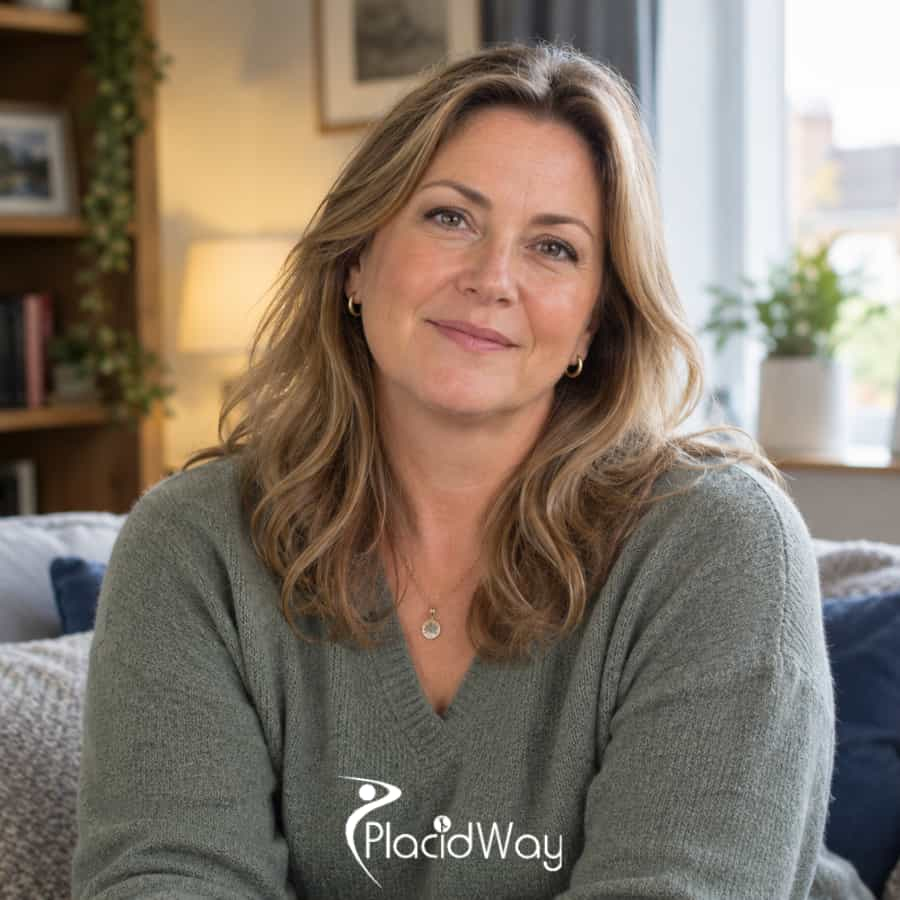
Meet Louise Bradshaw, a competent woman whose life has suddenly stalled.
Louise Bradshaw is not a real patient, but a composite built from the exact situations, constraints, and questions faced by adults navigating the British healthcare system today.
She is forty-eight years old and lives in Kent.
She manages a regional logistics firm.
She coordinates dispatch schedules, packs school lunches, drives the A21 daily, and handles crises long before they escalate.
She operates a perfectly ordinary, competent life.
She tried to dismiss the symptoms before the diagnosis arrived.
She blamed the throat discomfort on winter allergies.
Lozenges.
More water.
Sleeping propped up.
Throat sprays.
Ignoring the mirror.
She finally attended a general practitioner appointment.
She received a standard referral to an endocrinology unit.
She paid for a private diagnostic scan to bypass the initial imaging queue.
Current clinical guidelines for suspicious thyroid nodules typically involve a fine-needle aspiration biopsy, followed by a multidisciplinary team review to determine if surgical removal of the thyroid gland is necessary.
She opened the letter confirming a papillary thyroid carcinoma.
The closing sentence read:
"We will contact you regarding your surgical consultation."
When?
The public health framework moves at a different pace than her anxiety.
The national standard aims for a two-week wait for urgent suspected cancer referrals, but the subsequent wait for specialized oncology consultation and surgical intervention frequently extends beyond this target, with many regional trusts reporting delays of eight to fourteen weeks for endocrine surgery.
But Louise Bradshaw doesn't experience the system as a national statistic.
She stares at her phone during a lunch break, watching the screen lock and unlock.
"They said they would call by Tuesday."
She sits in her parked car outside the supermarket, unable to remember what she came to buy.
"I can't just keep driving around like this."
She touches the base of her neck while watching television, her fingers resting lightly on the lump.
"It feels bigger today."
She has already tried to be intensely patient.
She is not a careless shopper looking for a shortcut.
She called the hospital bookings team.
She left voicemails for the consultant's medical secretary.
She reviewed the regional wait times data online.
She joined a patient support group.
She attended an evening webinar on living with thyroid nodules.
"I am doing everything they asked me to do."
"It shouldn't be this difficult to get a date."
Her internal baseline has shifted from:
Can I tolerate this?
To:
How much of my life am I prepared to organise around it?
The domestic private alternative feels like an impossible compromise.
She explores the standard private route within the United Kingdom.
She requests quotes from established consultants in London.
The initial consultation alone costs GBP 250, followed by a total estimated pathway cost exceeding GBP 12,000 for the surgery, anesthesia, and pathology.
Her main savings account holds GBP 14,000, designated for a home extension and her daughter's university transition.
She sits at the kitchen table with her husband, tapping a pen against the printed hospital estimate.
"We can find the money if we have to."
"Having the money doesn't mean we can afford to empty the account."
She isn't searching for international options yet.
She opens her browser late at night.
Thyroid cancer survival rates
How fast does papillary thyroid cancer spread
Private thyroidectomy cost UK
Cheapest private hospital for thyroid surgery
Thyroid surgery abroad options
An online patient forum mentions high-volume endocrine surgery centers in Istanbul.
She recoils slightly at the idea.
"I'm not going abroad just because something is cheaper."
Her instinct to protect her physical safety is entirely correct.
Why does Istanbul keep appearing in the research?
Turkey has heavily invested in private medical infrastructure over the last decade, establishing large-scale facilities that handle high volumes of specific oncological and endocrine procedures, creating economies of scale that do not exist in standard regional health trusts.
The crucial reframe happens when she realises the central truth of medical travel.
The question is never whether a specific country is good at medicine.
Countries do not perform operations.
Surgeons do. Hospitals do. Clinical teams do.
There is something concrete and measurable to verify.
The British Association of Endocrine and Thyroid Surgeons advises patients seeking treatment independently to ensure their chosen surgeon participates in recognized clinical audits and performs a sufficient annual volume of relevant procedures to maintain expertise.
Her very first question was about the total cost.
The indicative cost for a self-funded total thyroidectomy in Istanbul varies between GBP 4,500 and GBP 7,000, depending on the need for neck dissection, the length of inpatient stay, and the specific accreditation tier of the surgical facility.
She remembers her father's old rule.
"If a price looks too simple, you haven't asked enough questions."
"What exactly am I getting?"
Twelve things the advertised price may or may not cover.
Does this figure include the initial endocrinology consultation?
Is the preoperative ultrasound mapping included?
Are the routine preoperative blood tests covered?
Does it pay the anesthesiologist's fee?
How many nights in the hospital ward are factored in?
What happens to the price if I need to stay an extra night?
Is the use of intraoperative nerve monitoring equipment standard practice here?
Who pays for the rapid frozen section pathology during the surgery?
Does the quote include the final histopathology report translated into English?
Are my first post-operative doses of levothyroxine provided?
Does it cover hotel accommodation for my mandatory recovery period?
Are the airport and clinical transfers managed directly by the clinic?
The advertised number is only the beginning of the conversation.
What does a total thyroidectomy actually involve?
Price should not answer a surgical question.
The true cost of any medical intervention includes the logistical complexity of managing it.
Louise Bradshaw realizes she needs to understand the physical reality of the procedure first.
The operation requires an incision across the lower neck to remove the entire thyroid gland, and potentially surrounding lymph nodes, under general anesthesia, usually taking two to four hours.
"How do I actually get home after neck surgery?"
The brochures rarely put the operational reality on the front page.
The unglamorous reality of international surgery involves navigating crowded airports, carrying luggage, and managing post-operative fatigue in transit.
Current guidance on flying after major surgery varies considerably, with some medical bodies suggesting a wait of several days to a week to minimize deep vein thrombosis risks and manage swelling, while others mandate specific clearance from the operating surgeon before boarding.
The variation itself is the lesson.
This physical constraint must be factored into the itinerary and budget before committing, rather than addressed as an afterthought.
"Wait. Does that mean I'm stuck in a hotel room for a week?"
Possibly, depending on your surgeon's specific clearance protocol.
Will my neck be too stiff to look up at departure screens?
How do I manage my luggage if I am advised not to lift anything heavy?
What if I experience calcium level drops while resting at the hotel?
Can I access immediate medical help from the hotel room if my breathing feels restricted?
Will the surgical team communicate directly with my GP back home?
How do I get my official pathology report sent to my UK oncologist?
What happens if my surgical drain needs to stay in longer than expected?
Do I need to wear compression stockings on the flight back?
Will I be comfortable sitting upright in a standard economy seat?
Who removes my stitches once I am back in Kent?
This isn't tourism in the usual sense.
Her husband isn't just coming along for a holiday.
Mark is the invisible second participant in this clinical pathway.
He will carry the passports, the medical files, and the suitcases.
He will monitor her breathing while she sleeps in the hotel bed.
He will communicate with the nurses during the night shift.
He will need to know what to do if she develops tingling or numbness in her fingertips.
He must ensure their specialized medical travel insurance explicitly covers complications arising from planned elective surgery abroad, as standard holiday policies will immediately void their coverage upon hospital admission.
He is part of the clinical safety system too.
Then comes the deeply uncomfortable conversation about risk.
Every neck surgery carries inherent, severe risks, including potential damage to the recurrent laryngeal nerve affecting vocal function, or accidental removal of the parathyroid glands leading to permanent hypocalcemia.
Louise Bradshaw learns to aggressively filter out clinics using specific language:
Completely safe. No risk. Guaranteed success. Routine procedure.
Informed consent means understanding the architecture of a complication, not merely hoping it does not occur.
Her consultation questions become significantly better.
Instead of asking if they are good, she asks how they manage failure.
How many total thyroidectomies did this specific surgeon perform last month?
Do you use continuous intraoperative nerve monitoring on every single patient?
Where is the frozen section pathology analyzed during the procedure?
What is your facility's documented rate of permanent vocal cord paralysis?
How long are patients monitored for hypocalcemia before discharge?
If I need radioactive iodine ablation later, how do you hand off my care to my UK oncologist?
Will you provide my operation notes in English before I board my flight?
What is the escalation protocol if I hemorrhage in the hotel room?
Who is legally responsible if I require corrective surgery?
What clinical finding during your review would make you tell me not to proceed?
She doesn't only want a clinician willing to operate on her.
She wants one willing to refuse.
Have I truly exhausted all my options at home?
Before transferring her care internationally, Louise Bradshaw must verify she has genuinely reached the limit of domestic possibilities, including requesting formal diagnostic acceleration through her local Patient Advice and Liaison Service.
Can my referral be upgraded to an urgent multidisciplinary team review?
Are there cancellation lists I can join for earlier surgical slots?
Is there a neighboring NHS Trust with shorter waiting times under patient choice rights?
Can I pay privately for the surgery but return to the NHS for ongoing endocrinology care?
What happens to my place in the NHS queue if I travel abroad?
Istanbul should be compared with Louise Bradshaw's real alternatives, not with a worst-case assumption about the British healthcare system.
The night before the decision feels entirely different.
The kitchen table is covered in paperwork again.
Printed correspondence from the local NHS trust. Two formal quotes from London private hospitals. A detailed itinerary from a JCI-accredited facility in Istanbul. Surgeon credential check reports. Medical travel insurance policies.
"It feels like a lot to take on," Mark says, leaning over the table.
"It feels like I finally have a grip on it," she replies.
The research didn't make her more afraid; it made her more capable of deciding.
What she actually wants isn't a surgical package abroad.
"Do you really want to go to Turkey for this?" her sister asks.
She gives the expected answer about saving time and protecting savings.
But her real objective is highly specific:
She wants to swallow without thinking about it.
She wants to sit in her garden without her fingers tracing her neck.
She wants to plan her Christmas travel without wondering if she will be in a hospital ward.
She wants to stop waiting for the phone to ring.
Not the medical tourism package. Not the discounted hotel stay. Not the surgical procedure itself. Not Istanbul.
Agency.
And underneath that:
Certainty.
Istanbul might be the answer, but it might not be.
Istanbul might be the answer.
It might not be.
She might decide the logistical burden is too heavy for her partner to carry.
She might secure a cancellation slot at her local NHS hospital next week.
She might find the prospect of flying after surgery physically intimidating.
She might negotiate a payment plan with a UK private consultant.
She might simply prefer the comfort of recovering in her own bed.
She might verify the overseas clinical standards, review the logistics, and choose to board the plane with absolute clarity.
Any of those can be an informed decision.
The goal is not to persuade you to travel, but to ensure that frustration does not make the decision on your behalf.
You do not need to decide today.
Maybe you are sitting at your own kitchen table right now.
Maybe you are looking at an appointment letter dated two months from today.
Maybe you are weighing your savings against your anxiety.
Maybe you are tired of searching for answers on your phone late at night.
Maybe you just want to know what your actual choices are.
You do not need to decide today.
What are my precise domestic wait times?
How much am I willing to spend to accelerate my care?
Am I physically prepared to travel for surgery?
Who will support me during an overseas recovery?
What are the measurable credentials of the surgeons I am considering?
How will my aftercare be managed when I return?
What happens if I simply wait?
You are no longer just comparing prices.
You are comparing paths forward.
Hope isn't the promise that everything will be fixed.
Hope isn't the promise that the operation will be easy.
Hope isn't the promise that the logistics will be flawless.
Hope isn't the promise that you won't feel afraid.
Hope is possessing enough factual information to make a decision that feels entirely yours.
You are capable of asking difficult questions. You are capable of demanding clear answers. You are capable of walking away from vague assurances. You are capable of organizing your own care. You are capable of reclaiming your timeline.
Your internal dialogue has shifted:
I suppose I'll just have to keep waiting.
To:
What other informed options do I have?
PlacidWay — Your Way to Hope.
PlacidWay helps patients explore international healthcare options by providing access to verifiable facility data, surgeon credentials, and transparent pricing structures. We assist you in comparing treatment pathways and preparing the crucial questions you need to ask, without offering medical advice or guaranteeing clinical outcomes. For someone facing a delayed thyroid cancer pathway, Istanbul isn't a promise; it is one route worth understanding.
Your way to hope.
Medical disclaimer
This article is for educational and informational purposes only and does not constitute medical advice, nor does it recommend that any individual undertake surgery or travel abroad for medical care. Individual suitability, diagnostic outcomes, and surgical risks require professional clinical assessment. The reader should always consult their own qualified clinician or domestic healthcare provider before making medical decisions, verify current regulatory status and facility accreditations independently, and obtain appropriate specialized medical travel insurance.






















Share this listing