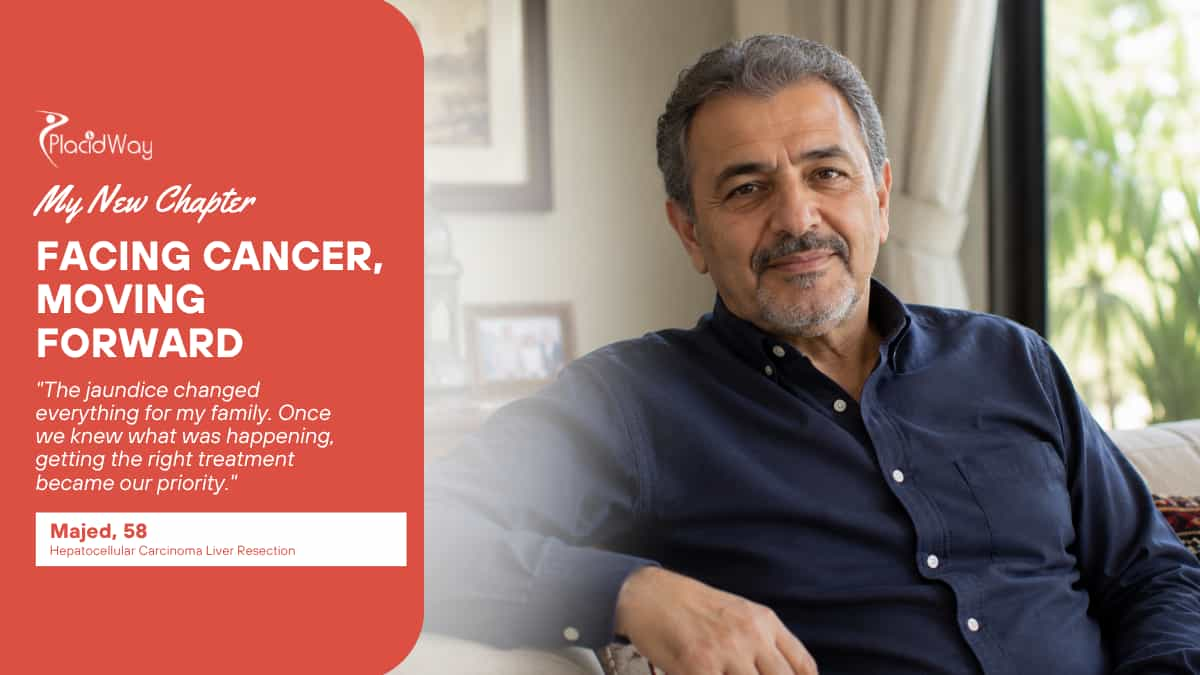
The Jaundice That Changed the Family’s Timeline: Majed Al-Shehri’s Hepatocellular Carcinoma Liver Resection Story from Saudi Arabia to Turkey

Publish date: Modified date: Medically reviewed by: Dr. Orhan Sencan on Sep 01, 2026 Author: Aamina Bibi

Majed Al-Shehri’s Hepatocellular Carcinoma Liver Resection Story 

Patient Profile

Name: Majed Al-Shehri

Age: 58

Condition: Hepatocellular carcinoma

Treatment: Liver resection, TACE, RFA or transplant evaluation according to stage

Destination: Istanbul, Turkey

Journey at a Glance

Main problems: Abdominal pain and distension; Jaundice (yellowing of skin/eyes); Unexplained weight loss; Fatigue and loss of appetite

Previous care: Consultation at major Saudi tertiary centers (King Majed Al-Shehri Specialist Hospital, National Guard Hospital); Imaging (CT, MRI, ultrasound) and biopsy confirmation; Discussion of chemotherapy or best supportive care

Travel driver: Access to specialized hepato-oncologic surgery, shorter treatment timeline, cost efficiency, and second-opinion validation from an internationally recognized center

Treatment explored: Liver resection, TACE, RFA or transplant evaluation according to stage

Personal goal: Secure a multidisciplinary treatment plan while he remains eligible for disease-directed therapy.

You stop making plans for the winter.

You stop scheduling meetings more than two weeks out.

You stop answering questions about upcoming holidays.

You let the gym membership lapse.

You nod when colleagues tell you to rest.

You adjust your trousers because the belt sits differently now over a swollen abdomen.

You eat smaller portions so the early fullness does not turn into nausea.

You learn to read the slight yellow tint in the bathroom mirror.

You organize your daily routine around sudden, unpredictable waves of fatigue.

"Just take the medication and rest," your brother says over tea.

"The hospital will call when they have a date," your colleague insists.

"We just have to be patient," your spouse whispers in the dark.

Your world has quietly become smaller.

The hardest part is not the physical pain or the financial burden, but the waiting.

Who is this patient?

Majed Al-Shehri is not a real PlacidWay patient.

He is a fictional composite built from the actual situations, medical records, and questions Saudi Arabian patients face every day.

He is fifty-eight years old and lives in Riyadh.

Before the jaundice appeared, he managed a logistics firm in the Olaya district.

He played squash on Thursday evenings.

He drove his youngest daughter to university.

He maintained the family property in the suburbs.

How the medical reality gradually escalated in his life.

He explained the abdominal pain away as indigestion from late office meals.

He ignored the unexplained weight loss as a belated benefit of dietary changes.

He attributed the deep fatigue to aging and long working hours.

Then the symptoms accumulated.

The ultrasound.

The referral to King Majed Al-Shehri Specialist Hospital.

The MRI confirmation.

The needle biopsy.

Hepatocellular carcinoma, primary liver cancer, is typically managed through surgical resection, localized ablation, or transarterial chemoembolization (TACE) when diagnosed at an intermediate stage without severe cirrhosis. The standard of care requires multidisciplinary intervention involving specialized hepato-pancreato-biliary surgeons and interventional radiologists.

The oncologist looked at the file and delivered the verdict:

"The tumor is localized, but our surgical schedule is currently full."

The most terrifying word in the consultation room was not cancer, but a question:

When?

Demand for specialized interventional oncology in the Gulf region frequently outpaces available operating theater capacity, with routine non-emergency surgical waitlists extending between six and twelve months in some public tertiary networks.

But Majed Al-Shehri doesn't experience the Saudi healthcare system as a national statistic.

He experiences it as a polite, apologetic receptionist handing him a card with a phone number.

"We will contact you if there is a cancellation," she says.

He experiences it sitting in his car in the hospital parking lot, staring at the steering wheel.

"Should I call my brother at the Ministry?" Amira asks from the passenger seat.

He experiences it staring at his phone, waiting for a notification that does not come.

He has already tried to be patient and follow the rules.

The assumption that patients seeking care abroad are merely impatient consumers is entirely false.

Majed Al-Shehri has followed every protocol.

He secured the initial referrals from his primary physician.

He waited six weeks for the diagnostic MRI.

He attended the multidisciplinary team consultation.

He inquired about private care at National Guard Hospital.

He researched best supportive care and palliative chemotherapy limits.

"I am doing everything I am supposed to do," he thinks.

"But the tumor does not care about the schedule," he realizes.

The internal framework changes:

From "Can I tolerate this?" to "How much of my life am I prepared to organise around it?"

The domestic private sector presents a different kind of barrier.

There are premium private facilities in Riyadh and Jeddah.

They offer excellent, world-class oncological care.

But their specialized surgeons are often the same consultants working in the public sector.

The capacity constraint simply moves from a waitlist to a financial barrier, where out-of-pocket costs for private liver resection can rapidly deplete a lifetime of savings.

"We can sell the property in Diriyah," Amira says, clearing the dinner plates.

"Selling it is not the same as affording it," Majed Al-Shehri replies.

He isn't searching for medical centers in Istanbul yet.

Majed Al-Shehri sits at his laptop at two in the morning.

Liver cancer surgery wait times Riyadh.

Private hepatectomy cost Saudi Arabia.

Alternatives to palliative chemotherapy HCC.

Best liver cancer hospitals Middle East.

TACE procedure availability private clinics.

Cost of liver resection Turkey.

He reads a forum post about an oncology center in Istanbul.

"I'm not going abroad just because something is cheaper," he tells Amira the next morning.

That instinct is entirely correct.

Price should never answer a medical question.

Why does Turkey keep appearing in these conversations?

Istanbul has intentionally positioned itself as a high-capacity medical hub by integrating international accreditation standards with rapid treatment timelines.

But the country is not the deciding factor.

Countries do not perform partial hepatectomies.

Surgical teams do, clinical care units do, and interventional radiologists do.

There is a concrete, verifiable track record to examine in specific facilities.

Patients seeking cross-border care are strongly advised to verify independent clinical outcomes and coordinate with their domestic primary care network before committing to foreign intervention.

His first practical question was about the financial reality.

The indicative baseline cost for liver cancer surgery or complex transarterial chemoembolization in Istanbul varies between USD 15,000 and 25,000, depending heavily on tumor complexity, ICU requirements, and inpatient recovery duration.

His father used to say:

"A cheap surgery is only cheap until something goes wrong."

"What exactly am I getting?"

Twelve things the advertised price may or may not cover.

Does this include the pre-operative PET scan?
Are multidisciplinary tumor board consultations billed separately?
How many days in the intensive care unit are covered?
What is the protocol if I need emergency blood transfusions?
Does the quote include postoperative pathology reports?
Are follow-up imaging scans part of the package?
Does it cover the cost of a specialized anesthesiologist?
Are prescription medications for discharge included?
What happens if the surgery takes four hours longer than expected?
Does the fee cover translator services during medical rounds?
Are airport transfers accommodated in specially equipped vehicles?
What is the cost of my wife staying in the hospital room?

The advertised number is only the beginning of the conversation.

The list of questions sits on the dining table.

It is longer than the original diagnosis report.

Majed Al-Shehri realizes he is managing a complex project, not just an illness.

What does hepatic resection actually involve?

Surgical resection for hepatocellular carcinoma involves removing the tumor alongside a margin of healthy liver tissue, relying on the organ's unique capacity to regenerate, provided the underlying cirrhosis is not too severe. It requires advanced intraoperative imaging, specialized clamping techniques to manage severe bleeding, and immediate access to a high-dependency care unit.

This clinical reality immediately reframes the geographical challenge.

"How do I manage the logistics of recovery away from home?"

The part the glossy brochures rarely put on the front page.

An operation of this magnitude requires a highly structured postoperative environment.

Official medical travel guidelines note that variable discharge protocols often dictate the true duration of your stay abroad, emphasizing that safe commercial air travel may not be permitted for several weeks post-surgery.

This variation itself is the lesson.

This constraint must be part of the plan before committing, not afterward.

"Wait. Does that mean I might be stuck in a hotel for a month?"

Possibly, depending on your liver function tests and drain removals.

Who checks the surgical wound when I leave the hospital?

How do I get prescription pain relief in a foreign pharmacy?

What if I develop a fever on a Sunday evening?

Is the hotel equipped with a walk-in shower?

How far is the accommodation from the emergency room?

Can I eat the local food with my modified digestion?

Who translates if I need to call the surgeon at midnight?

Are my medical records provided in English for my doctors in Riyadh?

Will the airline require medical clearance to fly home?

This isn't tourism in the usual sense.

There are no guided tours or sightseeing itineraries on this trip.

There is only the hospital, the hotel room, and the space between them.

The reality is entirely clinical.

Amira isn't just coming along as a companion.

The invisible second participant carries an enormous operational load.

Amira will carry the passports, the physical medical files, and the medication schedule.

She will be the one trying to read a Turkish pharmacy receipt.

She will watch the monitor in the ICU waiting room.

She needs to know exactly who to call if Majed Al-Shehri's breathing changes.

Private health insurance coverage for elective international care typically requires explicit pre-authorization and often excludes companion logistical support unless specifically ridered.

She is part of the care system too.

Then comes the uncomfortable conversation about risk.

Hepatic surgery carries intrinsic, undeniable physiological dangers.

Major risks include post-hepatectomy liver failure, biliary leakage, intra-abdominal bleeding, and deep vein thrombosis. The complexity of managing underlying cirrhosis alongside the malignancy complicates recovery immensely.

Majed Al-Shehri learns to immediately distrust certain phrases:

Completely safe. No risk. Guaranteed success. Routine procedure.

Informed consent means understanding more than the hoped-for outcome.

Majed Al-Shehri's questions become significantly better.

He no longer asks if the procedure is affordable or rapid.

How many partial hepatectomies has this specific surgeon performed this year?
What is your facility's rate of postoperative bile leaks?
Is your intensive care unit staffed by dedicated intensivists or general duty physicians?
Do you have an in-house interventional radiology team if TACE is needed instead of surgery?
How do you handle patients who develop acute liver decompensation?
Can I speak to the anesthetist before I fly?
What happens if the tumor board reviews my scans and decides surgery is no longer viable?
How is my follow-up oncology care handed back to King Majed Al-Shehri Specialist Hospital?
Who is legally responsible if a surgical complication requires a second operation?
What would you see on my MRI that would make you tell me not to proceed?

They don't only want someone willing to do the operation.

They want someone willing not to.

The tone of the virtual consultations changes.

The foreign surgeons speak to him differently now.

He has become a partner in his own clinical strategy.

Have I exhausted my options at home?

Saudi patients have a formalized right to seek secondary medical boards and apply for specialized treatment outside their primary healthcare cluster under state provisions if domestic care cannot be provided in a timely manner.

Is there a different regional hospital with shorter wait times?
Can my case be escalated to a priority surgical queue based on tumor growth?
Will the Ministry of Health sponsor this treatment abroad given the lack of local capacity?
Can my domestic oncologist coordinate with a Turkish counterpart?
If I pay out-of-pocket abroad, will the local system accept me back for chemotherapy?

The comparison must be fair:

Treatment in Istanbul should be compared with Majed Al-Shehri's real alternatives, not with a worst-case assumption about the Saudi system.

The night before the decision.

The dining table is covered in documents.

The translated radiology report from Riyadh.

The quoted surgical plan from the hospital in Istanbul.

The flight schedules to Sabiha Gökçen Airport.

The printed map showing the distance from the hotel to the clinic.

"Are we really doing this?" Amira asks, holding a pen.

"We are, because we finally know what 'this' actually is," Majed Al-Shehri replies.

The research didn't make them more afraid; it made them more capable of deciding.

What Majed Al-Shehri actually wants isn't a hospital bed in Istanbul.

"What are you looking for over there?" his brother had asked.

"I am looking for medical care," Majed Al-Shehri had replied.

But what he actually wants is to schedule surgery in Istanbul within four weeks, complete treatment within three months, and return home cancer-free.

He wants to sit at his desk in the logistics firm without a dull ache in his side.

He wants to watch his daughter graduate next spring.

He wants his wife to sleep through the night without listening to his breathing.

Not a cheaper hospital invoice. Not a medical tourism package. Not a faster waitlist. Not a trip to Turkey.

But what he actually wants is a single objective:

Control.

And underneath that:

Time.

Surgery in Istanbul might be the answer, or it might not be.

You might realize the logistical burden on your spouse is too high.

You might secure a cancellation slot at King Majed Al-Shehri Specialist Hospital tomorrow.

You might discover the tumor has progressed and palliation at home is the wisest choice.

You might conclude the financial stretch is unjustified without guaranteed outcomes.

You might simply decide the comfort of your own bed outweighs the speed of an overseas clinic.

But choosing to fly, armed with hard questions and clear expectations, is also a valid path.

Any of those can be an informed decision.

The goal of this exploration is not to persuade you to board a plane.

It is to make sure frustration doesn't make the decision for you.

Maybe you are sitting in a parked car holding an appointment card.

Maybe you are watching your spouse research clinics late at night.

Maybe you are staring at an abdominal scan you do not fully understand.

Maybe you are tired of being told to be patient.

Maybe you feel like the system has forgotten you.

You do not need to decide today.

What exactly is my current prognosis if I wait six months?

What clinical alternatives exist outside my local hospital network?

Who can independently verify the success rates of the clinics I am looking at?

What is the true total cost of seeking this intervention abroad?

How will my postoperative care be managed once I return?

Is my insurance or health ministry able to facilitate this transition?

What would cause a foreign surgeon to decline my case?

The aim is not just to find different prices.

The aim is to find viable paths forward.

Hope isn't the promise that everything will be fixed.

Hope is not the guarantee that surgery will be completely safe.

Hope is not the assurance that every trace of illness will be removed forever.

Hope is not a glossy brochure from a foreign hospital.

Hope is having enough accurate, unsentimental information to make a decision that feels like yours.

It is knowing what questions to ask.

It is understanding the risks and accepting them clearly.

It is reclaiming agency over a body that feels like it is failing.

It is looking at a problem and seeing a mechanism to address it.

He finally changes his perspective:

From "I suppose I'll just have to keep waiting." To "What other informed options do I have?"

PlacidWay — Your Way to Hope.

PlacidWay helps patients and families explore international healthcare options, compare accredited facilities, and prepare the rigorous questions necessary for complex medical decisions. We do not provide medical diagnoses, endorse specific surgical outcomes, or offer clinical advice. For someone like Majed Al-Shehri, examining an oncology clinic in Istanbul isn't a promise of a cure, it is simply one route worth understanding fully.

Your Way to Hope.

Medical disclaimer

This article is for educational and informational purposes only and does not recommend that any individual undertake cross-border medical travel or specific oncological procedures. Individual suitability, surgical candidacy, and medical risk require comprehensive professional assessment. Readers should always consult their own primary oncologist or domestic healthcare provider before altering their treatment plan, verify the current regulatory and accreditation status of any foreign facility independently, and obtain appropriate medical travel insurance and legal protection.
The Jaundice That Changed the Family’s Timeline: Majed Al-Shehri’s Hepatocellular Carcinoma Liver Resection Story from Saudi Arabia to Turkey

About Article

  • Translations: EN AR
  • Treatment: Cancer Treatment
  • Country: Turkey
  • Overview This educational overview follows Majed Al-Shehri, a composite Saudi patient exploring Liver Cancer Treatment in Istanbul, Turkey. It summarizes daily-life effects, previous care and why treatment abroad is being considered. Candidacy, safety, recovery and follow-up remain central to informed decision-making.

Trusted Medical Tourism Platform Since 2007

60+
Countries
2k+
Clinics
19.5k+
Reviews
2.5k+
Qualified Doctors
1.1M+
Patients Served Since 2007