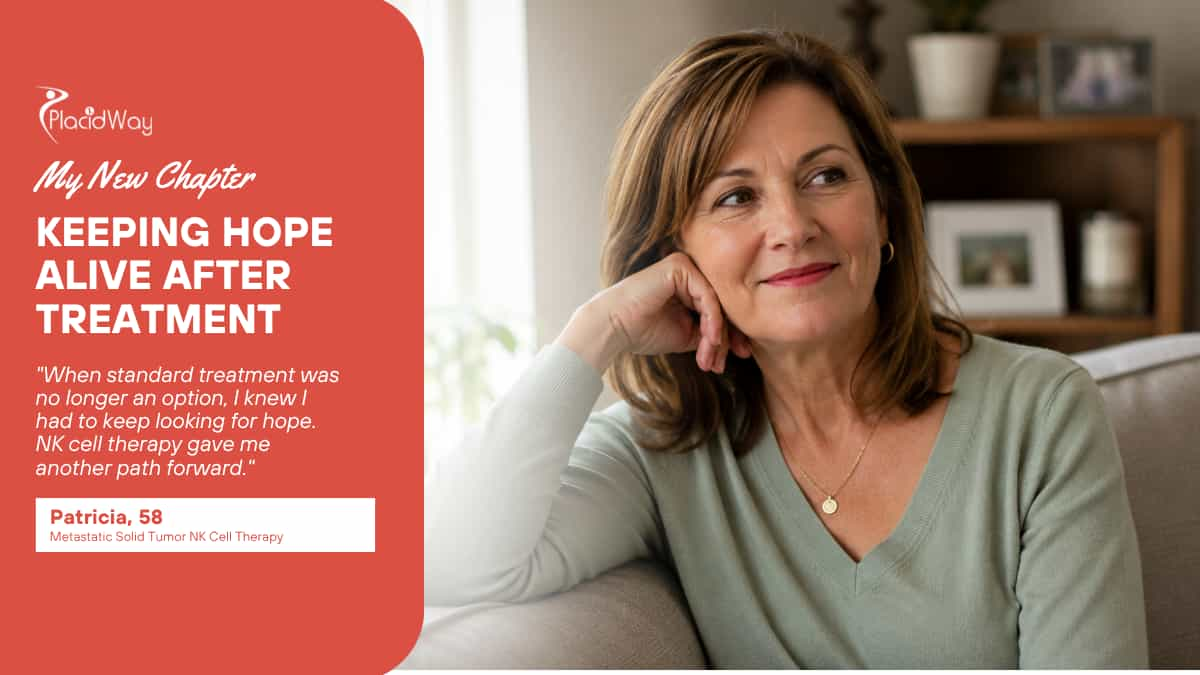
When Standard Cancer Treatment Ran Out: Patricia Lewis’s Metastatic Solid Tumor NK Cell Therapy Story from the United States to Mexico

Publish date: Modified date: Medically reviewed by: Dr. Orhan Sencan on Aug 31, 2026 Author: Aamina Bibi

Patricia Lewis’s Metastatic Solid Tumor NK Cell Therapy Story 

Patient Profile

Name: Patricia Lewis

Age: 58

Condition: Treatment-resistant metastatic solid tumor

Treatment: Natural Killer (NK) cell therapy explored as an investigational option

Destination: Tijuana, Mexico

Journey at a Glance

Main problems: Progression or recurrence despite chemotherapy, radiation, or surgery; Persistent fatigue, pain, declining functional capacity; Tumor markers not responding to standard protocols; Worsening quality of life with conventional treatment side effects

Previous care: Multiple rounds of chemotherapy and/or radiation therapy; Enrollment attempts in US clinical trials (denied due to eligibility, prior treatments, or waitlists); CAR-T cell therapy consultations (prohibitively expensive, limited approval indications)

Travel driver: Access to experimental immunotherapy unavailable in the US system; circumvent insurance barriers and trial eligibility restrictions; cost savings; shortened timeline to treatment initiation. --- PRIMARY ORIGIN MARKET PERSONA

Treatment explored: Natural Killer (NK) cell therapy explored as an investigational option

Personal goal: Understand eligibility, evidence and risks after standard treatment pathways have been exhausted.

You stopped checking your email during dinner.

You let the garden overgrow.

You quietly canceled the autumn trip.

You stopped asking for a concrete timeline.

You started taking the stronger pain medication.

You accepted that bone-deep fatigue is just your new weather.

You memorized the ceiling tiles in the infusion center.

You stopped arguing with the insurance representatives.

You noticed people speaking to you in softer, more careful voices.

"You just need to stay positive."

"We're keeping you in our thoughts."

"Just focus on resting today."

Your world has quietly become smaller.

You have learned the quietest lesson of all:

The hardest part is not the physical pain or the mounting financial cost, but the waiting.

The timeline quietly narrows for someone who did everything right.

Patricia Lewis is not a real PlacidWay patient.

She is a fictional composite built from the specific clinical situations and complex questions American oncology patients face every day.

She is fifty-eight years old.

She lives in Phoenix, Arizona.

She managed a regional logistics office for twenty years.

She organized neighborhood block parties.

She kept meticulous spreadsheets for the annual household budget.

She hiked Camelback Mountain every Thanksgiving morning.

The medical system eventually runs out of approved pathways.

She blames her initial exhaustion on the predictable onset of menopause.

She assumes the dull, persistent ache is just a pulled muscle from lifting a heavy box.

Then come the diagnostic scans.

Chemotherapy.

Radiation.

Second opinions.

Genomic testing.

Targeted inhibitors.

Dietary changes.

Waitlists.

The standard clinical approach for metastatic solid tumors involves systemic chemotherapy or FDA-approved immunotherapy regimens aimed at slowing disease progression, which frequently continue until biological toxicity becomes intolerable or the malignant cells cease responding entirely.

She reaches the only logical conclusion:

"There is nothing more we can offer."

When?

The national statistics hide the reality of the parking lot.

Current estimates suggest hundreds of thousands of American patients exhaust first- and second-line oncology protocols annually, frequently facing clinical trial denial rates exceeding fifty percent due to strictly enforced eligibility criteria and prior treatment exclusions.

But Patricia Lewis doesn't experience the United States healthcare system as a national statistic.

She experiences it sitting in her car in the clinic parking lot holding a denied preauthorization letter.

"They said my markers are too high."

She experiences it watching her husband David tally their remaining savings on a yellow legal pad.

"We can pull from the retirement account."

She experiences it waking at three in the morning to a deep, familiar ache.

"It feels heavier today."

Patience is no longer a sustainable medical strategy.

Patricia Lewis is not an impulsive consumer looking for an unearned shortcut.

She followed every procedural rule the clinic set.

She endured the cyclical nausea without complaint.

She submitted the multi-page insurance appeals.

She drove across three state lines for a twenty-minute consultation at a research hospital.

She joined the immunotherapy registry.

She waited for the phone to ring.

"I gave them three years."

"I cannot just wait to decline."

The operative inquiry shifts from "Can I tolerate this?" to:

"How much of my life am I prepared to organize around it?"

The domestic alternatives carry their own impossible burdens.

There is an experimental CAR-T clinical trial opening in Houston.

It requires permanently relocating to Texas for six months of rigorous observation.

The out-of-pocket costs for mandatory supportive care and specialized housing would drain their remaining home equity within twelve weeks.

The trial sponsor explicitly excludes patients who previously received her specific class of targeted inhibitors.

"We could sell the house,"

"Having the money isn't the same as being able to afford it,"

The search history begins to drift south of the border.

Late stage melanoma exhausted options
Compassionate use immunotherapy FDA
Off label Keytruda out of pocket cost
Natural killer cell therapy for solid tumors
NK cell therapy clinics outside US

Then the search algorithms begin suggesting a specific geography:

"I'm not going abroad just because something is cheaper."

Her instinct is entirely correct.

Why does Tijuana keep appearing in the immunotherapy research?

The current regulatory framework in Mexico allows licensed physicians to administer certain ex vivo expanded cell therapies that remain locked behind multi-year phased trial bottlenecks in the US system.

But the most critical question is never whether a given country is medically competent.

Countries do not practice oncology.

Clinical teams do.

Accredited hospitals do.

Specialized laboratory technicians do.

There is a concrete, auditable paper trail to verify for any facility.

Official advisories strongly recommend that patients considering cross-border experimental therapies coordinate closely with their primary oncology team and independently verify the specific accreditation of the foreign cellular laboratory.

The financial reality requires a completely different conversation.

Current institutional data indicates that NK cell therapy protocols in Tijuana commonly require an indicative investment between USD 30,000–60,000, varying significantly based on whether the cells are autologous or allogeneic, the precise number of required infusions, and the inclusion of necessary adjunct therapies.

Patricia Lewis relies on a piece of inherited financial wisdom:

"If they won't tell you the price, you can't afford it."

"What exactly am I getting?"

Are the pre-infusion hematology blood panels fully included?
Does this quote cover the essential daily clinical monitoring?
Are the supportive bridging medications priced entirely separately?
Is the allogeneic donor cell procurement treated as an additional fee?
What financial recourse exists if the cell expansion fails in the laboratory?
Are the private airport transfers factored into this initial quote?
Does the facility fee cover overnight nursing staff if required?
Is there an unexpected surcharge for administering supportive cytokines?
Does this comprehensive package include the post-treatment imaging scans?
Are the extended consultations with the immunologist billed at an hourly rate?
What about the specialized nutritional support during the week of active treatment?
Are there hidden administrative fees for medical translation services?
Does the contractual package cover emergency interventions if complications arise?
Are the follow-up telehealth visits included for the entire year?
Is the necessary baseline genomic testing considered an extra expense?

The advertised number is only the beginning of the conversation.

What does this biological intervention actually look like?

Natural killer cell therapy involves harvesting peripheral immune cells, isolating the innate NK lymphocytes, expanding them by the billions in a highly specialized bioreactor, and reinfusing them into the patient to aggressively target malignant cells that frequently evade conventional T-cell responses.

It is an intensive, biologically volatile intervention requiring meticulously controlled clean-room environments and continuous monitoring.

"Where am I supposed to stay while this happens?"

The part the brochures rarely put on the front page.

Treatment protocols commonly require patients to remain near the clinic for three to four consecutive weeks to accommodate multiple infusion cycles and mandatory clinical monitoring.

Official guidance on medical travel frequently notes that the lack of continuity in post-operative or post-infusion care is a primary source of adverse clinical outcomes.

The structural variation in aftercare standards itself is the foundational lesson.

This logistical constraint must be integrated into the core plan before committing, not frantically arranged afterward.

"Wait. Does that mean I have to manage a medical apartment?"

Possibly, depending heavily on the specific clinic's inpatient capacity.

Who buys the fresh groceries when you are too biologically fatigued to walk?

How structurally reliable is the residential Wi-Fi for your medical records access?

Is the assigned building equipped with a functioning, accessible elevator?

Can you precisely control the ambient room temperature during a severe cytokine fever?

Who physically launders the bed linens to acceptable clinical standards?

How far is the nearest fully stocked pharmacy for supportive prescription medications?

Is the surrounding neighborhood consistently quiet enough for uninterrupted daytime recovery sleep?

What is the exact vehicular travel time to the primary clinic in morning traffic?

Are the local municipal emergency services intimately familiar with the clinic's specific cellular protocols?

Is there a verified reliable clean water supply for taking vital oral medications?

The realization arrives slowly:

This isn't medical tourism in the usual sense.

The supporting caregiver carries an invisible burden.

David isn't just coming along to push the luggage cart.

He is the primary logistics coordinator who must administer medication schedules, track daily vitals, and navigate emergency hospital admissions in a foreign city if adverse reactions occur, especially since domestic health policies routinely exclude coverage for unapproved experimental treatments received abroad.

He is an active, indispensable part of the clinical care system too.

Informed consent means looking directly at the biological risks.

Potential adverse events from adoptive cell therapies include severe cytokine release syndrome, unpredictable neurotoxicity, life-threatening graft-versus-host disease in allogeneic transfers, and severe opportunistic systemic infections.

Patricia Lewis learns to immediately close any website promising the impossible:

Completely safe. No risk. Guaranteed success.

True informed consent means thoroughly understanding the potential catastrophic failures, far beyond just the hoped-for physiological outcome.

The consultation questions must become ruthlessly specific.

She used to softly ask:

"Can I tolerate this?"

"How much of my life am I prepared to organize around it?"

Now she looks directly at the clinic coordinator and asks:

How many documented times has your specific laboratory expanded this exact cell line?
What is your precise clinical protocol for managing grade three cytokine release syndrome?
Who holds the ultimate liability if the donor cells fail mandatory viability testing?
Which independent regulatory agency physically audits your clean room facilities?
Will I be evaluated daily by a board-certified immunologist or a general medical practitioner?
How do you securely and legally transmit my daily vitals back to my primary oncologist in Arizona?
What is the exact operational escalation path if I suddenly require mechanical intensive care?
Are your detailed laboratory flow cytometry reports provided in medically standard English?
Can you provide a redacted, HIPAA-compliant discharge summary of a patient who suffered a severe complication?
Who physically and legally transports the sensitive cells from the expansion lab to the infusion suite?
What specific metric would you see in my baseline blood work that would make you tell me not to proceed?

They don't only want someone theoretically willing to do it.

They want someone medically willing not to.

The domestic options require one final, rigorous review.

Patients hold the established right to request formal multidisciplinary tumor board reviews and actively petition pharmaceutical companies directly for compassionate use exemptions before assuming the enormous physical and financial burdens of cross-border cellular care.

Can we sequence the tumor tissue again to check for newly actionable genetic mutations?
Is there a broad basket trial opening within the next ninety days?
Would a different academic medical center interpret my clinical eligibility differently?
Can we aggressively appeal the primary insurance denial with an expedited peer-to-peer physician review?
Is there a phase one dose-escalation safety study I haven't considered?

NK Cell Therapy should be rigorously compared with Patricia Lewis's real, verified alternatives, not with a worst-case assumption about the domestic system.

The night before the decision brings everything into focus.

The kitchen table is heavily covered again.

The confirmed flight itineraries. The clinic's daunting fifty-page informed consent document. The translated, notarized laboratory accreditations. The signed advanced medical directives. The complex spreadsheet tracking USD 45,000 in scheduled international wire transfers.

"It's a lot of money to spend on a maybe,"

"It's a lot of money to save for a future I might not see,"

The exhaustive research didn't fundamentally make them more afraid.

It made them vastly more capable of safely deciding.

The ultimate goal is not a cellular infusion.

Her sister asks what she realistically hopes to get out of all this.

She absolutely expects Patricia Lewis to say she desperately wants a total cure.

Patricia Lewis says she just wants to hike Camelback Mountain one more time without stopping.

She wants to physically hold her impending future grandchild.

She wants to eat a normal dinner without mentally calculating anti-nausea medication timing.

She wants to wake up and not immediately meticulously assess her baseline pain level.

Not the advanced immunotherapy. Not the proprietary ex vivo expansion. Not the all-inclusive clinic package. Not Tijuana.

Time.

And underneath that:

Autonomy.

This intervention might be the answer, but it might not be.

You might comprehensively review the foreign laboratory protocols and find them medically lacking.

You might logically realize the extended travel logistics are simply too heavy a burden for your spouse to carry alone.

You might suddenly secure a rare compassionate use exemption at your local research hospital.

You might objectively decide the overwhelming financial risk drastically outweighs the actual biological probability of success.

You might peacefully choose to exclusively focus on palliative comfort measures at home.

Or you might intentionally wire the required deposit, pack the massive medical binder, and drive south with your eyes wide open to the risks.

Any of those choices can represent a profoundly informed decision.

Price should never exclusively answer a deeply complex medical question.

The institutional goal is not to aggressively persuade you toward a foreign intervention.

The fundamental goal is to make entirely sure systemic frustration doesn't irreversibly make the decision for you.

The decision requires looking at paths forward, not just prices.

Maybe you've exhaustively researched your local clinical trials.

Maybe you've unwillingly memorized the repetitive hold music for your insurance provider.

Maybe you've been plainly told there is absolutely nothing left to formally try.

Maybe you are helplessly staring at a rapidly draining savings account.

Maybe you are simply universally tired of being clinically managed.

You do not need to decide today.

What exactly is the underlying biological mechanism being commercially offered?

Who actively verifies the sustained safety of the cellular laboratory?

What is the objective, measurable criteria for clinical success?

What physically happens if something suddenly goes wrong?

Who is legally managing my long-term aftercare?

What are my concrete, domestic alternatives right now?

Am I logically running toward a medical solution or merely running away from a broken system?

You are not just comparing clinic prices.

You are comparing distinct paths forward.

Hope requires having enough information to decide.

Hope is not a glossy, perfectly lit marketing brochure.

Hope is not a willful, dangerous ignorance of the clinical statistics.

Hope is not blindly pretending the biological risk doesn't exist.

Hope is simply having enough unvarnished information to make a consequential decision that feels entirely like yours.

You can read the dense regulatory filings. You can aggressively ask the deeply uncomfortable questions. You can demand independent, third-party verification. You can safely walk away if the answers remain insufficient. You can take your time.

From:

"I suppose I'll just have to keep waiting."

To:

"What other informed options do I have?"

PlacidWay — Your Way to Hope.

PlacidWay helps patients and their exhausted families thoroughly explore international medical options, critically compare complex facility credentials, and meticulously prepare the rigorous questions strictly necessary for true informed consent. We do not provide clinical advice, medical diagnoses, or specific treatment recommendations under any circumstances. For someone like Patricia Lewis, NK cell therapy isn't a guaranteed promise; it is merely one potential route worth rigorously understanding before taking another step.

Your Way to Hope.

Your Way to Hope.
Medical disclaimer

This article is provided strictly for informational and educational purposes and does not recommend or endorse that any individual undertake cross-border medical travel or pursue unapproved experimental cellular therapies. Individual medical suitability and biological risk require comprehensive professional assessment. The reader must consult their own credentialed clinician or oncology adviser in their home healthcare system, independently verify the current regulatory status of any foreign facility, and obtain appropriate medical travel protection or specialized insurance before proceeding with any medical decision.

When Standard Cancer Treatment Ran Out: Patricia Lewis’s Metastatic Solid Tumor NK Cell Therapy Story from the United States to Mexico

About Article

  • Treatment: Cancer Treatment
  • Country: Mexico
  • Overview This educational overview follows Patricia Lewis, a composite American patient exploring NK Cell Therapy in Tijuana, Mexico. It summarizes daily-life effects, previous care and why treatment abroad is being considered. Candidacy, safety, recovery and follow-up remain central to informed decision-making.

Trusted Medical Tourism Platform Since 2007

60+
Countries
2k+
Clinics
19.5k+
Reviews
2.5k+
Qualified Doctors
1.1M+
Patients Served Since 2007