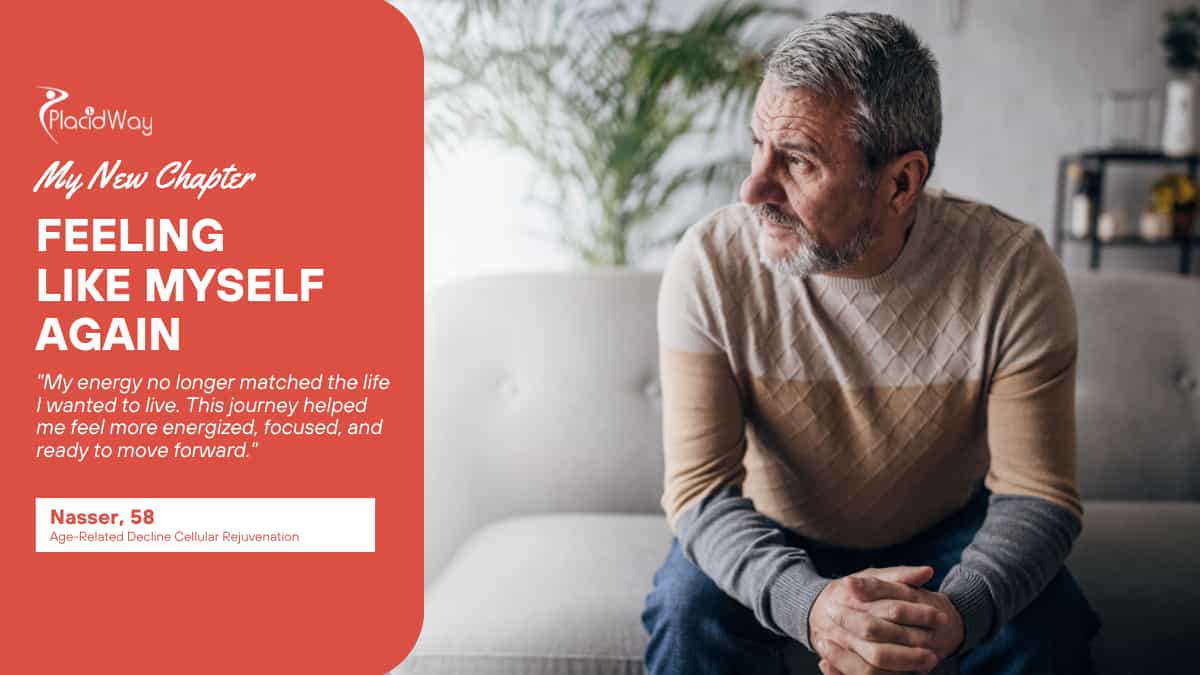
The Energy That No Longer Matched His Ambition: Nasser Al-Rashid’s Age-Related Decline Cellular Rejuvenation Story from Saudi Arabia to the UAE

Publish date: Aug 28, 2026 Medically reviewed by: Dr. Nitin Jain on Aug 28, 2026 Author: Araya Chaiyaporn

Nasser Al-Rashid’s Age-Related Decline Cellular Rejuvenation Story 

Patient Profile

Name: Nasser Al-Rashid

Age: 58

Condition: Age-related decline and cellular senescence concerns

Treatment: Longevity program combining advanced diagnostics, hormonal optimization and regenerative options

Destination: Dubai, UAE

Journey at a Glance

Main problems: Declining energy and mental sharpness despite wealth and access; Visible skin aging, reduced muscle tone, sexual dysfunction; Sleep disturbances and metabolic slowdown; Loss of competitive edge in business and social settings

Previous care: High-end cosmetic dermatology in Riyadh (Botox, fillers, peels); Private wellness clinics in Saudi Arabia offering unproven stem cell or PRP treatments; Personal trainers, luxury spas, and concierge medicine

Travel driver: Regulatory permissiveness: Dubai's medical free zones (DAFZA, Jebel Ali Free Zone) allow clinics to offer experimental longevity treatments (stem cells, exosomes) that are restricted or heavily regulated in Western countries and Saudi Arabia. This is…

Treatment explored: Longevity program combining advanced diagnostics, hormonal optimization and regenerative options

Personal goal: Protect physical vitality and performance while making evidence-aware decisions about longevity care.

You started taking the elevator instead of the stairs at the corporate office.

You stopped playing tennis on Thursday evenings.

You bought looser tailored suits.

You sleep with a glass of water and two paracetamol on the nightstand.

You tell people you prefer morning meetings because you are fresh.

You actually just know the afternoon brain fog is unmanageable.

You stopped looking at the mirror after a shower.

You delegate international site visits to junior vice presidents.

You excuse yourself from late dinners.

You tell yourself this is just what sixty looks like.

"You are just working too hard, Baba."

"Take a month off in London this summer."

"Everyone slows down eventually."

Your world has quietly become smaller.

You have learned the quietest lesson of all:

The hardest part is not the physical decline, but the waiting.

Meet Nasser Al-Rashid.

Nasser Al-Rashid is not a real PlacidWay client.

He is a fictional composite built from the situations and questions senior Saudi executives face.

He is fifty-eight years old and lives in Riyadh.

He is the chief executive of a mid-sized logistics firm.

He used to walk the warehouse floor at five in the morning.

He negotiated complex port contracts across three time zones.

He hosted seventy-person family gatherings on Fridays with effortless energy.

The subtle escalation of giving ground.

He explained the problem away as temporary stress.

Vitamins.

Testosterone gels.

Concierge blood panels.

Personal trainers.

Retreats in Switzerland.

Botox in Riyadh.

Conventional medical guidance typically focuses on symptomatic management of age-related metabolic decline once specific clinical thresholds for chronic disease are met. Physicians rarely intervene purely to restore a patient's competitive edge or perceived vitality unless a clear pathology exists.

"Normal aging process."

When?

The reality beneath the statistics.

Data suggests that significant physiological decline accelerates after age fifty, with metabolic syndrome affecting a substantial portion of the adult population in the Gulf region. The institutional response is generally designed to prevent acute illness rather than optimize physical performance.

But Nasser Al-Rashid doesn't experience the Saudi healthcare system as a national statistic.

He experiences it when his grip slips on the steering wheel of his Mercedes.

"Are you feeling well enough to drive?"

He feels it when younger competitors talk over him in board meetings.

"Let me handle this segment of the presentation."

He notices it when his wife looks at him with quiet concern rather than desire.

"We do not have to go out tonight."

He has already tried to be patient.

He is not an impulsive buyer looking for a quick fix.

He spent three years attempting to optimize his diet.

He hired a sleep specialist.

He consulted endocrinologists in Jeddah.

He endured unproven scalp injections at a luxury spa.

"I am doing everything right."

"Why do I still feel hollowed out?"

The question shifted from a passive thought to a structural reality:

From "Can I tolerate this?" to "How much of my life am I prepared to organise around it?"

The nearer alternative isn't always the solution.

Domestic options exist.

He could accept standard hormone replacement therapy in Riyadh.

But the local clinics feel reactive rather than preventative.

They treat illness, they do not optimize longevity.

They view his desire to feel forty at sixty as vanity, not biology.

"We have the money to go anywhere," his brother says over Arabic coffee.

"Having the money isn't the same as finding expertise," Nasser Al-Rashid replies.

He isn't searching for Dubai longevity clinics yet.

His late-night internet searches begin as quiet attempts to understand his symptoms and local alternatives.

Why am I so tired at 55

How to stop muscle loss after 50

Stem cell therapy for aging

Cost of NAD IV therapy Riyadh

Best longevity clinics Middle East

Dubai enters the algorithm.

"I am not going abroad just because something is cheaper."

He is correct to be suspicious.

Why does Dubai keep appearing in the research?

Dubai's medical free zones permit specific cellular and regenerative therapies under targeted regulatory frameworks that are often restricted in conventional Western or domestic settings.

The question is never whether Dubai is good.

Cities do not reverse cellular senescence.

Specific clinicians, using specific laboratory protocols, in specific certified facilities do.

There is something concrete to verify.

Patients considering elective interventions abroad are advised to conduct independent research and discuss their plans with their primary domestic physician before traveling.

His first question was about the price.

Comprehensive longevity and cellular rejuvenation protocols in Dubai have an indicative cost ranging from USD 15,000–45,000, varying heavily based on the inclusion of autologous stem cells, exosome therapies, and genomic profiling.

"You only get one body, do not bargain with it."

"What exactly am I getting?"

Twelve things the advertised price may or may not cover.

Are the initial diagnostic blood panels included?
Does this cover the full genomic sequencing?
Are the exosomes ethically sourced and certified?
Is the bioidentical hormone therapy customized or standard?
How many intravenous infusions are in the protocol?
Does the price include hyperbaric oxygen sessions?
Is the sleep architecture analysis a separate fee?
Who interprets the biological age clock?
Are follow-up blood tests in three months covered?
Does it include the cryopreservation of cellular material?
Are consultations with the lead endocrinologist guaranteed?
What happens if I react poorly to the peptides?

He closes the laptop.

He understands the assignment.

The advertised number is only the beginning of the conversation.

What does cellular rejuvenation actually involve?

Modern longevity protocols often involve a combination of biomarker diagnostics, targeted intravenous nutrition, peptide therapies, and occasionally regenerative cell applications designed to address cellular senescence.

It is not a single injection.

It is a multi-day clinical process.

"How do I manage the logistics of a week-long medical stay?"

The part the glossy brochures rarely put on the front page.

The unglamorous operational reality involves exhaustion.

Regulatory bodies note that international medical travel introduces variables in care continuity, follow-up access, and cross-border medical record transfers.

The variation itself is the lesson.

This constraint must be part of the plan before committing, not afterward.

"Wait. Does that mean I have to manage my own hormone prescriptions back in Riyadh?"

Possibly, depending on the continuity-of-care agreement.

Can my Saudi physician legally prescribe these specific peptides?

How do I transport temperature-sensitive vials on a flight?

Who do I call if my joints ache three days after the infusion?

Will customs flag these supplements at King Khalid International Airport?

Is there a partner clinic in Jeddah for my follow-up blood draws?

Do I need to return to Dubai every six months?

Can I conduct the three-month review via telehealth?

What dietary restrictions must I hold to during the first week back?

How quickly can I return to heavy lifting in the gym?

Will the initial fatigue from the cellular die-off affect my board meetings?

Nasser Al-Rashid looks at his calendar.

He cancels a domestic business trip.

Nasser Al-Rashid realizes the necessary reframe:

This isn't tourism in the usual sense.

His wife isn't just coming along.

She is the invisible second participant.

She will remember the specific timing for his evening supplements.

She will notice if his mood shifts wildly as his hormones adjust.

She will be responsible for navigating a foreign hospital system if he has an adverse reaction.

She needs to know exactly what the protocol entails.

Patients traveling for complex procedures are strongly advised to secure comprehensive medical travel insurance that covers unforeseen complications abroad.

She is part of the care system too.

Then comes the uncomfortable conversation about risk.

While regenerative therapies hold promise, they carry risks of infection, immune reactions, and unverified long-term efficacies that require careful clinical management.

He learns to distrust specific phrases.

Completely safe. No risk. Guaranteed success.

Informed consent means understanding more than the hoped-for outcome.

Nasser Al-Rashid's questions become better.

He stops asking if they can fix him.

What is the failure rate of this specific peptide stack in men my age?
Where do you source your cellular material?
Can I see the third-party lab assay for these exosomes?
Who is legally responsible if I suffer an infection?
Are your clinicians licensed both in Dubai and their home countries?
What happens if my biological age markers do not improve?
How do you handle acute medical emergencies in your clinic?
Can you coordinate directly with my primary physician in Riyadh?
What is the precise protocol if I have an allergic response to the IV?
Have you ever turned a patient away for being unsuitable?
What would you see in my bloodwork that would make you tell me not to proceed?

He drinks his coffee.

He underlines the last sentence.

He doesn't only want someone willing to do it:

He wants someone willing not to.

Have I exhausted my options at home?

Patients possess the right to seek second opinions and request exhaustive diagnostic testing within their domestic healthcare frameworks before seeking treatment abroad.

Before booking any flights, Nasser Al-Rashid must interrogate his current situation.

Is there a private endocrinologist here who specializes in anti-aging?
Can we run a full senescence biomarker panel locally?
Would my insurance cover bioidentical hormones if prescribed off-label?
Are there clinical trials I can join in Saudi Arabia?
Am I dismissing local doctors just because the clinics lack marble foyers?

Dubai's longevity protocols should be compared with Nasser Al-Rashid's real alternatives, not with a worst-case assumption about the Saudi system.

The night before the decision.

The dining table is covered in documents.

Flight schedules to Dubai. Clinic accreditation certificates. Telehealth consultation notes. Insurance policy addendums.

"You look very serious," his wife says.

"I finally know what I am looking at," he answers.

The research didn't make them more afraid; it made them more capable of deciding.

What Nasser Al-Rashid actually wants isn't cellular therapy.

"What are you hoping to get out of this?" his son asks.

He expects him to say longevity.

The real answer is simpler.

To walk the warehouse floor without his knees screaming.

To wake up at five in the morning actually feeling rested.

To look in the mirror and recognize the man looking back.

To play tennis on Thursdays again.

Not an injection. Not an exosome vial. Not a luxury clinic package. Not a trip to Dubai.

Vitality.

And underneath that:

Relevance.

Dubai might be the answer, but it might not be.

He might decide the continuity of care is too complex.

He might find a specialist in Jeddah who offers seventy percent of the protocol.

He might determine the biological age tests are too speculative.

He might realize he isn't willing to fly for follow-ups.

He might accept his current state rather than embrace the medical risk.

Alternatively, he might verify the clinic, secure his insurance, and book the flight.

Any of those can be an informed decision.

Price should not answer a medical question, and the goal is not to persuade: The goal is to make sure frustration doesn't make the decision for him.

Taking the next step.

Maybe you've stopped trusting the standard answers.

Maybe you've tried the luxury spas and realized you need actual science.

Maybe you've noticed the fatigue slowly rewriting your daily schedule.

Maybe you've realized that having the resources is useless if you can't find the right expertise.

Maybe you're tired of feeling like your best years are behind you.

You do not need to decide today.

What exactly is failing in my current routine?

Which domestic doctors haven't I spoken to yet?

Am I chasing a fantasy or a measurable medical intervention?

Who will manage my care when I return?

What are the concrete risks of hormonal optimization at my age?

Can my schedule accommodate the required recovery time?

How will I measure if the intervention was actually successful?

You are not just comparing prices:

You are comparing paths forward.

Hope isn't the promise that aging stops.

Hope is not a guaranteed return to your thirties.

Hope is not a magic injection that erases thirty years of stress.

Hope is not a sales pitch in a glossy brochure.

Hope is having enough information to make a decision that feels like yours.

You understand the science. You acknowledge the logistical burden. You respect the risks. You involve your partner. You verify the credentials.

The conversation changes from "I suppose I'll just have to keep waiting." to:

"What other informed options do I have?"

PlacidWay — Your Way to Hope.

PlacidWay helps you explore global healthcare options, compare accredited facilities, and prepare the hard questions you need to ask. We do not provide clinical advice, and we do not deliver medical outcomes.

For someone navigating the complex world of longevity medicine, a clinic in Dubai isn't a promise, it is one route worth understanding.

Medical disclaimer

This article is for educational purposes only and does not recommend that any individual undertake cellular therapies or travel abroad for medical procedures. Individual suitability and risk require independent professional assessment. You should consult your own qualified clinician or medical adviser, verify the current regulatory status of any international clinic, and obtain appropriate medical travel protection or insurance before proceeding.

The Energy That No Longer Matched His Ambition: Nasser Al-Rashid’s Age-Related Decline Cellular Rejuvenation Story from Saudi Arabia to the UAE

About Article

  • Treatment: Anti Aging
  • Country: UAE
  • Overview This educational overview follows Nasser Al-Rashid, a composite Saudi patient exploring Longevity Treatment in Dubai, UAE. It summarizes daily-life effects, previous care and why treatment abroad is being considered. Candidacy, safety, recovery and follow-up remain central to informed decision-making.

Trusted Medical Tourism Platform Since 2007

60+
Countries
2k+
Clinics
19.5k+
Reviews
2.5k+
Qualified Doctors
1.1M+
Patients Served Since 2007