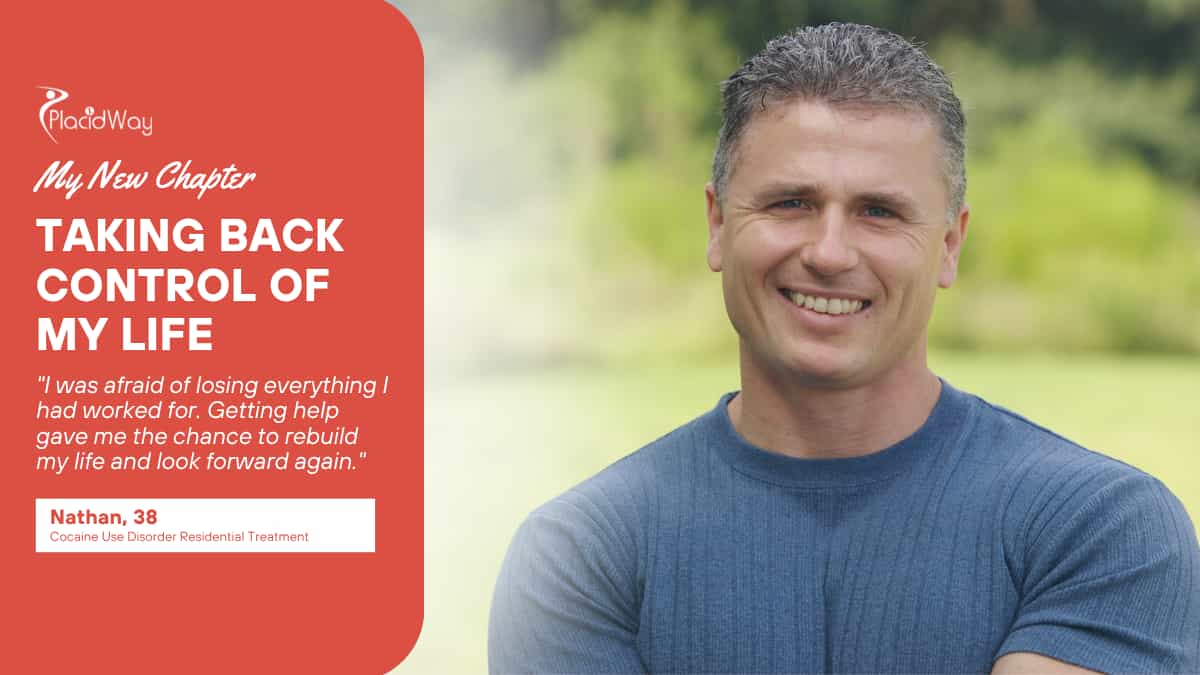
The Secret That Threatened His Career: Nathan Collins’s Cocaine Use Disorder Residential Treatment Story from the United Kingdom to Spain

Publish date: Aug 28, 2026 Medically reviewed by: Dr. Hector Mendoza on Aug 28, 2026 Author: Alejandro Ramirez

Nathan Collins’s Cocaine Use Disorder Residential Treatment 

Patient Profile

Name: Nathan Collins

Age: 38

Condition: Moderate-to-severe Cocaine Use Disorder

Treatment: Residential addiction treatment with CBT, psychiatric support and aftercare

Destination: Malaga, Spain

Journey at a Glance

Main problems: Daily cocaine cravings and loss of control over use; Inability to maintain employment or relationships; Sleep disruption, anxiety, depression, cognitive impairment; Financial depletion from ongoing drug costs

Previous care: Attended 1–3 Alcoholics Anonymous or Narcotics Anonymous meetings; felt uncomfortable or judged; Tried to "cut back" or quit alone; relapsed within days or weeks; Researched private UK rehab; shocked by costs (£12,000–£20,000) and waiting lists

Travel driver: Cost reduction (40–60% savings), shorter access to treatment (no 6–12 month NHS wait; private facilities often accept refer

Treatment explored: Residential addiction treatment with CBT, psychiatric support and aftercare

Personal goal: Protect his career and relationship while addressing addiction confidentially and comprehensively.

You start by skipping the occasional Monday morning meeting.

You tell yourself it is just a heavy weekend.

You switch to working from home on Tuesdays.

You stop answering calls from unknown numbers.

You drain your personal savings account before touching the joint account.

You calculate exact withdrawal limits so the bank does not flag your transactions.

You delete your message history every night at eleven.

You practice maintaining steady eye contact in the mirror.

"You've seemed really distracted lately."

"I just need you to be present for this campaign."

"Are you actually listening to me?"

Your professional and social world has quietly become smaller.

The hardest part is not the financial drain, but the waiting.

Nathan Collins is not a real PlacidWay client.

He is a fictional composite built from the situations and questions you may face.

Nathan Collins is thirty-eight.

He lives in London.

He directs marketing campaigns for a mid-sized technology firm.

He runs half-marathons in Richmond Park on Sunday mornings.

He manages a team of twelve people.

He cooks dinner for his partner on Thursday nights.

How the problem escalated.

He told himself the pressure required an outlet.

He attended an Alcoholics Anonymous meeting.

He sat at the back of the church hall.

He left before the tea was poured.

He tried leaving his credit cards in his desk drawer.

He relapsed three days later.

He paid a private counsellor for an hour of talk therapy.

He lied to the counsellor about the frequency of his use.

He finally asked his general practitioner for a referral.

The standard medical intervention for moderate to severe cocaine use disorder involves structured residential inpatient treatment, incorporating medically supervised detoxification, intensive cognitive-behavioural therapy, and long-term relapse prevention planning, which is normally considered when outpatient management fails to arrest the cycle of dependency.

"You need intensive residential rehabilitation."

When?

The current demand for addiction services significantly exceeds capacity, with some local authorities reporting waits of up to six to twelve months for funded residential placements, while private facilities frequently operate with waiting lists of eight to ten weeks.

But Nathan Collins doesn't experience the UK health system as a national statistic.

He experiences it staring at his phone in a hospital car park.

"We can offer you a preliminary assessment in October."

He experiences it locking his office bathroom door.

"I can't keep covering for your unexplained absences."

He experiences it staring at the ceiling at four in the morning.

"We will add your name to the cancellation list."

He has already tried to be patient.

Nathan Collins is not looking for a shortcut.

He spent three weeks researching local day programmes.

He called four separate clinical directors in the Home Counties.

He reviewed his employment contract for medical leave clauses.

"I just need to hold on until a spot opens up."

"I can manage this alone for a few more weeks."

He shifted his thinking:

From "Can I tolerate this?" to:

How much of my life am I prepared to organise around it?

The reality of the local alternative.

Private rehabilitation in the UK represents the conventional route.

The facilities offer established clinical standards and immediate geographical proximity.

But private UK clinics currently quote between GBP 12,000 and GBP 25,000 for a standard twenty-eight-day programme.

Nathan Collins has seven thousand pounds left in his accessible accounts.

His partner, Sarah, sits across the kitchen island.

"We could remortgage the flat if we have to."

"Being able to borrow the money isn't the same as affording it."

He isn't searching for residential rehab in Malaga yet.

He opens a private browsing window.

How to stop cocaine cravings fast
Outpatient addiction treatment London
Private rehab costs UK
Fastest rehab admission Europe
Cocaine addiction clinics Spain

The algorithm begins serving targeted advertisements for coastal recovery centres.

He pushes the laptop away.

"I'm not going abroad just because something is cheaper."

His instinct is entirely correct.

Why does southern Spain keep appearing?

Spain maintains a heavily regulated private healthcare sector with integrated addiction medicine protocols meeting strict European Union clinical directives.

The critical distinction is not the geography.

Countries do not treat chemical dependency.

Clinical teams do.

Psychiatrists do.

Therapeutic communities do.

There is something concrete to verify behind the marketing brochures.

Patients considering elective care abroad are strongly advised to verify the registration of overseas providers and to discuss their specific medical suitability with a qualified domestic healthcare professional before committing to any travel.

His first question was about the price.

Indicative costs for private residential treatment in Malaga currently range between EUR 8,000 and EUR 15,000 for a twenty-eight-day admission, though this varies significantly based on psychiatric requirements, detox duration, and single-occupancy room requests.

"If it sounds too good to be true, it usually is."

"What exactly am I getting?"

Does the price include supervised medical detoxification?
Is the initial psychiatric assessment conducted in fluent English?
Are comprehensive blood tests and liver function screens standard?
How many hours of individual therapy are scheduled per week?
Is daily group therapy moderated by a registered psychologist?
Are prescribed medications for withdrawal symptoms billed separately?
Does the facility actively manage dual diagnosis for severe anxiety?
What happens if I require an emergency hospital transfer?
Who pays for the ambulance transport in a medical emergency?
Are meals strictly tailored to nutritional recovery protocols?
Is structured family therapy conducted via secure video link?
Does the final cost cover secure airport transfers upon arrival?
Are mobile phones strictly prohibited during the initial week?
What specific aftercare is guaranteed once I return to London?

The advertised number is only the beginning of the conversation.

What does a residential addiction programme actually involve?

A comprehensive inpatient protocol requires physical isolation from existing triggers, managed withdrawal under pharmacological support, intensive daily cognitive restructuring to address the neurological pathways of addiction, and the systematic rebuilding of emotional regulation mechanisms.

"How do I explain a four-week absence to my employer?"

The part the brochures rarely put on the front page.

The operational reality of addiction treatment is physically exhausting and emotionally brutal.

Official clinical guidance notes that withdrawal protocols can vary widely between jurisdictions, and patients may experience profound mood instability during the initial week of cross-border transitions.

The variation itself is the lesson.

This constraint must be part of the plan before committing, not afterward.

"Wait. Does that mean I might be restricted from flying home?"

Possibly, depending on the terms of your clinical discharge and fitness-to-fly assessments.

What happens if I decide to walk out on day three?

Who communicates with my employer if my medical stay is extended?

How is my passport physically secured during my admission?

Can I access my own bank accounts during the therapeutic programme?

What happens to my luggage during the mandatory search upon arrival?

How are complex dietary requests handled in a different cultural environment?

Will I be sharing a bathroom with someone experiencing active withdrawal?

Are the night nursing staff fluent in conversational English or only medical terms?

What exact time are the lights turned out on the ward?

How is aggressive behaviour from other struggling patients formally managed?

This isn't tourism in the usual sense.

Sarah isn't just coming along.

She remains behind in London.

She monitors his unread email inbox.

She pays the standard household bills.

She deflects uncomfortable questions from his colleagues.

She lies to his mother about his sudden holiday.

She needs to know exactly who to call if the facility goes silent for forty-eight hours.

Standard travel insurance explicitly excludes coverage for planned medical treatments or rehabilitation stays, requiring specialised medical travel policies to protect against emergency repatriation costs.

She is part of the care system too.

Then comes the uncomfortable conversation about risk.

Leaving the UK does not eliminate the clinical risks of early recovery, which include severe depressive episodes, cardiovascular strain during acute withdrawal, and the statistically high probability of relapse immediately following discharge.

Nathan Collins learns to distrust specific phrases:

Completely safe. No risk. Guaranteed success.

Informed consent means understanding far more than the hoped-for outcome.

Nathan Collins's questions become better.

He stops asking if he can afford it.

He starts asking how it works.

What is the exact ratio of patients to clinical staff at night?
Do you have an onsite defibrillator and immediate cardiac support?
Can I speak directly to the psychiatrist who will manage my case?
What is your documented protocol for managing severe suicidal ideation?
How do you handle patients caught smuggling substances into the clinic?
Are your cognitive behavioural therapists formally accredited in the UK or Spain?
What specific medications do you use to manage severe dopamine depletion?
How many patients have you transferred to a local emergency hospital this year?
Will my UK general practitioner receive a professionally translated discharge summary?
How do you practically prevent impulsive patients from leaving the grounds?
What is your precise clinical definition of a successful programme completion?
What would you see in my medical records that would make you tell me not to proceed?

They don't only want someone willing to do it.

They want someone willing not to.

Have I exhausted my options at home?

UK patients possess legal rights regarding access to care, including the ability to challenge prolonged waiting times for specialist mental health referrals under the NHS Constitution.

Can my local health trust fund a private residential bed?
Is there an intensive local day programme I missed during my research?
Can my employer's occupational health policy secretly cover residential care?
What happens if I present myself at an emergency department today?
Are there subsidised charity beds available anywhere in the country this month?

Malaga should be compared with Nathan Collins's real alternatives, not with a worst-case assumption about the NHS.

The night before the decision.

The kitchen table is covered.

A printed spreadsheet of regional NHS waiting times. Three glossy brochures from Home Counties private clinics. A detailed PDF dossier from a Malaga facility. A specialized medical travel insurance quotation. A drafted leave-of-absence email to the company managing director.

"I feel like I'm finally looking at this clearly."

"You're looking at it like a project manager."

The research didn't make them more afraid; it made them more capable of deciding.

What Nathan Collins actually wants isn't a facility in Spain.

"Why are you really doing this?"

He could say he wants to save his marketing career.

He actually wants to empty his pockets at the end of the day without a spike of panic.

He wants to look his partner in the eye without calculating his next lie.

He wants to sleep through the night without waking in a sweat.

He wants his brain to finally feel quiet.

Not a Spanish villa. Not a daily therapy schedule. Not a cheaper medical bill. Not a geographical escape.

Freedom.

And underneath that:

AGENCY.

Malaga might be the answer. It might not be.

He discovers the Spanish clinic cannot legally manage his specific anti-depressant prescription.

He decides the logistical stress of international flying outweighs the financial savings.

He secures a sudden cancellation spot at a private clinic in Surrey.

He chooses an intensive domestic outpatient programme instead.

He determines he is simply not ready to surrender his phone for a month.

He finds a Malaga facility that answers his clinical questions transparently, coordinates with his London GP, and provides a clear medical rationale for their treatment structure.

Any of those can be an informed decision.

Price should not answer a clinical question, and the goal of this information is not to persuade you to leave the UK.

The goal is to ensure frustration doesn't make the decision for him.

Where does your search go next?

Maybe you have called the same private clinics.

Maybe you have stared at the same impossible waiting list times.

Maybe you have calculated your remaining savings three times today.

Maybe you are thoroughly exhausted from the hiding.

Maybe you are wondering if physical distance is the only way to break the cycle.

You do not need to decide today.

What does my GP actually recommend for my specific usage level?

What is the true financial and social cost of staying exactly where I am?

Who can help me independently evaluate an overseas clinic's clinical credentials?

How much time do I realistically have before this dependency becomes a public crisis?

What am I most afraid of finding out during an assessment?

Can I safely involve someone I trust in this research process?

What is my immediate next step?

You are no longer just looking at prices.

You are looking at paths forward.

Hope isn't the promise that everything will be fixed.

Hope is not a glossy brochure showing a coastal swimming pool.

Hope is not a guaranteed cure for chemical dependency.

Hope is not a flight away from your underlying problems.

Hope is having enough accurate information to make a decision that feels like yours.

You can read the international regulatory standards.

You can interview the overseas clinical directors.

You can compare the exact therapeutic protocols against NHS guidelines.

You can meticulously assess the aftercare logistics.

You can reclaim the process.

From "I suppose I'll just have to keep waiting."

To:

You are capable of evaluating medical credentials. You are capable of asking difficult logistical questions. You are capable of demanding transparency from international coordinators. You are capable of protecting your own physical future. You are capable of saying no if the terms do not align with your safety.

Your question has fundamentally changed.

From "I suppose I'll just have to keep waiting." to:

What other informed options do I have?

PlacidWay — Your Way to Hope.

PlacidWay helps individuals and families explore global healthcare alternatives, compare accredited facilities, and prepare the critical questions needed for professional medical consultations. For someone navigating the complexities of addiction, investigating treatment in Malaga isn't a guaranteed promise of recovery, but it is one structured route worth understanding thoroughly. PlacidWay does not provide clinical advice or direct medical services.

Your Way to Hope.

Medical disclaimer

This article is for educational purposes only and does not recommend that any individual undertake travel for psychiatric treatment or rehabilitation. Individual clinical suitability and risk require thorough professional assessment. Readers should always consult their own primary care clinician, psychiatrist, or medical adviser, verify current regulatory status of any provider, and obtain appropriate medical travel protection and insurance before making healthcare decisions.

The Secret That Threatened His Career: Nathan Collins’s Cocaine Use Disorder Residential Treatment Story from the United Kingdom to Spain

About Article

  • Treatment: Addiction Treatment
  • Country: Spain
  • Overview This educational overview follows Nathan Collins, a composite British patient exploring Cocaine Addiction Treatment in Malaga, Spain. It summarizes daily-life effects, previous care and why treatment abroad is being considered. Candidacy, safety, recovery and follow-up remain central to informed decision-making.

Trusted Medical Tourism Platform Since 2007

60+
Countries
2k+
Clinics
19.5k+
Reviews
2.5k+
Qualified Doctors
1.1M+
Patients Served Since 2007