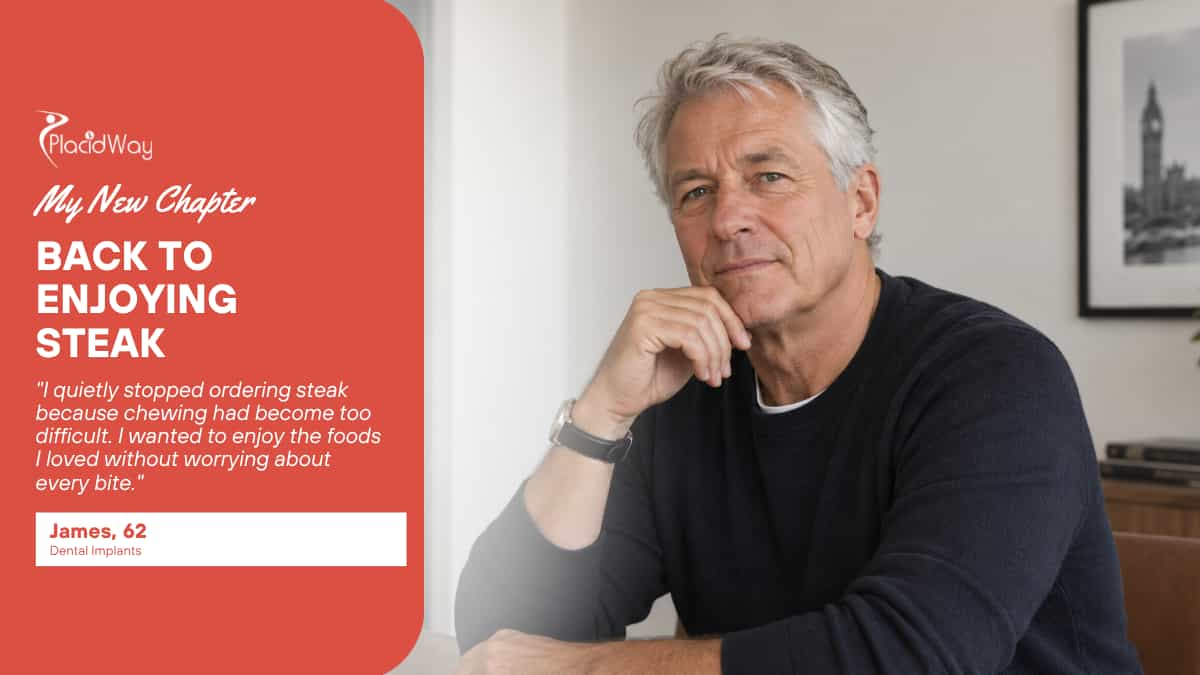
Why James Whitmore Quietly Stopped Ordering Steak Before Seeking Dental Implants in Istanbul from the UK

Publish date: Modified date: Medically reviewed by: Dr. Octavio Delacruz on Sep 14, 2026 Author: Rizal Aditya

Dental Implants in Istanbul from the UK

Patient Profile

Name: James Whitmore

Age: 62

Condition: Multiple tooth loss with emerging bone deterioration

Treatment: Comprehensive dental implant placement with potential bone grafting

Destination: Istanbul, Turkey

Journey at a Glance

Main problems: Difficulty chewing, visible gaps affecting appearance, speech changes, jaw pain from remaining adjacent teeth shifting.

Previous care: Placed on an extensive NHS waiting list; received a private UK quote of GBP 15,500 for three implants; currently managing with temporary partial dentures.

Travel driver: Elimination of 6–12 month waiting lists and a 75–80% reduction in private treatment costs.

Treatment explored: Multi-stage surgical placement of titanium implants and zirconia crowns.

Personal goal: Restore normal chewing function and regain confidence in social settings.

DENTAL IMPLANTS: UK PATIENTS SEEKING AFFORDABLE RESTORATION IN ISTANBUL

You chew exclusively on the left side of your mouth.

You politely decline the roasted almonds at dinner parties.

You smile with your lips firmly pressed together.

You avoid looking too closely in the bathroom mirror.

You stop volunteering for public speaking engagements.

You learn exactly how to position your tongue to mask the gap in your lower jaw.

You nod quietly when the clinic receptionist mentions another six-month delay.

"You just have to be a bit patient."

"It's only cosmetic, after all."

"At least it's not life-threatening."

Your world has quietly become smaller.

The hardest part is not the daily discomfort, but the waiting.

Meet James Whitmore.

James Whitmore is not a real PlacidWay client.

He is a fictional composite built from the exact situations, frustrations, and questions that British dental patients face every single day.

James is sixty-two years old and lives in a modest semi-detached home in Leeds.

He spent thirty-five years working as a secondary school history teacher before taking his retirement.

He used to project his voice across crowded assembly halls without a second thought.

He used to bite into crisp apples while walking to the train station.

He maintained his health quietly and consistently.

The escalation happened quietly.

A cracked lower molar.

A difficult extraction.

A failed root canal.

Another extraction.

A shifting bite.

A plastic partial denture.

Dental implants are surgically inserted titanium posts that fuse with the jawbone to support artificial teeth, typically considered the standard of care to prevent progressive bone resorption following chronic tooth loss . They require adequate bone density and healthy gum tissue to succeed, making timely intervention medically relevant.

"You need three implants to prevent further bone loss."

When?

The statistics do not explain the daily reality.

Access to NHS dental care has become severely constrained across England, with extensive waiting lists and extremely strict clinical criteria for publicly funded implants . The vast majority of adults requiring multi-tooth replacement are directed toward the private sector.

But James doesn't experience the healthcare system as a national statistic.

He sits at a restaurant table pushing roasted carrots around his plate.

He experiences it as pushing food around his plate.

"I'll just have the soup today."

He wakes up in the middle of the night rubbing his jaw.

"The remaining teeth are taking all the pressure."

He stares at the plastic prosthesis soaking in a glass on his nightstand.

"I feel ten years older than I am."

He has already tried to be patient.

People facing this decision are rarely impulsive shoppers looking for a quick fix.

James called every local clinic accepting new patients.

He filled out the necessary registration forms.

He waited on the phone lines for hours.

He asked his private dentist about long-term payment plans.

"I can manage with the gap."

"It's just a cosmetic issue."

He watched his own mindset shift from a question of endurance to one of logistics:

"How much of my life am I prepared to organise around it?"

The nearer alternative proves difficult to justify.

The domestic private route offers an immediate clinical solution without crossing any borders.

His local Leeds clinic quoted GBP 15,500 for three implants and the accompanying crowns.

That figure represents a massive portion of his fixed retirement reserves.

Going ahead would mean cancelling planned home repairs and entirely depleting his emergency funds.

David wipes down the kitchen counter and places the printed quote on the table:

"We have the savings if you need it."

"Having it doesn't mean we can afford to lose it."

He isn't searching for dental tourism yet.

His late-night internet searches begin as quiet attempts to understand his condition.

How to chew with missing molars

Do partial dentures cause bone loss

Average cost of three dental implants UK

Why is UK dentistry so expensive

Affordable dental implants abroad

The search results immediately and heavily feature clinics located in Turkey.

James closes his laptop and shakes his head:

"I'm not flying across Europe just because something is cheaper."

He is entirely right to be skeptical.

Why does Istanbul keep appearing in the research?

Turkey has systematically developed a massive medical travel infrastructure over the past decade, backed by direct regulatory oversight and high clinical volumes that drive domestic specialization .

The sheer volume of procedures allows for economies of scale that standard UK high-street clinics cannot naturally match.

But there is a crucial reframing required here:

Countries do not perform surgery.

Clinics do, surgeons do, and highly trained clinical teams do.

There is always a concrete operational reality to verify before booking anything.

The General Dental Council explicitly advises patients to thoroughly research the specific qualifications of overseas practitioners, understand the materials being used, and consult their domestic professional before travelling .

His first question was naturally about the cost.

An indicative package for a single implant with a crown in Istanbul commonly varies between GBP 800 and 1,200, representing a stark contrast to UK private fees .

This range moves based on the specific global implant brand chosen, the necessity of sinus lifts, and the complexity of the extraction sites.

He remembered a piece of enduring family wisdom:

"You always get exactly what you pay for."

"What exactly am I getting?"

The advertised number covers only the beginning of the conversation.

Are the initial surgical consultations included in this figure
Is the bone grafting considered an extra charge
Are the abutments made of solid titanium
Is the final crown monolithic zirconia
What specific brand of implant is being drilled into my jaw
Are the 3D panoramic X-rays covered by the package
Who pays for the temporary dentures while the gums heal
Does the package cover ground transfers to the clinic
Is the hotel accommodation bundled into the final price
Are prescription antibiotics and pain medications provided
What happens financially if the sinus lift fails
Are certified translation services available during the procedure

The advertised number is only the beginning of the conversation.

What does comprehensive implant placement actually involve?

A titanium screw is surgically embedded into the jawbone to act as an artificial tooth root.

The natural bone must physically grow around and fuse with this metal surface over several months, a biological process known as osseointegration .

Once the post is fully stable, an abutment is attached, and a custom-milled crown is permanently secured on top.

"How many trips does this actually require?"

The part the glossy brochures rarely put on the front page.

The unglamorous operational reality is that standard implants are almost never a single-visit procedure.

Current clinical guidance dictates that adequate healing time between extraction, grafting, implant placement, and loading is critical for long-term success, though specific protocols can vary widely between practitioners .

The variation itself is the most important lesson.

This geographic constraint must be integrated into the plan before making any financial commitment, not discovered afterward.

"Wait. Does that mean I have to fly twice?"

Possibly, depending on your bone density and healing rate.

Who removes the temporary surgical sutures.

What if an infection develops a week after returning to Leeds.

Will my local NHS dentist intervene if there is a severe complication.

Do I have to take two weeks off work for the first stage.

Can I fly immediately after a complex sinus lift.

What if the initial implant fails to integrate properly.

Will I have to travel back with a swollen face.

Who covers the cost of the revision flights.

How do I maintain my temporary crowns during the long wait.

This isn't tourism in the usual sense.

This is a structured medical journey with real logistical complexity.

David isn't just coming along for a holiday.

The invisible second participant carries the emotional and logistical weight of the journey.

David will be the one communicating with the hotel concierge while James is numb.

He will manage the frozen ice packs in the unfamiliar hotel room.

He will navigate the local pharmacy to collect the prescribed antibiotics.

UK citizens travelling abroad for elective treatment are strongly urged to ensure they hold specialized medical travel insurance, as standard holiday policies strictly exclude planned surgeries and their subsequent complications .

They are part of the clinical system too.

Then comes the uncomfortable conversation about risk.

Every surgical procedure carries inherent risks, including irreversible nerve damage, sinus perforation, and outright implant failure due to peri-implantitis .

Medical travel adds the specific physiological risks of altitude exposure post-surgery and the fragmentation of continuous aftercare.

James learns to deeply distrust certain phrases:

Completely safe. No risk. Guaranteed success.

Informed consent means understanding far more than the hoped-for outcome.

Price should never answer a surgical question.

James's questions become significantly better.

He moves away from asking "Is it cheap?" and "Is it fast?"

During video consultations with specialists in Istanbul, his demands sharpen.

How many complex implants do you place annually?
What is your clinical protocol for a suspected infection?
Which specific global implant brands do you utilize?
Are those exact components accessible to my local dentist?
Do you have a dedicated English-speaking coordinator on staff?
What is your detailed policy for surgical revisions?
Who signs the final medical fitness clearance before flying home?
Do you require full CBCT scans before providing a final quote?
How do you handle acute post-operative pain management?
What would you see on my scan that would make you tell me not to proceed?

They don't only want someone willing to do it.

They want someone willing not to.

Have I exhausted my options at home?

It is crucial to determine if there is any viable avenue left domestically before crossing international borders.

Patients have the right to request clear clinical reasoning for NHS funding denials and to explore formal appeals if their systemic health is significantly compromised by continuous tooth loss .

Can I be referred to a specialized dental teaching hospital
Is there any medical exemption I qualify for regarding bone loss
Can I finance the private treatment over a five-year period
Are there mid-tier domestic clinics located outside of central London
What is the absolute minimum intervention required right now

Istanbul should be compared with James's real alternatives, not with a worst-case assumption about the home system.

The night before the decision arrives.

The kitchen table is covered in documents once again.

The printed panoramic X-rays. Three itemized Turkish clinic quotes. The specialized medical insurance policy terms. The flight schedules from Manchester to Istanbul.

David asks the only question that mattered:

"Are we really doing this?"

"I think I finally know enough to decide."

The research didn't make them more afraid; it made them more capable of deciding.

What James actually wants isn't titanium posts.

"What are you hoping to get out of this?"

"I just want my teeth fixed."

He wants to bite into an apple without hesitation.
He wants to speak to his former colleagues without a lisp.
He wants to stop running his tongue over the painful gap.
He wants his jawbone to stop deteriorating.
Not the four-hour flight. Not the Turkish clinic. Not the zirconium crown. Not the titanium screw.

Normalcy.

And underneath that:

Autonomy.

Istanbul might be the answer, but it might not be.

He might decide the travel risks outweigh the financial savings entirely.

He might realize his bone density requires complex grafting better managed at home.

He might secure a zero-percent finance plan with his local Leeds dentist.

He might not find a Turkish clinic that clearly answers his medical questions.

He might choose to adapt to a high-quality cobalt-chrome partial denture instead.

Proceeding to treatment only happens when the clinical, logistical, and financial facts align cleanly for his specific health profile.

Any of those can be an informed decision.

The goal is not to persuade him to go, it is to make sure frustration doesn't make the decision for him.

You do not need to decide today.

Maybe you've stopped eating crusty bread entirely.

Maybe you've memorized the exact angles to hide your smile in photographs.

Maybe you've grown tired of the dull ache in your jaw at night.

Maybe you've felt the sting of those domestic private price quotes.

Maybe you've wondered if there is a medically sound way out of this stalemate.

You do not need to decide today.

What does my jaw need?

What can my savings tolerate?

Who will manage my aftercare?

Where do I draw the line on surgical risk?

Who is advocating for my long-term oral health?

Am I running toward a solution or fleeing a waitlist?

What happens if I do nothing?

Not just prices.

Paths forward.

Hope isn't the promise that your smile will be perfect.

Hope is not a glossy brochure featuring generic white smiles.

Hope is not a discount code for dental surgery.

Hope is not ignoring surgical risks for the sake of financial savings.

Hope is having enough information to make a decision that feels entirely yours.

You can read the clinical studies.

You can interview the overseas surgeons.

You can map out the recovery logistics.

You can weigh the financial realities honestly.

You can refuse to be rushed.

You are capable of reading clinical studies. You are capable of interviewing overseas surgeons. You are capable of mapping recovery logistics. You are capable of weighing financial realities honestly. You are capable of refusing to be rushed.

From "I suppose I'll just have to keep waiting."

To:

"What other informed options do I have?"

PlacidWay — Your Way to Hope.

PlacidWay exists to help patients systematically explore their medical options, compare international providers, and prepare the right clinical questions. We do not provide clinical advice, and we do not perform dental procedures. For someone like James, traveling for dental care isn't a promise of perfection, it is one route worth understanding comprehensively before making a choice.

Your Way to Hope.

Your Way to Hope.
Medical disclaimer

This article is strictly educational and does not recommend that any individual undertake cross-border dental surgery. Individual suitability, bone density, and surgical risk require direct professional assessment. You must verify credentials independently and undergo a formal assessment with a qualified domestic clinician before traveling. Always verify the current regulatory status of any international clinic and obtain appropriate specialized medical travel insurance before committing to treatment abroad.
Why James Whitmore Quietly Stopped Ordering Steak Before Seeking Dental Implants in Istanbul from the UK

About Article

  • Treatment: Dentistry
  • Country: Turkey
  • Overview James Whitmore has adapted his diet and speech around missing teeth while bone loss slowly complicates restoration. An NHS delay and a private UK quote of GBP 15,500 prompt him to compare implant care in Istanbul. Before booking, he needs clarity on imaging, bone-graft requirements, implant brands, staged treatment, temporary teeth, healing time, warranty limits and who will manage maintenance or complications after he returns.

Trusted Medical Tourism Platform Since 2007

60+
Countries
2k+
Clinics
19.5k+
Reviews
2.5k+
Qualified Doctors
1.1M+
Patients Served Since 2007