After Losing 85 Pounds, Jessica Miller Still Faced Painful Arm Chafing — An American Patient’s Brachioplasty Surgery in Santo Domingo

Publish date: Modified date: Medically reviewed by: Dr. Lorenzo Halverson on Sep 14, 2026 Author: Amelia Pricilia

American Patient’s Brachioplasty Surgery in Santo Domingo 

Patient Profile

Name: Jessica Miller

Age: 54

Condition: Redundant upper arm skin secondary to massive weight loss

Treatment: Brachioplasty (Arm Lift)

Destination: Santo Domingo, Dominican Republic

Journey at a Glance

Main problems: Loose, sagging upper arm skin causing severe chafing, inability to wear sleeveless clothing, and persistent physical self-consciousness despite losing 85 pounds.

Previous care: Multiple consultations with US plastic surgeons yielding out-of-pocket quotes of USD 12,000–18,000, followed by firm insurance denials classifying the procedure as purely cosmetic.

Travel driver: Seeking board-certified surgical intervention at an accessible price point without depleting household retirement savings or taking on high-interest medical debt.

Treatment explored: Bilateral brachioplasty with redundant tissue excision and contouring.

Personal goal: To physically reflect the hard work of her weight loss and regain the freedom to move without hiding her body.

You gave up on sleeveless shirts three summers ago.

You stopped raising your hand high at family gatherings.

You started checking the fabric weight of every cardigan before buying.

You learned exactly how to cross your arms to hide the loose skin.

You declined the invitation to the community pool.

You cropped yourself out of the vacation photos.

You stopped looking in the full-length mirror after getting out of the shower.

You accepted the persistent chafing as a permanent tax on your body.

You listen politely to the well-meaning comments.

"You look great in anything anyway."

"Nobody is even looking at your arms."

"You should just be proud of the weight loss."

Your world has quietly become smaller.

The hardest part is no longer the physical discomfort or the cost of new clothes, but the waiting for a solution that never seems to arrive.

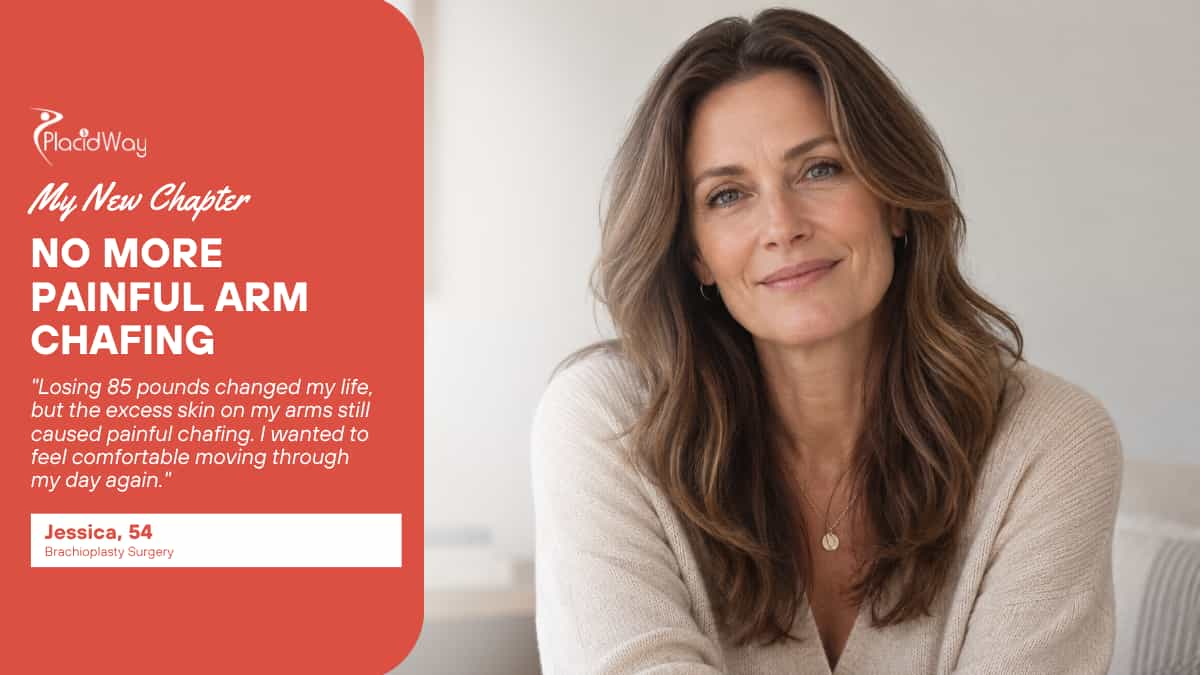
Meet Jessica Miller.

Jessica Miller is not a real PlacidWay patient.

She is a fictional composite built entirely from the specific situations, financial constraints, and clinical questions that women face after massive weight loss.

She is fifty-four years old and lives in Ohio.

She manages a regional logistics team.

She calculates the monthly household budget.

She organizes the schedules for her newly blended family.

She achieved something remarkable by losing eighty-five pounds through sheer discipline.

The daily toll of a body that doesn't fit.

She explained the problem away as an inevitable side effect of getting older.

Cardigans in August.

Three-quarter sleeves.

Firming creams.

Collagen supplements.

Targeted tricep dips.

Radiofrequency treatments.

Acceptance.

Brachioplasty is a surgical procedure that removes excess skin and underlying fat from the axilla to the elbow, typically considered only after a patient's weight has remained stable for six to twelve months . The skin loses its elasticity following significant expansion, rendering diet and exercise completely ineffective for localized redundant tissue.

Her domestic surgeon wrote it plainly in her chart:

"Severe bilateral upper extremity skin laxity."

When?

The gap between achievement and reality.

Over 100,000 massive weight loss patients seek body contouring annually, though actual surgical access remains highly dependent on private financing capabilities rather than clinical need . The prevailing medical framework treats post-bariatric skin redundancy as an aesthetic issue rather than a functional impairment, unless severe recurrent infections are documented.

But Jessica Miller doesn't experience the healthcare system as a national statistic.

She experiences it in specific, painful moments.

She experiences it in the fitting room of a department store.

"This dress just doesn't sit right on me."

She experiences it at the edge of the lake on a family weekend.

"I think I'll just watch from the chair today."

She experiences it opening the mail at her kitchen counter.

"They denied the appeal again."

She has already tried to be patient.

The assumption that patients seeking surgery abroad are reckless or impatient consumers entirely misses the reality of their preparation.

She waited a full year for her weight to stabilize.

She paid for three separate local consultations.

She documented her skin chafing.

She submitted the photographs to her insurance provider.

She filed the formal appeal when the first denial arrived.

"I did exactly what I was supposed to do."

"Why does this feel like a punishment for losing the weight?"

Her underlying question quietly shifted:

From "Can I tolerate this?"

To "How much of my life am I prepared to organise around it?"

The math that doesn't add up at home.

The domestic quotes for bilateral brachioplasty sat neatly in a folder on her desk.

The lowest was USD 12,500.

The highest was just over USD 18,000 with facility fees.

It wasn't that she had zero access to credit.

It was that authorizing a payment plan of that size meant diverting money away from her retirement catch-up contributions.

It meant deciding her body was more important than the planned roof repair.

"We technically have the money in savings."

"But we don't have it for this."

She isn't searching for Santo Domingo yet.

Her late-night internet searches follow a predictable path of quiet desperation.

How to tighten arm skin without surgery

Insurance appeal successful arm lift

Cheapest state for skin removal surgery

CareCredit monthly payments 15000

Arm lift surgery Dominican Republic reviews

When the international clinics finally populate her search results, her initial reaction is highly guarded.

"I'm not going abroad just because something is cheaper."

That instinct is exactly right.

Why does Santo Domingo keep appearing?

Santo Domingo has deliberately positioned itself as a major hub for medical tourism by investing heavily in private, internationally accredited surgical facilities .

But the crucial mental shift happens when the geography becomes secondary to the personnel.

Countries do not perform arm lifts.

Surgeons do.

Hospitals do.

Clinical teams do.

There is always something concrete to verify.

Travelers considering medical procedures abroad are explicitly advised to independently research the specific surgeon's credentials, verify facility accreditation, and arrange a pre-travel consultation with their primary care physician at home .

Her first question was: "How much?"

An indicative range for an arm lift in Santo Domingo currently sits between USD 4,500 and 7,500.

This variable pricing is driven by the specific technique required, the length of anesthesia, and the tier of the recovery facility chosen .

She remembered her father's practical warning:

"You always pay for it one way or another."

"What exactly am I getting?"

The advertised price may or may not cover twelve essential components.

Is the pre-operative cardiology clearance included in this quote?
Does this cover the anesthesiologist's fee?
Are the compression garments provided by the clinic?
How many nights in the actual hospital are covered?
Who pays for my transport from the airport to the clinic?
Does the surgical fee include liposuction of the axilla if needed?
Are post-operative lymphatic drainage massages included?
What happens if I need extra pain medication?
Is the hotel stay for the recovery period bundled into this price?
Who covers the cost of medical translation if the night nurses don't speak English?
Are all follow-up appointments done in person or via telemedicine?
What is the financial protocol if a revision is required six months later?

The advertised number is only the beginning of the conversation.

A necessary pivot in logic.

Suddenly, the math of contouring surgery looks entirely possible.

But a lower price point is never a substitute for clinical safety.

Price should never be used to answer a medical question.

What does brachioplasty actually involve?

The procedure requires an extensive incision along the inner arm, the careful excision of redundant tissue, and complex layered suturing to reconstruct the underlying fascial support system . It is major surgery that severely restricts arm mobility, leaves significant scarring, and demands meticulous wound care to prevent widening of the incisions.

"How do I manage my luggage in the airport with fresh incisions?"

The part the brochures rarely put on the front page.

The logistics of recovering far from home are profoundly unglamorous.

Current medical guidance regarding air travel after major body contouring varies significantly, with some bodies suggesting a wait of at least seven to ten days, while others advise longer periods to mitigate the elevated risk of deep vein thrombosis .

The variation itself is the lesson.

This immobility constraint must be built into the operational plan before committing to a date, not discovered afterward.

"Wait. Does that mean I have to stay in a hotel room for two weeks?"

Possibly, depending on the specific recovery house protocol your surgeon mandates.

Who changes the dressings on day four?

How do you shower when you cannot lift your arms above your waist?

Who prepares your meals in the recovery suite?

How do you wash your hair?

Who monitors the drain outputs?

What happens if the compression garment is too tight?

How do you communicate with the nursing staff if there is a language barrier?

Who drives you to the follow-up appointments in Santo Domingo traffic?

How do you get out of bed without using your arms for leverage?

This isn't tourism in the usual sense.

Her sister isn't just coming along.

The invisible second participant in this journey holds a vital job.

She will carry all the luggage.

She will set the alarms for the pain medication.

She will help pull the compression sleeves on over swollen tissue.

She will need a clear action plan if a fever spikes in the middle of the night.

Standard international travel insurance policies routinely exclude coverage for any complications that arise directly from elective medical procedures sought abroad.

The companion is part of the care system too.

Then comes the uncomfortable conversation about risk.

Seroma formation, wound dehiscence, asymmetry, and hypertrophic scarring are inherent risks of extensive contouring procedures, regardless of the geographic location of the operating room .

She learned to immediately distrust specific phrases:

Completely safe. No risk. Guaranteed success.

Informed consent means understanding more than just the hoped-for outcome.

Jessica Miller's questions become better.

She stopped asking "Is it cheap?" and started asking structural questions.

Does this clinic have an intensive care unit on-site if required?
Who manages the transfer if I need emergency tertiary care?
What is your specific rate of wound healing complications for this procedure?
How many arm lifts do you perform in a typical month?
What specific brand of compression garments do you utilize?
Are you board-certified by the Dominican Society of Plastic Surgery?
How exactly do we communicate once I fly back to Ohio?
Can I speak to a former patient from the United States?
What are your protocols for deep vein thrombosis prevention during recovery?
What would you see in my blood work that would make you tell me not to proceed?

She didn't just want a surgeon willing to operate.

She wanted a surgeon willing not to.

Have I exhausted my options at home?

Patients routinely have the legal right to request an independent peer-to-peer review of an insurance denial if they can document severe, intractable functional impairment caused by skin redundancy .

Before booking flights, Jessica Miller must interrogate her current situation.

Have I escalated my appeal to the highest level?
Has my primary care doctor documented the chronic skin infections thoroughly?
Have I asked my US surgeon if they offer cash-pay discounts?
Is a smaller, modified procedure available domestically?
Would waiting another year make domestic financing feasible?

Santo Domingo should be compared with Jessica Miller's real alternatives, not with a worst-case assumption about the domestic system.

The night before the decision.

The kitchen table was covered in paper again.

Spreadsheets detailing the cost of recovery house stays. Printed credentials of two short-listed Dominican surgeons. Flight schedules from Ohio to Santo Domingo. Medical complication insurance policies.

"You don't have to go through with this."

"I know, but I actually think I'm ready."

The research didn't make her more afraid; it made her more capable of deciding.

What Jessica Miller actually wants isn't plastic surgery.

"Are you really doing all this just to wear a tank top?"

"Yes, it's about the clothes."

But the real answer lived deeper:

TO MOVE WITHOUT THINKING ABOUT HER ARMS.

To wave across a crowded room without hesitation.

To feel the air directly on her skin.

To exist physically without constantly apologizing for her shape.

Not the brachioplasty. Not the expensive compression sleeves. Not the tropical recovery suite. Not Santo Domingo.

Freedom.

And underneath that:

PEACE.

Santo Domingo might be the answer. It might not be.

She might decide the logistical burden of flying is too stressful.

She might realize her sister cannot secure enough time off work to travel.

She might discover a domestic surgeon who accepts a workable payment plan.

She might decide to postpone the procedure for another two years.

She might ultimately choose to make peace with the loose skin.

She might book the flight and undergo the procedure in the Dominican Republic with full awareness of the requirements.

Any of those can be an informed decision.

The goal of examining this route is not to persuade you to travel, but to ensure that exhaustion and frustration do not make the decision for you.

The choice is yours to make.

Maybe you've hidden your arms for three years.

Maybe you've been denied by your insurance for the final time.

Maybe you've stared at a USD 15,000 domestic quote in disbelief.

Maybe you've tentatively typed a foreign city into a search bar.

Maybe you've wondered if there is a realistic way out of this physical trap.

You do not need to decide today.

What exactly is stopping me from living fully right now?

Am I willing to do the hard work of vetting an international clinic?

Who would travel with me if I went?

Do I understand the limits of what surgery can actually achieve?

Am I physically healthy enough to handle this recovery?

What would a safe plan actually look like?

Can I accept the risks involved?

You are not just comparing prices.

You are comparing paths forward.

Hope isn't the promise that surgery will fix everything.

It is not a guarantee of perfect symmetry.

It is not an assurance of invisible scars.

It is not a magical escape from the hard reality of physical recovery.

Hope is having enough transparent information to make a decision that finally feels like yours.

You are capable of asking the difficult questions. You are capable of demanding clear answers. You are capable of walking away if the details don't align. You are capable of weighing the clinical realities against your daily discomfort. You are capable of taking control of your own physical future.

From "I suppose I'll just have to keep waiting."

To: "What other informed options do I have?"

PlacidWay — Your Way to Hope.

PlacidWay helps patients explore international healthcare infrastructure, compare accredited facilities, and prepare the critical questions needed for independent consultations. We do not provide clinical assessments, recommend specific surgical interventions, or deliver medical outcomes. For someone like Jessica Miller, looking abroad isn't a guaranteed promise, it is simply one route worth understanding comprehensively.

Your Way to Hope.

Medical disclaimer

This article is strictly educational and does not recommend that any individual undertake arm lift surgery or travel abroad for medical care. Individual physical suitability, surgical viability, and complication risks require professional medical assessment. The reader should always consult their own primary care clinician, verify the current regulatory status and board certifications of any foreign provider independently, and obtain appropriate medical travel protection or insurance before committing to a procedure.


After Losing 85 Pounds, Jessica Miller Still Faced Painful Arm Chafing — An American Patient’s Brachioplasty Surgery in Santo Domingo

About Article

  • Treatment: Cosmetic/Plastic Surgery
  • Country: Dominican Republic
  • Overview Jessica Miller lost 85 pounds but still lives with upper-arm chafing, restricted clothing choices and the feeling that her body does not reflect her effort. With US surgery priced beyond reach, she considers brachioplasty in Santo Domingo. The practical comparison includes scarring, wound-healing risk, surgeon training, facility capability, compression garments, time away from work and reliable follow-up after travel.

Trusted Medical Tourism Platform Since 2007

60+
Countries
2k+
Clinics
19.5k+
Reviews
2.5k+
Qualified Doctors
1.1M+
Patients Served Since 2007