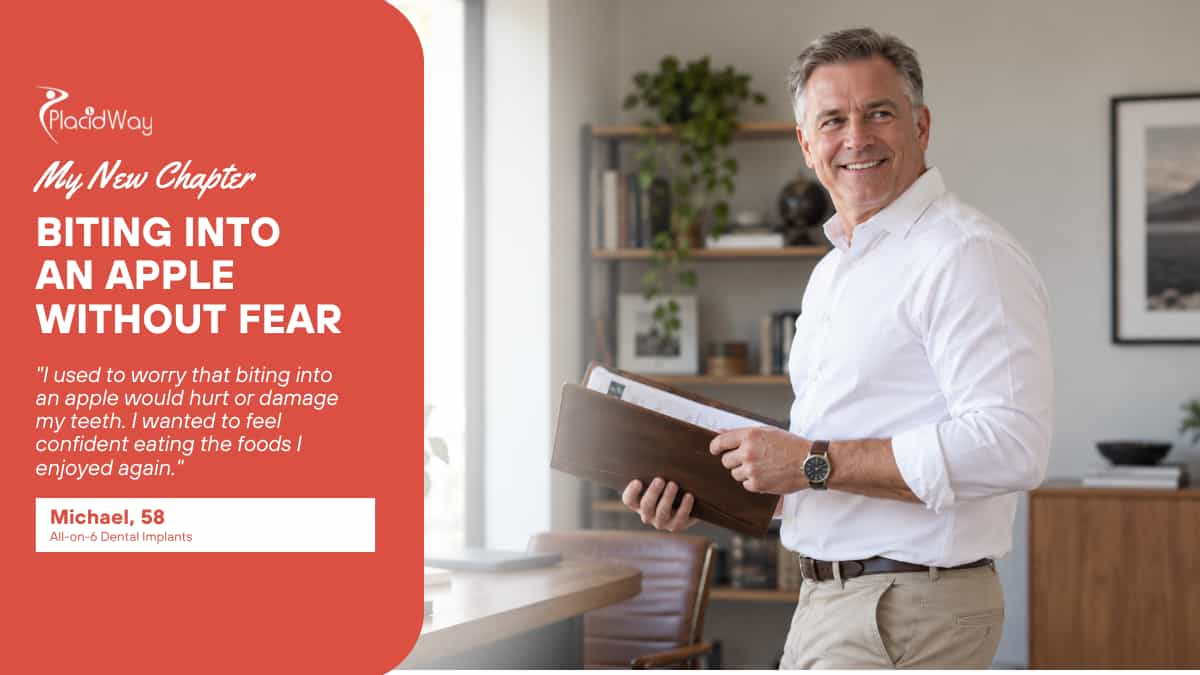
Michael Rodriguez Wanted to Bite an Apple Without Fear: An American Patient’s All-on-6 Dental Implants in Puerto Vallarta

Publish date: Modified date: Medically reviewed by: Dr. Octavio Delacruz on Sep 11, 2026 Author: Rizal Aditya

American Patient’s All-on-6 Dental Implants in Puerto Vallarta 

Patient Profile

Name: Michael Rodriguez

Age: 58

Condition: Severe edentulism and advanced periodontal disease

Treatment: All-on-6 Dental Implants

Destination: Puerto Vallarta, Mexico

Journey at a Glance

Main problems: Multiple failing teeth, facial sagging from bone loss, difficulty chewing, and social withdrawal due to appearance shame.

Previous care: Multiple consultations with US dentists resulting in out-of-pocket quotes exceeding USD 35,000, maxed-out dental insurance, and reliance on failing partial dentures.

Travel driver: Seeking comprehensive, full-mouth implant restoration at a manageable cost without decimating his retirement savings.

Treatment explored: Fixed, rapid-restoration All-on-6 dental implant system.

Personal goal: Reclaim the ability to eat solid foods, speak clearly, and smile without hesitation.

You stop chewing on the left side.

You learn to smile without parting your lips.

You decline invitations to steakhouses and barbecues.

You start holding your hand over your mouth when you laugh.

You study the annual maximums on your dental insurance.

You realize the coverage is essentially a drop in the ocean.

You sit through consultations that feel more like mortgage applications.

You absorb the well-meaning remarks from people who don't understand:

Let's just order the soup.

Did you catch what he said?

It's just age, everyone goes through it.

Your world has quietly become smaller.

The hardest part is not the chronic ache in your jaw or the staggering cost of the cure, but the endless waiting.

Meet Michael Rodriguez.

Michael Rodriguez is not a real PlacidWay client.

He is a fictional composite built entirely from the specific situations, financial constraints, and midnight anxieties that patients in this position face.

He is fifty-eight years old and lives in rural Texas.

He used to coach little league baseball under the stadium lights.

He used to bite into crisp apples without a second thought.

He used to command a room with a broad, unselfconscious grin.

He has slowly adapted to a deteriorating reality.

He blamed his receding gums on brushing too hard.

He told himself the loose molars were just a temporary issue.

He started with one extraction.

Then a bridge.

Then failing root canals.

Then partial dentures.

Then dietary modifications.

Then outright denial.

The standard clinical remedy for this degree of deterioration is full-mouth implant restoration, typically considered when advanced periodontal disease or structural decay compromises the remaining dentition beyond the repair capacity of traditional prosthetics .

The specialist looked at his panoramic X-ray and delivered the final verdict:

We need to look at full extraction and implants.

Michael sat in the leather chair and asked the only question that mattered:

When?

The statistics do not capture the daily humiliation.

Over 35 million Americans are entirely edentulous, and many face prohibitive financial barriers to comprehensive implant therapy due to standard insurance limitations .

But Michael doesn't experience the US dental system as a national statistic.

He experiences it sitting alone in the cab of his truck after receiving a quote for USD 35,000.

I guess I'll just keep the partials for now.

He experiences it staring at a plate of overcooked pasta while his family eats steak.

I'm just not very hungry today.

He experiences it physically stepping backward to avoid the photographer at his daughter's wedding.

Just take it from a bit further back.

He has already tried to be patient.

It is a mistake to view people in Michael's position as impulsive consumers demanding a quick fix.

He has been exceptionally patient.

He spent months calling regional specialists looking for sliding-scale fees.

He appealed to his insurance provider for a medical necessity exemption.

He bought discount dental plans that ultimately excluded the major surgical work he needed.

He ran the numbers on medical credit lines and realized the interest would ruin him.

I just need to hold out a bit longer.

Maybe the prices will come down next year.

Eventually, the bone loss in his jaw accelerated, forcing a change in perspective.

His internal narrative shifted from the old question to the new reality:

From Can I tolerate this?

To How much of my life am I prepared to organise around it?

The conventional path requires sacrifices he cannot justify.

The standard domestic alternative is to accept traditional removable dentures.

He knows that without implants to stimulate the jawbone, his facial structure will continue to collapse.

He also knows that financing USD 35,000 would wipe out the security he spent thirty years building.

He sat across the kitchen table from his wife to discuss the numbers.

We have some equity in the house.

I'm not draining our retirement just so I can eat a steak.

There is a profound difference between being technically able to afford a procedure and surviving the financial aftermath of paying for it.

He isn't searching for dental tourism in Mexico yet.

His journey begins with quiet, embarrassed typing late at night.

Options for failing teeth.

How to fix severe bone loss dental.

Cost of full mouth implants Texas.

Why are dental implants so expensive.

All-on-6 implants cost abroad.

The algorithms begin serving him advertisements for clinics in Puerto Vallarta.

His initial reaction is entirely rational and appropriately guarded:

I'm not going abroad just because something is cheaper.

That instinct is perfectly correct.

Why does Puerto Vallarta keep appearing in his search results?

He discovers that the Mexican Council of Maxillofacial Surgery requires rigorous specialist credentialing that mirrors US board standards .

He realizes he needs to adjust his framework entirely.

The central question is never whether Mexico is good at dentistry.

Countries do not perform complex oral surgeries.

Prosthodontists do, surgical teams do, and dedicated implant clinics do.

There are concrete, verifiable metrics to evaluate before making any commitment.

The CDC officially advises prospective medical tourists to research the specific clinical facility and verify the operating surgeon's qualifications independently before traveling .

His first question was fundamentally about the numbers.

An All-on-6 full-mouth restoration in Puerto Vallarta generally carries an indicative cost of USD 12,000–18,000, varying based on the necessity of sinus lifts, bone grafting, and the specific materials chosen for the final bridge .

He remembered his father's voice echoing in his head:

If a deal looks too good to be true, it probably is.

What exactly am I getting?

Does that price cover the initial extractions?

Are the temporary acrylic teeth included in the surgical package?

Is the clinic using premium titanium implants or generic alternatives?

Who pays for the 3D CBCT scans required for surgical planning?

Are IV sedation fees billed separately by an external anesthesiologist?

Does the quote include the final zirconia bridge, or just the temporary one?

How many follow-up visits are bundled into the initial payment?

What happens to the price if they discover I need extensive bone grafting during surgery?

Are medications and post-operative pain management included?

Is airport transportation to the clinic part of the package?

Will I need to pay out-of-pocket for a translator?

What is the warranty policy if an implant fails to fuse with the bone?

The advertised number is merely a starting point:

The conversation must establish every hidden variable.

What does a full-mouth implant restoration actually involve?

The All-on-6 procedure is a surgical intervention where remaining compromised teeth are extracted and six titanium posts are anchored strategically into the jawbone to support a fixed prosthetic arch .

It routinely requires an initial trip for extractions and implant placement, followed by a healing period of four to six months before a second trip is required to attach the permanent zirconia teeth.

During the healing phase, patients wear a temporary fixed prosthesis while the titanium integrates with the bone.

It is a significant physical trauma disguised by modern surgical precision.

Wait. Does that mean I have to stay there for two weeks?

The unglamorous operational reality rarely makes the glossy brochures.

Possibly, depending on your clinical protocol and initial healing response.

The reality of surgical travel involves facial swelling, localized pain, and drinking pureed soup in a hotel room while waiting for clearance to fly.

Current aviation medicine guidelines on flying after oral surgery vary considerably, heavily dependent on the extent of sinus involvement and the risk of pressure-induced bleeding .

The variation in official guidance is precisely the lesson.

This logistical constraint must be factored into the timeline before any deposit is paid.

Where is the nearest pharmacy to the hotel?

Does the hotel kitchen accommodate strict liquid or soft-food diets?

Who do I call if my temporary bridge cracks at two in the morning?

Is there a reliable shuttle service that avoids jarring cobblestone streets?

How do I manage ice packs without a freezer in the room?

Will the clinic provide a medical certificate for the airline if I need extra assistance?

What happens if a tropical storm delays my return flight?

How do I secure an expedited passport if mine is expiring soon?

Will my US bank block my debit card when I try to pay the remaining balance?

How do I communicate with the clinical staff on a Sunday?

He recognized the fundamental truth of the endeavor:

This isn't a medical vacation in the usual sense.

His wife isn't just coming along for a tropical vacation.

She is the invisible second participant in the surgical journey.

She will be the one communicating with the front desk when Michael is too swollen to speak.

She will be the one tracking the medication schedule.

She will be the one evaluating whether a complication requires immediate clinical attention.

Standard international travel insurance rarely covers the cost of complications arising from planned, elective medical procedures .

She needs to understand the emergency protocols just as clearly as he does.

She is an essential component of the care system.

Then comes the uncomfortable conversation about risk.

Price alone should never answer a complex surgical question.

Documented risks of full-arch implant surgery include post-operative infection, nerve damage resulting in numbness, sinus cavity penetration, and the failure of implants to integrate with the jawbone .

He learned to identify the warning signs in promotional material:

Completely safe. No risk. Guaranteed success.

True informed consent means grappling with the possibility of failure.

It means understanding exactly what the recourse is if the hoped-for outcome does not materialize.

Michael's questions begin to change shape.

He stops asking if Mexico is cheaper and starts asking how specific surgeons mitigate risk.

What is your protocol if an implant fails to integrate during the healing phase?

Who covers the cost of revision surgery if a complication arises?

Can I speak with a former patient who required follow-up care?

What specific brand of implants do you use, and are parts available in the US?

Will my local dentist be able to service the abutments if a screw comes loose?

Do you have an in-house laboratory for rapid adjustments?

How do you handle patients who present with insufficient bone density upon arrival?

What are your sterilization protocols compared to standard US practices?

Do you provide detailed clinical notes in English for my records?

What would you see on my CT scan that would make you tell me not to proceed?

He doesn't just want a surgeon willing to perform the operation.

He desperately wants a surgeon capable of telling him no.

Have I truly exhausted my options at home?

There are domestic avenues designed to lower the barrier to entry.

University dental schools frequently offer reduced rates for treatments performed by residents under the strict supervision of veteran prosthodontists .

Before booking a flight, Michael owes it to himself to ask his local provider:

Can we phase this treatment over three years to maximize my annual insurance limit?

Is a removable, implant-supported overdenture a viable, cheaper alternative?

Would a dental school in the state accept my case?

Can we preserve any of my natural teeth to anchor a partial bridge?

Are there charitable foundation grants available for severe edentulism?

The guiding principle of his research is fairness:

Puerto Vallarta should be compared with Michael's real alternatives, not with a worst-case assumption about the US system.

The night before the final decision looks different.

The kitchen table is no longer bare.

Digital panoramic X-rays. Itemized surgical quotes. Translated physician credentials. Direct emails from the clinic coordinator. Sample flight itineraries.

You've been reading for three hours.

I finally know what I'm looking at.

The intensive research didn't make him more afraid.

It made him dramatically more capable of deciding.

What Michael actually wants isn't titanium implants.

His daughter asked him why he was putting himself through so much logistical stress.

He could have talked about bone resorption or occlusal force.

The truth was entirely grounded in the physical world:

THE ABILITY TO CHEW AN APPLE.

To smile in a photograph without hesitation.

To speak without the faint lisp of failing partials.

To stop feeling old long before his time.

Not the titanium hardware. Not the polished zirconia crowns. Not the all-inclusive recovery package. Not a trip to Mexico.

He was searching for something far simpler:

Dignity.

And underneath that:

Control.

Puerto Vallarta might be the answer, but it might not be.

He might decide the international travel logistics are simply too complex.

He might uncover a local university dental program that fits his budget.

He might choose to accept a high-quality overdenture in Texas.

He might delay treatment for another year to aggressively save cash.

He might discover through an independent scan that he lacks the necessary bone density for immediate loading.

Choosing to walk away after conducting thorough, sober research is a profoundly successful outcome.

Any of those can be an informed decision.

The goal of this exploration is not to persuade you to leave the country.

The goal is to ensure that frustration and financial exhaustion do not make the decision for you.

The decision you make must be yours to live with.

Maybe you've stopped eating the foods you love.

Maybe you've deleted photos because you couldn't bear to look at your mouth.

Maybe you've spent nights staring at the ceiling, wondering how you will pay for the decay.

Maybe you've felt the deep, private shame of an aging body betraying you.

Maybe you've resigned yourself to the pain.

You do not need to decide today.

Do I fully understand the domestic options available to me?

Have I gathered independent X-rays and a clear treatment plan?

Can I accurately compare the credentials of an international surgeon?

Do I understand the total, unvarnished cost of the travel?

Am I prepared for the discomfort of the healing process abroad?

Do I have a local dentist willing to manage my long-term maintenance?

Is my spouse or partner fully aligned with the logistical reality?

You are no longer comparing blind prices.

You are comparing clearly illuminated paths forward.

Hope isn't the promise that your mouth will be flawless.

Hope is not a glossy brochure promising eternal youth.

Hope is not a suspiciously low price tag.

Hope is not pretending that complex surgery is a vacation.

Hope is simply having enough verifiable information to make a decision that feels entirely yours.

It is the capacity to ask uncomfortable questions.

It is the ability to walk away from a bad fit.

It is the refusal to accept permanent embarrassment as an inevitable condition.

It is the willingness to confront the hard logistics of healing.

It is the quiet realization that you still have agency.

The fundamental shift sounded like this:

From "I suppose I'll just have to keep waiting."

To What other informed options do I have?

PlacidWay — Your Way to Hope.

PlacidWay helps individuals explore international medical options, compare accredited facilities, and prepare the critical questions required for safe travel. We do not provide clinical advice or perform medical procedures. For someone like Michael, traveling to Puerto Vallarta for dental implants isn't a guaranteed promise of success, it is simply one structured route worth understanding thoroughly before deciding.

Your Way to Hope.

Medical disclaimer

This article is for educational and informational purposes only and does not constitute medical advice, diagnosis, or a recommendation that any individual undertake travel for surgery. Individual suitability for an All-on-6 restoration and its associated risks require professional assessment. Readers must consult their own qualified local clinician, independently verify the current regulatory status and credentials of any international provider, and obtain appropriate travel and medical insurance protection prior to making any commitments.
Michael Rodriguez Wanted to Bite an Apple Without Fear: An American Patient’s All-on-6 Dental Implants in Puerto Vallarta

About Article

  • Treatment: Dentistry
  • Country: Mexico
  • Overview Michael Rodriguez’s failing teeth and bone loss have changed how he eats, speaks and smiles. US full-mouth quotes above USD 35,000 bring Puerto Vallarta and All-on-6 implants into his planning. The full plan must address bone volume, extractions, the implant system, immediate-loading criteria, temporary teeth, healing trips, daily hygiene, long-term prosthetic maintenance and who pays if an implant fails.

Trusted Medical Tourism Platform Since 2007

60+
Countries
2k+
Clinics
19.5k+
Reviews
2.5k+
Qualified Doctors
1.1M+
Patients Served Since 2007