
Exploring Focused Ultrasound Therapy: Prostate Cancer Treatment in Saudi Arabia
High-Intensity Focused Ultrasound (HIFU) for Prostate Cancer Treatment in Saudi Arabia represents an advancement in focal therapy, using concentrated ultrasound energy to target cancerous tissue within the prostate while aiming to limit damage to surrounding healthy structures. At King Faisal Specialist Hospital and Research Centre (KFSHRC), this advanced technology combines MRI-guided imaging with precise treatment planning to help specialists identify and treat selected areas of prostate cancer. Unlike conventional surgery, HIFU delivers focused energy to the targeted tissue without requiring surgical incisions, offering an alternative for carefully selected patients with localized, early-stage prostate cancer. By concentrating treatment on the affected area, the technique aims to reduce the extent of tissue disruption while supporting the preservation of urinary and sexual function where possible.

Quick Summary: Key Aspects of HIFU Care
- Focal Precision: High-Intensity Focused Ultrasound (HIFU) targets cancerous tissue within the prostate while aiming to preserve surrounding healthy tissue.
- Non-Invasive Approach: According to King Faisal Specialist Hospital and Research Centre (KFSHRC), the procedure is performed in a single treatment session without surgical incisions or visible scars.
- Advanced Imaging Guidance: An MRI fusion-guided system combines magnetic resonance imaging with prostate-targeting technology to help specialists identify the exact treatment zone.
- Robotic Support: A robotic platform assists with precise positioning of the treatment probe and accurate delivery of focused ultrasound energy.
- Candidate Eligibility: Intended primarily for selected patients with early-stage, low- to intermediate-risk prostate cancer confined to the organ.
- Reported Early Outcomes: KFSHRC reported stable clinical outcomes, shorter hospitalization, and fewer complications compared with standard approaches in its early results.
- Multidisciplinary Care: Delivered within KFSHRC Saudi Arabia's Center of Excellence for Surgery alongside robotic surgery, radiation therapy, and systemic treatments.
Featured Medical Center - KFSHRC
King Faisal Specialist Hospital and Research Centre (KFSHRC) in Saudi Arabia is a world-class tertiary care facility at the forefront of oncology and advanced surgical innovation. Its Center of Excellence for Surgery provides comprehensive Prostate Cancer Treatment in Saudi Arabia, integrating state-of-the-art diagnostic imaging, focal therapies, robotic technology, and multidisciplinary care protocols.
Specializing in localized, locally advanced, and metastatic prostate disease, KFSHRC offers non-invasive alternatives like HIFU Prostate Cancer Therapy in Saudi Arabia alongside established surgical and radiation pathways.
View Hospital Profile & Request Info Hospital Campus - Riyadh, Saudi Arabia
 Institutional Excellence & Accreditation
Understanding Prostate Cancer and Its Impact on Men's Health
Prostate cancer remains one of the most frequently diagnosed malignancies among men globally. The prostate gland, located just below the bladder and surrounding the urethra, plays a critical role in male reproductive health. When malignant cells develop within prostate tissue, they can disrupt normal urinary and reproductive functions, making early identification and structured management essential for long-term health.
Advances in modern urologic oncology have expanded options beyond total gland treatment. Facilities like King Faisal Specialist Hospital and Research Centre offer comprehensive care programs designed to evaluate each patient's specific disease characteristics and determine whether focal treatments, surgical intervention, or radiation therapy are most suitable.
How Prostate Cancer Develops and Progresses
Prostate cancer typically originates when healthy glandular cells undergo genetic changes, leading to uncontrolled cellular multiplication. In its early stages, a Prostate Tumor Treatment in Saudi Arabia focuses on localized disease that has not extended beyond the prostatic capsule.
If unmanaged, cellular changes can progress through several clinical stages:
Localized Disease
Cancerous cells remain entirely confined within the prostate gland, making focal therapies like HIFU potential options.
Locally Advanced
Tumor growth extends slightly beyond the prostatic capsule into nearby structures, requiring surgical or radiation modalities.
Metastatic Disease
Cancer cells spread to regional lymph nodes, bones, or distant organs, managed through systemic and hormone therapies.
Global Prostate Cancer Incidence Trends
According to the World Health Organization (WHO) International Agency for Research on Cancer (IARC) GLOBOCAN report, prostate cancer accounts for over 1.4 million newly diagnosed cases worldwide annually, demonstrating the critical need for precise diagnostic and therapeutic strategies.
Estimated Worldwide Annual Prostate Cancer Cases (IARC / WHO Data)
Source: World Health Organization (WHO) International Agency for Research on Cancer (IARC) GLOBOCAN Reports.
Common Symptoms and Warning Signs of Prostate Cancer
Early-stage prostate tumors often produce no noticeable physical warning signs. However, as localized growth progresses, patients may experience specific changes in urinary or pelvic function:
Urinary Changes
- Difficulty starting or maintaining urination
- Frequent urination, particularly at night (nocturia)
- Weak or interrupted urine flow stream
- Sudden, strong urges to urinate
Physical Indications
- Presence of blood in urine (hematuria)
- Blood in semen (hematospermia)
- Erectile difficulties or discomfort
- Pelvic discomfort or dull lower back pressure
Advanced Warning Signs
- Pelvic discomfort or persistent bone pain
- Unexplained weight loss or fatigue
- Swelling in lower extremities
- Urinary function changes needing medical evaluation
What Is High-Intensity Focused Ultrasound (HIFU) for Prostate Cancer?
High-Intensity Focused Ultrasound (HIFU) is a non-invasive medical technology that uses concentrated ultrasound energy to target cancerous tissue within the prostate gland. Unlike radical prostatectomy, which removes the entire gland, or whole-gland radiation therapy, HIFU provides a focal approach designed to destroy specific malignant lesions while preserving surrounding healthy tissues, nerves, and sphincters.
At KFSHRC Saudi Arabia, the procedure utilizes advanced image-guided systems to map prostate anatomy and ensure pinpoint delivery of thermal energy.
How HIFU Uses Focused Ultrasound Energy to Target Prostate Tumors
The biological mechanism of HIFU Prostate Cancer Therapy in Saudi Arabia relies on focal acoustic energy conversion. Key operational features include:
- Directing focused ultrasound waves: Concentrated acoustic waves travel harmlessly through tissue until converging precisely at the predefined focal point within the prostate gland.
- Generating thermal ablation: At the focal point, energy concentration raises local tissue temperature to 65°C–85°C in seconds, causing rapid coagulation necrosis and targeted tumor destruction.
- Limiting exposure to surrounding tissue: Tissues outside the immediate acoustic focal zone remain unharmed where technically feasible, preserving neurovascular bundles controlling erectile function and urinary continence.
- MRI fusion-guided imaging: Multiparametric magnetic resonance imaging (mpMRI) is fused with real-time ultrasound to map tumor margins precisely.
- Robotic assistance: A computerized robotic platform controls probe positioning to execute the treatment plan with millimeter precision.
- Single-session execution: According to KFSHRC, the entire non-invasive procedure is completed in a single session without surgical incisions or visible scars.
Which Prostate Cancer Patients May Be Suitable for HIFU?
HIFU focal therapy is not recommended for every stage of prostate disease. It is specifically intended for selected men meeting strict oncologic criteria. Ideal candidates generally include patients with organ-confined, low- to intermediate-risk prostate cancer (Gleason score 6 or 7 / ISUP Grade Group 1 or 2) where malignant lesions are clearly visible on multiparametric MRI.
Clinical Considerations: Suitability depends on precise tumor location, prostate volume, calcification distribution, urinary baseline function, and individual patient preferences regarding side effect profiles.
Diagnostic Tests and Evaluations Before HIFU Treatment
Before recommending focal HIFU at King Faisal Specialist Hospital and Research Centre, patients undergo rigorous diagnostic evaluation:
- Prostate-Specific Antigen (PSA) Assessment: Measuring baseline PSA levels and evaluating PSA velocity trends.
- Multiparametric Prostate MRI (mpMRI): High-resolution imaging to identify anatomical location, volume, and PI-RADS scoring of suspicious lesions.
- Targeted Prostate Biopsy: Confirming histology, tumor grade, and tissue characteristics via MRI-ultrasound fusion biopsy.
- Anatomical & Volume Evaluation: Assessing prostate gland size, calcification patterns, and proximity to the rectal wall.
- Urodynamic & Sexual Function Scoring: Establishing baseline International Prostate Symptom Score (IPSS) and SHIM scores.
- Multidisciplinary Tumor Board Review: Case review involving urologists, radiation oncologists, and radiologists to discuss treatment alternatives and risks.
How HIFU Prostate Cancer Treatment Is Performed
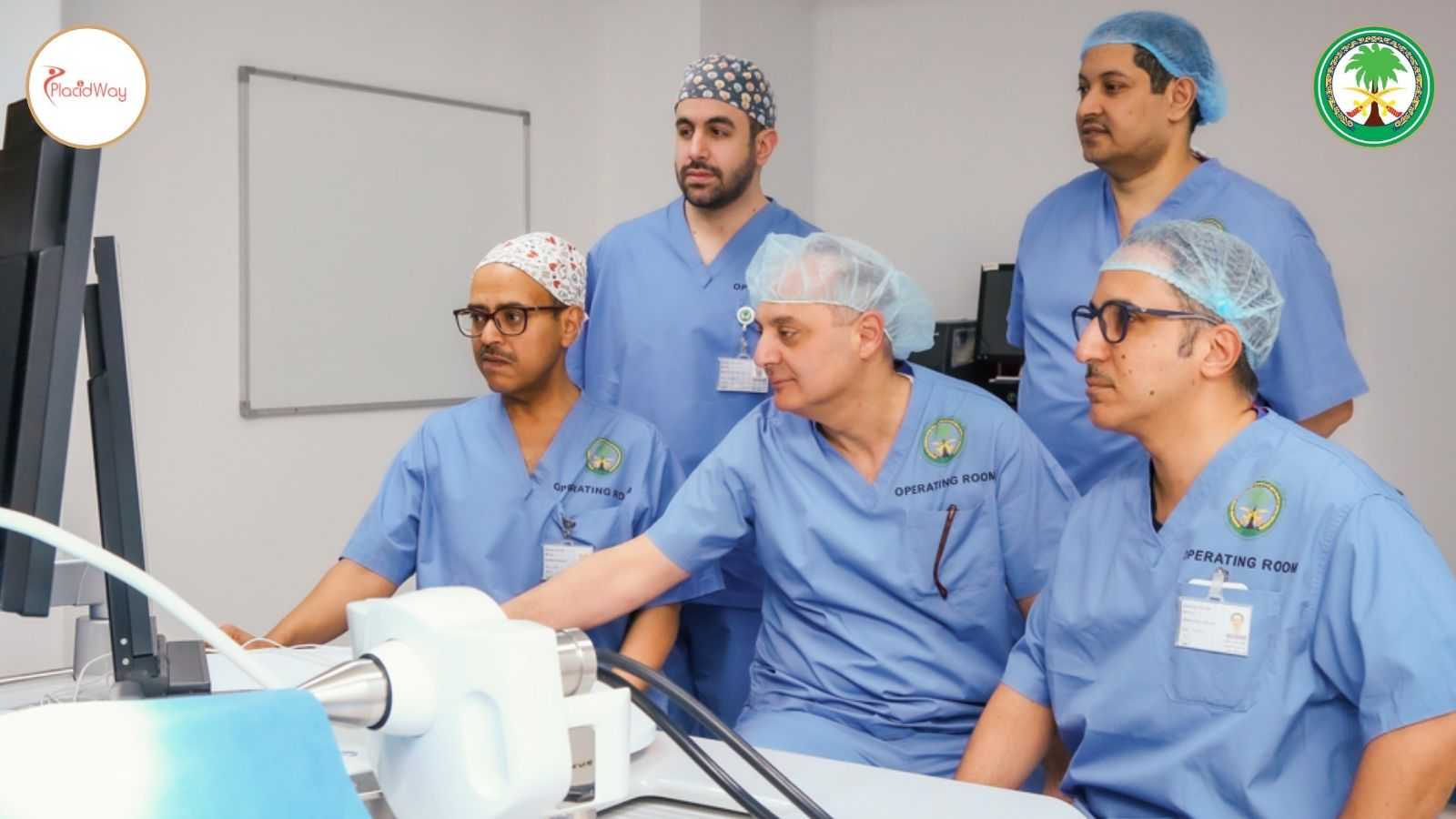
The HIFU procedure is performed in an operating room under general anesthesia to ensure complete patient comfort and immobility. A specialized transrectal probe is positioned adjacent to the prostate. Using integrated MRI fusion guidance and robotic assistance, focused high-intensity ultrasound waves are delivered sequentially across the targeted lesion, destroying cancerous tissue in a controlled, step-by-step manner over 1.5 to 3 hours.
Comparing HIFU with Surgery, Radiation Therapy, and Active Surveillance
| Treatment Modality | Invasiveness & Approach | Primary Inclusions / Inpatient Stay | Functional Preservation Profile |
|---|---|---|---|
| Focal HIFU Therapy | Non-invasive focal energy delivery | Single session; outpatient or overnight stay | High preservation of urinary control & potency |
| Robotic Radical Prostatectomy | Surgical removal of entire gland | Invasive surgery; 1–3 hospital days | Variable risk of erectile dysfunction & incontinence |
| Radiation Therapy (EBRT / SBRT) | Whole-gland external ionising radiation | Multiple outpatient sessions over weeks | Risk of bowel irritation, urinary frequency & delayed ED |
| Active Surveillance | Monitoring without immediate treatment | Regular PSA tests, MRIs, and repeat biopsies | No procedure-related side effects; disease monitoring needed |
Potential Benefits of HIFU for Selected Prostate Cancer Patients
For appropriately selected patients, focal HIFU offers several key advantages:
- Targeted Cancer Ablation: Focuses thermal energy directly on identified tumors, minimizing unnecessary destruction of healthy gland tissue.
- No Surgical Incisions: Transrectal delivery leaves no abdominal incisions, surgical scars, or suture lines.
- Shorter Hospitalization: KFSHRC reports shorter hospital stays and faster return to normal activities compared to open or robotic surgery.
- Reduced Complications: Lower rate of acute urinary incontinence and sexual dysfunction compared with radical whole-gland options.
- Repeatability & Salvage Options: Preserves future treatment options (including surgery or radiation) should cancer recur later.
Understanding the Risks, Side Effects, and Limitations of HIFU
While non-invasive, HIFU remains a therapeutic procedure carrying potential medical risks that require clear patient understanding:
Urinary Symptoms
Temporary urinary burning, frequent urination, or temporary urinary retention requiring short-term catheterization (typically 3–7 days).
Functional & Sexual Effects
Possible changes in ejaculatory volume, mild transient erectile weakness, or minor stress urinary incontinence in select cases.
Oncologic Limitations
Risk of persistent or recurrent cancer in untreated portions of the prostate, requiring strict post-treatment PSA surveillance and repeat biopsy if indicated.
Recovery, Follow-Up, and PSA Monitoring After HIFU
Post-procedural recovery following focal HIFU is generally swift. Patients usually discharge on the same day or following an overnight observation stay. A temporary urinary catheter remains in place for several days to allow localized prostate edema to resolve.
| Timeframe | Clinical Monitoring Step | Key Milestone / Goal |
|---|---|---|
| Days 1–7 Post-HIFU | Catheter management & light activity | Removal of urinary catheter once spontaneous voiding is confirmed |
| Month 3 | First post-treatment PSA blood test | Evaluating drop in serum PSA level (nadir calculation) |
| Months 6–12 | Follow-up mpMRI imaging & PSA velocity | Confirming complete thermal ablation zone and absence of recurrence |
| Annually | Routine urologic checkup & PSA surveillance | Long-term disease control and functional maintenance tracking |
Long-Term Cancer Control and the Possibility of Additional Treatment
Reported early results from leading medical centers, including KFSHRC, demonstrate promising disease control, short recovery periods, and low complication rates. However, these findings do not guarantee identical long-term results for every individual patient.
Because HIFU leaves non-tumorous prostate tissue intact, ongoing monitoring is essential. If follow-up MRI or biopsy indicates persistent or secondary primary lesions in the untreated gland, patients retain full eligibility for repeat focal HIFU, robotic radical prostatectomy, or radiation therapy.
Accessing HIFU Prostate Cancer Treatment in Saudi Arabia
Saudi Arabia has established itself as a major healthcare hub in the Middle East, offering advanced oncologic treatments through internationally accredited centers like King Faisal Specialist Hospital and Research Centre (KFSHRC) in Riyadh. International and regional patients seeking focal prostate treatment can access multidisciplinary medical evaluations, state-of-the-art MRI fusion systems, and robotic surgical platforms.
Cost Breakdown of HIFU Prostate Treatment (USD Planning Ranges)
Treatment costs vary depending on diagnostic requirements, hospital stay duration, anesthesia needs, and pre-procedure MRI imaging. Below is an indicative planning guide in USD:
| Medical Service Component | Indicative USD Range | What Is Included? |
|---|---|---|
| Pre-Procedure MRI & Diagnostics | $1,200 – $2,500 | mpMRI prostate scan, targeted biopsy review, PSA tests |
| Focal HIFU Procedure & Anesthesia | $12,000 – $18,000 | Robotic ultrasound system usage, surgeon & anesthesia fees |
| Hospital Stay & Immediate Care | $1,500 – $3,000 | Overnight facility room, post-op nursing, catheter placement |
| Follow-up Consultations & Lab Work | $800 – $1,500 | Post-op visits, catheter removal, 3-month PSA blood test |
Note on Quotes: Medical estimates are personalized following clinical assessment of MRI imaging and biopsy reports. Request an itemized quotation before confirming medical travel.
Frequently Asked Questions
What is High-Intensity Focused Ultrasound (HIFU) for prostate cancer?
HIFU is a non-invasive focal therapy that uses concentrated acoustic energy to destroy targeted prostate tumor tissue precisely without surgical incisions.
Is HIFU prostate treatment available at KFSHRC in Saudi Arabia?
Yes, King Faisal Specialist Hospital and Research Centre (KFSHRC) in Riyadh offers focal HIFU therapy as part of its Center of Excellence for Surgery prostate cancer program.
Who is an ideal candidate for HIFU prostate treatment?
HIFU is generally suitable for patients with early-stage, localized, low- to intermediate-risk prostate cancer that is clearly visible on MRI scans.
Does HIFU require surgical incisions or cuts?
No, HIFU is completely non-invasive and performed transrectally using ultrasound energy, leaving no visible surgical scars or incisions.
What are the main advantages of HIFU compared to radical prostatectomy?
HIFU offers a non-invasive focal approach with shorter hospital stays, faster recovery, and lower risk of urinary incontinence and erectile dysfunction compared to radical surgery.
What are the potential side effects of HIFU prostate therapy?
Possible side effects include temporary difficulty urinating, temporary catheter reliance, urinary tract irritation, and potential changes in ejaculatory or erectile function.
How long is the recovery period after a HIFU procedure?
Most patients return home on the same day or after one night in the hospital, resuming normal light activities within 1 to 2 weeks.
How is treatment efficacy monitored after HIFU?
Efficacy is monitored through baseline PSA blood tests every 3 months and follow-up multiparametric MRI scans at 6 to 12 months post-procedure.
Can HIFU treatment be repeated if cancer returns?
Yes, because HIFU preserves non-treated gland tissue, repeat focal HIFU, surgery, or radiation therapy remain viable options if recurrent cancer is detected.
How does MRI fusion guidance improve HIFU accuracy?
MRI fusion guidance combines detailed pre-operative magnetic resonance imaging with real-time ultrasound mapping to target tumor tissue with pinpoint millimeter accuracy.
Explore Prostate Treatment Options at KFSHRC
PlacidWay can help you connect with King Faisal Specialist Hospital and Research Centre (KFSHRC), review treatment options for Prostate Tumor Treatment in Saudi Arabia, prepare diagnostic records, and request personalized medical information. Contact KFSHRC through PlacidWay to discuss your case with a medical coordinator.
Request Medical ConsultationDisclaimer: This content is for educational and informational purposes only and does not replace formal medical evaluation or diagnosis. Treatment decisions regarding prostate cancer should be made in direct consultation with qualified urologists and oncologists. Early clinical reported outcomes do not guarantee identical results for every individual.
References & Official Sources:
- World Health Organization (WHO) — Global Cancer Observatory (IARC)
- National Cancer Institute (NCI) — Prostate Cancer Treatment Guidelines
- European Association of Urology (EAU) — Guidelines on Prostate Cancer
- American Urological Association (AUA) — Localized Prostate Cancer Guidelines
- Ministry of Health Saudi Arabia — National Healthcare Standards & Services
- RadiologyInfo.org — High-Intensity Focused Ultrasound (HIFU) Overview
- Prostate Cancer Foundation (PCF) — Focal Therapy and Emerging Treatments



























Share this listing