
Clinical evidence & decision guide
Menopause Hormone Therapy Risks and Benefits Explained
In the Women's Health Initiative, estrogen plus progestin raised the hazard ratio for invasive breast cancer to 1.26 (JAMA, 2002). Trial averages; individual results vary and are not guaranteed. Menopause hormone therapy relieves hot flashes, but its risks depend on type, dose, age and history, so a physician assesses each woman.
01 / Key facts
Core clinical findings at a glance
Evaluating menopause hormone therapy starts with separating proven symptom relief from long-term statistical averages across large clinical trials. Each figure below reflects specific study conditions and requires individual medical context.
| Item | Fact | Source |
|---|---|---|
| Treatment | Estrogen, with a progestogen when the uterus is present | The Menopause Society position statement, 2022 |
| Main benefit | Relief of hot flashes and night sweats | The Menopause Society position statement, 2022 |
| WHI estrogen plus progestin, breast cancer | Hazard ratio 1.26 | Rossouw et al., JAMA 2002 |
| WHI estrogen plus progestin, hip fracture | Hazard ratio 0.66 | Rossouw et al., JAMA 2002 |
| Status | Prescription medicine, given after a physician's assessment | The Menopause Society position statement, 2022 |
02 / What is menopause hormone therapy?
How therapy works and why uterine status matters
Menopause hormone therapy replaces some of the estrogen that the ovaries stop making after menopause. It comes as tablets, patches, gels, sprays or vaginal products. Women who still have a uterus receive a progestogen as well, because estrogen alone can thicken the lining of the uterus and raise the risk of endometrial cancer.
Hormone therapy is a prescription medicine decided case by case by a physician. Healthi Life in Bangkok publishes a hormone testing pack for women, but this article is general information about hormone therapy. It does not describe a treatment program at the clinic, and the clinic confirms at the consultation what it can offer.
The 2022 position statement of The Menopause Society, formerly the North American Menopause Society, is a widely used summary of the evidence. It describes hormone therapy as an effective treatment for hot flashes and night sweats and for the genitourinary symptoms of menopause, and says the risks and benefits depend on age, time since menopause and individual health history.
Delivery routes
Tablets, patches, gels, sprays, and local vaginal formulations are each selected with a physician based on symptoms and medical history.
Endometrial protection
Adding a progestogen when the uterus is intact protects the uterine lining against estrogen-induced thickening.
03 / What are the benefits?
Symptom relief, bone outcomes, and personal priorities
The proven benefit of hormone therapy is relief of vasomotor symptoms, meaning hot flashes and night sweats. It also treats vaginal dryness and discomfort, and it helps prevent bone loss. In the Women's Health Initiative, women taking estrogen plus progestin had a hazard ratio for hip fracture of 0.66 and for colorectal cancer of 0.63 compared with placebo (Rossouw et al., 2002). Trial averages; individual results vary and are not guaranteed.
Bone protection is a real effect, but hormone therapy is not usually the first choice when the only concern is osteoporosis, because other medicines exist for that purpose. Sleep and mood sometimes improve as a secondary effect when night sweats settle.
Use the benefit that matters to you as the starting point. A woman with severe hot flashes is weighing a different question from a woman who is symptom-free and wants to prevent disease.
04 / What are the risks?
Relative hazard ratios versus absolute trial rates
The main risks of hormone therapy are breast cancer, blood clots and stroke, and the size of each depends on the formulation and the woman. In the Women's Health Initiative trial of estrogen plus progestin, the hazard ratios compared with placebo were 1.26 for invasive breast cancer, 1.29 for coronary heart disease, 1.41 for stroke and 2.11 for venous thromboembolism (Rossouw et al., 2002). Trial averages; individual results vary and are not guaranteed.
Those numbers describe relative risk in a group whose average age at enrolment was 63, many years after menopause. In absolute terms, the trial reported about 8 additional strokes, 8 additional pulmonary emboli and 8 additional invasive breast cancers per 10,000 women taking therapy for one year, a small number for any individual woman.
Therapy Type & Timing Breakdown
05 / Who should not take hormone therapy?
Contraindications, family history, and prevention guidance
Hormone therapy is generally avoided in women with unexplained vaginal bleeding, a history of breast cancer, a current or past blood clot, active liver disease, or a past stroke or heart attack (The Menopause Society, 2022). A physician checks these before prescribing. Family history, smoking, body weight and migraine with aura also change the advice.
The US Preventive Services Task Force recommends against combined estrogen plus progestin to prevent chronic conditions in postmenopausal women (JAMA, 2022). That recommendation concerns prevention in healthy women, not the treatment of bothersome symptoms. The distinction matters when reading headlines.
Anyone with breast or ovarian cancer in the family should tell the physician, because a genetic cause such as a BRCA variant changes the risk discussion.
Symptom treatment vs. disease prevention
Individual medical history, age at initiation, and symptom burden guide every clinical decision.
06 / What alternatives exist?
Non-hormonal options and baseline testing
Non-hormonal options exist for hot flashes. These include lifestyle changes (cooler rooms, layered clothing, reducing alcohol, regular exercise), cognitive behavioral therapy, and several prescription medicines taken as pills. Vaginal dryness can be managed with local products that act at the site and have little systemic absorption.
Before any treatment, a baseline helps. At Healthi Life in Bangkok, the Her Hormonal Transition pack measures FSH, LH, estradiol, progesterone, thyroid, lipid and bone-related markers such as calcium and vitamin D, with a physician consultation. The pack is a test pack. It does not prescribe therapy, and its results are one input to a physician's decision.
Clinic, Physicians & Credential
Healthi Life Longevity Center
Longevity and preventive health center located on Ekkamai 10 in Bangkok offering diagnostic testing and physician consultations.

Dr. Sarassawadee Suwanjinda, MD (Dr. Petch)
Physician profile associated with clinical consultation and individualized evaluation.

Dr. Napat Hunsajarupan, MD (Dr. First)
Physician profile associated with clinical assessment and medical guidance.
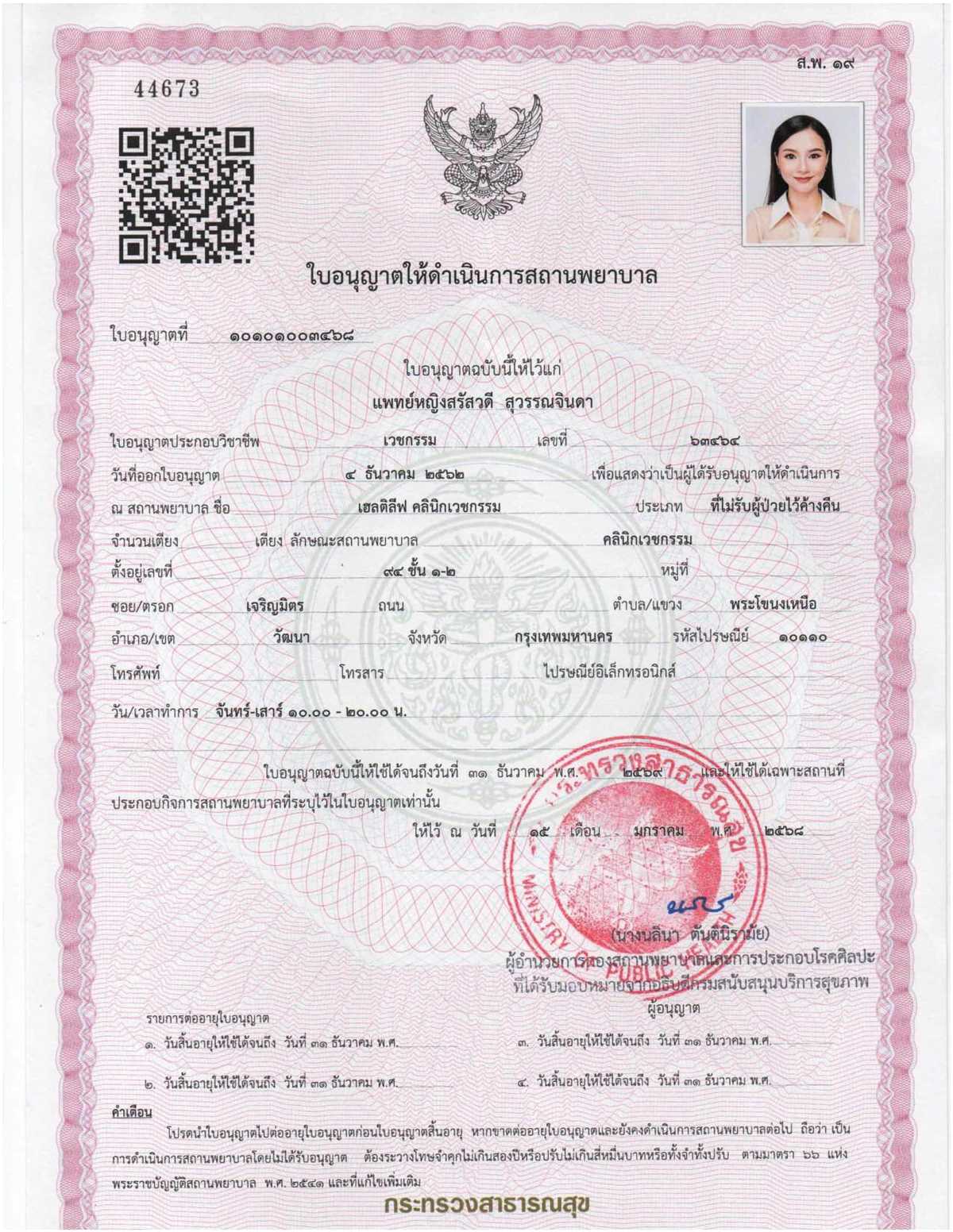
Healthi Life Longevity Center Certificate
Official center certificate record for reference during provider review.
07 / Risks and limits
Methodological limits when interpreting study data
Interpreting clinical findings requires understanding how studies are constructed and where population averages stop short of predicting an individual response.
- Relative risks from a trial do not tell one woman her own risk.
- The Women's Health Initiative tested specific products, doses and an older population, so results do not transfer to every formulation.
- Observational studies cannot prove cause and effect.
08 / Questions to ask any clinic
Checklist for your physician consultation
Bringing focused questions helps clarify how population evidence applies to your personal health history, screening schedule, and treatment goals.
- What is my personal risk of breast cancer and clots, given my history?
- Which type, dose and route do you suggest, and why that one?
- When will we review whether to continue?
- Which tests or screening do I need before starting and while taking it?
- What non-hormonal options fit my symptoms?
- What do I do if I get bleeding, leg swelling or chest pain?
09 / FAQ
Frequently asked questions
What are the main risks of menopause hormone therapy?
The main risks are breast cancer, blood clots and stroke, and their size depends on the type, dose, route and your age. In the Women's Health Initiative, estrogen plus progestin had hazard ratios of 1.26 for breast cancer and 1.41 for stroke. Trial averages; individual results vary and are not guaranteed.
Does hormone therapy cause breast cancer?
Combined estrogen plus progestogen therapy is linked with higher breast cancer risk, and risk rises with years of use, according to a 2019 pooled analysis (Collaborative Group on Hormonal Factors in Breast Cancer, Lancet 2019). Estrogen alone showed no increase in the Women's Health Initiative intervention phase. A physician reviews your family history and screening before prescribing.
Is hormone therapy safe for women under 60?
Risk is lower when therapy starts before age 60 or within 10 years of menopause, per The Menopause Society's 2022 statement, but safe is not guaranteed for any individual. Suitability depends on your history of clots, cancer and heart disease. A physician decides after assessment.
How long can you take hormone therapy?
There is no fixed limit. The Menopause Society advises the lowest effective dose for the shortest time that meets treatment goals, with a review at least once a year. Some women with persistent symptoms continue longer after discussing risks with their physician.
Does hormone therapy protect bones?
Yes, it reduces bone loss. In the Women's Health Initiative, estrogen plus progestin had a hazard ratio of 0.66 for hip fracture. Trial averages; individual results vary and are not guaranteed. Other medicines are usually considered first when osteoporosis is the only concern.
Can I discuss hormone therapy with a physician in Bangkok as a visitor?
You can book a consultation at Healthi Life on Ekkamai 10 in Bangkok to discuss symptoms and testing. Whether therapy is suitable is a physician's decision after assessment, and the clinic confirms at the consultation what it can offer to overseas guests.
References
1. Rossouw JE, et al. Risks and benefits of estrogen plus progestin in healthy postmenopausal women. JAMA. 2002;288(3):321-333. https://doi.org/10.1001/jama.288.3.321
2. The 2022 Hormone Therapy Position Statement of The North American Menopause Society. Menopause. 2022;29(7):767-794. https://doi.org/10.1097/GME.0000000000002028
3. Collaborative Group on Hormonal Factors in Breast Cancer. Type and timing of menopausal hormone therapy and breast cancer risk. Lancet. 2019;394(10204):1159-1168. https://doi.org/10.1016/S0140-6736(19)31709-X
4. Manson JE, et al. Menopausal hormone therapy and health outcomes during the intervention and extended poststopping phases of the WHI randomized trials. JAMA. 2013;310(13):1353-1368. https://doi.org/10.1001/jama.2013.278040
5. US Preventive Services Task Force. Hormone therapy for the primary prevention of chronic conditions in postmenopausal persons. JAMA. 2022;328(17):1740-1746. https://doi.org/10.1001/jama.2022.18625
This article is for information only and does not replace a medical consultation.


























Share this listing