

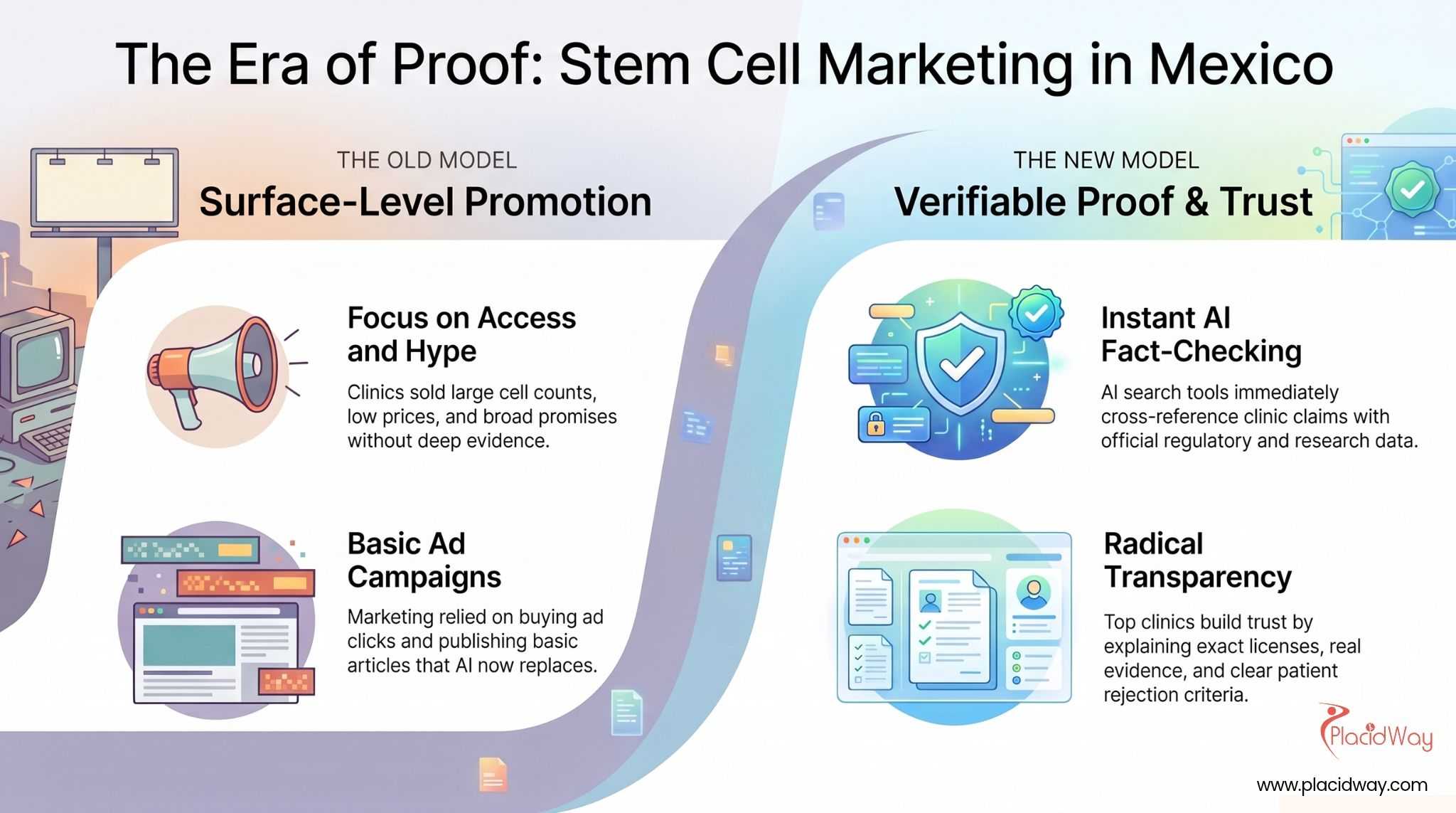
For years, marketing Regenerative Medicine in Mexico followed a fairly predictable formula.
A clinic created pages around conditions such as osteoarthritis, multiple sclerosis, Parkinson’s disease, autism, spinal cord injury or anti-aging. The website highlighted advanced technology, experienced doctors, large cell counts, attractive pricing and the ability to receive treatment in Mexico.
Patients searched Google.
Clinics competed for rankings.
The clinic with the strongest advertising, most content or highest visibility often received the inquiry.
That market is changing.
Stem cell providers in Mexico are now operating in an environment where regulation, patient skepticism, search quality standards and artificial intelligence are converging around one central issue: proof.
A clinic can still say that it is experienced.
It can still say that it uses advanced technology.
It can still say that it operates legally.
But patients, regulators, Google and AI systems can now ask the next question almost immediately:
Can you prove exactly what you mean?
That is becoming the defining marketing challenge for regenerative medicine providers in Mexico.
And it is why the next generation of successful stem cell marketing will look very different from the last one.
The Market Has Shifted From Access to Verification
Ten or fifteen years ago, simply offering regenerative medicine could differentiate a clinic.
Patients might travel because a treatment was unavailable, restricted, expensive or difficult to access in their home country.
The marketing message could therefore be relatively simple:
We offer stem cell treatment in Mexico.
As more providers entered the market, the message changed.
Clinics started competing on:
-
cell numbers
-
laboratory technology
-
physician experience
-
treatment combinations
-
location
-
price
-
convenience
-
patient testimonials
-
“advanced” protocols
-
regulatory licenses
That created the second stage of the market:
Why choose our stem cell clinic instead of another one?
The industry is now entering a third stage.
Patients are asking much harder questions:
-
What type of cells are being used?
-
Where do they come from?
-
Are they autologous or allogeneic?
-
How are they processed?
-
What testing is performed?
-
What is the evidence for my condition?
-
Is the treatment standard, investigational or experimental?
-
What exactly does the clinic’s COFEPRIS license cover?
-
Does that license mean my treatment is approved?
-
Who decides whether I qualify?
-
Who should not receive treatment?
-
What risks are known?
-
What outcomes does the clinic actually measure?
-
What happens if treatment does not work?
-
What alternatives should I consider?
That changes marketing completely.
The question is no longer simply:
“Do you provide stem cells?”
It is becoming:
“Can I independently verify that what you are proposing is medically, scientifically and regulatorily reasonable for someone like me?”
Mexico’s Regulatory Environment Is Becoming More Defined
This shift is not happening only because patients are becoming more sophisticated.
Mexico itself is strengthening the regulatory framework surrounding cellular therapies.
Mexico’s Programa Nacional de Infraestructura de la Calidad 2026 includes work on requirements governing stem cells, progenitor cells, mesenchymal cells and lymphocytes used for therapeutic or research purposes.
The stated scope includes areas such as:
-
procurement
-
processing
-
preservation
-
transport
-
therapeutic use
-
research use
The government specifically notes that regulatory gaps exist and that the proposed framework is intended to establish minimum requirements and greater control over these activities.
COFEPRIS also identifies specific licensing categories covering establishments involved in cells, tissues and regenerative medicine.
These include licenses for establishments involved in extraction, analysis, conservation, preparation and supply of organs, tissues and cells; stem-cell collection and banking; transplantation; and a specific license for regenerative-medicine establishments under COFEPRIS-09-027.
A 2026 review published in Revista CONAMED also describes regulatory changes affecting therapeutic use of stem cells, establishment operations, traceability and surveillance in Mexico.
For providers, the message is clear:
Mexico is not moving toward less scrutiny of cellular therapies. It is moving toward greater definition, documentation and traceability.
That should change the way providers communicate with patients.
A License Is Important, but It Is Not the Entire Medical Argument
One of the most common marketing strategies in the Mexican regenerative-medicine market is to place a phrase such as:
COFEPRIS licensed prominently across a website.
Providers should absolutely communicate legitimate licenses and regulatory credentials.
But they must also communicate them accurately.
A facility license may demonstrate that an establishment is authorized to perform certain regulated activities.
That does not automatically establish that every intervention offered by that facility has been clinically proven effective for every condition being advertised.
Those are separate questions.
This distinction matters because patients increasingly interpret words such as:
-
licensed
-
authorized
-
approved
-
registered
-
certified
-
regulated
as though they all mean the same thing.
They do not.
Providers should therefore explain:
What is licensed?
Which entity holds the license?
Which activities does it cover?
Does the statement refer to the clinic, laboratory, product, procedure or physician?
What does the authorization not establish?
Regulatory transparency may feel less exciting than a headline promising advanced regenerative medicine.
But in a high-risk healthcare category, it can create considerably more trust.
Advertising Claims Are Becoming a Documentation Problem
Mexico's health advertising requirements make another issue increasingly important.
COFEPRIS requires supporting documentation for statements made in health-related advertising, depending on the applicable category and procedure.
Its published requirements for health-service advertising specifically reference documentation supporting advertising claims, along with establishment and professional credentials.
COFEPRIS also strengthened its coordination with Mexico's cybersecurity and public-security authorities in March 2026 to monitor potentially misleading promotion of health-related products and services online.
This changes the internal question marketing teams should ask.
The old question was:
“Does this headline sound persuasive?”
The new question should be:
“If someone asks us tomorrow to substantiate this sentence, what exact evidence will we provide?”
Consider the difference between these statements:
Our stem cells regenerate damaged tissue.
versus:
Mesenchymal stromal cells are being studied for their immunomodulatory and signaling properties, but clinical evidence and expected outcomes vary substantially by condition and protocol.
The first sounds stronger.
The second is much easier to defend.
That distinction will increasingly matter.
Google Has Already Changed the Commercial Environment
Providers should also recognize that advertising platforms have made the category harder to promote.
Google's current healthcare advertising policies generally prohibit promotion of stem-cell therapies, non-stem cellular therapies, gene therapies and similar regenerative interventions, subject to specific exceptions.
Google does allow advertising that is exclusively educational or informational in nature.
This means the traditional model of:
Stem Cell Treatment for Parkinson's in Mexico — Book Now
faces very different platform restrictions from:
Understanding Current Research Into Cell-Based Therapies for Parkinson's Disease
This is strategically important.
The future of patient acquisition in this field is likely to depend increasingly on:
-
education
-
physician authority
-
organic search
-
AI search
-
video
-
research interpretation
-
patient decision support
-
third-party authority
-
condition-specific content
-
reputation
-
referral networks
rather than simply buying traffic to treatment pages.
Stem Cell Providers Are Operating in a YMYL Environment
Healthcare belongs to what Google describes as Your Money or Your Life, or YMYL.
These are topics where inaccurate information can meaningfully affect a person's health, financial stability, safety or well-being.
Google explains that stronger E-E-A-T signals receive greater consideration for YMYL subjects and that trust is the most important element of E-E-A-T.
E-E-A-T refers to:
-
Experience
-
Expertise
-
Authoritativeness
-
Trustworthiness
For a restaurant review, a factual error may ruin dinner.
For an article about experimental cancer immunotherapy, the consequences can be far more serious.
A patient might:
-
spend tens of thousands of dollars
-
delay conventional treatment
-
travel internationally
-
stop medication
-
misunderstand the evidence
-
accept an intervention carrying significant uncertainty
That means providers cannot treat healthcare SEO like ordinary content marketing.
Publishing more pages is not automatically an advantage.
Publishing better-supported pages is.
E-E-A-T for a Stem Cell Provider Is Not an Author Box
Many marketers treat E-E-A-T as a checklist.
Add a doctor name.
Add a publication date.
Add some references.
Add MedicalReviewer schema.
Problem solved.
That misses the point.
For regenerative medicine, E-E-A-T has to exist through the entire information environment.
Experience
Can the provider demonstrate real-world clinical experience?
That may include responsibly presented information about:
-
patient selection
-
actual treatment workflow
-
follow-up
-
rehabilitation
-
adverse-event monitoring
-
practical travel experience
-
cases that were declined
-
long-term patient management
Expertise
Can the medical team demonstrate relevant training?
Not simply:
“Dr. X is an experienced regenerative medicine specialist.”
But:
-
medical degree
-
specialist training
-
professional license
-
board certification where applicable
-
research experience
-
relevant publications
-
clinical responsibilities
-
current institutional affiliations
Authoritativeness
Can other credible sources verify the organization and its people?
Authority may come from:
-
regulatory records
-
professional organizations
-
peer-reviewed research
-
hospital affiliations
-
academic affiliations
-
clinical-trial participation
-
reputable third-party healthcare platforms
-
independent media coverage
Trust
Can a patient understand both the strengths and the limitations of what is being offered?
Trust is often created by sentences such as:
-
You may not qualify.
-
Evidence remains limited.
-
This intervention is not established as standard treatment for this condition.
-
Results vary substantially.
-
Standard treatment alternatives should be discussed.
-
This treatment may not replace oncology care.
-
Our physicians decline patients when the expected benefit does not justify treatment.
Those statements may convert fewer impulsive leads.
They may create more qualified patients.
Consumer Intent Has Changed
Providers often continue producing content as though the patient's main question is:
Where can I get stem cells?
For many patients, that is no longer the first question.
The search journey is becoming much more investigative.
A patient might search:
Can stem cells help knee osteoarthritis?
Then:
What type of stem cells are used for osteoarthritis?
Then:
Are stem cells approved for arthritis?
Then:
Are stem cells legal in Mexico?
Then:
COFEPRIS stem cell regulations
Then:
Mexico stem cell treatment risks
Then:
umbilical cord MSC vs bone marrow stem cells
Then:
clinic name reviews
Then:
doctor name license
Then:
clinic name Reddit
Then:
clinic name FDA warning
Then:
clinic name research publications
Then they may ask ChatGPT, Gemini, Perplexity or another answer engine:
Compare this clinic with three other stem cell clinics in Mexico and tell me which claims are actually supported.
That is a very different patient journey.
The provider no longer controls the research environment.
AI Has Made Medical Websites “Naked”
A recent PlacidWay analysis described this change with a deliberately uncomfortable phrase:
AI has made every medical tourism website naked.
The point is not that websites suddenly reveal confidential information.
The point is that claims can now be examined far more easily.
A clinic can write:
We are one of Mexico's leading stem cell centers.
An AI-assisted patient can immediately ask:
-
Leading according to whom?
-
What licenses does the clinic have?
-
What is the license number?
-
Can it be independently verified?
-
Who are the physicians?
-
Are their professional credentials verifiable?
-
What type of stem cells are used?
-
For which conditions?
-
What evidence supports those uses?
-
Are there published clinical studies?
-
Did the clinic participate in them?
-
Are the studies about the same protocol?
-
What risks does the clinic mention?
-
What risks does the scientific literature mention?
-
Is the treatment approved in the patient's home country?
-
What does COFEPRIS regulation actually say?
-
Are there conflicting claims elsewhere online?
-
Did the clinic make stronger claims five years ago?
-
What do third-party websites say?
-
How does this provider compare with competitors?
That is what “naked” means in an AI-search environment.
A website is no longer evaluated only page by page.
Its claims can be evaluated entity by entity and relationship by relationship.
LLMs Can Cross-Link Information That Used to Remain Separate
This is perhaps the most important change providers need to understand.
Historically, the following pieces of information existed in different places:
Your treatment page.
Your doctor's profile.
A COFEPRIS database.
A PubMed article.
A clinical trial.
A LinkedIn profile.
A YouTube interview.
A medical tourism profile.
A patient review.
An FDA consumer warning.
An ISSCR guideline.
An old version of your website.
A competitor's treatment page.
A press release.
A conference biography.
An academic publication.
Humans could investigate all of those sources, but doing so required time.
LLMs dramatically reduce that friction.
Now a patient can ask one question:
“This Mexican clinic says its umbilical-cord stem-cell treatment can improve my Parkinson's disease. Check its doctors, regulatory status, research claims, treatment mechanism and evidence, and tell me what is verified and what is marketing.”
The system can retrieve and connect information across sources.
That changes digital reputation.
Your website does not exist in isolation anymore.
It exists inside an evidence graph.
Contradictions Are Becoming More Dangerous Than Missing Content
Imagine that five sources say five different things.
Website:
25 years of clinical experience.
Doctor profile:
Medical degree obtained 14 years ago.
Third-party listing:
Clinic established eight years ago.
Press release:
Company entered Mexico six years ago.
LinkedIn:
Physician joined last year.
A human visitor may never notice.
An LLM may.
Now consider a treatment claim.
Website:
Clinically proven treatment.
Research paper:
Early-stage observational evidence.
ClinicalTrials.gov:
Recruiting Phase I trial.
Professional guideline:
Insufficient evidence for routine use.
Patient brochure:
Proven to restore damaged tissue.
An AI system can place those statements next to each other.
The problem is no longer simply bad copy.
It is entity inconsistency.
LLM Visibility Is Not Traditional SEO With a New Name
Many companies have responded to AI search by inventing another checklist:
-
add FAQs
-
add schema
-
publish llms.txt
-
use conversational questions
-
create more pages
Those things can help with accessibility and machine understanding.
They do not solve the core problem.
An AI system still needs a reason to trust the information.
Google's 2026 guidance for generative-AI search emphasizes valuable, original, non-commodity content rather than material that simply repeats what already exists online.
That should be taken seriously by regenerative-medicine providers.
If an AI model can generate your entire article without knowing anything about your clinic, why does that page need to exist?
Consider these topics:
-
10 Benefits of Stem Cell Therapy
-
Why Choose Mexico for Stem Cells
-
Advantages of Regenerative Medicine
-
How Stem Cells Work
-
Why Stem Cells Are the Future of Medicine
An LLM can generate all of them instantly.
Your competitive advantage cannot be information everyone already has.
It must increasingly be information that exists because your organization exists.
What AI Cannot Easily Invent
A provider has valuable information that generic AI does not inherently possess.
For example:
Your actual patient-selection process
Who qualifies?
Who gets rejected?
Why?
Your actual protocol
What cells are used?
What source?
What processing?
What testing?
What dose?
What route?
Your laboratory standards
How is identity assessed?
How is viability evaluated?
What microbiological testing occurs?
How is traceability maintained?
Your physician reasoning
Why would one patient receive an intra-articular intervention while another would not?
Why might a neurologist discourage treatment in one case?
Your adverse-event procedures
What happens if a patient becomes ill after returning home?
Your outcomes
What do you measure?
Pain scores?
Mobility?
MRI findings?
Medication use?
Quality-of-life measures?
Over what period?
Your limitations
What results have you not been able to demonstrate?
Your clinical uncertainty
Where is the science still developing?
This is the material that creates modern authority.
Treatment Pages Need to Move From Promotion to Decision Support
The old stem cell treatment page often followed this structure:
What is the disease?
What are stem cells?
Benefits of stem cells
Why choose our clinic?
Treatment package
Testimonials
Contact us
That structure is increasingly inadequate.
A stronger treatment page should help a patient evaluate a difficult medical decision.
For example:
What problem is the patient actually trying to solve?
Pain?
Disease progression?
Mobility?
Inflammation?
Failure of conventional treatment?
What is standard treatment?
A regenerative provider should not pretend conventional medicine does not exist.
Where might cellular therapy fit?
Potential adjunct?
Investigational option?
Research setting?
What cells are being discussed?
“Stem cells” is not precise enough.
What evidence exists for this specific indication?
Not evidence that MSCs exist.
Not evidence that cells secrete signaling molecules.
Evidence relevant to the actual clinical question.
What are the limitations?
Small sample size?
No randomized trials?
Short follow-up?
Different protocol?
Different administration method?
Who may be a candidate?
Who may not be?
What are the risks?
What does Mexican regulation cover?
What questions should patients ask the provider?
What should patients discuss with their home physician?
That page may appear less promotional.
It is much more useful.
Stop Treating Biological Mechanism as Clinical Proof
This is particularly important in regenerative medicine.
A provider may accurately explain that mesenchymal stromal cells have been studied for:
-
paracrine signaling
-
immunomodulation
-
cytokine interaction
-
inflammatory pathways
-
tissue-response mechanisms
That does not automatically prove that administering a particular MSC product will produce a meaningful clinical benefit for every disease.
The distinction is:
biological plausibility
versus
clinical evidence.
The same problem appears in oncology.
Natural killer cells play an important role in immune surveillance.
That fact alone does not establish that every commercial NK-cell protocol improves survival in every cancer.
Providers should clearly distinguish:
-
mechanism
-
preclinical evidence
-
early clinical evidence
-
larger clinical evidence
-
accepted clinical use
-
investigational use
The more precisely these categories are communicated, the stronger the brand becomes.
Cancer Immunotherapy Requires Even Greater Precision
Providers offering cancer-related cellular immunotherapies face an even higher level of scrutiny.
“Cancer immunotherapy” can refer to very different interventions:
-
checkpoint inhibitors
-
monoclonal antibodies
-
CAR-T therapy
-
TIL therapy
-
cancer vaccines
-
cytokine treatments
-
NK-cell therapy
-
engineered cellular therapies
These treatments do not share the same regulatory status, evidence or indication.
Therefore a page titled:
Advanced Immunotherapy for Cancer in Mexico
may create more questions than answers.
Providers should explain:
-
exact therapy type
-
intended treatment objective
-
applicable cancer types
-
disease stage
-
eligibility criteria
-
evidence level
-
relationship to standard oncology
-
combination treatment considerations
-
known risks
-
whether use is standard or investigational
Cancer patients should never be left with the impression that the word “immunotherapy” itself establishes efficacy.
The Scientific Community Is Already Warning Patients
The International Society for Stem Cell Research states that substantially manipulated or non-homologously used stem-cell, cell and tissue interventions should demonstrate safety and effectiveness before routine marketing and clinical use.
Its guidance also warns against commercialization of unproven interventions outside appropriately regulated clinical research or tightly controlled medical innovation.
The FDA similarly warns US consumers that many regenerative products are marketed with misleading claims and may not have been shown to be safe or effective for advertised uses.
Providers in Mexico cannot make these warnings disappear.
Trying to outrank them with stronger promotional claims is the wrong strategy.
A much stronger approach is to acknowledge them.
Explain:
-
why regulators are concerned
-
what bad actors do wrong
-
how your organization differs
-
what is known
-
what remains uncertain
-
how patients can verify information themselves
That is how an industry with a trust deficit begins rebuilding trust.
“You May Not Qualify” Could Become One of the Strongest Marketing Messages
Traditional lead-generation systems try to maximize inquiries.
Healthcare should maximize appropriate inquiries.
Those are not the same objective.
A regenerative-medicine provider may actually strengthen trust by prominently explaining:
Not every patient is accepted.
Then show why.
Possible exclusion considerations might include, depending on the intervention:
-
uncontrolled infection
-
unstable medical conditions
-
certain malignancies
-
pregnancy
-
severe organ dysfunction
-
inappropriate disease stage
-
unrealistic treatment expectations
-
absence of adequate diagnostic workup
The exact criteria must come from the provider's physicians and protocol.
The marketing principle is more important:
Eligibility should be part of the content strategy.
A clinic that explains who should not receive treatment can appear more trustworthy than one claiming virtually everyone is a candidate.
Providers Need an Evidence Architecture, Not Just a Content Calendar
A typical SEO strategy asks:
What 100 articles should we write?
A modern regenerative-medicine strategy should first ask:
What 100 claims are we making?
Then build an evidence system behind them.
For each important clinical claim, maintain:
This becomes the foundation for:
-
website pages
-
patient coordinators
-
social media
-
videos
-
brochures
-
AI systems
-
physician interviews
-
third-party profiles
-
regulatory review
The goal is consistency.
Every Provider Should Run an AI Claim Audit
The question is no longer:
Does our website look professional?
Ask AI systems to investigate you the way a skeptical patient would.
For example:
Analyze our website and identify every medical efficacy claim.
Which claims are not clearly supported by a cited source?
Which regulatory claims might confuse establishment licensing with treatment approval?
Compare our physician biographies with independent sources.
Find inconsistencies in years of experience, credentials, treatment descriptions and locations.
Compare our treatment claims with ISSCR guidance.
Compare our US-facing claims with FDA statements.
Identify conditions where we present mechanistic evidence as though it were clinical evidence.
Compare our website with competing Mexican regenerative-medicine clinics.
Which information would make a skeptical patient distrust us?
This is one of the most valuable exercises a provider can conduct in 2026.
Because patients are already beginning to do it.
The New Content Strategy Should Follow Patient Intent
Providers should build content around the actual questions patients ask at different stages.
Stage One — Understanding
-
What are mesenchymal stromal cells?
-
What is regenerative medicine?
-
How are stem cells collected?
-
What is NK-cell therapy?
Stage Two — Evidence
-
What does research show for knee osteoarthritis?
-
What is known about MSCs for multiple sclerosis?
-
What evidence exists for NK-cell therapy in solid tumors?
Stage Three — Safety
-
What are the risks?
-
Can cells cause infection?
-
How are donor cells screened?
-
What laboratory testing should patients ask about?
Stage Four — Regulation
-
What does COFEPRIS regulate?
-
What does a regenerative-medicine license mean?
-
Is legal the same as clinically proven?
-
How can a patient verify a license?
Stage Five — Comparison
-
autologous vs allogeneic cells
-
bone marrow vs adipose vs umbilical tissue
-
IV vs local administration
-
stem-cell intervention vs standard orthopedic care
-
NK cells vs CAR-T
Stage Six — Eligibility
-
Who might qualify?
-
Who should avoid treatment?
-
What medical records are required?
Stage Seven — Provider Evaluation
-
questions to ask a stem cell clinic
-
how to evaluate laboratory standards
-
how to verify physician credentials
-
what outcome data to request
Stage Eight — Travel Decision
Only here should destination logistics, treatment packages and travel planning become dominant.
That is a much more patient-centered funnel.
E-E-A-T Must Extend Beyond the Website
A provider cannot create authority entirely on its own domain.
Patients and AI systems look for corroboration.
That means providers should strengthen information across:
-
COFEPRIS sources
-
physician registries
-
academic profiles
-
peer-reviewed literature
-
clinical-trial databases
-
hospital websites
-
conferences
-
professional organizations
-
reputable medical tourism platforms
-
authoritative interviews
-
structured provider profiles
This is sometimes called entity building.
The clinic should become a clearly understandable entity.
The doctor should become a clearly understandable entity.
The laboratory should become a clearly understandable entity.
The research should become clearly attributable.
Their relationships should be consistent.
That is how machine-readable authority develops.
Structured Data Helps AI Understand You, but It Cannot Rescue Weak Evidence
Technical optimization still matters.
Providers should maintain appropriate structured data for information such as:
-
organization
-
medical organization
-
physician
-
articles
-
videos
-
FAQs where appropriate
-
breadcrumbs
-
authorship
-
review dates
They should also maintain:
-
crawlable HTML
-
accurate titles
-
clear headings
-
consistent treatment naming
-
canonical URLs
-
clean internal linking
-
accessible physician profiles
-
research references
-
clear dates
-
language alternates where relevant
But technical markup cannot transform an unsupported claim into a trustworthy one.
Schema describes information.
It does not validate it.
AI Content at Scale Is Not the Answer
Generative AI makes it possible to create hundreds of condition pages quickly.
That temptation is particularly dangerous in YMYL healthcare.
Google's guidance says using generative AI to create large numbers of pages without adding user value can fall under scaled-content abuse, and it emphasizes accuracy, relevance, manual fact-checking and trustworthiness.
A provider publishing:
Stem Cells for Condition A
Stem Cells for Condition B
Stem Cells for Condition C
using the same introduction, benefits, mechanism, procedure, testimonial and CTA with only the disease name changed is not building authority.
It is building a content footprint that makes the business look more templated.
Instead of 100 shallow pages, a provider may gain more long-term value from 20 deeply researched pages supported by:
-
physician input
-
condition-specific evidence
-
original diagrams
-
protocol information
-
patient-selection criteria
-
videos
-
regulatory explanation
-
genuine clinical insight
Testimonials Must Stop Carrying the Entire Evidence Burden
Patient stories matter.
They demonstrate experience.
They help future patients understand:
-
travel
-
communication
-
hospital experience
-
recovery
-
fears
-
logistics
But testimonials should not substitute for clinical evidence.
One patient saying:
“I walked better after treatment.”
does not establish an efficacy rate.
Neither does:
“My symptoms improved dramatically.”
Providers should distinguish between:
patient-reported experience
and
clinical outcome evidence.
Both can be valuable.
They are not interchangeable.
Pricing Transparency Is Becoming a Trust Signal Too
Patients increasingly compare providers across Mexico.
AI makes that comparison easier.
A clinic quoting:
Treatment from $7,500
without explaining what is included may lose trust even when the price is accurate.
More useful information includes:
-
physician consultation
-
laboratory work
-
treatment sessions
-
cell processing
-
hospital fees
-
medications
-
imaging
-
rehabilitation
-
follow-up
-
accommodation
-
airport transportation
-
potential additional costs
Transparency reduces unnecessary inquiries and helps AI systems understand what two superficially similar packages actually contain.
The Winning Position Is Not “We Are the Best”
Words such as:
-
best
-
leading
-
world-class
-
revolutionary
-
breakthrough
-
cutting-edge
-
safest
-
most advanced
have been overused throughout healthcare marketing.
In the AI era, they create a verification problem.
If you say:
We are Mexico's leading regenerative medicine center.
an AI system may ask:
Based on what measurable criterion?
A more durable positioning model is:
Here is exactly how we practice medicine.
Then show:
-
credentials
-
protocol
-
evidence
-
screening
-
safety
-
limitations
-
outcomes
-
regulation
-
follow-up
Evidence becomes the positioning.
What Stem Cell Providers in Mexico Should Do Now
The market is not telling regenerative-medicine providers to stop communicating.
It is telling them to communicate differently.
Providers should begin with ten actions.
1. Audit every medical claim
Identify every statement about:
-
efficacy
-
safety
-
regeneration
-
disease modification
-
improvement
-
outcomes
-
superiority
Determine what evidence supports each one.
2. Audit every regulatory claim
Clarify the difference between:
-
establishment licensing
-
physician licensing
-
laboratory authorization
-
product authorization
-
treatment approval
-
research authorization
3. Create condition-specific evidence pages
Do not reuse generic stem-cell explanations as proof across unrelated diseases.
4. Publish eligibility and exclusion criteria
Show that medicine—not sales—determines treatment.
5. Strengthen physician entities
Each physician should have a detailed, verifiable professional profile.
6. Explain laboratory processes
Where legally and commercially appropriate, explain sourcing, processing, testing, traceability and quality systems.
7. Label evidence honestly
Separate:
-
laboratory science
-
animal research
-
early human studies
-
observational evidence
-
randomized trials
-
established clinical care
8. Improve third-party corroboration
Authority cannot exist only on your own website.
9. Build educational search visibility
Answer the difficult questions patients are already asking AI systems.
10. Perform regular LLM audits
Ask AI what it believes about your organization and investigate why.
What This Market Shift Really Means
Regulation is becoming more defined.
Patients are becoming more skeptical.
Google is demanding stronger trust signals for health information.
Advertising options are narrower.
AI can cross-reference claims in seconds.
Scientific organizations are educating consumers about questionable interventions.
And generic content is becoming almost worthless because AI can generate it instantly.
That may sound like bad news for regenerative-medicine providers.
For credible providers, it may actually be the opposite.
The old market rewarded whoever made the strongest claim.
The emerging market increasingly rewards whoever can provide the strongest proof.
That creates an opportunity for serious organizations.
A provider that can clearly demonstrate:
what it does,
who performs it,
how patients are selected,
how treatment is regulated,
what evidence exists,
what remains uncertain,
what risks are acknowledged,
and
how outcomes are measured
has something much more valuable than another “advanced stem cell clinic” website.
It has a verifiable medical identity.
The Future of Stem Cell Marketing in Mexico Is Radical Transparency
Artificial intelligence has not made marketing disappear.
It has made weak marketing easier to expose.
A website can still make a claim.
But now the patient can ask an AI system to investigate that claim.
A provider can still say it is licensed.
But the patient can ask what the license actually covers.
A doctor can say they are an expert.
But the patient can check their training, publications and professional history.
A clinic can say its protocol is evidence-based.
But the patient can ask whether the cited research actually studied that protocol, condition, cell type and treatment route.
That is the new environment.
The providers that adapt will stop thinking primarily like advertisers.
They will begin thinking like publishers of evidence, educators, clinicians and accountable healthcare organizations.
The question providers should ask about every future page is therefore not:
“Will this help us rank for stem cell treatment in Mexico?”
It should be:
“If a patient, regulator, physician, journalist, Google evaluator and AI system all examined this page together, would the claim still hold up?”
That is the standard regenerative-medicine marketing is moving toward.
And for providers prepared to meet it, that shift could become a competitive advantage rather than a threat.
Provider Takeaway
The next era of visibility for stem cell and cellular-therapy providers in Mexico will be built on:
Regulatory clarity + evidence transparency + clinical expertise + patient education + consistent entity data + third-party authority + machine-readable information.
SEO still matters.
Content still matters.
Social media still matters.
Advertising still matters where permitted.
But none of them can compensate indefinitely for a weak evidence foundation.
In the age of AI, you cannot simply tell the internet who you are.
You have to give the internet enough consistent, verifiable evidence to reach the same conclusion.
Strengthen Your Stem Cell Clinic’s Visibility and Credibility
As stem cell marketing in Mexico evolves, providers need more than online exposure to earn patient trust and remain competitive. PlacidWay Medical Tourism helps healthcare providers strengthen their digital presence, communicate their services more effectively, and connect with international patients through strategic medical tourism marketing. Discover how a more credible, transparent, and patient-focused approach can help your clinic stay visible and relevant in a changing market.
Explore Provider Marketing OpportunitiesEducational note: This article discusses healthcare marketing, digital visibility and regulatory trends for educational purposes. It is not legal or regulatory advice. Providers should obtain advice from qualified Mexican regulatory counsel and appropriate medical professionals before making treatment, advertising or compliance decisions.
