



Rare Diseases Patient Success Story at Helene Clinic Tokyo
Read real patient reviews from individuals who once faced severe, progressive neurological and structural disorders that conventional medical systems could not adequately treat. In this comprehensive review of Stem Cell Therapy for Parkinson's Disease in Japan, you will explore authentic patient stories alongside documented case records from Helene Clinic in Tokyo. Discover how advanced regenerative interventions help optimize systemic function, reverse chronic tissue calcification, and mitigate degenerative symptoms through cutting-edge biological medicine.
Executive Overview: Rare Disease Regenerative Therapy in Japan
Helene Clinic in Tokyo is a globally recognized pioneer in advanced regenerative medicine, fully authorized by the Ministry of Health, Labour and Welfare of Japan. Utilizing cutting-edge Autologous Stem Cell Therapy in Tokyo Japan, the clinic focuses on cellular repair, tissue regeneration, and down-regulating complex inflammatory or calcifying pathways.
✓ Targeted Intravenous Delivery: Autologous Mesenchymal Stem Cells (MSCs) are isolated from the patient's own tissue, cultured to ideal potencies, and infused directly into the bloodstream to cross biological barriers and stimulate repair.
✓ Strict Regulatory Compliance: Treatments are certified under Japan's rigorous Act on the Safety of Regenerative Medicine, providing international standards of patient safety and high cell viability controls.
✓ Root-Cause Intervention: By focusing on cellular-level regeneration rather than short-term symptom suppression, these therapies offer renewed functional capabilities for patients with limited options.
Why Choose Helene Clinic for Rare and Degenerative Disease Support?
When dealing with complex rare medical conditions, finding a clinic with certified cell processing capabilities and deep clinical experience is paramount. Helene Clinic distinguishes itself as an international standard-bearer in Tokyo. By utilizing a patient's own tissue for customized infusions, their expert medical staff targets the foundational physiological mechanisms of motor decline and anomalous systemic tissue ossification.
-
Full Government Accreditation: Operating under rigorous Japanese regenerative medicine guidelines, verifying legal safety, pure cell extraction, and transparent tracking.
-
High-Density Formulations: Delivering therapeutic cell counts ranging from 1 billion to over 2.25 billion high-viability autologous MSCs per treatment path for maximum tissue response.
-
Multi-Systemic Impact: Simultaneously addresses secondary systemic concerns such as microvascular tissue health, inflammation reduction, and metabolic stability.
-
Bilingual Care Integration: Complete international patient coordination, medical translation, and post-treatment tracking designed specifically for global medical travelers.
Quick Facts: Rare Disease Autologous MSC Therapy
| Primary Cellular Vector | Autologous Mesenchymal Stem Cells (MSCs) |
| Administration Route | Intravenous (IV) Drip Infusion |
| Therapeutic Potency Range | 1 Billion to 2.25 Billion High-Viability Cells per Course |
| Core Medical Focus Areas | Neurodegeneration, Pathological Calcification, Microvascular Fibrosis |
| Primary Efficacy Indicators | Motor control restoration, pain reduction, tissue size containment |
Rare Diseases Clinical Case Reports
Case Report 1: Significant Quality of Life Improvement via Stem Cell Therapy for Parkinson's Disease in Japan
I. Patient Profile & Baseline Metrics:
Age: 81 | Sex: Female | Height/Weight: 152cm / 43kg
Lifestyle Factors: Non-smoker, does not consume alcohol. No cognitive impairment (actively participates in recreational activities like mahjong).
Chief Complaints at Baseline:
1. Severe tremors affecting the hands, feet, and tongue occurring 3–4 times daily, significantly impairing eating capabilities, with each episode lasting up to 3 hours.
2. Markedly stiff movements in the hands and feet resulting in slow mobility, motor hesitation, and highly unstable standing postures.
3. Extreme fall risks requiring constant, round-the-clock family supervision.
4. Long-term regular medication use provided no visible symptomatic relief.
II. Medical and Treatment History:
• 2003: Onset of slow, unsteady movements and occasional motor tremors leading to clinical evaluation. Tremors worsened within a year, accompanied by frequent nocturnal urination. Diagnosed with Parkinson's disease at a secondary facility and prescribed Madopar HBS.
• 2006: Pituitary gland tumor detected; managed conservatively with no active pharmaceutical or surgical intervention.
• 2010: Underwent successful coronary artery bypass surgery with an excellent post-op recovery profile. Concurrently noted slight systemic osteoporosis.
III. Specialized MSC Treatment Plan at Helene Clinic:
The medical team scheduled a high-dose target protocol utilizing autologous cell vectors administered via intravenous routes:
• July 2018 & November 2018: Intravenous drip infusions delivering a total concentration of 1 billion autologous Mesenchymal Stem Cells (MSCs).
IV. Post-Treatment Progression & Feedback:
• Initial Status: Upon initial consultation and tissue harvesting, the patient had completely lost independent mobility, relying entirely on family members to maneuver her in a wheelchair.
• Clinical Outcome & Observations: Following 2 courses of autologous MSC treatment, the patient experienced a profound drop in tremor frequency. The duration of remaining tremors dropped by half, lasting less than 1.5 hours per episode. Overall baseline clinical symptoms were reduced by approximately 50%.
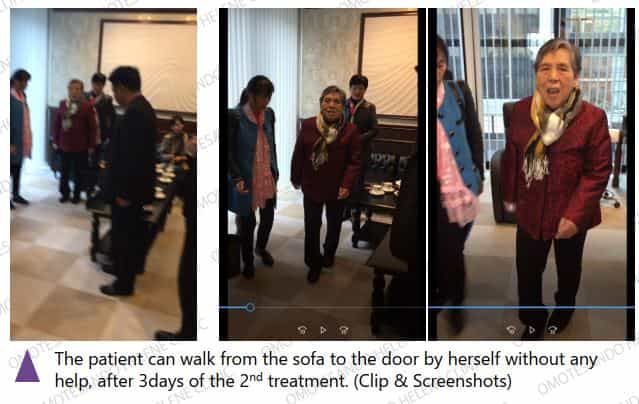
• Functional Recovery: The patient reported a rapid recovery of physical strength following the first session. Remarkably, 3 days after completing her second treatment course, the patient was able to stand up, balance safely, and walk completely unsupported. Clinical video captures and screenshots confirmed she could walk from the sofa to the door independently, returning high-level daily autonomy to her and her family.
Case Report 2: Successful Pain Management & Calcification Containment via Microcalcification Treatment in Japan
I. Patient Profile & Baseline Metrics:
Age: 45 | Sex: Female | Height/Weight: 167cm / 49kg
Lifestyle Factors: Non-smoker, does not consume alcohol.
Chief Complaints at Baseline:
1. Intractable, severe pain in the right arm and shoulder following prior surgery to excise calcified muscle tissues, with abnormal calcium deposition continuing post-operatively.
2. Forced reliance on daily medical morphine and high-dose analgesics, causing severe physical debilitation and psychological stress.
3. Routine radiological screenings subsequently revealed new microcalcifications forming in the left breast.
4. Comprehensive multi-organ testing over six months discovered expanding calcifications within other distinct soft tissues of the body, with conventional specialists offering no effective treatment plan.
II. Medical and Treatment History:
• 2015 – 2019: Diagnosed via blood tests and X-rays with severe right shoulder calcific tendonitis, completely disrupting sleep cycles. Underwent joint replacement and surgical calcification removal, followed by heavy maintenance regimens of morphine and sleeping pills. Concurrently received monthly placenta injections at Morishita Hospital in Nagoya.
• 2019 – 2020: Developed a partial rotator cuff tear alongside left breast microcalcifications. A 2019 chest CT confirmed lung fibrosis, calcification of the mediastinal artery ligament, and expanding breast clusters. Managed temporarily with Triamcinolone acetonide injections and underwent minimally invasive stereotactic breast surgery in 2020.
III. Specialized MSC Treatment Plan at Helene Clinic:
To address wide-ranging soft tissue fibrosis and cellular calcification, the clinic initiated an intensive autologous systemic protocol:
• November 2020 & November 2021: Targeted intravenous drip delivery consisting of 2.25 billion cultured autologous MSCs.
IV. Post-Treatment Progression & Feedback:
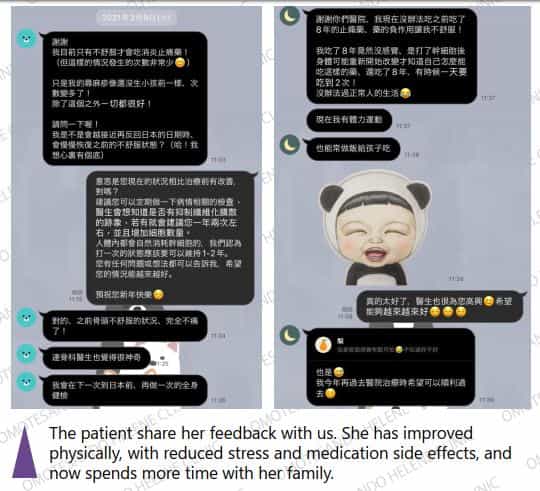
• Clinical Efficacy: Following her baseline infusions, the patient reported outcomes that far exceeded her initial expectations. Her daily physical pain dropped dramatically, allowing her to rapidly decrease and discontinue multiple daily doses of medical morphine and heavy analgesics.
• Radiological Modification: Attending physicians confirmed that the microcalcifications within her left breast had significantly decreased in size. Due to this long-term stability, her medical tracking was safely extended from a strict semi-annual checkup schedule to a relaxed two-year routine maintenance protocol.
• Systemic Recovery: Alongside profound physical relief, the psychological stress and toxic chemical side effects associated with high-dose opiates were completely resolved, allowing the patient to return to a vibrant, normal daily routine with her family.
Ready to Explore Advanced Cellular Therapies for Rare Conditions?
Take a proactive step toward stopping progressive degenerative diseases, resolving chronic pain parameters, and accessing high-potency cellular isolates. Plan an expert medical consultation regarding Microcalcification Treatment in Japan with the clinical specialists at Helene Clinic through PlacidWay Medical Tourism. Secure your comprehensive evaluation map and review autologous cellular tracking tailored specifically to your recovery profile.
Request Your Private Consultation Now









.png)
.png)
.png)
.png)








Share this listing