


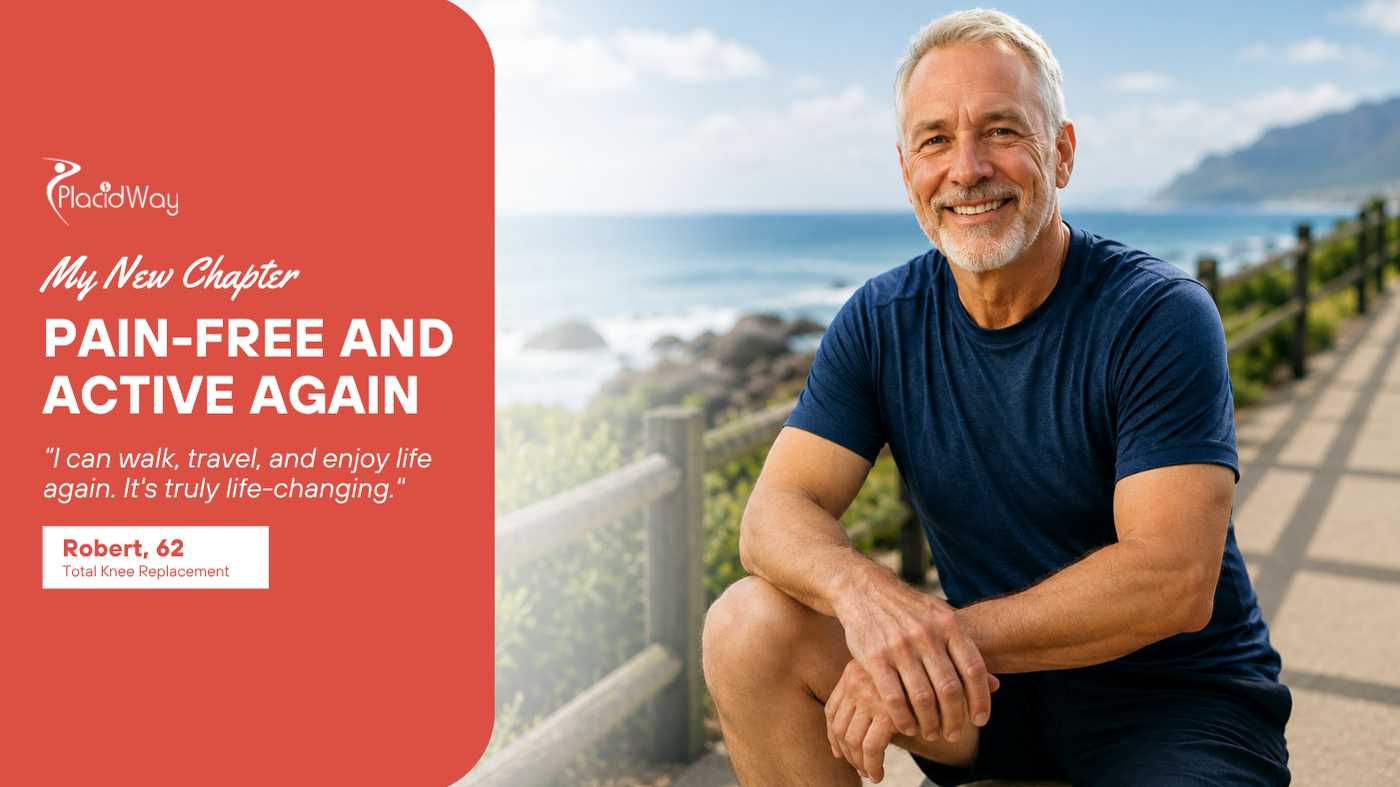
Patient Profile
- Patient Name: Robert
- Storyteller: Patient (First-Person)
- Age: 62
- Profession: Construction Manager
- City of Residence: Calgary, Alberta
- Home Country: Canada
- Treatment: Total Knee Replacement
- Destination City: Tijuana
- Destination Country: Mexico
- Provider: Hospital CYNTAR
Journey at a Glance
- Diagnosis: Severe osteoarthritis in the right knee
- Local barrier: 18-24 month waitlist for public surgery
- Reason for treatment abroad: Needed to save his career before forced retirement
- Treatment decision: Pay out-of-pocket in Mexico for immediate care
- Destination country: Mexico
- Time abroad: Short hospital and hotel stay
- Recovery status: Four months post-surgery, ongoing physical therapy
- Current outcome: Back at work, grinding pain gone, building stamina
If you have never worked construction in Calgary during November, it is hard to explain what the cold does to the ground. The mud freezes into uneven, jagged ridges. Walking across a foundation site feels like walking across a rocky beach that has been sprayed with liquid nitrogen. You need heavy steel-toe boots, and you need good balance. For thirty-five years, I walked those sites without thinking about it. But by the time I turned sixty-two, every single step on my right leg was something I had to plan.
I am a construction manager. My job is to be out there, checking the framing, arguing with contractors, and climbing up three flights of temporary scaffolding to make sure things are being done right. I don't sit behind a desk looking at spreadsheets all day. I have an office in a trailer, but if you stay in the trailer, you lose control of the site.
The problem started as a dull ache. Over a few years, it turned into a sharp, grinding pain every time I bent my right knee. My doctor took an X-ray and told me the cartilage was gone. Severe osteoarthritis. It was bone rubbing on bone. Every time my heel hit the frozen dirt, the shock traveled straight up my leg, and it felt like someone was driving a nail into the side of my kneecap.
I started avoiding parts of the job site. I would stand at the bottom of the ladder and yell up at the guys instead of climbing it to check the work myself. I knew they noticed.
I was hiding it as best as I could. I started taking high doses of ibuprofen just to get through a shift. When I got home, I would collapse into my armchair and refuse to move for the rest of the evening. My wife, Sarah, stopped asking me to go for walks or to run out to the grocery store. She knew that once I took my boots off, I was done for the night. I was angry all the time, mostly at myself, because I felt my body shutting down long before my mind was ready to quit.
The Alberta Waitlist Was a Death Sentence for My Career
I finally gave in and went to the specialist, expecting them to schedule a surgery date. I live in Canada. We are told our healthcare system will take care of us when we really need it. The specialist looked at my X-rays, agreed that I needed a total knee replacement, and then handed me a piece of paper that changed everything.
He told me I was going on the waitlist. When I asked how long the wait would be, he wouldn't look me in the eye. He finally said it would be at least eighteen to twenty-four months just to get a confirmed surgical date. Not to get the surgery. Just to get the date.
I sat in my truck in the hospital parking lot and did the math. I was sixty-two. Two years of waiting meant I would be sixty-four. I knew exactly what was going to happen. I couldn't survive two more Calgary winters walking on a bone-on-bone knee. Within six months, I would be forced to step down or take early retirement. I am not a wealthy man. We have a mortgage. We have plans for our actual retirement. Being forced out of my career three years early because of a bad joint was going to ruin us financially, and honestly, it was going to ruin my pride.
I called Sarah from the truck. I told her the timeline. She went quiet on the phone. We both knew the public healthcare system had just told me my pain wasn't urgent enough to matter, but to my employer, my lack of mobility was eventually going to be a liability.
Finding a Private Option Without Remortgaging the House
I started looking for private options. I figured maybe I could just pay for it locally or go down to the United States. I called a private clinic in Alberta, and they quoted me a price that was roughly the cost of a new pickup truck. The quotes I got from hospitals in Montana and Washington State were even worse. It just wasn't an option.
One of the older guys I used to work with told me he got his shoulder done in Mexico a few years back. At first, I laughed at him. I am a pragmatic guy. I build things to code in Canada. The idea of going to Mexico for major joint surgery sounded reckless. But as the winter set in and the pain in my knee got so bad that I couldn't sleep through the night, I started searching online.
I found out that Tijuana is basically a hub for this kind of thing. I read about different hospitals, but I honestly didn't have the patience to figure out how to arrange medical records, book a surgeon, and handle the language barrier all by myself. I found a company called PlacidWay while reading a forum. They are coordinators. I contacted them, sent over my X-rays, and told them I wanted to go to Hospital CYNTAR in Tijuana. They handled the back-and-forth emails, got me a quote that was actually affordable, and locked in a surgery date for late February. It was a purely practical decision. I paid my deposit, told my boss I was taking medical leave, and packed a bag.
Waking Up in Tijuana and Facing the Brutal Reality
The lights in the recovery room at Hospital CYNTAR were bright, and my mouth tasted like dry cotton. I remember waking up and feeling a heavy, dead weight where my right leg used to be. The surgery was done.
I don't remember much about the hospital stay itself, just the steady beep of the monitors and the nurses coming in to check my vitals. They were professional, the room was quiet, and the surgeon came by to tell me everything went exactly as planned. He said the joint was securely in place. But the reality of what I had done didn't hit me until the nerve block completely wore off the next day.
People talk about knee replacements in Tijuana like you just get a new part installed and walk out the door. It is not like that. It felt like someone had taken a sledgehammer to my thigh bone and then wrapped the whole area in tight, burning wire. The physical therapist came into my room and told me it was time to stand up. I looked at her like she was crazy. I am a big guy, used to telling other people what to do, but in that hospital bed, I felt completely helpless.
Getting out of bed took five minutes. Putting weight on the leg sent a shockwave of stiff, heavy pressure up my side. I used a walker to take three steps across the room, and I was sweating through my hospital gown by the time I turned around. The clinic staff told me this was normal, that the joint was strong, but the muscles and tissues had been severely traumatized. I realized then that the surgery was only the easy part. The real work was going to be the recovery.
The Slow Process of Getting My Right Leg Bending Again
The next few weeks were a blur of frustration. Getting back home to Calgary was exhausting, but being in my own house didn't make the physical therapy any easier. I had exercises I had to do three times a day. Leg lifts, heel slides, trying to force the knee to bend.
My knee was swollen to the size of a melon. It was tight and hot to the touch. The goal was to get a 90-degree bend so I could eventually sit in the driver's seat of my truck again. Every day, I sat on the edge of the bed, gripping the sheets, pulling my heel back until my eyes watered. There were days when I made no progress at all. There were mornings when I woke up stiff and thought I had made a terrible mistake. I missed work. I hated being stuck in the house. I hated having Sarah bring me ice packs.
It was slow. Very slow. But somewhere around week six, I noticed that I had walked from the kitchen to the living room without the cane. And more importantly, the pain I felt was surgical pain muscle soreness and stiffness. The old pain, that sharp, bone-on-bone grinding that used to drop me to my knees, was completely gone. The joint itself felt solid. It felt like a piece of steel.
I started pushing harder in physiotherapy. The therapist told me my range of motion was getting better. By week eight, I managed to climb into my truck. It was tight, and my knee protested, but I could sit behind the wheel.
Back in Calgary and Back on the Frozen Dirt
It has been four months since I went down to Hospital CYNTAR. I am not going to sit here and say my knee feels like it did when I was twenty-five. It doesn't. When the weather changes or when a cold front moves in, the joint feels stiff. It clicks sometimes when I stand up too fast. I still have some numbness on the outside of the scar.
But last week, I went back to work full-time. I parked my truck at a new foundation site on the edge of the city. The ground was that familiar, frozen, uneven mud. I laced up my steel-toe boots, put on my hard hat, and walked out onto the site. I walked across the ruts. I stood at the bottom of the temporary scaffolding, grabbed the rail, and climbed up to the second floor without hesitating.
The younger guys were up there, surprised to see me. I didn't say anything about it. I just looked at the framing, pointed out a mistake they needed to fix, and climbed back down.
I still do my stretches every morning, and I still ice it if I have been on my feet for ten hours. But I am back to doing my job. The public system wanted me to sit in a chair for two years and watch my career fade away. I chose to take control of the situation instead. It was expensive, it was painful, and the recovery tested my patience more than anything I have ever done. But as I sit here lacing up my boots for another shift, I know I made the right call.
Ready to Take Control of Your Healthcare Timeline?
If waitlists are threatening your career, explore accredited international clinics and compare detailed quotes to find a solution that works for you.
Start a Personalized InquiryRemember to compare multiple facilities, verify your surgeon's credentials, and ask exactly what is excluded from your quote.
Disclaimer: This story is a fictionalized narrative based on a representative patient persona. It contains logically invented details designed to reflect common patient experiences. This is not a verified testimonial for Hospital CYNTAR, PlacidWay, or any specific medical provider, nor does it guarantee specific surgical outcomes. It should not be interpreted as medical advice. Always consult a qualified healthcare professional regarding joint replacement surgery and rehabilitation.







.png)









Share this listing