


3D Printed Total Ankle Arthroplasty in Beijing, China by AMCare
Living with severe joint degradation can make every single step an agonizing experience. For decades, patients suffering from end-stage ankle arthritis were presented with limited, mobility-restricting surgical options. Today, a medical breakthrough is changing lives globally. By opting for advanced Total Ankle Arthroplasty in Beijing China, patients are unlocking unprecedented access to state-of-the-art 3D-printed custom ankle prostheses. This revolutionary approach seamlessly merges cutting-edge biomedical engineering with world-class surgical expertise, offering highly personalized joint replacements, drastically reduced operating times, and a robust pathway back to pain-free mobility.
Video Chapters & Quick Navigation
The Devastating Burden of Ankle Arthritis
The human ankle is a complex, weight-bearing marvel of biological engineering, designed to absorb tremendous amounts of kinetic energy with every step we take. Unfortunately, when the protective cartilage within this crucial joint begins to deteriorate due to osteoarthritis, rheumatoid arthritis, or severe post-traumatic injury, the resulting bone-on-bone friction causes debilitating pain. Patients often find themselves altering their gait to avoid discomfort, which inevitably leads to secondary issues in the knees, hips, and lower back.
Living with chronic ankle pain restricts a patient's ability to participate in daily activities, exercise, and enjoy a high quality of life. For many years, the standard of care for severe ankle joint degradation was ankle arthrodesis, commonly known as ankle fusion. While effective at eliminating pain, this procedure permanently locks the joint in place with screws and plates, permanently sacrificing the natural range of motion.
The Evolution of Total Ankle Replacement Surgery
Recognizing the limitations of joint fusion, medical science pivoted toward joint replacement, aiming to replicate the success seen in knee and hip arthroplasty. Early iterations of ankle replacements struggled due to the unique, multi-directional biomechanics of the ankle. However, modern implant designs have drastically improved, moving closer to mimicking the exact natural anatomy of the human foot.
As highlighted in the video [00:15], leading orthopedic experts like Prof Yong WU have spent years developing and perfecting these advanced surgical techniques within China. The latest generation of ankle replacements no longer relies on a one-size-fits-all methodology. Instead, the medical field has embraced hyper-personalization, realizing that every patient's bone structure, deformity angle, and ligament tension is entirely unique.
Understanding Patient-Specific Instruments (PSI)
The true revolution in modern orthopedic surgery lies in the implementation of 3D-printed customized surgical guides. In the medical community, this is referred to as Patient-Specific Instrument (PSI) technology. As Prof Yong WU expertly explains at [02:45], PSI represents a tailored approach where implant components and the specific tools used to place them are engineered exclusively for one individual patient.
Traditional orthopedic surgeries require surgeons to use standard alignment jigs and measuring tools during the operation to determine the correct angles for cutting the bone (osteotomy). This manual, intraoperative calculation can lead to minute human errors, extending the time the patient spends under anesthesia. PSI technology entirely removes this guesswork by shifting the critical decision-making process to a virtual environment long before the first incision is ever made.
How 3D Printing Transforms Orthopedics
Three-dimensional printing allows medical manufacturers to create highly complex, patient-matched structures using biocompatible materials. Once a patient's anatomical data is securely processed, massive medical-grade 3D printers lay down microscopic layers of medical plastics and titanium to build the surgical guides and trial molds. These guides are designed to fit perfectly onto the patient's existing bone structure like a puzzle piece, ensuring the surgeon can only make cuts at the pre-calculated, perfect angle.
The Meticulous Pre-Surgical Planning Process
The success of a bespoke ankle replacement is heavily dependent on the quality of the data gathered before the surgery. The process of creating a custom 3D printed ankle prosthesis begins in the radiology department. As detailed at [01:30] in the video, standard two-dimensional X-rays are insufficient for this level of precision.
Patients undergo a comprehensive series of High-Resolution Computed Tomography (CT) scans. This typically includes a full-length scan of the tibia, a detailed scan of the ankle joint itself, and scans of the lower extremities. Gathering imaging data of the entire leg is critical because it allows the medical team to map the exact mechanical weight-bearing axis of the patient's body. The new joint must be perfectly aligned with this axis to ensure longevity and prevent premature wear of the implant materials.
Engineer and Surgeon Collaboration
Once the vast amount of CT imaging data is collected, it is handed over to specialized biomedical engineers. Using highly advanced 3D reconstruction software, the engineers build a perfect virtual replica of the patient's damaged joint. In this virtual space, they can digitally remove osteophytes (bone spurs), correct severe deformities, and simulate the exact placement of the titanium implant.
As noted at [02:00], this digital roadmap is then sent directly to the lead surgeon for rigorous review. The surgeon meticulously evaluates the proposed plan, analyzing the osteotomy depth, the prosthesis sizing, and the overall joint alignment across the coronal, sagittal, and horizontal planes. Only when the surgeon is completely satisfied with the digital simulation is the data sent to the manufacturing facility for 3D printing.
Inside the Operating Room: Precision and Speed
The true magic of the PSI methodology is witnessed inside the operating theater. Because the extensive planning and alignment calculations have already been finalized virtually, the actual surgical execution becomes highly streamlined and exceptionally precise. The surgeon opens the joint and applies the 3D-printed custom guide directly to the bone. Because the guide is molded to the specific contours of the patient's damaged bone, it snaps perfectly into place.
With the guide securely fastened, the surgeon uses built-in slots to guide the surgical saw. This guarantees that bone removal is executed with sub-millimeter accuracy. The profound impact of this efficiency is highlighted at [00:40], where Prof Yong WU explains that an entire total ankle replacement—including suturing the skin—can now be completed in under one hour.
In remarkable cases where the initial positioning is flawless, the core surgical procedure can be concluded in as little as 40 minutes [00:50]. This represents a monumental leap forward compared to traditional ankle arthroplasty, which historically required three to four hours of complex surgical labor and prolonged anesthesia exposure.
| Feature / Comparison | Traditional Ankle Replacement | Custom 3D Printed PSI Replacement |
|---|---|---|
| Pre-Surgical Planning | Based on standard 2D X-rays; general estimation. | 3D virtual simulation using comprehensive full-leg CT scans. |
| Surgery Duration | Typically 3 to 4 hours. | Often completed in under 1 hour (40-60 minutes). |
| Fluoroscopy (Radiation) Use | High frequency required to manually check alignment intraoperatively. | Significantly reduced (often under 10 uses) due to precise pre-planning. |
| Implant Fit & Accuracy | Standard off-the-shelf sizing; relies on manual shaping. | Sub-millimeter accuracy tailored to the exact anatomy of the patient. |
| Infection Risk | Higher due to prolonged open-wound exposure and tissue trauma. | Lowered significantly due to minimized operative time and rapid closure. |
The Compounding Benefits of Fast, Precise Surgery
Reducing surgical time from several hours down to a mere 40 to 60 minutes creates a cascade of physiological benefits for the patient. Prolonged surgeries expose open tissues to the ambient air of the operating room for longer durations, inherently increasing the risk of bacterial contamination. By dramatically slashing the time the wound is open, the 3D-printed PSI technique organically reduces post-operative infection rates [01:05].
Furthermore, shorter surgeries mean less time under general anesthesia. Anesthesia, while safe, places stress on the cardiovascular and respiratory systems. Minimizing this stress allows patients to wake up faster, experience less post-operative nausea, and begin their physical rehabilitation sooner.
- Minimized Radiation Exposure: Because the alignment is guaranteed by the custom guide, surgeons do not need to constantly take intraoperative X-rays (fluoroscopy) to check their work. As noted at [03:40], radiation use drops to under 10 times per procedure, protecting both the medical staff and the patient.
- Preservation of Healthy Bone: The extreme accuracy of the pre-planned osteotomy ensures that only the strictly necessary amount of diseased bone is removed. Preserving healthy bone stock is vital for the long-term stability of the implant.
- Additional Deformity Correction: The detailed planning allows surgeons to identify soft tissue issues prior to surgery. For example, if a patient has a severely contracted Achilles tendon preventing proper dorsiflexion, the surgical team can plan an Achilles tendon lengthening procedure alongside the joint replacement [03:10].
Why Medical Tourists Are Choosing Beijing for Orthopedic Excellence
For patients residing in the United States, Canada, the UK, or Australia, accessing top-tier 3D printed ankle arthroplasty can be hindered by exorbitant domestic healthcare costs, agonizingly long public health waitlists, or a lack of localized surgical expertise in this specific niche.
This reality has fueled a surge in international medical tourism directed toward Beijing, China. Hospitals and specialty clinics in Beijing are equipped with next-generation medical infrastructure that rivals or exceeds the most prestigious facilities in the West. More importantly, highly esteemed surgeons like Prof Yong WU bring decades of specialized experience and thousands of successful case studies to the operating table. The synergy of a highly practiced surgical team—where an entire procedure flows seamlessly through mere eye contact and unspoken coordination—guarantees a world-class standard of care.
By partnering with established healthcare facilitators like PlacidWay Medical Tourism, international patients can access comprehensive, transparently priced medical packages. These packages frequently encompass the advanced 3D CT scans, the custom engineering of the PSI guides, the premium titanium ankle prosthesis, hospital stays, and dedicated post-operative care, all at a highly competitive price point compared to Western medical systems.
Comprehensive Recovery and Rehabilitation Protocols
The success of a Total Ankle Surgery in China utilizing 3D PSI technology does not end when the patient leaves the operating room. A rigorously structured, customized post-operative rehabilitation program is paramount for achieving the optimal range of motion and returning to a high-impact lifestyle.
Because the PSI methodology results in vastly reduced trauma to the surrounding ligaments and soft tissues, patients typically experience a notably accelerated initial healing phase. Within the first few days, pain management is closely monitored, and patients are gently encouraged to begin non-weight-bearing movement to promote blood circulation and prevent deep vein thrombosis (DVT).
As the bone begins the critical process of osseointegration—where the patient's natural bone grows into and fuses with the porous surface of the titanium implant—physical therapists introduce progressive weight-bearing exercises. The overarching goal is to achieve a holistic, integrated treatment process. This involves extensive pre-surgical education so the patient knows exactly what to expect, precision execution during the surgery, and relentless, guided physical therapy in the months that follow.
Ready to Reclaim Your Mobility in Beijing?
Don't let chronic ankle pain dictate your life. Connect with world-renowned orthopedic surgeons in China through PlacidWay. Access cutting-edge 3D printed custom prosthetics and experience unparalleled medical care at a fraction of the cost.
GET YOUR FREE MEDICAL CONSULTATIONView Translated Video Transcript
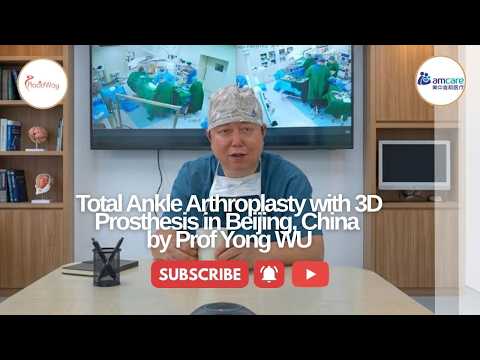
[00:05] We have just completed a total ankle arthroplasty using a 3D-printed customized surgical guide.
[00:15] We have been actively developing and performing this specific surgery domestically in China for over three years.
[00:25] This surgical approach is exceptionally precise. When compared to traditional methods and conventional alignment tools, this bespoke positioning system simplifies the entire intraoperative process tremendously.
[00:40] The surgery we just concluded, from the initial incision all the way through to suturing the skin, was finished in less than one hour.
[00:50] Because the surgical guide ensures that the positioning is perfectly accurate right away, if we succeed smoothly on the first try, the entire procedure can end in about 40 minutes, including skin closure.
[01:05] This efficiency provides numerous advantages for the patient, primarily a significant reduction in the risk of wound infection due to less exposure time.
[01:15] This is unequivocally the future direction of joint replacement. However, using 3D-printed custom guides does require substantially more preparation and work before the surgery takes place.
[01:30] The overall process works roughly like this: First, we must obtain complete, highly detailed imaging data of the patient. This includes a full-length CT scan of the tibia, a detailed CT scan of the ankle joint itself, and a CT scan of the lower extremities.
[01:45] Our biomedical engineers utilize this extensive data to reconstruct a 3D digital model, accurately simulating the patient's real anatomical situation.
[02:00] Based on the specific requirements provided by the surgeon, the engineer formulates a surgical plan and transmits this proposed plan back to the surgeon for review.
[02:15] I thoroughly review the proposal. If the plan is optimal—meaning the placement of the prosthesis, the size of the bone osteotomy, and the alignment across the coronal, sagittal, and horizontal planes are all perfectly reasonable—I approve the plan.
[02:30] Following my approval, the data is sent to the manufacturing facility. The factory creates a customized guide (often made of biocompatible plastic) and an osteotomy trial mold based exactly on my approved plan.
[02:45] This trial mold is tailored completely according to the patient's specific anatomical deformity. In medical terms, this is called PSI, which stands for Patient-Specific Implant and Instrument.
[02:55] Because it is customized, this plan is highly precise and tailored specifically to the individual patient's ankle condition.
[03:10] Of course, there are sometimes necessary additional operations. For instance, if a patient has long-term inability to dorsiflex and their Achilles tendon is severely contracted, we will perform an Achilles tendon lengthening procedure alongside the joint replacement.
[03:25] Overall, this surgery accurately executes the meticulous pre-operative plan, saving a massive amount of surgical time. In the past, similar surgeries took us three to four hours; now, we have perfected the workflow to complete it in under an hour.
[03:40] Our team is highly coordinated. After performing hundreds of these specialized cases, our synergy is so refined that a simple glance communicates the next operational step. The intraoperative use of radiation (fluoroscopy) is kept well under 10 times, heavily reducing radiation exposure, which protects both the patient and the medical staff. This represents a complete, integrated principle of treatment: pre-operative education, intraoperative precision, and post-operative rehabilitation.









.png)
.png)
.png)




.png)
.png)








Share this listing