


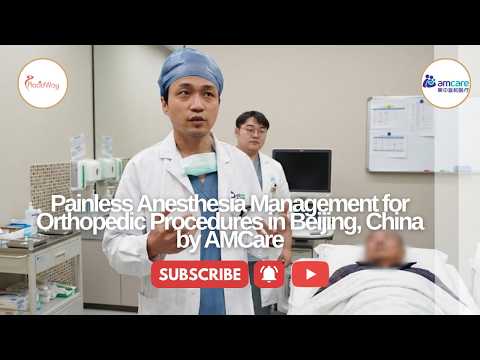
Advanced Pain Control for Orthopedic Surgery in Beijing, China by AMCare
About this video: Living with chronic orthopedic pain can feel like a lifelong sentence, but modern medical advancements in Beijing are rewriting the narrative for international patients. While traditional pain management often relies on generalized treatments, Dr. Xu Ting at AMCare is pioneering a shift toward precision-guided, painless anesthesia management. This approach doesn't just mask the symptoms; it utilizes high-definition ultrasound guidance to target the exact source of inflammation, offering relief even to those who have struggled for years with unsuccessful surgeries.
Watch this detailed medical insight to understand how breakthrough diagnostic injections and specialized nerve nutrition therapy are helping patients regain mobility without the need for invasive surgical intervention. Discover why Orthopedic Care in China has become a premier destination for those seeking sophisticated, non-surgical orthopedic solutions.
Video Chapters & Quick Navigation
Medical tourism in China has expanded beyond traditional medicine to include high-tech orthopedic interventions. Patients suffering from long-term joint issues are finding that specialized anesthesia management can provide a "reset" for their bodies, allowing natural healing to take place where it was previously blocked by chronic inflammation.
Understanding Precision Anesthesia Management in Beijing
Precision anesthesia management is a specialized field that focuses on the exact delivery of medication to nerve centers or inflamed tissues. Unlike general anesthesia used for major surgeries, this technique is used both for immediate pain relief and as a long-term therapeutic tool.
At the [00:00:33] mark, Dr. Xu Ting explains the composition of the therapeutic cocktail used: a combination of long-acting corticosteroids, local anesthetics, and nerve nutrition medications. This triple-action approach reduces local inflammation, blocks pain signals, and provides the biological building blocks necessary for nerve repair.
The Role of Ultrasound Guidance in Pain Relief
One of the most significant advancements discussed in the video is the move away from "blind" injections. In the past, doctors relied on physical touch and anatomical landmarks to guess the site of an injection, which often led to errors and reduced efficacy.
Eliminating Errors with Visual Precision
[00:01:14] Ultrasound-guided intervention allows the physician to see the needle and the target tissue in real-time. By using a monitor to display the internal structures, Dr. Xu Ting ensures the medication is delivered precisely around the bone spurs or within the fascia layers where the pain is most acute.
This level of accuracy is critical for conditions like plantar fasciitis or sacroiliac joint dysfunction, where even a few millimeters of deviation can mean the difference between total relief and continued suffering. This visual confirmation minimizes the margin of error and maximizes the therapeutic outcome.
Solutions for Long-Term Chronic Pain and Failed Surgeries
A poignant example shared by Dr. Xu [00:02:02] involves an elderly patient who had previously undergone open spinal surgery with internal fixation. Despite the major surgery, the patient's pain persisted for years, leading to a distorted gait and a significant decline in quality of life.
| Feature | Traditional Approach | Precision Management (Beijing) |
|---|---|---|
| Injection Technique | Blind / Palpation-based | Ultrasound & C-arm Guided |
| Medication Focus | Pain suppression only | Anti-inflammatory + Nerve Nutrition |
| Diagnostic Value | Low | High (Locates source of pain) |
Integrating Nerve Nutrition into Orthopedic Care
Effective anesthesia management in Beijing goes beyond simply "numbing" the area. The inclusion of nerve nutrition agents is a strategic choice designed to support the body’s own healing mechanisms. When a nerve has been compressed or inflamed for years, it requires specific nutrients to recover its functional integrity.
[00:03:24] During the procedure, the delivery of these nutrients directly to the affected site allows for a more robust recovery. This is particularly beneficial for elderly patients whose natural regenerative capacity may be slower. By providing these biological tools at the site of the injury, the treatment facilitates a faster return to normal activity.
The Power of Diagnostic-Led Treatment
A key takeaway from Dr. Xu's methodology is that these injections serve a dual purpose: therapy and diagnosis. For many patients, the exact source of their pain is a mystery. Is it the lower spine, or is it the sacroiliac joint?
[00:02:43] By performing a targeted injection with local anesthetic, the physician can confirm the diagnosis. If the patient experiences immediate relief, it confirms that the injected area is indeed the source of the problem. This "instant feedback" [00:03:31] prevents patients from undergoing unnecessary, high-risk surgeries for the wrong condition.
Post-Treatment Recovery and Long-Term Mobility
The procedure is only the first step. Dr. Xu emphasizes that the primary goal of the treatment is to eliminate local inflammation so that the patient has a "window of opportunity" for rehabilitation. Without the barrier of acute pain, patients can engage in the physical therapy necessary to correct gait issues and muscle imbalances.
[00:01:34] Following the precision injection, a protocol of rest is typically required—often involving three weeks of limited weight-bearing to allow the inflammation to subside fully. This structured approach ensures that the immediate relief provided by the anesthesia management translates into long-term orthopedic success.
Why Beijing for Orthopedic Medical Tourism?
Choosing Beijing for these procedures offers access to specialists like Dr. Xu Ting who utilize hybrid guidance—combining C-arm X-ray positioning with real-time ultrasound [00:03:16]. This dual-layer of technology ensures the highest safety standards and the most effective delivery of orthopedic care available globally.
Connect with Orthopedic Specialists in Beijing
PlacidWay Medical Tourism facilitates access to world-class pain management and orthopedic centers in China. Discover how precision-guided treatments can help you avoid unnecessary surgery and regain your mobility.
REQUEST A CONSULTATIONView Full Video Transcript
[00:00:00] Two treatments are usually enough. Actually, some elderly people have a better tolerance for pain.
[00:00:03] So after the injection, the effects can last for a relatively long period of time.
[00:00:09] The purpose of our treatment is to first eliminate the local inflammation and then give the body a chance to recover on its own.
[00:00:16] Therefore, after this treatment, rehabilitation therapy still needs to follow up.
[00:00:19] Additionally, it depends on the patient's own individual repair ability.
[00:00:25] This is actually a very routine treatment, and most results are quite good. I will press down to find the most painful spot.
[00:00:29] Where does it hurt the most? Is this the spot? The medication we use is a long-acting hormone to reduce local inflammation.
[00:00:37] There is also a local anesthetic and nerve nutrition medicine. It is injected between the painful fascia layers.
[00:00:44] We just saw an 80-year-old patient who has suffered from plantar fasciitis for 5 or 6 years.
[00:00:48] He tried many places but didn't see good results, so he came to us. We perform a block treatment at the pain point under ultrasound guidance.
[00:00:56] Traditional block treatments are basically "blind" injections based on pressure and pain points.
[00:01:03] They find the most obvious pain point and then perform the puncture. The problem with this is that it's a blind puncture and has a certain margin of error.
[00:01:10] To minimize this error, we use ultrasound guidance. The monitor shows the specific area.
[00:01:17] We perform the local block around the bone spur of the plantar fascia. Local drug delivery is more accurate, and the effect is better.
[00:01:25] This allows a patient with a long-standing condition to receive precise treatment and relief.
[00:01:34] After that, some rest is required—no weight-bearing for three weeks. After three weeks, they can gradually start walking again.
[00:01:42] This allows the local inflammation to be relieved and the muscle tension to decrease, facilitating better recovery.
[00:01:50] As soon as the patient walked in, their gait caught our attention. In common terms, they were limping heavily to one side.
[00:01:58] It was clear this disease had a huge impact on them. This elderly person had undergone open spinal surgery for internal fixation years ago.
[00:02:06] After the surgery, the symptoms did not improve. Subsequent check-ups at other hospitals treated it as a spinal issue, but with no success.
[00:02:20] After coming to us, I examined them and looked at the medical history. I suspected it was more likely a sacroiliac joint issue.
[00:02:28] We suggested trying pain treatment for the sacroiliac joint first. This treatment has two benefits.
[00:02:32] One is immediate relief and effective relief for a period afterward. Second, it is a diagnostic treatment.
[00:02:43] Because we include local anesthetics, if the symptoms are caused by that joint, the effect will be immediate.
[00:02:53] Conversely, if it's not a joint issue, the injection won't have an effect. But this patient is special because of the history of long-segment spinal surgery.
[00:03:08] Years of bad gait made the treatment challenging. In the procedure room, we first used C-arm X-ray for positioning.
[00:03:21] Then we used real-time ultrasound guidance to inject local anesthesia, corticosteroids, and nerve nutrition near the joint.
[00:03:31] Ten minutes after the injection, the patient got off the bed and the symptoms had improved. Not only did we relieve the pain, but we also solved a years-long mystery of why they weren't getting better.
[00:03:42] Next, we suggest they proceed with further rehabilitation. With a clear diagnosis, it answers another big question: do they need more surgery?
[00:03:51] For this sacroiliac joint issue, surgery may not be necessary, at least in the short term.
-Diagnosis-and-Integrated-Management-Package-in-Beijing,-China-by-AMCare.jpg)
-Using-Suture-Button-Fixation-in-Beijing,-China-by-AMCare.jpg)


.png)








Share this listing