
Alternative cancer therapies can sound promising, but the most important step is separating proposed benefits from established evidence. If you are considering sonodynamic or biomagnetic treatment for lung cancer in Tijuana, careful evaluation of the therapy, provider, and follow-up plan is essential.
A lung-cancer diagnosis can make every new option feel urgent. Tijuana is close to the United States and has private centers that market programs under terms such as “sono dynamic therapy,” “sonodynamic therapy,” “biomagnetic therapy,” or “biomagnetic pair treatment.” These names can sound scientific, but they do not establish that a treatment improves survival, shrinks lung tumors, or has been approved for that purpose.
This guide is designed for comparison and due diligence, not promotion. It explains what these approaches are claimed to do, where the evidence currently stands, how they differ from established oncology, what costs may arise, and how to verify a provider in Mexico. Neither proposed therapy should replace prompt evaluation by a qualified thoracic oncologist.
Why Patients Consider Alternative Lung Cancer Treatment in Tijuana
Patients usually explore Tijuana after hearing that a treatment is gentler, more targeted, less expensive, or available sooner than care at home. Some want another option after progression, while others fear chemotherapy or have been told that surgery is not possible. Caregivers may also be searching for hope when standard treatment has stopped working. Those motivations are understandable, but marketing language should never substitute for a diagnosis-specific risk-benefit discussion.
Convenience is another factor. Tijuana can be reached by road from Southern California, and some centers coordinate airport pickup, lodging, translation, and appointments. A packaged experience may reduce logistics, but it can also blur the distinction between medical charges and travel services. Patients should request separate prices, the legal name of every facility, and the name and credentials of each physician who will make clinical decisions.
Alternative cancer care is not one category. Evidence-based supportive measures—nutrition counseling, smoking cessation, symptom control, pulmonary rehabilitation, psychological support, and palliative care—can complement oncology when coordinated safely. By contrast, a service marketed as destroying cancer cells must be judged as an anticancer intervention. It needs credible human evidence, standardized delivery, regulatory oversight, transparent adverse-event reporting, and a clear role alongside or within established treatment.
Important distinction: Choosing comfort-focused care is a legitimate medical decision. Replacing proven treatment with an unvalidated tumor-control claim is a different decision and may allow the cancer to progress during a time when effective treatment is still possible.
How Sonodynamic Therapy Is Proposed to Work for Lung Cancer
Sonodynamic therapy, often abbreviated SDT, is an experimental approach that combines ultrasound energy with a substance described as a sonosensitizer. In preclinical models, ultrasound may activate the sensitizer and contribute to the formation of reactive oxygen species. These chemically reactive molecules can damage cell membranes, proteins, or DNA and may trigger cancer-cell death under controlled laboratory conditions.
The concept is related in name—but not clinically interchangeable—to photodynamic therapy. Photodynamic therapy uses a light-activated drug and is an established option for selected tumors in or near the airways. Sonodynamic therapy uses sound energy, different activation parameters, and often experimental sensitizers or nanoparticles. Evidence for photodynamic therapy in a limited clinical setting does not validate SDT for deep lung tumors.
The details matter. “SDT” can refer to very different sensitizers, ultrasound frequencies, intensities, treatment fields, timing, imaging methods, and combination therapies. A proposal should identify the exact drug or compound, manufacturer, regulatory status, dose route, ultrasound device, treating target, protocol, and human evidence for the same lung-cancer type and stage. A generic explanation about oxygen or immune activation is insufficient.
Lung tissue also creates technical challenges. Air affects ultrasound transmission, tumors vary in depth and location, and nearby structures may include the heart, large blood vessels, esophagus, nerves, ribs, or previously irradiated tissue. A plausible laboratory mechanism does not prove that enough energy reaches a human tumor safely or that an observed cellular effect improves survival.
What the Evidence Shows About Sonodynamic Therapy for Lung Cancer
Current lung-cancer publications on SDT largely describe cells, engineered particles, or animal tumor models. For example, recent research has tested ultrasound-responsive nanoparticles or combinations with chemotherapy in non-small cell lung cancer models. Such studies are useful for generating hypotheses, but they cannot establish a safe dose, response rate, progression-free survival, overall survival, or quality-of-life benefit in people.
Early human SDT research has focused mainly on brain tumors, including high-grade glioma. Those studies investigate specific compounds, devices, and ultrasound delivery methods in defined protocols. Results from a brain-tumor study cannot be transferred to lung cancer because anatomy, tumor biology, energy delivery, drug distribution, and safety constraints differ. A search of major trial registries should be repeated immediately before a decision because registrations can change, but patients should not interpret unrelated early-phase studies as proof for lung cancer.
A credible clinic should be able to provide a peer-reviewed human lung-cancer study of the same protocol it offers. Ask for the study design, number of participants, cancer stage, comparison group, response criteria, follow-up duration, dropouts, serious adverse events, and full publication—not only a testimonial, abstract, laboratory paper, or before-and-after image. Also ask whether scans were interpreted by an independent radiologist using accepted criteria.
| Evidence type | What it can show | What it cannot prove |
|---|---|---|
| Cell or nanoparticle study | Possible mechanism under laboratory conditions | Safety or benefit in patients |
| Animal tumor model | Biological activity and early toxicity signals | Human survival or reliable dosing |
| Uncontrolled case series | Feasibility and observations in selected patients | Whether SDT caused the outcome |
| Randomized controlled trial | Comparative benefit and harms within its studied population | Benefit outside the protocol or population |
The practical conclusion is cautious: SDT for lung cancer is investigational, and its uncertainties are substantial. If it is offered as research, request the public trial registration, ethics approval, informed-consent document, sponsor, monitoring plan, and explanation of costs. Participation in research should never be described as guaranteed benefit.
Biomagnetic Cancer Treatment Claims and Missing Evidence
Biomagnetic or biomagnetic-pair treatment typically involves placing static magnets on selected areas of the body. Promoters may say that magnetic fields correct pH imbalance, affect microorganisms, improve circulation, restore energy, or create conditions in which cancer cannot survive. These claims are not supported by reliable clinical evidence showing that the method shrinks lung tumors, delays progression, or extends life.
Cancer is not diagnosed or staged by finding magnetic “pairs,” and tumor acidity cannot be safely corrected with magnets placed on the skin. Cancer behavior is driven by genetic, cellular, immune, vascular, and environmental factors. Even if a person feels relaxed during a session, symptom relief or a supportive experience does not demonstrate tumor control.
Static magnets have been studied more often for pain than for cancer, and the U.S. National Center for Complementary and Integrative Health reports no conclusive evidence that static magnets are effective for any form of pain. That limited pain research is not evidence of anticancer activity. Patients should be especially skeptical of claims that one technique treats many unrelated diseases or works better than chemotherapy while leaving all healthy cells untouched.
Direct physical risk from a magnet applied to intact skin may appear low, but the overall medical risk can be high. Magnets can interfere with pacemakers, insulin pumps, and other implanted devices. More importantly, an ineffective program can delay surgery, radiation, systemic therapy, or urgent symptom management. It can also create financial harm and false reassurance while the disease progresses.
Evidence check: Ask the provider to identify a prospective human lung-cancer trial, the protocol, a comparison group, independently verified imaging outcomes, and peer-reviewed publication. If the response relies on testimonials, “energy balance,” or a universal cure claim, the claim is not clinically established.
Standard Lung Cancer Treatments to Compare Before Mexico Travel
Treatment begins with the correct diagnosis. Non-small cell lung cancer and small cell lung cancer behave differently. The plan also depends on stage, tumor location, lymph-node involvement, metastases, performance status, lung and heart function, prior treatment, and the patient’s goals. Pathology review and adequate tissue sampling are essential.
For non-small cell lung cancer, biomarker testing may identify changes such as EGFR, ALK, ROS1, BRAF, KRAS, MET, RET, NTRK, or HER2 alterations, while PD-L1 testing may inform immunotherapy decisions. The relevant panel depends on histology and clinical context. Beginning an alternative program before testing can waste time and obscure an effective targeted option.
- Surgery: potentially curative for selected early-stage tumors when the patient can tolerate resection.
- Radiation therapy: may be curative in selected localized disease, combined with chemotherapy in locally advanced disease, or used for symptom control and metastases.
- Chemotherapy: used alone or with radiation, immunotherapy, or surgery depending on histology and stage.
- Targeted therapy: selected according to a validated tumor biomarker rather than by diagnosis alone.
- Immunotherapy: checkpoint inhibitors may be appropriate before or after surgery, after chemoradiation, or in advanced disease depending on biomarkers and regimen.
- Supportive and palliative care: addresses breathlessness, cough, pain, appetite, anxiety, sleep, and family needs at any stage and can be provided alongside tumor-directed care.
Small cell lung cancer often grows rapidly and is commonly treated with chemotherapy, radiation, and—in extensive-stage disease for eligible patients—immunotherapy. Because timing matters, travel should not postpone a recommended start date. A home oncologist can explain what may happen if treatment is delayed by one, two, or four weeks.
Lung Cancer Trends and Patient Demographics Relevant to Tijuana
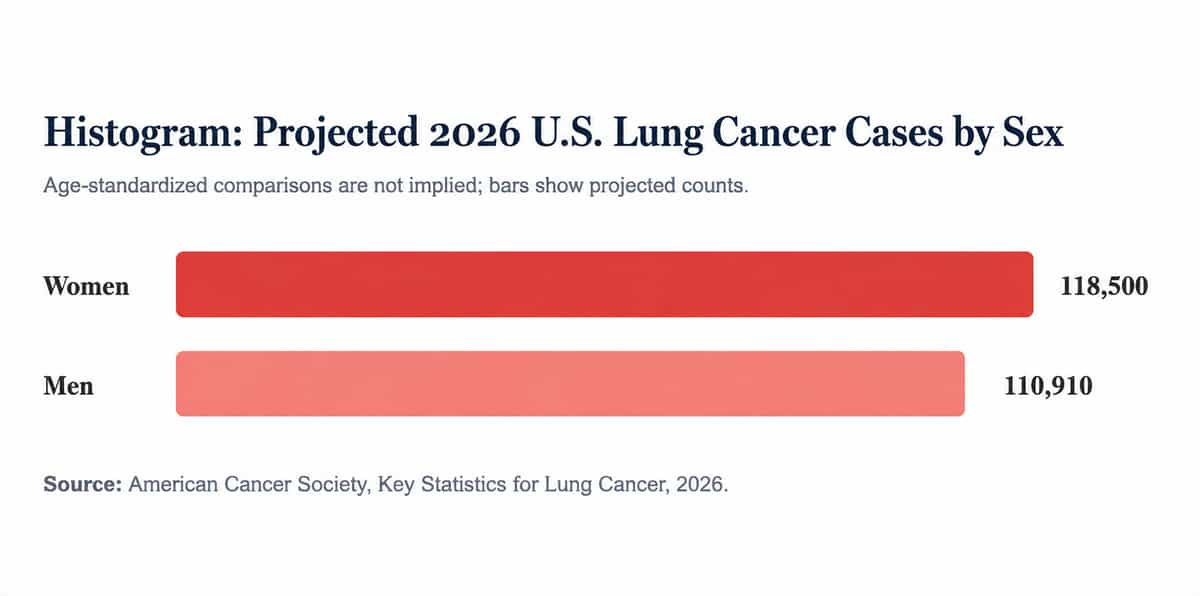
Lung cancer remains a major cause of cancer mortality. The American Cancer Society estimated about 225,000 new U.S. cases in 2025 and projects 229,410 in 2026. These are annual projections, not final observed counts, and a change between them does not show that alternative therapies are becoming more or less effective.
Line Graph: Projected U.S. Lung Cancer Cases
Annual new-case estimates, 2025–2026
Source: American Cancer Society, 2025 lung cancer data and 2026 key statistics.
Most people diagnosed with lung cancer are age 65 or older, and the average age at diagnosis is about 70. Very few are younger than 45. Older travelers may have chronic obstructive pulmonary disease, heart disease, diabetes, frailty, or oxygen needs that materially affect border travel and emergency planning.
Tijuana traveler data: Reliable public information on the national origin, age, sex, cancer stage, treatment history, outcomes, or complications of patients traveling specifically to Tijuana for lung-cancer SDT or biomagnetic treatment is information not available. Proximity makes U.S. and Canadian inquiries plausible, but inquiry geography is not evidence of clinical benefit or patient volume.
Alternative Lung Cancer Treatment Costs in Tijuana
Alternative programs are generally self-pay. Current Tijuana planning estimates are approximately $3,000–$7,000 per sonodynamic session, $500–$2,000 per biomagnetic session, and $10,000–$25,000 for a comprehensive multiweek program. These figures are not evidence of value, effectiveness, regulatory authorization, or inclusion. A lower price can still be poor value if the intervention has not been shown to help.
| Potential item | Planning range in Tijuana | Questions to ask |
|---|---|---|
| Sonodynamic session | $3,000–$7,000 | Exact sensitizer, device, imaging, physician fees, number of fields |
| Biomagnetic session | $500–$2,000 | Claimed purpose, practitioner credential, implanted-device screening |
| Multiweek alternative plan | $10,000–$25,000 | Itemized services, refund terms, exclusions, evidence for each component |
| Travel and lodging | Patient-specific | Companion, oxygen, accessible transport, border delay, extended stay |
| Emergency or hospital care | Usually separate | Deposit, ambulance, intensive care, transfer and repatriation coverage |
| Country | SDT or biomagnetic lung-cancer price comparison | Coverage context |
|---|---|---|
| Mexico | Ranges above may be used for planning; obtain a signed itemization | Typically self-pay for alternative programs |
| United States | No validated standard comparator for lung-cancer SDT or biomagnetism | Unproven care is generally not covered; standard oncology coverage varies |
| Canada | No validated standard comparator for lung-cancer SDT or biomagnetism | Provincial coverage applies to eligible standard care, not routine alternative travel |
Request a written cancellation policy and never rely on a verbal “all-inclusive” promise. Clarify pathology review, scans, blood tests, medications, physician visits, oxygen, meals, lodging, transportation, companions, taxes, complications, follow-up, and records. Ask whether a deposit is refundable if the home oncologist advises against travel.
Safety Risks and Emergency Planning in Tijuana
SDT-related risks are uncertain because the sensitizer, ultrasound device, settings, and target can vary. Potential concerns include drug reactions, pain, heating, cavitation-related injury, damage to nearby tissue, altered oxygen needs, unknown interactions with radiation or systemic therapy, and incomplete targeting. A facility should disclose known and theoretical risks in writing rather than promising “no side effects.”
Biomagnetic treatment may interfere with implanted devices. Every patient should disclose pacemakers, defibrillators, neurostimulators, insulin pumps, infusion ports, metal implants, and oxygen equipment. The larger danger remains indirect: progression during delayed or interrupted oncology care.
Before crossing the border, identify the nearest emergency department capable of managing respiratory failure, bleeding, blood clots, infection, heart problems, or neurological emergencies. Confirm who answers after hours, who pays the deposit, how records are transferred, and whether an ambulance can cross the border. Travel insurance often excludes cancer-related or planned-treatment complications, so exclusions require written review.
Seek urgent assessment for coughing up significant blood, severe or rapidly worsening breathlessness, blue lips, chest pressure, fainting, new confusion or weakness, seizure, fever with chills, low oxygen saturation, facial or neck swelling, uncontrolled pain, or inability to keep fluids down. Do not wait for a scheduled alternative-treatment appointment.
How to Choose a Licensed Lung Cancer Facility in Tijuana
Start with the facility’s complete legal name and street address. Ask for its current operating authorization, responsible medical director, and the specific COFEPRIS status of every medicine and device. A product registered for one purpose is not automatically authorized to treat lung cancer, and a legal clinic is not proof that every claim it makes is evidence-based.
- Verify the sensitizer’s generic and brand name, lot, manufacturer, storage, route, and approved indication.
- Ask for the ultrasound device model, intended use, maintenance records, operator training, and target-planning method.
- Confirm access to CT imaging, laboratory testing, oxygen, resuscitation equipment, pharmacy support, and a transfer hospital.
- Request infection-control procedures, adverse-event reporting, and proof of professional liability coverage.
- If called a clinical trial, confirm its registry number, ethics committee approval, sponsor, principal investigator, monitoring, and injury policy.
- Ask whether the facility participates in Mexico’s hospital certification process; understand that certification and treatment efficacy are separate questions.
Warning signs include a guaranteed cure, treatment without pathology review, discouraging contact with the home oncologist, requiring immediate nonrefundable payment, refusing to name the drug or device, using only testimonials, or offering the same protocol for many cancers. A trustworthy provider welcomes independent review and explains uncertainty clearly.
Patients can compare options through PlacidWay’s Mexico cancer treatment center listings, but listing information should be treated as a starting point for verification, not endorsement of a specific treatment or outcome.
How to Verify a Lung Cancer Oncologist in Mexico
Ask who is responsible for diagnosis, prescribing, ultrasound delivery, emergency decisions, and follow-up. Obtain each clinician’s full legal name, professional cédula number, specialty, and board-certificate status. Verify the cédula through Mexico’s Secretaría de Educación Pública and specialist certification through the appropriate council, such as the Consejo Mexicano de Oncología and CONACEM directories.
The lead physician should be able to interpret the pathology, TNM or limited/extensive stage, molecular testing, PD-L1 result, current scans, performance status, pulmonary function, and previous therapy. Ask how many patients with the same histology and stage the doctor has managed, what outcomes are tracked, and how complications are counted. “Cancer specialist” is not specific enough.
Arrange an independent consultation with a board-certified medical, radiation, or thoracic oncologist who does not sell the proposed alternative program. Provide the complete protocol and ask three direct questions: What proven options remain? What is the risk of delaying them? Is there a registered clinical trial with stronger oversight? A second opinion is especially important when a clinic frames SDT or biomagnetism as a replacement for chemotherapy, surgery, radiation, targeted therapy, or immunotherapy.
Travel, Recovery, and Follow-Up After Tijuana
Travel fitness depends on more than the proposed procedure. Ask the home team about oxygen needs at rest and with walking, clot risk, recent surgery, brain metastases, pleural effusion, infection, anemia, pain control, and medication timing. Bring medicines in original containers, a concise medical summary, scan images, pathology, biomarker results, allergy list, emergency contacts, and advance-care documents.
If flying, confirm airline rules for portable oxygen concentrators and batteries. If driving, plan rest stops and allow for unpredictable border queues. Patients with fragile health should travel with a capable adult who knows the medication list and emergency plan. Avoid assumptions that a same-day border return will always be possible.
Before discharge, obtain English-language records describing every compound, dose, route, device, ultrasound setting, treatment field, laboratory result, adverse event, and recommendation. Request DICOM scan files rather than screenshots. The provider should state who will review symptoms, when imaging should occur, and how suspected progression will be handled.
Schedule the home-oncology appointment before travel and avoid stopping prescribed cancer treatment without that clinician’s guidance. Post-treatment fatigue, breathlessness, fever, or chest symptoms should not be dismissed as “detox.” Recovery claims must be assessed medically, and follow-up imaging should use accepted protocols interpreted in clinical context.
Patient FAQs About Alternative Lung Cancer Therapies in Tijuana
Is sonodynamic therapy approved to treat lung cancer?
Sonodynamic therapy is investigational for lung cancer. Research publications are mainly preclinical, and early human work has focused on other tumors under defined protocols. Ask for the exact regulatory status in Mexico, human lung-cancer evidence, and trial registration; a legal ultrasound device or drug does not automatically authorize their combined anticancer use.
Can SDT replace chemotherapy or immunotherapy?
There is no reliable evidence that SDT can replace standard systemic treatment for lung cancer. Chemotherapy, targeted therapy, and immunotherapy have defined roles based on stage, histology, biomarkers, and clinical trials. Replacing them may allow progression. Discuss the exact delay and interaction risks with an independent thoracic oncologist before making changes.
Does biomagnetic therapy shrink lung tumors?
No credible clinical evidence shows that static magnet placement shrinks lung tumors, prevents metastasis, or extends survival. A person may feel relaxed during a session, but that is not tumor response. Claims should be tested with peer-reviewed human trials, comparison groups, accepted imaging criteria, and long-term follow-up—not testimonials or energy-balance explanations.
What should a Tijuana clinic provide before I pay?
Request the legal facility name, licenses, treating doctors and credentials, exact substances and devices, COFEPRIS status, protocol, evidence, informed consent, itemized price, cancellation terms, complication policy, emergency hospital, and follow-up plan. Obtain these in writing and share them with an independent oncologist. Refusal to disclose details is a major warning sign.
How much do these treatments cost in Tijuana?
Planning estimates are about $3,000–$7,000 for a sonodynamic session, $500–$2,000 for a biomagnetic session, and $10,000–$25,000 for a multiweek program. Travel, testing, medicines, complications, and follow-up may be separate. Confirm inclusions and refunds in writing; price does not establish safety, approval, or effectiveness.
Is a noninvasive treatment automatically safer?
No. A treatment can avoid an incision yet still expose patients to drug reactions, ultrasound-related tissue effects, implanted-device interference, interactions, or delayed proven care. Safety depends on the exact protocol, patient condition, operator, monitoring, and emergency readiness. Ask for adverse-event data from comparable human lung-cancer patients, not general assurances.
Can I combine SDT with standard cancer treatment?
Combination safety and benefit are not established for many SDT protocols. The sensitizer, ultrasound parameters, chemotherapy, immunotherapy, radiation fields, and timing could matter. Give both teams a complete treatment list and obtain written coordination. “Complementary” does not guarantee compatibility, and unmonitored combinations may add risk without proven benefit.
How can I tell whether a success story is reliable?
A testimonial cannot show what caused an outcome. Look for confirmed pathology, stage, biomarkers, all concurrent treatments, standardized scans, independent review, follow-up duration, and reporting of unsuccessful cases. Improvement after multiple therapies cannot be assigned to SDT or biomagnetism. Prefer complete peer-reviewed cohorts and controlled trials over selected stories.
What records should I bring home from Mexico?
Obtain the complete chart, compounds and doses, device model and settings, procedure notes, laboratory results, scan reports and DICOM files, adverse events, discharge instructions, receipts, and direct clinician contact. Records should be in English or accompanied by a reliable translation. Send them promptly to the home oncology team.
When should I seek emergency care during the trip?
Seek urgent help for major bleeding, severe breathlessness, chest pressure, fainting, blue lips, new confusion or weakness, seizure, fever with chills, rapidly falling oxygen levels, facial or neck swelling, uncontrolled pain, or dehydration. Do not wait for border travel or a clinic callback if symptoms suggest a life-threatening complication.
Who may be a poor candidate for travel?
People with unstable oxygen needs, recent severe bleeding, infection, uncontrolled pain, acute blood clots, serious heart problems, neurological symptoms, rapidly declining function, or no emergency support may face high travel risk. Suitability requires individualized assessment. Even medically stable patients need a companion, records, medicines, insurance review, and a border-delay plan.
What is a safer way to access experimental treatment?
Ask an oncologist about a registered clinical trial with a defined protocol, ethics oversight, eligibility criteria, monitoring, adverse-event reporting, and transparent consent. A trial still cannot promise benefit, but it provides stronger safeguards than an unregistered commercial program. Confirm the registry entry and contact the listed research site independently.
Compare Questions Before You Travel
PlacidWay can help you request program details to compare. Ask every provider for the exact protocol, physician credentials, regulatory status, itemized price, emergency plan, and evidence—and review the response with an independent oncologist.
Medical Disclaimer
Disclaimer: This information is for educational purposes only and does not replace professional medical advice. Always consult a qualified healthcare provider before making medical decisions.
Authoritative References
- National Cancer Institute: Non-Small Cell Lung Cancer Treatment (PDQ®)—Patient Version
- National Cancer Institute: Small Cell Lung Cancer Treatment (PDQ®)—Patient Version
- PubMed: Preclinical Sonodynamic-Chemotherapy Research in Non-Small Cell Lung Cancer
- ClinicalTrials.gov: Early-Phase Sonodynamic Therapy Study in Diffuse Midline Glioma
- National Center for Complementary and Integrative Health: Magnets—Evidence and Safety
- U.S. Food and Drug Administration: Illegally Sold Cancer Treatments

























Share this listing