
When your husband receives a prostate cancer diagnosis, questions about treatment options, specialists, and where to receive care often follow. For families exploring prostate cancer treatment in Turkey for UK patients, the most important consideration is not only whether treatment is available abroad, but whether the recommended approach is appropriate for his individual situation. Factors such as cancer stage, grade, PSA levels, imaging findings, overall health, previous treatments, and long-term follow-up needs should all be reviewed before making a decision.
Turkey has hospitals offering urology, radiation oncology, medical oncology, robotic surgery, and advanced imaging, but the quality of care and available technology can vary between centres. Before travelling, look for a facility authorised for international health tourism by the Republic of Türkiye Ministry of Health, verify the treating specialist’s qualifications, and request a written multidisciplinary treatment plan along with an itemised quote. Cost should come after clinical suitability, not before it.
Quick Summary: Prostate Cancer Treatment in Turkey for UK Families
- Possible treatments: Depending on the cancer, options may include active surveillance, prostate surgery, external-beam radiotherapy, brachytherapy, hormone therapy, chemotherapy or selected targeted/radiopharmaceutical treatments.
- USD treatment cost: There is no reliable national public USD price for prostate cancer treatment in Turkey. Obtain an individual written quote after the hospital reviews your husband's records.
- Hospital check: Confirm the facility appears on the Turkish Ministry of Health list of providers authorised for international health tourism.
- Doctor check: Ask for the urologist, radiation oncologist or medical oncologist's specialist qualifications, registration details, prostate-cancer experience and case volume.
- Clinical priority: A treatment offered in Turkey should be compared with the plan recommended by your husband's UK multidisciplinary team, not judged by technology or price alone.
- Travel caution: GHIC and EHIC cards are not valid in Turkey, so appropriate insurance and a plan for complications or medical evacuation are important.
- Before booking: Make sure you know the TNM stage, Gleason/ISUP Grade Group, PSA, imaging findings, treatment goal and expected follow-up requirements.
Understanding Your Husband's Prostate Cancer Before Considering Turkey
The right prostate cancer treatment depends first on what type of cancer your husband actually has and how far it has progressed. Two men can both be told they have prostate cancer and still need completely different approaches. Some localised cancers can safely be monitored, while higher-risk or metastatic cancers may require combination treatment.
Before requesting opinions from hospitals in Turkey, gather the same information a UK prostate cancer multidisciplinary team would use. Sending complete records reduces the risk of receiving a generic treatment recommendation based only on a diagnosis name.
| Information | Why It Matters | What to Obtain |
|---|---|---|
| PSA | Helps assess disease risk and monitor response or recurrence. | Current PSA and previous PSA trend. |
| Biopsy pathology | Shows how abnormal and potentially aggressive the cancer appears. | Pathology report, Gleason score and ISUP Grade Group. |
| TNM stage | Shows local tumour extent, lymph-node involvement and distant spread. | Staging report from the UK team. |
| MRI and other imaging | Helps define tumour location and whether disease may have spread. | Reports plus original imaging files where possible. |
| Previous treatment | Changes which surgery, radiation or medicines remain appropriate. | Operation notes, radiotherapy details and systemic-treatment history. |
| General health | Heart, lung and other conditions influence treatment benefits and risks. | Medical history, medication list and recent blood tests. |
Which Prostate Cancer Treatments May Be Considered in Turkey?
Hospitals in Turkey may offer many of the same evidence-based treatment categories used in European prostate cancer care. What is appropriate depends on whether your husband's disease is low-risk localised, intermediate-risk, high-risk, locally advanced, recurrent or metastatic.
A long list of available technologies does not mean your husband needs all of them. The treatment plan should start with disease biology and treatment goals, then identify the technology needed to deliver that plan safely.
| Prostate Cancer Situation | Options That May Be Discussed | Important Question |
|---|---|---|
| Lower-risk localised disease | Active surveillance may be appropriate for selected men. | Would immediate treatment provide meaningful benefit over monitoring? |
| Intermediate-risk localised disease | Radical prostatectomy, external-beam radiotherapy or selected brachytherapy approaches may be considered. | How do cancer control, urinary and sexual side effects compare? |
| High-risk or locally advanced disease | Multimodal treatment may involve surgery in selected men or radiotherapy combined with androgen-deprivation therapy. | Is the proposed plan intended to cure the cancer or control it? |
| Metastatic hormone-sensitive disease | Hormone treatment is commonly intensified with additional systemic treatment when clinically appropriate. | Which combination is recommended and why is it suitable for him? |
| Metastatic castration-resistant disease | Options may include chemotherapy, androgen-receptor pathway treatments, biomarker-selected therapies and selected radiopharmaceutical treatment. | Have molecular testing and previous treatment sequence been reviewed? |
| Cancer returning after previous treatment | Salvage treatment depends strongly on where recurrence is located and what treatment was given previously. | Is recurrence proven to be local, regional or metastatic? |
Prostate Surgery, Radiotherapy or Monitoring in Turkey: How Do You Compare Them?
For localised prostate cancer, families often reach the point where surgery and radiotherapy both appear possible. Neither is universally better. The decision depends on cancer risk, prostate anatomy, urinary symptoms, life expectancy, other illnesses and how your husband values possible side effects.
Radical Prostatectomy in Turkey
The prostate is surgically removed, usually with assessment of nearby structures and lymph nodes when indicated.
Questions to ask:- Is robotic, laparoscopic or open surgery proposed?
- Is nerve-sparing clinically appropriate?
- How often does the surgeon perform radical prostatectomy?
- What happens if final pathology shows higher-risk disease?
Radiotherapy for Prostate Cancer in Turkey
Modern external-beam treatment can shape radiation around the prostate while limiting exposure to nearby organs.
Questions to ask:- What radiotherapy technique and schedule is proposed?
- Is hormone therapy recommended as well?
- How are the bladder and rectum protected?
- How will treatment be followed after returning to the UK?
Advanced Prostate Cancer Treatment in Turkey: What May Change the Plan?
When prostate cancer has spread beyond the prostate, treatment becomes more dependent on the cancer's biology, previous treatments and the locations of metastases. Hormone treatment remains central to many advanced prostate cancer pathways, but modern management often involves combination therapy rather than hormone treatment alone when a patient is fit for intensification.
Molecular testing can also matter. In metastatic prostate cancer, abnormalities involving DNA-repair genes such as BRCA may influence whether certain targeted therapies are appropriate. Selected patients with PSMA-positive advanced disease may also be evaluated for radioligand treatment, depending on previous therapy, imaging findings, regulatory availability and specialist assessment.
| Advanced Prostate Cancer Question | Why It Matters |
|---|---|
| Is the cancer hormone-sensitive or castration-resistant? | Treatment sequencing differs substantially. |
| Where has the cancer spread? | Bone, lymph-node and organ involvement can influence treatment selection. |
| Has genomic testing been considered? | Certain DNA-repair alterations may affect targeted-treatment options. |
| What treatments has he already received? | Previous hormone medicines, chemotherapy and radiotherapy affect subsequent choices. |
| What is the goal of the proposed treatment? | Treatment may aim to prolong disease control, reduce symptoms, prevent complications or achieve several goals together. |
If a Turkish clinic proposes an advanced treatment, ask whether it is standard for your husband's disease setting, approved locally, supported by guideline-level evidence, or being offered experimentally. Those are very different situations.
How Much Does Prostate Cancer Treatment in Turkey Cost for UK Patients?
There is no single reliable national USD price for prostate cancer treatment in Turkey. A meaningful quote depends on whether your husband needs consultation only, surgery, several weeks of radiotherapy, systemic treatment, imaging, pathology review or a combination of services.
For this reason, quoting one generic number before the medical records have been reviewed can be misleading. Ask for the clinical plan first and the itemised financial proposal second.
| Treatment Setting | Reliable Standard USD Price | What the Family Should Do |
|---|---|---|
| UK NHS treatment | Not a self-pay package comparison for eligible NHS patients. | Clarify the NHS-recommended pathway and expected timeline. |
| Private prostate cancer treatment in Turkey | Information not available as a single verified national prostate-cancer price. | Request a patient-specific USD quote after medical review. |
What Should Be Itemised in a Turkey Prostate Cancer Quote?
| Possible Cost Item | Question to Ask |
|---|---|
| Specialist consultation | Is the first and post-treatment consultation included? |
| Pathology review | Will UK biopsy slides need reviewing again? |
| Imaging | Are MRI, CT, bone imaging or PSMA imaging clinically required? |
| Procedure or radiotherapy | Exactly which treatment and technology does the quote cover? |
| Anaesthesia and hospital stay | Are anaesthetist, theatre, medicines and room charges included? |
| Complications | What happens financially if admission or another procedure is needed? |
| Interpreter and transfers | Are these included or charged separately? |
| Follow-up | How many remote reviews are included after returning to Britain? |
How to Choose a Hospital for Prostate Cancer Treatment in Turkey
The first credential to check is not a marketing award. For an international patient, confirm that the Turkish healthcare facility is appropriately licensed and appears on the Ministry of Health's list of providers authorised for international health tourism.
Turkey's regulatory framework requires healthcare facilities operating in international health tourism to obtain authorisation. International-patient services also involve arrangements for admission, coordination and communication. This is a more meaningful first check than relying only on international accreditation logos.
| Hospital Check | What to Verify | Why It Matters |
|---|---|---|
| Ministry licensing | Valid healthcare facility status. | Basic regulatory requirement. |
| International Health Tourism Authorization Certificate | Check the current Ministry list rather than relying on a website logo. | Confirms authorisation to provide international-health-tourism services. |
| Multidisciplinary cancer team | Urology, radiation oncology, medical oncology, radiology and pathology access. | Prostate cancer decisions frequently involve more than one speciality. |
| Emergency capability | ICU, blood services and escalation arrangements. | Important if complications occur. |
| International accreditation | JCI or another recognised programme if genuinely held. | Can be an additional quality signal, but does not replace national licensing. |
| Aftercare system | Named contact, emergency number and UK follow-up handover. | Cancer care continues after the flight home. |
How to Check a Prostate Cancer Doctor or Surgeon in Turkey
Different prostate cancer treatments require different specialists. A surgeon's expertise does not automatically establish expertise in radiation oncology or systemic cancer treatment. For complex cases, look for a multidisciplinary recommendation rather than a single-doctor sales consultation.
Doctor Verification Checklist
- Ask for the doctor's full name and recognised medical speciality.
- Verify professional registration and specialist credentials through appropriate Turkish regulatory channels.
- Ask how many prostate cancer cases of the proposed type the doctor personally treats.
- For surgery, ask specifically about radical prostatectomy experience rather than general urology experience.
- Ask for the hospital's complication-management pathway.
- Request discussion of reasonable alternatives, including treatment available in the UK.
- Ask whether your husband's case will be reviewed by a formal multidisciplinary tumour board.
Prostate Cancer Treatment Risks and Recovery When Travelling to Turkey
Treatment side effects vary considerably. Radical prostatectomy can affect urinary control and erectile function. Radiotherapy may cause urinary, bowel or sexual effects. Hormone treatment can affect energy, sexual function, bone health, metabolism and other aspects of health. Systemic therapies have their own risks and monitoring requirements.
Travelling adds another layer: your husband must be medically stable enough for the journey, and you need to know who will manage problems once you return to the UK.
| Timeframe | Clinical Process | What He May Experience | Activity | Action Required |
|---|---|---|---|---|
| Before treatment | Staging, anaesthetic or treatment assessment. | Usually related to existing cancer symptoms rather than treatment. | Depends on health and disease stage. | Confirm fitness, medicines and travel plan. |
| Early treatment period | Healing after surgery or early response to radiation/systemic therapy. | Symptoms depend heavily on treatment type. | Follow the treating team's restrictions. | Do not arrange a return flight solely around hotel checkout dates. |
| After returning to UK | Ongoing recovery and PSA monitoring. | Some urinary, bowel, fatigue or sexual effects can persist. | Gradual recovery based on treatment. | Ensure UK clinicians receive the complete treatment record. |
UK Prostate Cancer Trends and What They Mean Before Travelling to Turkey
Recent national audit data show why it is worth obtaining a complete UK treatment recommendation before assuming that travelling abroad is necessary. The 2025 National Prostate Cancer Audit reported 58,218 prostate cancer diagnoses in England in 2024, compared with 53,462 in 2023 and 49,974 in 2022.
Line Graph: Prostate Cancer Diagnoses in England
Source: National Prostate Cancer Audit State of the Nation Report 2025 / Royal College of Surgeons of England.
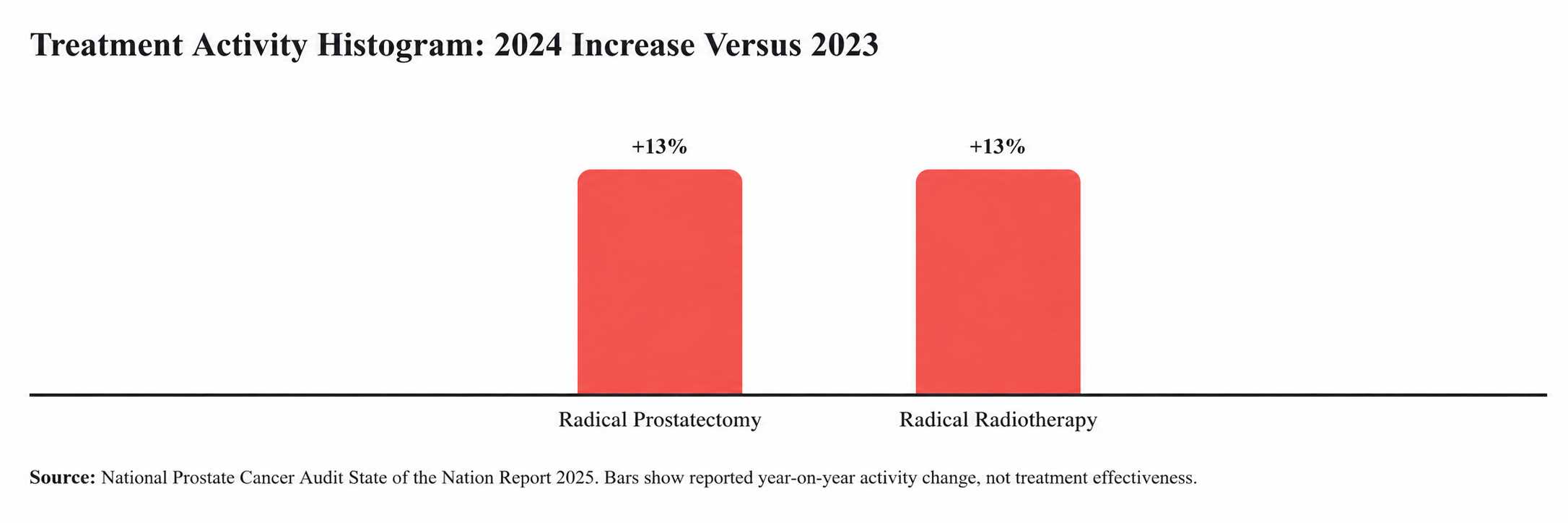
The same 2025 audit reporting found that activity for both radical prostatectomy and radical radiotherapy in England increased by 13% in 2024 compared with 2023. This does not tell an individual patient which treatment to choose, but it confirms that both radical-treatment pathways remain actively used.
UK Patient Demographics, Medical Tourism and Travel to Turkey
Prostate cancer predominantly affects older men, but age alone should not decide treatment. Current European guidance places considerable emphasis on overall health, comorbidities and life expectancy rather than using chronological age as the sole treatment criterion.
Turkey has a substantial international healthcare sector. Available health tourism statistics generally describe total international healthcare activity across many medical fields and do not provide a reliable breakdown of UK patients travelling specifically for prostate cancer treatment. These figures should not be used as evidence that a particular prostate cancer treatment is safer or more effective. Families should instead focus on the suitability of the proposed treatment, specialist qualifications, hospital capabilities, and follow-up arrangements.
Public data reviewed for this article did not provide a reliable current breakdown showing the age, UK region or number of British men travelling specifically to Turkey for prostate cancer care. Rather than inventing a demographic profile, families should treat claims such as “thousands of UK prostate cancer patients choose us every year” cautiously unless the provider can document the source.
Planning Prostate Cancer Treatment Between the UK and Turkey
International cancer treatment is not finished when your husband leaves the hospital. Before travelling, decide who will monitor PSA, manage urinary or sexual side effects, review medicines and respond if complications develop after you return to Britain.
UK government travel guidance states that GHIC and EHIC cards are not valid in Turkey. Families should therefore arrange suitable insurance and understand whether planned cancer treatment, complications of planned treatment and medical repatriation are excluded from the policy.
| Stage | Family Action | Documents Needed |
|---|---|---|
| Before requesting a Turkish opinion | Complete the UK diagnostic and staging picture where clinically appropriate. | PSA history, pathology, imaging and NHS treatment recommendation. |
| Before paying | Request written MDT recommendation and itemised quote. | Treatment plan, provider authorisation and financial terms. |
| Before travelling | Discuss the proposed foreign treatment with the UK clinical team. | Medication list, fit-to-travel advice if needed and insurance documents. |
| Before leaving Turkey | Collect the complete medical record. | Operation report, pathology, radiation plan, medication record and discharge summary. |
| After returning to UK | Arrange ongoing surveillance and management. | Written follow-up schedule and contact information for Turkish specialists. |
Should Your Husband Go to Turkey for Prostate Cancer Treatment?
Turkey may be worth exploring when you want a properly documented second opinion or a particular evidence-based treatment from a qualified centre. But travelling should solve a real clinical or practical problem. It should not be driven mainly by a package price, a hospital's technology list or promises of better results.
Reasons to Continue Exploring Turkey
- A specialist has reviewed the complete medical records.
- The recommendation is consistent with recognised prostate cancer guidance.
- The hospital is properly authorised.
- Credentials and treatment experience are transparent.
- The written quote is clear and itemised.
- A realistic aftercare plan exists in the UK.
Reasons to Slow Down and Ask More Questions
- Treatment is recommended before pathology or imaging review.
- The clinic guarantees cure or success.
- The discussion focuses mainly on price or equipment.
- No multidisciplinary opinion is offered.
- Doctor credentials are difficult to verify.
- There is no clear plan if complications occur after returning home.
Questions to Put to Both the UK and Turkish Teams
- What is his exact stage and risk group?
- Is treatment needed now?
- What is the goal: cure, long-term control or symptom relief?
- What are the reasonable alternatives?
- Would you recommend this same treatment if cost and country were irrelevant?
- What are the important urinary, sexual, bowel and general-health risks?
- Would the treatment make later treatment more difficult?
- How much experience does the treating team have with patients like him?
- Who handles a complication once he is back in Britain?
- What follow-up schedule is required during the next year?
Frequently Asked Questions About Prostate Cancer Treatment in Turkey
Is Turkey a good place for prostate cancer treatment for a UK patient?
Turkey has hospitals providing prostate cancer diagnosis and treatment services, but available expertise, facilities and treatment approaches vary between centres. Patients should evaluate the hospital’s authorisation, specialist qualifications, multidisciplinary care process, proposed treatment plan and follow-up arrangements before deciding whether treatment abroad is appropriate.
What prostate cancer treatments are available in Turkey?
Depending on the cancer stage, risk group and individual medical situation, treatment options may include active surveillance, radical prostatectomy, radiotherapy, brachytherapy, hormone therapy, chemotherapy and selected advanced treatments. The availability of a treatment does not mean it is suitable for every patient.
Is robotic prostate surgery in Turkey better than surgery in the UK?
A robotic surgical system alone does not determine treatment outcomes. The decision depends on factors such as cancer characteristics, surgeon experience, patient suitability, hospital support and possible risks. Patients should compare the recommended approach with other clinically appropriate options.
How much does prostate cancer treatment in Turkey cost in USD?
There is no single standard USD cost for prostate cancer treatment in Turkey. Costs vary depending on diagnosis, staging tests, treatment type, hospital, length of care and follow-up requirements. A personalised written estimate should be requested after medical records have been reviewed.
How can I verify a prostate cancer hospital in Turkey?
Check whether the facility is authorised by the Republic of Türkiye Ministry of Health for international health tourism. Also review the prostate cancer team’s qualifications, multidisciplinary approach, emergency capabilities, treatment documentation and follow-up arrangements.
Should my husband get a second opinion in Turkey before committing to treatment?
A second opinion may help when there is uncertainty about treatment choices, disease stage or available approaches. Providing pathology reports, imaging and previous treatment records allows specialists to review the case and explain possible options, benefits and risks.
Can my husband return to the NHS after prostate cancer treatment in Turkey?
Patients should discuss planned overseas treatment with their UK healthcare team and arrange continuity of care. Before returning, collect complete medical records, including treatment details, pathology reports, imaging, medicines and follow-up recommendations, so future care can be coordinated.
Does a UK GHIC cover prostate cancer treatment in Turkey?
No. GHIC and EHIC cards are not valid in Turkey. Patients should arrange appropriate insurance and understand whether planned treatment, possible complications and medical evacuation are covered before travelling.
Is HIFU in Turkey a safer alternative to prostate surgery?
HIFU and other focal treatments may be considered for selected patients, but they are not automatically safer or more appropriate than surgery or radiotherapy. Suitability depends on cancer characteristics, treatment goals and available clinical evidence for the individual case.
What documents should we send to a prostate cancer specialist in Turkey?
Important records may include pathology reports, Gleason score or ISUP Grade Group, PSA history, MRI and other imaging reports, previous treatment records, medical history, current medications and any relevant molecular testing results.
Request a Prostate Cancer Treatment Evaluation in Turkey
Treatment recommendations depend on your husband's diagnosis, cancer stage, previous treatments, overall health, and medical records. Submit available records to help determine whether a suitable provider can review his case.
Disclaimer
Disclaimer: This information is for educational purposes only and does not replace professional medical advice. Always consult a qualified healthcare provider before making medical decisions.
References
- Treatment for Prostate Cancer – NHS
- Prostate Cancer: Diagnosis and Management – NICE
- 2026 Prostate Cancer Treatment Guideline – European Association of Urology
- NPCA State of the Nation Report 2025 – National Cancer Audit Collaborating Centre
- Healthcare Providers Authorized by the Ministry – Republic of Türkiye Ministry of Health
- Regulation on International Health Tourism and Tourist Health – Republic of Türkiye Ministry of Health
- Health Tourism Data – USHA?
- Turkey Health and Medical Tourism Advice – GOV.UK


.png)






.png)
.png)


.jpg)

.png)
.png)








Share this listing