


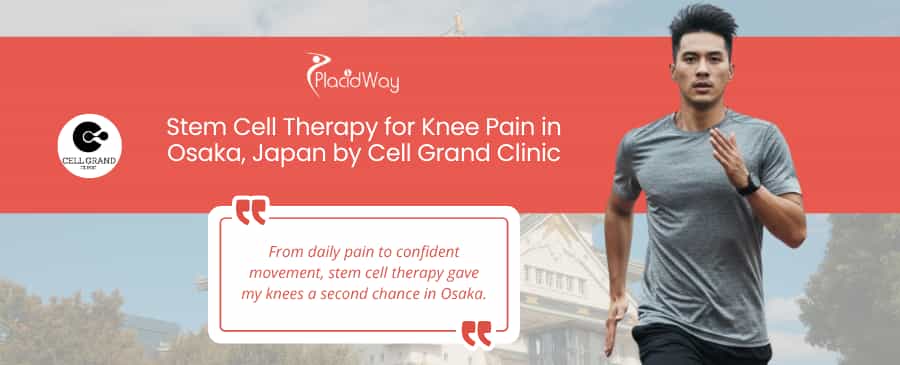
Introduction: Don't Let Knee Pain define Your Retirement
Are you forcing yourself to give up golf, hiking, or even simple walks with your family?
Knee Osteoarthritis (KOA) is a progressive condition that slowly robs you of your mobility. For many active individuals, the diagnosis comes with a frustrating ultimatum from their doctors: "Wait until it gets worse, then have Total Knee Replacement surgery."
But surgery is drastic. It requires hospitalization, months of painful rehabilitation, and carries risks of infection or implant failure. On the other hand, conservative treatments like Hyaluronic Acid injections only mask the pain temporarily.
There is a third option.
At Cell Grand Clinic in Osaka, Japan, we offer a breakthrough in regenerative medicine. By using high-quality Autologous Adipose-Derived Stem Cell Therapy for Knee Pain in Osaka, Japan, we aim to repair the damaged cartilage environment without the knife, helping you get back on your feet—naturally.
The Science: Why "Lubricants" Are Not Enough
To understand why our therapy is different, we must look at why standard treatments fail.
The Problem with Hyaluronic Acid (HA)
Hyaluronic Acid is often compared to "engine oil." It lubricates the joint, reducing friction for a week or two. However, it does nothing to fix the "rust" or the "worn-out gears" (cartilage). Once the oil dries up, the pain returns.
The Regenerative Solution: "Repairing" the Joint
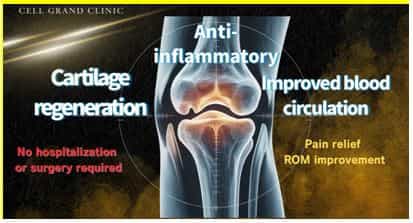
Stem Cell Therapy moves beyond lubrication to regeneration. When we inject your own cultured stem cells into the knee capsule, they initiate a biological repair process known as the Paracrine Effect:
Comparison: Stem Cells vs. Surgery vs. HA
Why are wealthy patients worldwide choosing Regenerative Medicine over traditional options?
| Feature | Stem Cell Therapy | Hyaluronic Acid (HA) | Knee Replacement Surgery |
|---|---|---|---|
| Goal | Repair & Regeneration | Temporary Lubrication | Artificial Replacement |
| Invasiveness | Low (Injection) | Low (Injection) | High (Major Surgery) |
| Downtime | None (Walk same day) | None | Months of Rehab |
| Duration | Long-term (Years) | Short-term (Weeks) | Permanent (15-20 yrs) |
| Risk | Very Low (Own cells) | Low | Infection, Blood Clots |
Why Japan — and Why Cell Grand Clinic?
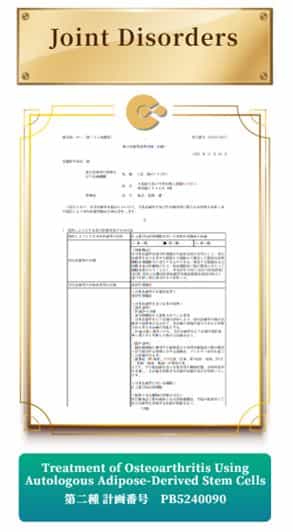
Japan is the only major country with a dedicated law governing regenerative medicine. Under the Act on the Safety of Regenerative Medicine (2014), every stem cell treatment must be government-approved, processed in licensed pharmaceutical-grade facilities, and reported to a national safety database. This isn't optional — it's the law.
Many popular stem cell tourism destinations have no such framework. The lower price you see elsewhere often reflects the absence of these safeguards — not better value.
The Clinic: Where World-Class Science Meets Patient Care
Your stem cells are cultured at a government-certified Cell Processing Center (FA5250001) linked to Professor Takahiro Ochiya of Tokyo Medical University — a Web of Science Top 0.1% Highly Cited Researcher for 6 consecutive years, with 800+ publications and 57,000+ citations. His cutting-edge exosome research directly informs the cultivation protocols used on your cells. This level of academic partnership is virtually unheard of in a clinical setting.
Our cell quality standard — "Fresh, Pure, Young":
| Feature | What You Get | Industry Comparison |
|---|---|---|
| FRESH | ?98% cell viability at administration | vs. 70–85% industry average |
| PURE | Multi-marker tested (CD73+/CD90+/CD105+ ?98%) | vs. many clinics that skip testing |
| YOUNG | Low-passage P3 cells — maximum potency | vs. P5+ cells with diminished effect |
Result: Up to 200 million verified, high-potency stem cells per treatment.
Meet the Experts
Your Doctor: A Physician-Scientist, Not a Salesperson
Dr. Yuichi Wakabayashi, M.D., Ph.D. brings credentials that bridge East and West:
-
NIH Research Fellow: With 3+ years of U.S. clinical experience.
-
Published Author: First author on a Pfizer-collaborated world-first PET tracer study.
-
ABRM Diplomate: American Board of Regenerative Medicine certified.
-
Next Era Leader: Featured in The Wall Street Journal.
-
Native-level English: Direct communication, no interpreters needed.
The clinic holds 10 Type II Government Licenses — the highest outpatient classification — issued by Japan's Ministry of Health.
Treatment Process for International Patients
We have optimized our flow for busy executives and international visitors.
Preliminary screening with our medical team to discuss your MRI/X-ray results.
A minimally invasive fat harvesting procedure (approx. 30 minutes) under local anesthesia. You can return to your hotel immediately.
Your cells are processed in our specialized CPC. You return home during this period while we cultivate your cells to maximum potency.
You return to Osaka for the treatment. The stem cells are administered via direct intra-articular injection into the knee. The procedure takes 30 minutes.
Note: Repeat treatments may be recommended depending on severity.
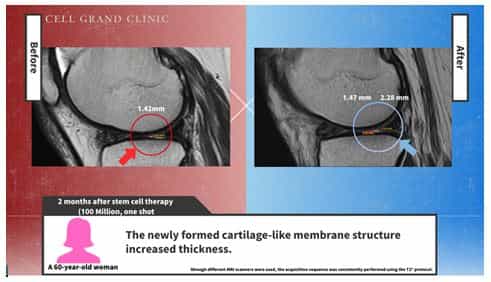
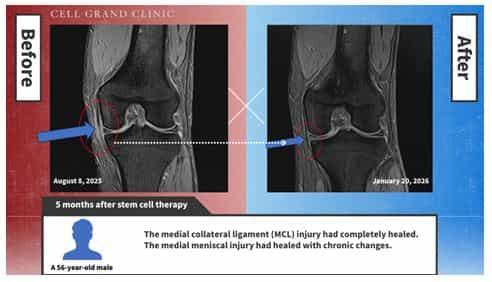
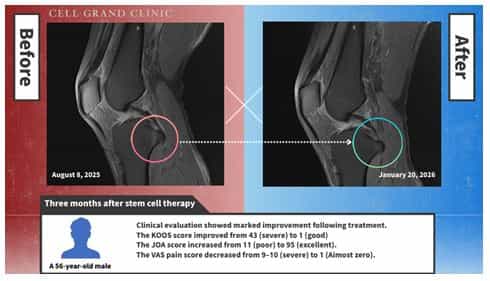
Candidate Assessment: Is this for me?
This therapy is ideal for:
-
Grade II to III Osteoarthritis: Patients with moderate degeneration often see the best results.
-
Active Lifestyle: People who want to continue sports (golf, tennis) which might be impossible after artificial joint surgery.
-
Surgery Avoiders: Those who cannot or do not want to undergo general anesthesia and long rehab.
Note: For Grade IV (bone-on-bone), results vary. However, many patients still choose this therapy to reduce pain and delay surgery.
Frequently Asked Questions (FAQ)
1. How effective is this compared to surgery?
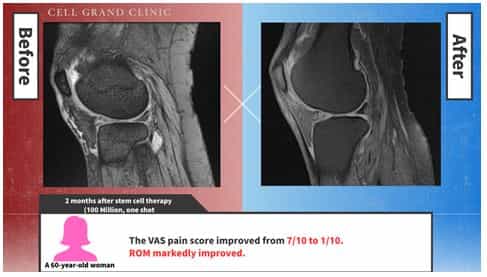
Surgery replaces the joint, while stem cell therapy preserves it. For appropriate candidates, stem cell therapy can reduce pain by 50-80% and significantly improve mobility, effectively eliminating the need for surgery.
2. Is there an age limit?
No strict limit. We have successfully treated patients in their 80s. However, the vitality of stem cells can vary with age, which is why our 7-week culture process is so critical—it allows us to multiply even older cells to effective numbers.
3. Can I walk immediately after the procedure?
Yes. Unlike surgery, there is no cast or crutches required. You can walk out of the clinic. We recommend avoiding strenuous impact sports for a few weeks to allow the cells to settle.
4. Does insurance cover this treatment?
Regenerative medicine is currently considered an elective treatment and is generally not covered by standard health insurance. We provide transparent pricing for all our international patients.
5. Are there side effects?
Because we use your own cells, allergic rejection is not a risk. Some patients experience minor soreness or bruising at the site of fat harvesting or injection, which typically resolves within a few days.
6. How long until I feel the results?
While some patients notice a reduction in inflammation within weeks, the biological repair process typically reaches its peak between 3 to 6 months post-injection.
7. Can both knees be treated at the same time?
Yes, we frequently treat both knees during a single administration visit if both joints are affected by osteoarthritis.
8. How many cells are injected into the knee?
Depending on the case and the concentration achieved during culture, we typically administer up to 100-200 million high-potency stem cells per joint.
9. Why is the 7-week culture period necessary?
This time allows us to select the strongest cells and multiply them to a therapeutic threshold that simple "same-day" procedures cannot achieve.
10. Is the clinic accessible from the airport?
Yes, Cell Grand Clinic is located in Osaka, with convenient access from Kansai International Airport (KIX), making it ideal for international travelers.
Don't Replace Them—Restore Them!
Your knees are your foundation. Don't replace them—restore them.
With the highest safety standards in Japan and a premium 7-week cultivation process, Cell Grand Clinic offers the premier non-surgical solution for your joints.
References
-
Cao M, Ou Z, Sheng R, Wang Q, Chen X, Zhang C, et al. Efficacy and safety of mesenchymal stem cells in knee osteoarthritis: a systematic review and meta-analysis. Stem Cell Res Ther. 2025;16(1):122.
-
Jo CH, Lee YG, Shin WH, et al. Intra-articular injection of mesenchymal stem cells for the treatment of osteoarthritis of the knee. Stem Cells. 2014;32(5):1254-1266.
-
Freitag J, et al. Mesenchymal stem cell therapy in the treatment of osteoarthritis: reparative pathways, safety and efficacy - a review. BMC MusculoskeletDisord. 2016;17:230.
Ready to Restore Your Mobility?
Take the next step toward a pain-free lifestyle. Stem Cell Therapy for Knee Pain in Osaka, Japan provides a sophisticated path to recovery, focusing on biological healing rather than temporary fixes. Backed by Japan’s rigorous safety standards and the expertise of Cell Grand Clinic, you can explore a viable alternative to major surgery. Contact Cell Grand Clinic via PlacidWay Medical Tourism to start your assessment and reclaim the activities you love.
Contact Us Today for an Assessment














Share this listing