



Hearing that lung cancer has spread can immediately change the questions you and your family are asking. Instead of focusing only on removing a tumor from the lung, your oncology team now needs to understand where the cancer has traveled, what type of lung cancer you have, and which biological features may make one treatment more appropriate than another.
If you are researching metastatic lung cancer treatment in Mexico, the most useful comparison is not simply which hospital offers treatment fastest. You need to know whether the diagnosis has been confirmed correctly, whether appropriate biomarker testing has been completed, whether the recommended treatment follows evidence-based oncology practice, and how complications or follow-up will be handled after you return home.
Quick Summary
- What “spread” usually means: Lung cancer found in distant organs may be considered metastatic or stage IV non-small cell lung cancer. Small cell lung cancer uses a different staging framework and may be described as extensive-stage disease.
- Cost in Mexico: There is no reliable national private-pay price for metastatic lung cancer treatment. Costs depend heavily on pathology, molecular testing, medications, radiation, hospital services, treatment duration, and complications. Request a written itemized quote in USD.
- Important tests: Confirmed pathology, complete staging, molecular or biomarker testing when appropriate, and assessment of your general health can directly affect treatment selection.
- Common treatment categories: Depending on the cancer type and biomarkers, care may include targeted therapy, immunotherapy, chemotherapy, radiation therapy, supportive treatment, or combinations of these approaches.
- Doctor credentials in Mexico: Verify the physician's professional registration through Mexico's Registro Nacional de Profesionistas and look for current specialist certification through a CONACEM-recognized specialty council such as the Consejo Mexicano de Oncología when applicable.
- Facility checks: Ask about the facility's applicable COFEPRIS sanitary authorization and whether it participates in national quality certification through the Consejo de Salubridad General.
- Main caution: Do not travel based only on claims about a “new,” “natural,” “immune-boosting,” or “alternative” cancer treatment. Ask for the exact treatment name, regulatory status, scientific evidence, expected goal, and emergency plan.
What Does It Mean When a Lung Cancer Scan Shows the Cancer Has Spread?
A scan showing cancer outside the original lung tumor changes the treatment plan, but the scan alone may not answer every question. Your oncology team needs to interpret the imaging together with pathology, previous scans, symptoms, laboratory results, and sometimes additional testing.
For non-small cell lung cancer, distant spread may involve the opposite lung, brain, bones, liver, adrenal glands, or other sites. Stage IV disease is not one uniform condition. A person with one or a few distant lesions may face different decisions from someone with cancer affecting several organs.
Small cell lung cancer is generally divided into limited-stage and extensive-stage disease. Extensive-stage disease means the cancer has spread beyond the area that could normally be included within a single radiation treatment field.
| Finding | Why It Matters | Question to Ask |
|---|---|---|
| Another lung lesion | Doctors must determine whether it represents metastatic disease, another primary tumor, or another process. | “How certain are we that this is metastatic lung cancer?” |
| Brain lesion | May affect treatment sequencing and whether local brain-directed treatment is needed. | “Do I need a brain MRI or radiation oncology review?” |
| Bone involvement | May cause pain or fracture risk and can require symptom-directed treatment. | “Is any bone lesion at risk of fracture or spinal compression?” |
| Liver or adrenal involvement | Helps establish disease extent and systemic treatment priorities. | “Will this change which treatment you recommend first?” |
Before Starting Lung Cancer Treatment in Mexico, Confirm the Diagnosis and Biomarkers
The next step after metastatic disease is identified is usually not simply “start chemotherapy.” Modern treatment selection depends on the exact lung cancer subtype and, particularly for many patients with non-small cell lung cancer, the molecular features of the tumor.
Pathology identifies whether the cancer is non-small cell or small cell and may further classify the tumor. Molecular testing looks for changes in cancer cells that may be targeted with particular medicines. PD-L1 testing can also help oncologists determine whether certain immunotherapy approaches may be appropriate.
Depending on the tumor subtype and clinical situation, oncologists may investigate alterations involving genes such as EGFR, ALK, ROS1, BRAF, MET, RET, NTRK and KRAS. The exact testing panel should be determined by a qualified oncology team rather than selected by the patient independently.
Records to Have Before a Mexico Oncology Consultation
- Pathology report and, when possible, pathology slides or digital pathology files.
- CT, PET/CT, MRI and other imaging in DICOM format rather than screenshots alone.
- Previous oncology consultation notes.
- Biomarker, molecular profiling and PD-L1 reports, if already performed.
- Previous chemotherapy, immunotherapy, targeted therapy or radiation records.
- Current medication list and relevant medical conditions.
- Recent blood tests and organ-function results.
If a clinic proposes treatment without reviewing pathology, disease extent, prior treatment and relevant biomarkers, ask why. For metastatic lung cancer, those details can substantially change what evidence-based treatment looks like.
Treatment Options for Metastatic Non-Small Cell Lung Cancer in Mexico
For stage IV non-small cell lung cancer, systemic therapy usually becomes central because treatment needs to reach cancer cells throughout the body. The appropriate approach depends on tumor biology, previous treatment, symptoms, performance status and patient preferences.
| Treatment Category | When It May Be Considered | What Patients Should Verify |
|---|---|---|
| Targeted therapy | When testing identifies an actionable molecular alteration for which an appropriate targeted treatment exists. | Exact biomarker, laboratory method, medication, regulatory status and monitoring plan. |
| Immunotherapy | For selected patients depending on tumor characteristics, biomarkers and treatment history. | Eligibility rationale and plan for recognizing immune-related side effects. |
| Chemotherapy | May be used alone or combined with another systemic treatment depending on pathology and biomarkers. | Drugs planned, treatment schedule, laboratory monitoring and emergency instructions. |
| Radiation therapy | May help control particular metastatic sites or relieve symptoms such as pain, bleeding or neurological problems. | Target area, treatment goal, number of sessions and expected side effects. |
| Local treatment in selected cases | Some carefully selected patients with limited metastatic burden may be evaluated for additional local treatment. | Whether a multidisciplinary tumor board reviewed the case. |
| Supportive and palliative care | Can be integrated at any stage to address symptoms, treatment effects and quality of life. | Pain, breathing, nutrition and psychosocial support availability. |
The goal of treatment may be to shrink or control the cancer, relieve symptoms, delay progression and support quality of life. The expected benefit is different for every patient, so avoid clinics that promise a fixed response or cure rate without considering your individual disease characteristics.
If the Diagnosis Is Extensive-Stage Small Cell Lung Cancer in Mexico
Extensive-stage small cell lung cancer follows a different treatment pathway from metastatic non-small cell lung cancer. Small cell lung cancer tends to grow and spread quickly, so systemic treatment is usually central.
Current evidence-based approaches can include chemotherapy combined with immunotherapy for appropriate patients. Radiation therapy may also be used in selected circumstances, including treatment directed at symptomatic areas such as the brain, spine or bone.
Ask the Mexico Oncology Team
- Has the pathology clearly confirmed small cell lung cancer?
- Is the disease considered limited-stage or extensive-stage?
- What is the exact goal of the proposed treatment?
- Will chemotherapy be combined with immunotherapy?
- Is radiation needed now, later, or only if particular symptoms develop?
- How will treatment response be assessed?
- What happens if the cancer progresses after first-line treatment?
How Brain, Bone and Other Metastases Can Change Lung Cancer Care in Mexico
Where lung cancer has spread can affect both urgency and treatment sequencing. A treatment plan should therefore address not just the primary lung tumor but also any metastatic site that could cause immediate harm.
| Metastatic Site | Possible Concern | Potential Care Discussion |
|---|---|---|
| Brain | Neurological symptoms, swelling or seizures | Brain imaging, systemic treatment options and radiation assessment |
| Spine | Spinal cord compression | Urgent imaging and specialist review |
| Weight-bearing bone | Pathological fracture | Orthopedic and radiation assessment when indicated |
| Pleural space | Fluid accumulation and shortness of breath | Evaluation for symptom-relieving procedures |
Who May Be Able to Travel to Mexico for Metastatic Lung Cancer Treatment?
Being medically eligible for a cancer treatment and being medically fit to travel are separate questions. Some patients can travel safely with appropriate planning, while others need stabilization or treatment closer to home first.
Your oncologist should consider your breathing, oxygen requirements, blood counts, infection risk, recent blood clots, cardiovascular conditions, neurological symptoms, pain control and general ability to perform everyday activities.
Travel May Be More Practical When
- Your condition is medically stable.
- Your treatment plan allows enough time for travel.
- You can tolerate the journey.
- Necessary medications and records are organized.
- Care is coordinated with your home oncologist.
- A clear emergency plan exists.
Travel May Need to Be Delayed When
- You have uncontrolled breathing problems.
- You have a medical emergency related to metastases.
- You have a serious active infection.
- Your physician considers air travel unsafe.
- Urgent treatment is available locally and delay could be harmful.
- There is no safe continuity plan after treatment.
How Much Does Metastatic Lung Cancer Treatment Cost in Mexico?
There is no credible single national price for metastatic lung cancer treatment in Mexico. The final amount can vary substantially because two people with the same stage may receive completely different testing, medicines and supportive care.
For that reason, a medically responsible cost comparison should begin only after the provider has reviewed your records. Ask for the quotation in USD and request that procedure-only, medication-only and package inclusions are clearly separated.
| Cost Component | Mexico Pricing Status | What to Request |
|---|---|---|
| Oncology consultation | Provider-specific | Consultation and multidisciplinary review fees |
| Pathology review | Provider-specific | Pathology, immunohistochemistry and slide-review charges |
| Molecular testing | Varies by laboratory and panel | Exact panel, genes tested and laboratory fee |
| Immunotherapy or targeted medicines | Highly treatment-specific | Drug name, dose basis, number of planned cycles and monitoring costs |
| Chemotherapy | Regimen-specific | Medication, infusion center, physician and laboratory charges |
| Radiation therapy | Depends on technique and number of treatments | Planning, imaging and complete treatment-course cost |
| Hospitalization | Not always included | Room, ICU, medications, procedures and physician fees |
Mexico vs the United States and Canada: What Should You Compare?
| Country | Why a Single Price Is Misleading | Best Comparison Method |
|---|---|---|
| Mexico | Private hospital, medicine, molecular testing and radiation charges vary. | Request a complete individualized written quotation. |
| United States | Hospital contracts, insurance benefits, drug coverage and out-of-pocket obligations differ widely. | Compare your actual insurer or self-pay estimate with the Mexico quote. |
| Canada | Coverage and access depend on provincial systems, medication funding and individual circumstances. | Compare what is covered locally with private treatment and travel expenses abroad. |
How to Choose a Hospital for Lung Cancer Treatment in Mexico
For advanced lung cancer, choose the hospital based on oncology capability and regulatory status rather than hospitality packages. The facility should be able to manage the proposed treatment safely and respond to complications.
COFEPRIS is Mexico's federal health-risk regulator and administers sanitary authorization processes for health-service establishments where applicable. Mexico also has a national healthcare quality certification framework through the Consejo de Salubridad General. International accreditation can provide additional information, but it should not replace Mexican licensing and clinical capability checks.
Hospital Verification Checklist
- Ask for the facility's legal name and applicable sanitary license or authorization.
- Confirm which authority issued the authorization.
- Ask whether systemic anticancer medicines are prepared and administered under appropriate pharmacy controls.
- Confirm whether emergency physicians and inpatient care are available.
- Ask about ICU access or formal hospital-transfer arrangements.
- Ask whether medical oncology, pathology, radiology and radiation oncology work together.
- Confirm how complications are managed outside normal clinic hours.
- Ask for the provider's infection-control and emergency contact procedures.
- Request written details about follow-up after you return home.
JCI or another international accreditation may be useful when genuinely applicable, but lack of international accreditation alone does not establish that a Mexican hospital is unsafe. Government authorization, specialist qualifications, appropriate infrastructure and transparent clinical processes matter more.
How to Verify an Oncologist Before Lung Cancer Treatment in Mexico
You should verify both the physician's legal professional registration and relevant specialist certification. A doctor's website biography should not be your only source.
Mexico's Registro Nacional de Profesionistas allows patients to check whether a professional title is registered. CONACEM provides a public search tool for current specialist certification and recognizes specialty councils including the Consejo Mexicano de Oncología.
| What to Verify | Why It Matters |
|---|---|
| Professional cédula | Confirms registered professional qualifications. |
| Relevant specialty certification | Helps confirm current specialist certification where applicable. |
| Experience with lung cancer | General oncology experience is not identical to managing complex thoracic cancers. |
| Multidisciplinary access | Advanced cases may require input from several oncology specialties. |
| Complication protocol | Immunotherapy, chemotherapy and advanced cancer itself can produce urgent problems. |
Questions Worth Asking the Oncologist
- What is my exact histologic diagnosis?
- What stage are you assigning and why?
- Which biomarker tests have been completed?
- Is additional tissue or blood-based testing needed?
- What is the goal of the proposed treatment?
- What evidence supports this treatment for my tumor profile?
- How will response be measured?
- What complications require immediate hospital care?
- Who will manage me when I return to my country?
Planning Travel to Mexico During Metastatic Lung Cancer Treatment
Travel should be built around the treatment schedule rather than the treatment being forced into a short vacation itinerary. Some therapies involve repeated cycles, laboratory monitoring and follow-up imaging over weeks or months.
| Timeframe | Clinical Process | What You May Experience | Action Required |
|---|---|---|---|
| Before travel | Record review and treatment planning | Appointments and testing coordination | Confirm fitness to travel and send complete records |
| Arrival | In-person assessment and possible repeat testing | Additional imaging, laboratory tests or consultations | Do not schedule treatment before the medical review is complete |
| During treatment | Systemic therapy or radiation, depending on plan | Effects vary by treatment and individual response | Remain within practical reach of the treating team |
| Before returning home | Medical reassessment | Fitness for travel should be reconsidered | Collect treatment records and emergency instructions |
| After returning | Monitoring and continuity of care | Ongoing side effects or treatment needs may continue | Share the complete Mexico record with your home oncologist |
What Current Lung Cancer Statistics Can and Cannot Tell International Patients
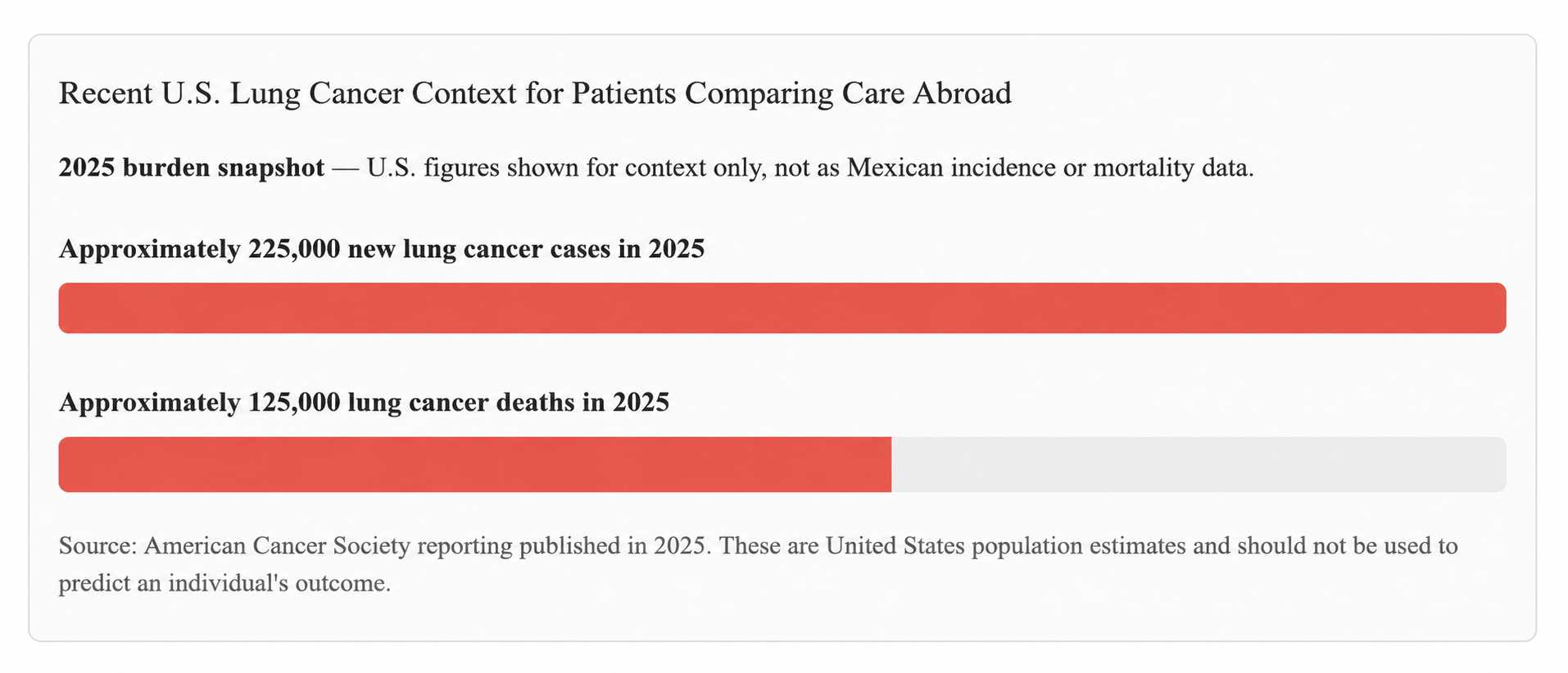
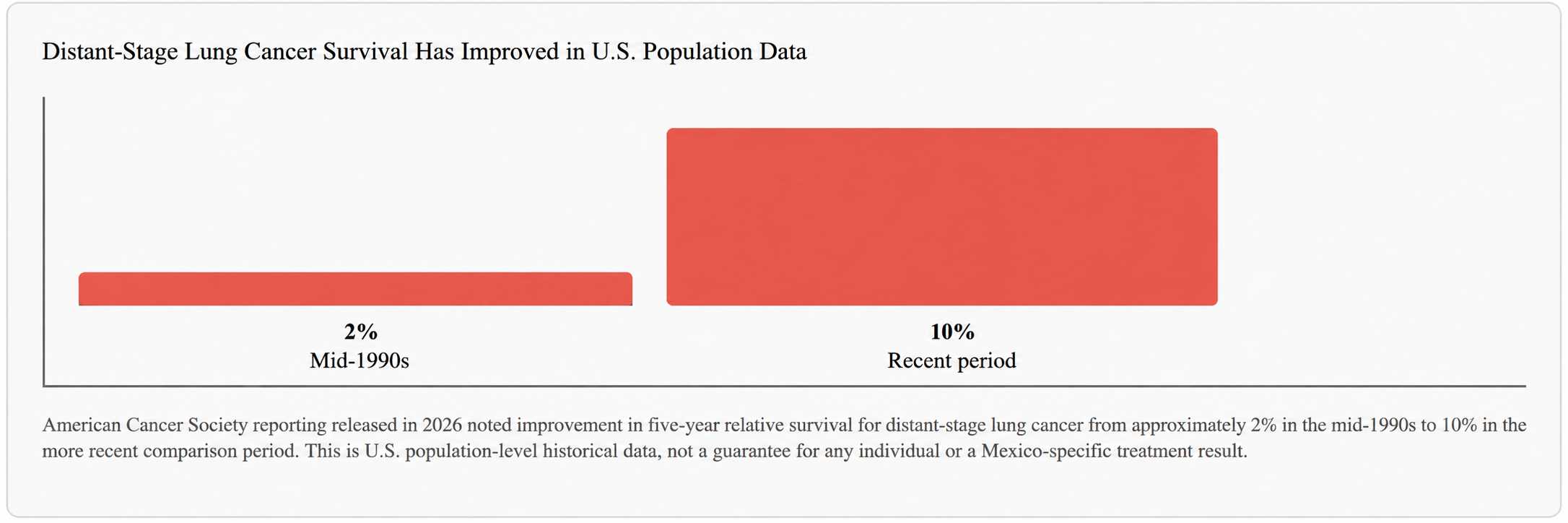
Population statistics provide context, but they cannot predict what will happen to one patient. Age, cancer subtype, molecular profile, metastatic sites, general health, previous treatment and response can all influence an individual's outlook.
Another important limitation is medical-tourism data. No authoritative current national dataset was identified that reliably reports the age, sex, home country and stage of international patients traveling specifically to Mexico for metastatic lung cancer treatment. Publishing a demographic chart for those travelers would therefore require assumptions and would be misleading.
Questions to Answer Before Choosing Your Next Lung Cancer Treatment in Mexico
A good treatment decision should become clearer as specific questions are answered. If several important facts remain unknown, obtaining those answers may be more valuable than rushing to begin the first treatment offered.
- Has metastatic disease been confirmed? Understand which scan or biopsy establishes the diagnosis.
- Is this non-small cell or small cell lung cancer? Their treatment pathways differ.
- Has enough tissue been tested? Ask whether further pathology or biomarker testing could affect treatment.
- Is there an actionable molecular alteration? This can change the first treatment considered for some patients with NSCLC.
- What is the role of immunotherapy? Ask why it is or is not recommended for your particular cancer.
- Does any metastasis require urgent local treatment? Brain, spine, airway or painful bone disease can sometimes change priorities.
- What is the treatment goal? Disease control, symptom relief and other goals should be explained plainly.
- How will success be measured? Ask when scans, laboratory tests and clinical assessments will be repeated.
- What is the complete financial plan? Obtain an itemized quote rather than only a starting treatment price.
- Who manages complications? Know exactly who to call and which hospital can admit you.
- How will care continue at home? Your home oncology team should receive complete records.
Frequently Asked Questions About Metastatic Lung Cancer Treatment in Mexico
Does lung cancer that has spread always mean stage 4?
For non-small cell lung cancer, spread to distant organs generally indicates metastatic or stage IV disease, but staging depends on the exact pattern of spread. Small cell lung cancer uses limited-stage and extensive-stage terminology. Your oncologist should explain the stage using your imaging and pathology results.
What should I do first after a scan shows metastatic lung cancer?
Confirm the diagnosis, identify the lung cancer subtype, complete appropriate staging and review whether molecular and biomarker testing is needed. These steps can determine whether targeted therapy, immunotherapy, chemotherapy, radiation or a combination is most appropriate.
Can metastatic lung cancer be treated in Mexico?
Medical oncology, systemic anticancer treatments and radiation services are available in Mexico, but suitability depends on the individual provider and your clinical situation. Verify physician credentials, facility authorization, treatment evidence, emergency capability and continuity of care before traveling.
Is immunotherapy an option for stage 4 lung cancer in Mexico?
Immunotherapy may be appropriate for certain patients with advanced lung cancer, depending on cancer subtype, biomarkers, molecular findings, previous treatment and health status. It is not suitable for every patient. A medical oncologist should explain the clinical reason for recommending it.
Should I get biomarker testing before traveling to Mexico?
If you have non-small cell lung cancer, biomarker testing can be important because certain molecular alterations may affect treatment selection. Ask both your home oncologist and the Mexico provider which tests are appropriate and whether your existing tissue sample is adequate.
How much does stage 4 lung cancer treatment cost in Mexico?
No reliable national price applies to every patient. Costs vary according to drugs, molecular tests, imaging, radiation, hospital care and treatment duration. Request a personalized written quote in USD after the oncology team has reviewed your medical records.
How can I verify a cancer doctor in Mexico?
Check the physician's professional registration through Mexico's Registro Nacional de Profesionistas. For specialist status, CONACEM provides a tool for checking current certification through recognized specialty councils, including the Consejo Mexicano de Oncología where relevant.
How can I check whether a hospital in Mexico is properly regulated?
Ask for the facility's exact legal name and applicable sanitary authorization, then verify the relevant regulatory information. COFEPRIS regulates health-service establishments, while certification through the Consejo de Salubridad General can provide an additional quality indicator.
Can I travel home immediately after lung cancer treatment in Mexico?
Not necessarily. Fitness to travel depends on the treatment received, your symptoms, oxygen needs, complications and general health. Your treating physician should reassess you before air or long-distance travel and provide written records and emergency instructions.
What if a Mexican clinic offers an alternative cancer treatment instead of standard oncology care?
Ask for the exact treatment, active substances, regulatory status, published evidence, expected goal, risks and interactions with standard treatment. Do not discontinue evidence-based oncology care solely because a provider promises a safer, natural or guaranteed alternative.
Should I get a second opinion before starting metastatic lung cancer treatment?
A second oncology opinion can be particularly useful when pathology is uncertain, biomarker testing is incomplete, treatment recommendations differ, or an unusual therapy is proposed. Bring your complete pathology, scans and molecular results so the second team can review the same evidence.
Can radiation still help after lung cancer has spread?
Yes, radiation may remain useful even when lung cancer is metastatic. Depending on the situation, it can treat specific metastatic sites, relieve pain or other symptoms, or address areas that pose particular clinical risks. A radiation oncologist should determine suitability.
Compare Lung Cancer Treatment Options in Mexico Carefully
When a scan shows that lung cancer has spread, the next decision should be based on more than a clinic name or treatment price. PlacidWay can help you compare providers, request information, understand proposed costs and prepare questions for oncology consultations.
Disclaimer
Disclaimer: This information is for educational purposes only and does not replace professional medical advice. Always consult a qualified healthcare provider before making medical decisions.
References
- Non-Small Cell Lung Cancer Treatment – National Cancer Institute
- Small Cell Lung Cancer Treatment – National Cancer Institute
- Licencias Sanitarias de Servicios de Salud – COFEPRIS
- Verification of Current Medical Specialist Certification – CONACEM
- People Are Now Living Longer After a Cancer Diagnosis – American Cancer Society, 2026
- 2025 Lung Cancer Data – American Cancer Society









.png)
.png)

.png)
















Share this listing