
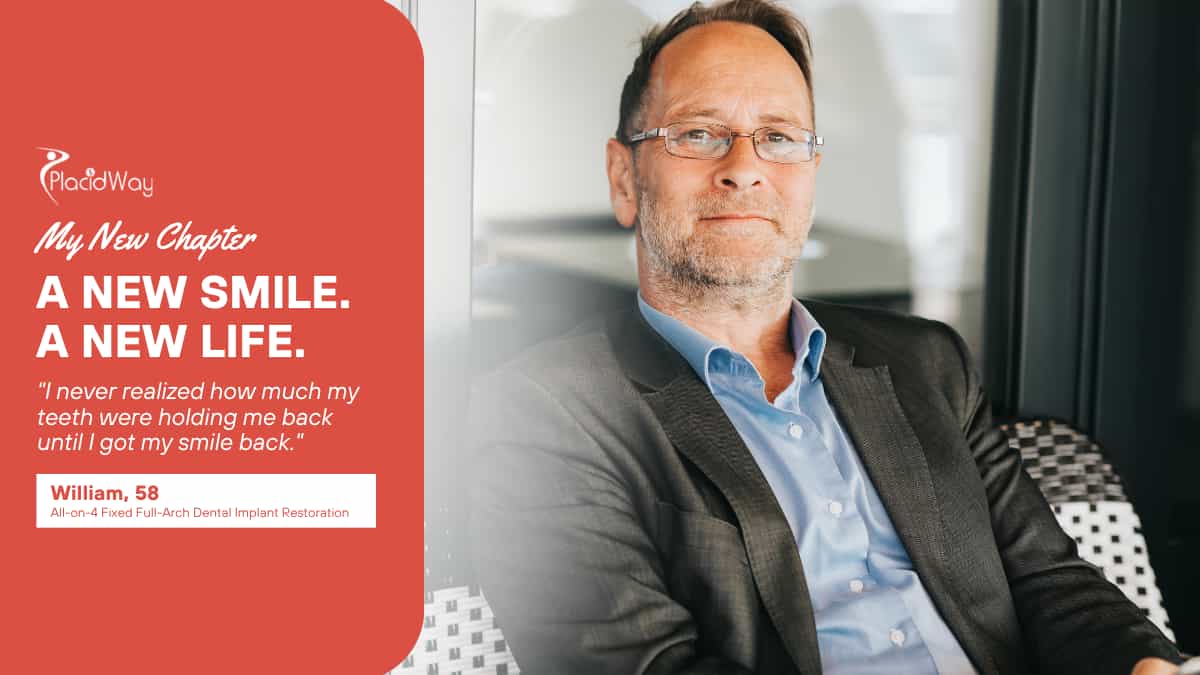
Patient Profile
Name: William Turner
Age: 58
Condition: Severe tooth loss, advanced periodontal disease or extensive dental decay
Treatment: All-on-4 fixed full-arch dental implant restoration
Destination: Los Algodones, Mexico
Journey at a Glance
Main problems: Significant tooth loss, decay, or bone deterioration requiring full or near-full mouth reconstruction; Difficulty chewing solid foods; dietary restriction and nutritional compromise; Speech changes or slurring; Facial collapse and premature aging…
Previous care: Multiple dental consultations in the US; hearing the same $25,000–$35,000+ quote repeatedly; Exploring partial implants, bridges, or high-end dentures; disappointment with comfort and durability; Applying for dental credit lines (CareCredit) and…
Travel driver: Cost reduction (50–70% savings) combined with speed of treatment and geographic proximity; inability to access this level of care within their budget in the US
Treatment explored: All-on-4 fixed full-arch dental implant restoration
Personal goal: Eat comfortably, smile openly and reduce dependence on removable dentures.
You stopped eating almonds first.
Then you quietly gave up on ordering steak at restaurants.
You learned to chew carefully on the left side of your mouth.
You started covering your mouth with your hand when you laughed.
You began declining invitations to neighborhood dinner parties.
You started dreading the family photographs at holiday gatherings.
You accepted that a dull ache was just part of your normal morning routine.
You stopped looking closely in the mirror while brushing your remaining teeth.
You learned to surrender the simple things first:
Apples.
Then came the well-meaning but agonizing comments from family.
"You're looking a bit thinner lately."
"Are you sure you don't want to come?"
"You never smile in pictures anymore."
Your world has quietly become smaller.
The hardest part is not the chronic physical discomfort or the staggering financial quotes, but the waiting.
William Turner is not a real PlacidWay patient.
He is a fictional composite built entirely from the exact situations, financial constraints, and clinical questions American dental patients face every day.
He is fifty-eight years old.
He manages a regional hardware supply store in a mid-sized town in rural Texas.
He earns a respectable living that feels increasingly inadequate for his mounting healthcare needs.
He used to command a room with a booming, unselfconscious laugh.
He spent his weekends coaching youth baseball and talking loudly across crowded fields.
He lived an ordinary, deeply competent life before his teeth began to rapidly fail.
How did the situation escalate to this point?
He tried to explain the problem away as normal aging.
Over-the-counter numbing gels.
Warm saltwater rinses.
Carefully adjusted diets.
Temporary bridge repairs.
Austerity.
Endurance.
Silence.
For patients experiencing severe edentulism or advanced periodontal disease, standard conservative treatments eventually fail, requiring consideration of full-mouth reconstruction or All-on-4 implants to restore basic mechanical function.
Then came the clinical verdict from the periodontist:
"You need full extractions and implants."
The diagnosis left him with one agonizing question:
When?
Current guidance states that an estimated 120 million Americans are missing at least one tooth, and out-of-pocket costs for extensive surgical restorations frequently exceed annual middle-class incomes, leaving a massive demographic fundamentally priced out of standard domestic care (American Dental Association).
But William Turner doesn't experience the American dental care system as a national statistic.
He experiences it sitting in the driver's seat of his truck after another frustrating consultation.
"They want thirty-five thousand dollars."
He experiences it watching his wife, Sarah, review their retirement account balances at the kitchen counter.
"We can't pull that much out right now."
He experiences it trying to eat Sunday dinner with his young grandchildren.
"Grandpa, why are you only eating potatoes?"
He has already tried to be patient.
He is not a careless shopper looking for a shortcut.
He submitted three different pre-authorizations to his employer's dental insurance provider.
He watched all three get rejected due to standard implant exclusion clauses.
He applied for a specialized medical credit line and balked at the twenty-six percent interest rate.
He joined a waiting list for a university dental school program three counties over.
He sat through free consultations at local clinics that felt uncomfortably like timeshare presentations.
"I have done everything exactly right."
"It shouldn't be this hard to chew."
The old question he used to ask himself was:
Can I tolerate this?
The new question keeping him awake is:
How much of my life am I prepared to organise around it?
Why does the domestic route feel so impossible?
The conventional medical option is right down the street.
His local periodontist is highly skilled and can perform the extractions perfectly.
The failure in this scenario is not clinical.
He knows what the real barrier to treatment is:
Arithmetic.
He simply cannot liquidate a third of his hard-earned retirement savings for his jaw.
"It isn't about whether we can afford it."
"It's about whether we survive financially afterward."
He isn't searching for Los Algodones yet.
How to fix severe tooth decay without insurance.
Cost of full mouth dental implants Texas.
Can you negotiate dental implant prices.
Cheaper alternatives to All on 4.
Dental tourism Mexico safe.
Then the targeted search algorithms take over.
A tiny border town immediately south of Yuma, Arizona, keeps appearing on his screen.
He recoils at the idea initially.
"I'm not going abroad just because it's cheaper."
His profound skepticism is entirely appropriate.
Price should never answer a medical question.
Why does this specific border town keep appearing in the research?
Los Algodones has developed an extensive infrastructure specifically catering to cross-border medical travelers, maintaining a dense concentration of English-speaking dental specialists operating within walking distance of the US port of entry.
The mental reframe happens slowly.
He realizes that the core question is never whether Mexico as a country is good at dentistry.
Countries do not perform complex oral surgeries.
Individual oral surgeons do.
Dedicated clinic teams do.
Board-certified prosthodontists do.
There is something concrete and rigorous to verify.
Official advisories recommend that patients traveling internationally for dental care conduct independent research on individual providers and consult with their domestic primary dentist prior to departure.
His first question was: "How much?"
The indicative cost for an All-on-4 procedure in Los Algodones frequently varies between USD 6,000 and USD 12,000 per arch, driven by the choice of prosthetic material, the need for complex extractions, and the specific clinic's technological footprint.
He hears his father's voice echoing in his head:
"You get exactly what you pay for."
"What exactly am I getting?"
Does that price include the initial 3D CBCT scan?
Are the temporary acrylic dentures included in that baseline figure?
What specific brand of titanium implants are they placing in my jaw?
Are the fourteen necessary extractions billed separately?
Is IV sedation included in the package or charged by the hour?
Does the final quote cover the permanent zirconia arch I will need months later?
Are there hidden laboratory fees for the surgical guide?
What about the multi-unit abutments that connect the teeth to the posts?
Will I need a minor bone graft, and is that an extra out-of-pocket cost?
Does this treatment plan cover all post-operative antibiotics and pain medications?
Is the initial consultation fee waived if I proceed with the surgery?
What happens financially if an implant fails to integrate with the bone?
Does the clinic quote include ground transportation from the Yuma airport?
Are the necessary hotel nights factored into the final advertised package?
The advertised number is only the beginning of the conversation.
He writes these questions down in a spiral notebook.
He crosses out the international clinics that refuse to answer them in writing.
He starts treating the medical process like a rigorous procurement contract for his hardware store.
What does the procedure actually involve?
The All-on-4 protocol involves the strategic surgical placement of four titanium implants into the jawbone, utilizing the denser bone at the front of the mouth to often eliminate the need for grafting, allowing for the immediate attachment of a fixed provisional prosthesis.
It is major, invasive oral surgery.
It is permanent and irreversible.
"How do I get home with temporary teeth?"
The part the brochures rarely put on the front page.
The operational reality of cross-border medical care involves significant logistical friction.
Wait times at land border crossings can vary dramatically depending on the time of day, occasionally taking several hours for pedestrians returning to the United States on foot.
The variation itself is the lesson.
This physical constraint must be part of the plan before committing, not discovered exhaustedly afterward.
"Wait. Does that mean I cross back bleeding?"
Possibly, depending on where your hotel is located.
Where exactly will I be sleeping on the night immediately following the surgery?
Is the hotel room equipped with a blender for a strict liquid diet?
Who is physically driving me to the clinic for the check-up on day two?
How long do I have to stand in the border line while managing post-surgical pain?
Do I have the proper passport card to expedite re-entry into the US?
Can the clinic legally arrange a medical pass for the fast-track border lane?
What if I need stronger pain medication in the middle of the night?
Is the local Mexican pharmacy open after regular evening hours?
Will I feel well enough to navigate an airport in Phoenix three days later?
How many return trips will I have to make to Mexico for the final zirconia teeth?
How do I manage taking time off work for the mandatory second phase six months from now?
This isn't tourism in the usual sense.
Sarah isn't just coming along for the ride.
She is the invisible second participant in this complex medical journey.
She is the one who will carry the heavy bags across the border.
She is the one who will meticulously manage the complex medication schedule.
She is the one who will notice if a dangerous post-operative fever develops.
She needs to be prepared for the most crucial part of the journey:
The recovery.
She needs to know exactly what to do if something goes wrong.
Current Medicare rules generally do not cover dental care or emergency medical services received outside the United States, meaning any emergency care accessed abroad must be paid out-of-pocket or covered by specific travel medical insurance.
She is part of the care system too.
Then comes the uncomfortable conversation about risk.
While modern dental implants have a high historic success rate, serious complications such as peri-implantitis, nerve damage, sinus issues, and mechanical failure of the prosthesis remain statistically possible and require immediate professional intervention.
He learns to relentlessly distrust certain phrases:
Completely safe.
No risk.
Guaranteed success.
The absolute best.
Informed consent means understanding far more than the hoped-for outcome.
It means staring clearly and soberly at the negative possibilities.
William Turner's questions become noticeably sharper.
He no longer asks simply if the procedure will hurt.
He asks how the inevitable pain will be scientifically managed.
What is the specific clinical protocol if a titanium implant fails to integrate?
Who pays for the necessary revision surgery if a major complication occurs?
Do you use proprietary implant brands that my local US dentist cannot source parts for?
Can you provide the physical documentation of the implant lot numbers for my records?
How many years have you been performing the All-on-4 technique specifically?
Do you have an on-site dental laboratory for immediate prosthetic adjustments?
What kind of advanced diagnostic imaging do you require before making a single cut?
How do you handle post-operative infections once I return to my home in Texas?
Will you collaborate openly with my local periodontist for long-term maintenance?
What would you see in my scan that would make you tell me not to proceed?
He doesn't only want someone willing to do it.
He wants someone willing not to.
Have I truly exhausted my options at home?
Patients seeking complex dental reconstruction may have access to federally qualified health centers or academic institutions offering sliding-scale fees, though waitlists for comprehensive implantology are often extensive.
Do I have an administrative appeal left with my employer's insurance company?
Could a multi-year phased treatment plan spread out the costs locally?
Have I checked the admissions status of every dental school within a six-hour drive?
Is there a regional charitable foundation that assists with senior dental care?
Will my local dentist offer an extended, interest-free payment plan if I ask directly?
Los Algodones should be compared with William Turner's real alternatives, not with a worst-case assumption about the domestic system.
The night before the decision.
The kitchen table is covered in paperwork again.
A printed CBCT scan interpretation from a local radiologist.
Three itemized treatment quotes from different Mexican clinics.
A detailed map of the pedestrian border crossing at Andrade.
A specialized travel medical insurance policy binder.
"It feels different looking at it this time."
"Because you actually know what you're looking at."
The rigorous research didn't make them more afraid; it made them more capable of deciding.
What William Turner actually wants isn't a dental implant.
"What are you most looking forward to?"
"Having normal teeth again."
He wants to confidently order a steak without calculating if he can chew it.
He wants to smile widely in a photograph with his grandson.
He wants to speak to his hardware store employees without a subtle lisp.
He wants to wake up without a dull, radiating ache in his jaw.
Not the implants.
Not the titanium posts.
Not the discounted surgical package.
Not the trip to Mexico.
Normalcy.
And underneath that desire is something deeper:
AGENCY.
Los Algodones might be the answer. It might not be.
He might discover his low bone density requires extensive grafting that local dentists can manage better over time.
He might secure a sudden, affordable opening at a Texas dental school.
He might decide the sheer logistical burden of multiple border crossings is simply too high.
He might find a domestic periodontist willing to match the out-of-pocket reality.
He might simply decide he isn't comfortable leaving the familiar US healthcare framework.
But if he does proceed southward, he will walk into that clinic knowing precisely what he is buying.
Any of those paths can be an informed decision.
The goal is not to persuade anyone to cross a border, but to make sure sheer frustration doesn't make the decision for them.
You are the one sitting at the table now.
Maybe you've stopped eating almonds too.
Maybe you've hidden your smile in the last ten family photos.
Maybe you have memorized the ceiling tiles in expensive consultation rooms.
Maybe you've stared at a thirty-five-thousand dollar estimate in pure disbelief.
Maybe you are deeply exhausted from trying to simply endure it.
You do not need to decide today.
What exactly is failing mechanically in my mouth?
What are the precise clinical steps required to fix it?
Who is demonstrably qualified to perform those steps safely?
What is the true, compounding cost of doing nothing?
What is the true financial cost of staying domestic?
What is the true logistical cost of going abroad?
Can I manage the recovery environment safely and effectively?
You are no longer just comparing prices.
You are comparing paths forward.
Hope is not a glossy brochure.
Hope isn't the promise that the complex surgery will be entirely easy.
Hope isn't the promise that crossing an international border is a vacation.
Hope isn't the promise that a cheaper price tag magically solves a complex medical reality.
Hope is having enough robust information to make a decision that feels entirely like yours.
You are capable of reading the clinical documentation.
You are capable of asking the highly uncomfortable questions.
You are capable of walking away from a high-pressure sales consultation.
You are capable of accurately weighing the logistical burdens against the financial savings.
You are capable of taking your time.
You realize something profound has shifted in your mind:
"I suppose I'll just have to keep waiting."
"What other informed options do I have?"
PlacidWay — Your Way to Hope.
PlacidWay helps patients deliberately explore international medical options, compare facility credentials, and prepare the rigorous questions required for navigating cross-border care.
We do not provide clinical advice, and we do not deliver medical outcomes.
For someone like William Turner, Los Algodones isn't a promise; it is one route worth understanding fully.
Your Way to Hope.
This article is for educational purposes only and does not recommend that any individual undertake travel for medical or dental care. Individual clinical suitability and procedural risk require comprehensive professional assessment. The reader should always consult their own primary dentist or medical adviser prior to making treatment decisions, independently verify the current regulatory status and credentials of any international provider, and obtain appropriate travel medical protection or insurance.
.png)




.png)
.png)
.png)
.jpg)
.jpg)
.jpg)
.jpg)









Share this listing