The Calls for Help That Led to a Year-Long Wait: Charlotte Evans’s Alcohol Use Disorder Rehabilitation Story from the United Kingdom to Spain

Publish date: Modified date: Medically reviewed by: Dr. Hector Mendoza on Sep 01, 2026 Author: Iqra Naseer

Charlotte Evans’s Alcohol Use Disorder Rehabilitation Story 

Patient Profile

Name: Charlotte Evans

Age: 47

Condition: Alcohol Use Disorder

Treatment: Residential alcohol rehabilitation with medical detoxification, therapy and relapse-prevention planning

Destination: Malaga, Spain

Journey at a Glance

Main problems: Daily or frequent alcohol consumption despite repeated attempts to cut back; Withdrawal symptoms (tremors, anxiety, insomnia) when not drinking; Neglect of work, relationships, or personal hygiene; Blackouts or memory lapses

Previous care: Attended GP appointments; placed on NHS waiting list with no clear timeline; Researched private rehab clinics in UK (rejected due to cost: £15,000–£30,000); Attempted self-help: AA meetings, online recovery apps, cutting back on own

Travel driver: Cost barrier removal + immediate access + anonymity + therapeutic environment change

Treatment explored: Residential alcohol rehabilitation with medical detoxification, therapy and relapse-prevention planning

Personal goal: Return home sober with a durable aftercare plan before work and family relationships deteriorate further.

You start by pouring the last inch down the sink.

Then you start buying your wine from three different shops on rotation.

You take the recycling out at midnight so the glass doesn't clink.

You stop making evening phone calls.

You decline dinner invitations that require driving.

You begin calculating the hours until you can safely operate a car.

You hide the receipts.

You pretend you've already had one when you arrive.

You stop looking your partner in the eye after eight o'clock.

You endure the morning panic of trying to remember the end of the previous night.

"We're just worried you're doing too much."

"You look exhausted lately."

"I think you need a real break."

Your world has quietly become smaller.

The hardest part is not the shame, but the waiting.

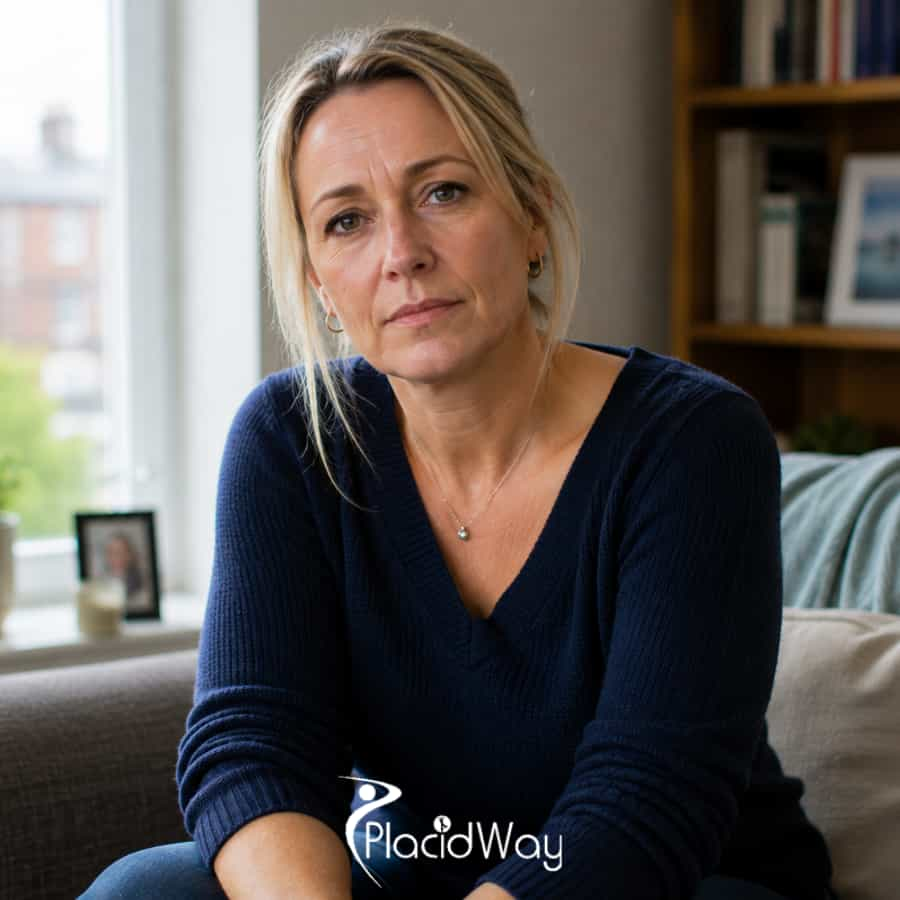
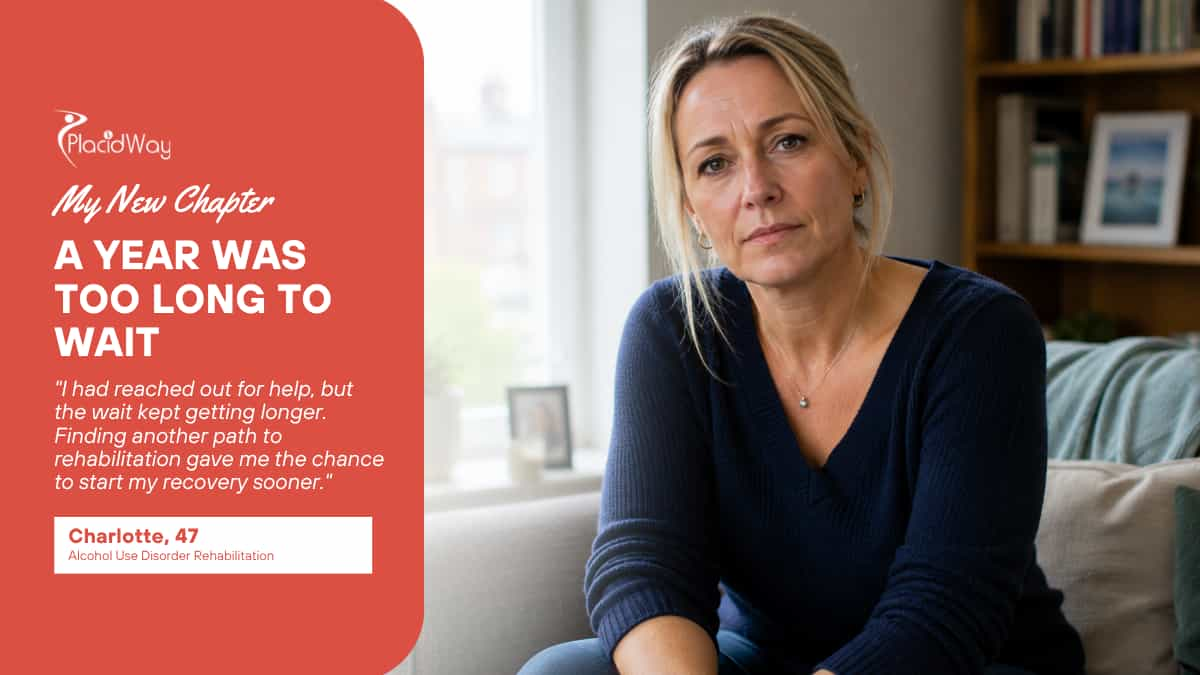
Meet Charlotte Evans.

Charlotte Evans is not a real PlacidWay client, but a fictional composite built from the exact situations and questions UK families navigate when exploring addiction treatment abroad.

She is forty-seven and lives in Manchester.

She runs a regional logistics department.

She oversees fifty staff members.

She manages a complex household schedule.

She bakes for the school fundraisers.

She maintains a tidy front garden.

The escalation happens slowly.

She told herself she just needed to unwind after stressful quarterly reviews.

She tried tracking her units in a mobile app.

She switched from wine to gin because she read it was easier to measure.

She attended two local support meetings.

She left at the break because she saw someone from her office building.

She promised her husband she would only drink on weekends.

She read three different memoirs about sobriety.

She deleted the local clinic's phone number from her search history.

Alcohol dependence is typically addressed through a tiered system starting with primary care intervention, moving toward community-based support, and escalating to medically assisted withdrawal and intensive residential rehabilitation for those exhibiting severe physiological dependence or a high risk of relapse.

Her GP looked at the screening questionnaire, nodded gravely, and delivered the verdict:

"We need to get you onto the residential waiting list."

When?

The system works on its own timeline.

The national waiting time for residential rehabilitation varies heavily by region, with some trusts reporting waits of up to twelve months for fully funded inpatient placements due to constrained public health budgets.

But Charlotte Evans doesn't experience the health system as a national statistic.

She experiences it as her hands trembling while holding a coffee cup during a morning staff briefing.

"Are you feeling alright today?"

She experiences it as her husband finding a bottle behind the laundry detergent.

"I thought we agreed to stop this."

She experiences it as the quiet, terrifying realization that she cannot stop on her own.

"I just need a little more time."

She has already tried to be patient.

People seeking addiction treatment are rarely acting impulsively or shopping carelessly.

She has attended the initial GP appointments.

She has submitted the self-assessment forms.

She has called the local community drug and alcohol service.

She has waited for the follow-up letter that never arrived.

She has paid for private outpatient counselling.

She has found that an hour a week does not stop the evening cravings.

"I am trying to do this right."

"Why is it so hard to get help?"

The central question has fundamentally changed:

From "Can I tolerate this?" to:

"How much of my life am I prepared to organise around it?"

The nearer alternative requires a different kind of sacrifice.

The obvious solution is a private clinic in Cheshire or London.

The brochures are discreet and the admission can happen in days.

But a twenty-eight-day residential programme in the UK commonly costs between GBP 15,000 and GBP 25,000.

A comprehensive ninety-day programme, which clinical evidence strongly suggests for sustained recovery, frequently exceeds GBP 40,000.

They have equity in their house and some savings set aside for their daughter's university fees.

They could theoretically secure the funds.

James sits at the kitchen table with a calculator and a spreadsheet.

"We can afford it if we take out a loan."

"Having the money isn't the same as being able to afford it."

She isn't searching for Spain yet.

Her late-night internet history reads like a map of diminishing options.

How to stop drinking safely at home

Private rehab costs North West

NHS wait times residential alcohol treatment

Cheapest private alcohol detox UK

Residential rehab Europe affordable

The algorithm begins serving her articles about treatment centres in Malaga.

She sees images of private rooms, swimming pools, and Mediterranean gardens.

She notes the flight time is under three hours.

Her immediate reaction is a protective cynicism.

"I'm not going abroad just because something is cheaper."

That skepticism is entirely healthy and deeply appropriate.

Why does Malaga keep appearing in the search results?

Spain has developed a robust private healthcare sector, heavily regulated by regional health ministries, which increasingly caters to international patients seeking both medical and psychiatric care.

The crucial shift in thinking happens when she stops viewing the location as the treatment.

Countries do not rehabilitate patients.

Clinical teams do.

Multidisciplinary medical staff do.

Accredited psychiatric facilities do.

The question isn't whether Spain is good at addiction treatment, but whether a specific clinic holds the correct licencing, employs registered psychiatrists, and follows evidence-based protocols.

The UK regulatory body advises individuals considering treatment abroad to thoroughly research the specific facility and consult their own doctor before committing to any programme.

Her first question was predictably about the price.

An indicative residential rehabilitation programme in Malaga varies between EUR 8,000 and EUR 15,000 per month, heavily dependent on the level of medical detoxification required, the staff-to-patient ratio, and the duration of the stay.

She hears her mother's voice in her head: "If it looks too good to be true, it usually is."

"What exactly am I getting?"

Twelve things the advertised price may or may not cover.

Is the initial medical detoxification included in that daily rate?
Are the consulting psychiatrists physically present on the premises every day?
Does the fee cover medications required during the withdrawal phase?
Is the cognitive behavioural therapy delivered one-on-one or only in groups?
How many hours of structured therapy occur daily?
Are meals and nutritional rehabilitation part of the package?
Does the clinic treat co-occurring disorders like anxiety or depression?
Are airport transfers handled by the clinical staff?
What happens if I require emergency hospital admission during detox?
Is there an English-speaking doctor on call overnight?
Does the cost cover family therapy sessions via video link?
What specific aftercare is provided once I return to Manchester?

The advertised number is only the beginning of the conversation.

What does residential alcohol rehabilitation actually involve?

A comprehensive programme requires an initial phase of medically supervised withdrawal to safely manage the physiological symptoms of dependence, which can occasionally be life-threatening if attempted abruptly without pharmaceutical support.

Once the physical dependence is stabilized, the psychological work begins through intensive cognitive behavioural therapy, trauma assessment, and the development of alternative coping mechanisms.

The goal is to dismantle the behavioral loops that trigger alcohol use and rebuild a physical and mental baseline that can sustain long-term sobriety.

"How do I actually get there when I can barely function?"

The part the brochures rarely put on the front page is the logistics of arrival.

Flying to a foreign country while actively experiencing alcohol withdrawal is physically grueling and complicated.

Current guidance regarding fitness to fly varies significantly between airlines, with some carriers refusing boarding to passengers exhibiting signs of active intoxication or severe withdrawal tremors.

The variation itself is the lesson.

This constraint must be part of the operational plan before committing, not afterward.

"Wait. Does that mean I have to detox before I travel?"

Possibly, depending on the severity of your physical dependence and the assessment of the receiving medical team.

Who assesses my fitness to fly?

Will the Spanish clinic coordinate with my GP in Manchester?

Do I need a medical escort for the flight?

What if my flight is delayed and I miss my medication window?

How do I manage the anxiety of the airport environment without drinking?

Will someone be waiting at the arrivals gate?

Are the clinic staff permitted to administer medication during the transfer?

What happens to my passport once I arrive?

Am I allowed a mobile phone during the first week?

How quickly can I call James to tell him I am safe?

Will I share a room with someone in a similar condition?

What happens if I decide I want to leave on the second day?

This isn't tourism in the usual sense.

James isn't just waving goodbye at the terminal.

He is the invisible second participant in this recovery.

He will carry the administrative burden at home.

He will remember the emergency contact numbers.

He will notice the shifts in her tone during their weekly supervised calls.

He will be responsible for explaining her absence to the children and the neighbours.

He needs to know exactly what happens if the treatment plan fails.

Standard travel insurance rarely covers repatriation for issues arising from pre-existing psychiatric conditions or substance use disorders, requiring specialized medical coverage policies.

He is part of the care system too.

Then comes the uncomfortable conversation about risk.

The risk of relapse following residential treatment remains significant, particularly in the first ninety days after discharge, regardless of where the rehabilitation took place.

Charlotte Evans learns to instinctively distrust certain phrases during her preliminary video calls with clinic admission coordinators.

Completely safe. No risk. Guaranteed success.

Informed consent means understanding more than the hoped-for outcome.

Charlotte Evans's questions become better.

She stops asking "How much does it cost?" and "How nice are the rooms?"

What is your clinical protocol if I suffer a seizure during withdrawal?
Which local general hospital do you use for acute medical emergencies?
Are your nursing staff trained in psychiatric intervention or just general care?
Can I see the credentials of the psychiatrist who will oversee my case?
How do you handle patients who become aggressive or non-compliant?
What is your staff-to-patient ratio during the night shift?
Do you conduct dual-diagnosis assessments upon admission?
How is patient confidentiality legally protected under Spanish law?
What specific therapeutic modalities do your counsellors use?
How do you manage the transition from residential care back to outpatient life?
What does the family support program actually entail for my husband?
What would you see in my medical file that would make you tell me not to proceed?

She doesn't only want someone willing to take her case.

She wants someone willing not to.

Have I exhausted my options at home?

Before booking a flight, patients have the right to request a formal reassessment of their case urgency through their local NHS trust, which can occasionally expedite funding for complex cases.

She sits down with her local community key worker to ask the difficult questions.

Is there any emergency funding available for immediate placement?
Can we bridge the wait time with intensive day programming?
What is the realistic timeline for a residential bed in this region?
Are there any charity-funded beds I haven't explored?
If I detox privately, does that change my NHS rehabilitation status?

Malaga should be compared with Charlotte Evans's real alternatives, not with a worst-case assumption about the domestic system.

The night before the decision looks different than she expected.

The kitchen table is covered in documents.

The clinic's medical registration certificates. The psychiatrist's translated credentials. The proposed ninety-day treatment itinerary. The specialized medical travel insurance policy. The emergency repatriation protocols.

"Are we actually doing this?"

"I think we have to."

The research didn't make them more afraid; it made them more capable of deciding.

What Charlotte Evans actually wants isn't a clinic in Spain.

Her sister asks her what she is hoping to get out of all this travel.

The expected answer is a tan and a period of sobriety.

The real answer is a complete 90-day rehab and a return home with a relapse prevention plan and sustained sobriety.

She wants to look her daughter in the eye without hiding anything.

She wants her career to be defined by her competence, not her coping mechanisms.

She wants the quiet noise in her head to finally stop.

Not the Spanish villa. Not the cognitive behavioural therapy. Not the medically supervised detox. Not the Mediterranean climate.

Freedom.

And underneath that:

Redemption.

Malaga might be the answer. It might not be.

She might secure an NHS bed sooner than anticipated.

She might decide the logistical risk of travelling during withdrawal is too high.

She might find a UK outpatient program that finally breaks the cycle.

She might realize the Spanish clinic cannot accommodate her specific co-occurring anxiety disorder.

She might decide to take the loan and stay in Manchester.

If she proceeds, it is because the medical credentials are verified, the logistics are secured, and the anonymity of a foreign city provides the psychological break she requires.

Any of those can be an informed decision.

The goal is not to persuade you to fly to Spain, but to ensure that frustration does not make the decision for you.

Price should never be the sole answer to a medical question.

This is where Charlotte Evans's story catches up to yours.

Maybe you've already called every private clinic in your county.

Maybe you've stared at the waiting list letter until the words blurred.

Maybe you've hidden another bottle today.

Maybe you've realized you cannot endure another year of pretending you are fine.

Maybe you are finally ready to treat this as the medical emergency it is.

You do not need to decide today.

What is the actual severity of my physical dependence?

Can I safely travel, or do I require domestic stabilization first?

What happens to my family if I wait another six months?

Am I seeking treatment, or am I seeking an escape?

Who can independently verify the clinic I am looking at?

What does the return to normal life look like?

What am I prepared to change?

The comparison is no longer just about prices.

It is about paths forward.

Hope isn't the promise that everything will be fixed.

Hope is not a guarantee against relapse.

Hope is not a marketing brochure promising a painless detox.

Hope is not pretending the damage never happened.

Hope is having enough information to make a decision that feels entirely yours.

You are allowed to demand transparency. You are allowed to ask exhausting questions. You are allowed to expect clinical excellence. You are allowed to look outside your postcode for a chance to start again. You are allowed to prioritize your survival.

The shift is quiet but absolute:

From "I suppose I'll just have to keep waiting."

To "What other informed options do I have?"

PlacidWay — Your Way to Hope.

We help individuals and families explore international healthcare options, compare accredited facilities, understand complex logistical requirements, and prepare the difficult questions they need to ask.

We do not provide clinical advice, medical diagnoses, or treatment recommendations.

For someone like Charlotte Evans, residential rehabilitation in Malaga isn't a promise of an effortless cure, it is one heavily structured route worth understanding.

Medical Disclaimer

This article is strictly for educational and informational purposes and does not recommend that any individual undertake travel for medical or psychiatric treatment. Individual clinical suitability, travel safety, and the risks associated with alcohol withdrawal require comprehensive professional assessment. The reader must consult their own registered clinician or primary care provider before making any healthcare decisions. Always verify the current regulatory status, accreditation, and licencing of any international healthcare provider independently, and ensure you obtain appropriate specialized medical travel protection or insurance.


The Calls for Help That Led to a Year-Long Wait: Charlotte Evans’s Alcohol Use Disorder Rehabilitation Story from the United Kingdom to Spain

About Article

  • Treatment: Addiction Treatment
  • Country: Spain
  • Overview This educational overview follows Charlotte Evans, a composite British patient exploring Alcohol Rehabilitation in Malaga, Spain. It summarizes daily-life effects, previous care and why treatment abroad is being considered. Candidacy, safety, recovery and follow-up remain central to informed decision-making.

Trusted Medical Tourism Platform Since 2007

60+
Countries
2k+
Clinics
19.5k+
Reviews
2.5k+
Qualified Doctors
1.1M+
Patients Served Since 2007